Gaza: Three Years of Genocide in Statistics
Three years after 7 October 2023, the war on Gaza has produced a body of numbers unlike any conflict before it – a daily ledger of the dead and a satellite map of every broken roof, a famine classified in phases and a defence industry's record year. This feature draws them together from the agencies that compiled them and sets them down in order.
The count began on the first day and never stopped. By the end of October 2023 the Gaza Ministry of Health had recorded 8,005 people killed. By the end of November it was 15,207; by the end of December 22,185. The United Nations Office for the Coordination of Humanitarian Affairs took the ministry's figures and published them in snapshots, and Statista - a global data collating firm specialising in statistics, reports and insights - took the snapshots and laid them end to end, so that three years of killing can now be read as a single column of 33 numbers. The last of them, dated 3 June 2026, is 72,945 dead and 173,011 injured. OCHA's own figure, four months on, is 74,032 dead and 175,142 injured at 30 September 2026.
The shape of that column is the shape of the war. Thirty thousand people were recorded dead in the first five months, more than 6,000 a month, as the air campaign and the ground invasion moved through Gaza City, Khan Younis and the central camps. From February 2024 to the ceasefire of October 2025 the register grew by about 1,800 a month, with a dip during the January to March 2025 truce and a surge through the summer of 2025, when the monthly additions climbed back above 2,500. The ceasefire of 10 October 2025 did not flatten the line at once: the first snapshot after it added 2,727 names, the most in any month since March 2024, among them bodies recovered once the fighting paused; 1,242 and 1,274 followed in December and January, and between 150 and 450 in each month after that. In the eight months from the early-October snapshot to the June one the register grew by 6,797, which is more than the whole of the 2014 war.
These are registrations, not deaths occurring in the month. A cumulative count rises when a body is recovered from rubble, when a family completes a death notice, when a hospital's records are reconciled, and OCHA's October 2026 report records 81 retroactive additions in one reporting interval alongside the newly reported dead. The ministry's count also stops at the point of trauma. It does not include people who died of untreated illness, of hunger, of infections contracted in tents, or of the collapse of dialysis, oncology and maternity care, and Statista's own page carries the caveat that estimates for the past year have exceeded 100,000.
The reliability of the ministry's figures was challenged early and from the top. President Biden said in October 2023 that he had no confidence in the numbers. Since then both American and Israeli intelligence have assessed them as broadly reliable, which did not stop the House of Representatives passing an amendment in mid-2024 forbidding the US government from citing them. Statista, a German commercial data company with no stake in the argument, records both facts on the same page and goes on publishing the ministry's count, because there is no other.
The scale is easier to grasp by proportion than by number. Statista's page notes that 55,000 deaths amount to about two per cent of Gaza's pre-war population; 74,032 is more than three per cent of it. Applied to Britain, two per cent is 1.4 million people. Applied to Israel it is about 200,000, a city the size of Netanya.
Who the dead were
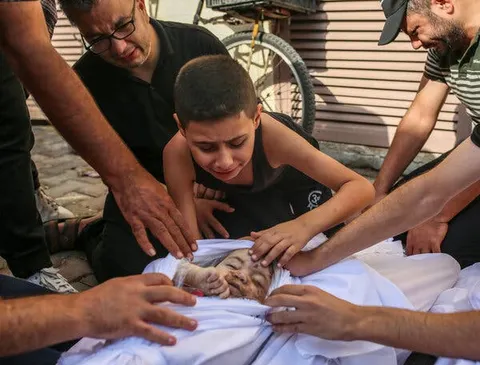
By 31 July 2025 the ministry had identified 60,199 of the people it had recorded as killed, a total that stood at 61,158 on 6 August, each with a name and an identity number. OCHA's analysis of that list, published on 6 August 2025 and reproduced by Statista, gives the only reliable demographic breakdown of the dead. Men aged 18 to 59 were 27,605 of them, or 45.86 per cent. Women of the same ages were 9,735, or 16.17 per cent. Children, meaning everyone aged 17 and under, were 18,430, or 30.62 per cent, and people aged 60 and over were 4,429, or 7.35 per cent. More than half of the identified dead, 54 per cent, were women, children or the elderly, and the share of children among the dead, 31 per cent, is lower than their share of Gaza's pre-war population, 47 per cent, only because so many adults were killed too. By 31 December 2025 the identified list had grown to 71,444: 34,078 men, 21,283 children, 10,983 women and 5,100 elderly.
The ministry's list does not say who was a fighter. Neither do OCHA or Statista, whose footnote records that the figures 'do not distinguish civilian or militant fatalities', and the age and sex of a corpse are not evidence either way. What the breakdown does establish is that 32,266 of the identified dead to the end of 2025 were women or children, and that whatever number of fighters Israel's claims account for sits somewhere inside the 34,078 adult men, where no published source separates them.
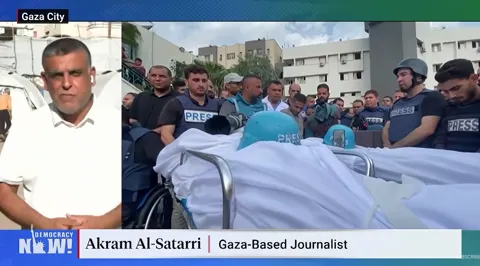
Among the dead are the people whose job was to keep others alive. OCHA's snapshot of 4 February 2026 counts about 1,700 health workers killed, 588 aid workers, 258 journalists and media workers and 142 civil-defence staff, with a note that the health and aid categories overlap. By 30 September 2026 the aid-worker toll stood at 597, of whom 403 worked for the UN or its contractors, 135 for non-governmental organisations, 55 for the Palestine Red Crescent and four for the International Committee of the Red Cross; 408 were men and 189 women. The Palestinian Journalists Syndicate counted 262 media workers killed by the end of June 2026. The Committee to Protect Journalists, which applies a narrower test of who counts as a journalist and completed a review of its register in September 2026, puts the figure at 190 Palestinian journalists killed in Gaza, 189 of them by Israel, and Reporters Without Borders counted 25 work-related killings of journalists in the Palestinian territories in 2025, after 21 in 2024, the most of any country in the world.
Then there are the dead who were never counted. Two peer-reviewed studies have tried to measure the gap between the ministry's register and the real toll. A capture-recapture analysis in The Lancet, published in January 2025, matched hospital records, the ministry's online death notices and obituaries for the period to 30 June 2024 and estimated 64,260 deaths from traumatic injury, with a 95 per cent confidence interval of 55,298 to 78,525, against a ministry count for the same period of about 38,000: an under-reporting rate of roughly 41 per cent. A household survey published in The Lancet Global Health in February 2026, which interviewed 2,000 households in the first week of January 2025, estimated 75,200 violent deaths to 5 January 2025, with an interval of 63,600 to 86,800, against the ministry's register of 49,090 for the same period, an under-reporting rate of about 35 per cent, and a further 16,300 non-violent deaths, of which 8,540 were in excess of what the pre-war death rate would have produced. Both studies are historical estimates with wide intervals, the second has drawn a published critique and a reply, and neither can be added to the register. What they share is a direction: both found more dead than the ministry had counted.
The other side of the ledger
The war's first day is the best-documented single event in it, and even that has four death tolls. OCHA, relaying Israeli authorities, gives about 1,200 killed and some 5,400 injured on 7 October 2023 and in its immediate aftermath, 5,431 in Statista's table, a figure that includes foreign nationals. Israel's Ministry of Foreign Affairs gives 1,195. The Institute for National Security Studies in Tel Aviv registered 1,163 and sorted them by age: eight children under 12, 27 aged 12 to 17, 881 aged 18 to 59, 160 aged 60 and over, and 87 whose age was not recorded. OCHA's identified count is 1,162, including 33 children. The differences are small and the scopes are not quite the same; the number has not moved in three years, and everything that followed has been measured against it.
Two hundred and fifty-five people were taken from Israel into Gaza as prisoners of war, 251 on 7 October and four earlier. Sixty-four per cent were men and 36 per cent women, and the Institute for National Security Studies classed 91 per cent of them as civilians, a label that records who was in uniform that morning rather than who had served. In a country where most Jewish citizens are conscripted at 18 and remain liable for reserve duty for two decades afterwards, a good many of those counted as civilians will have been reservists or former soldiers, and the label says nothing about what they had done in that service. Over the following 27 months 168 were returned alive and 87 dead, the last remains recovered on 26 January 2026, after which no Israeli remained held in Gaza. A poll by the Israel Democracy Institute in the first week of January 2025, taken after Netanyahu had said fighting would resume once a deal was done, found 57.5 per cent of Israelis wanting a comprehensive agreement that freed everyone in exchange for ending the war, 12 per cent a partial deal for a temporary ceasefire and 23 per cent continued military pressure. The comprehensive deal was the one the government resisted longest.
The soldiers' ledger is kept separately, and the German edition of Statista's casualty page footnotes that the 7 October figures exclude them. By 14 January 2026, 471 Israeli soldiers had been killed in the Gaza ground operation and 2,995 injured; by 30 September 2026 the figures were 474 and 3,004. Set against the Palestinian register at the same January date, 71,439 dead, the ratio of Palestinian to Israeli military deaths in Gaza is about 150 to one. Set against the 1,200 killed on 7 October, the war killed 60 Palestinians for every Israeli who died in the attack that was its stated cause.
The West Bank, which is not in the Gaza register at all, kept its own count. The German casualty page, updated 12 August 2026 from Palestine Red Crescent figures relayed through OCHA's monthly reports, puts Palestinians killed there since 7 October 2023 at more than 1,193 and injured at about 13,177, most of them, the page says, by Israeli soldiers and a small number by settlers. OCHA's own derived tally to 31 August 2026 is lower, 1,129 killed and 13,056 injured, because its verification rules differ; its monthly snapshot for January 2025 to August 2026 alone records 322 Palestinians killed, 74 of them children, and 5,927 injured, against 20 Israelis killed and 126 injured. For scale, OCHA's verified database for the whole of the occupied territory recorded 877 Palestinian deaths in 2008, 2,327 in 2014, the year of Operation Protective Edge, and never more than 1,100 in any other year before 2023. That database still excludes the Gaza war, pending independent verification, and its 2008 to 2025 total, 7,411 deaths, is a tenth of what Gaza alone has lost since.
What was destroyed
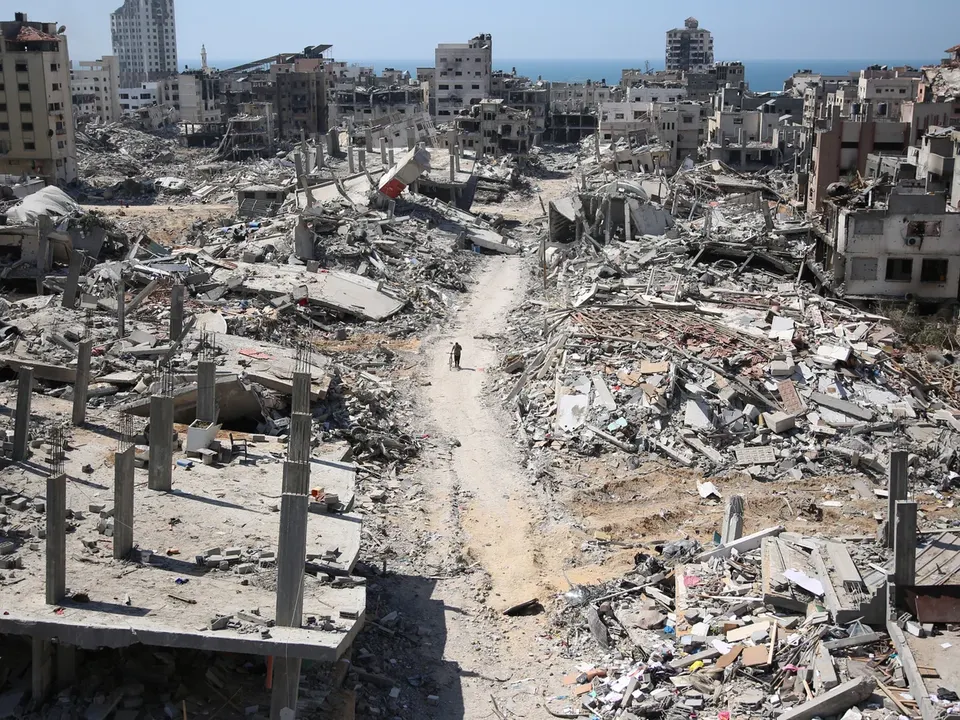
Gaza is 361 square kilometres, and the United Nations Satellite Centre has photographed all of it from orbit at 30 and 50 centimetre resolution, over and over, since the first week of the war. Its assessment from imagery of 11 October 2025, the day after the ceasefire, found 81 per cent of all structures in the territory damaged or destroyed. Its next assessment, from imagery of 16 June 2026 and published on 29 July, found the proportion had risen to 82 per cent in eight months of ceasefire: 201,290 structures affected, of which 134,422 were destroyed outright, 13,848 severely damaged, 28,096 moderately damaged and 24,924 possibly damaged. The number of destroyed buildings rose nine per cent between the two surveys. Within those structures UNOSAT estimates 328,627 damaged housing units.
The Rapid Damage and Needs Assessment carried out by the UN, the European Union and the World Bank, with a damage cut-off of October 2025, counts the housing stock differently and arrives at 371,888 of 485,361 units damaged or destroyed, which is 76.6 per cent. That is the figure Statista's table carries, though the text beside it, and the key figure on its conflicts hub, say 92 per cent of housing; the 92 per cent belongs to Gaza's commercial and industrial premises, which is to say to nearly every shop and workshop in the territory. The same assessment found 74 per cent of the classified road network destroyed and a further 13 per cent damaged, or 62 per cent of all roads once farm tracks are included. Ninety per cent of the energy infrastructure was destroyed, including the distribution grid; 88 per cent of above-ground water and sanitation assets and 76 per cent of those below ground were damaged; and 81 per cent of telecommunications infrastructure was destroyed, with the remaining 19 per cent damaged. OCHA's compilation adds that 76 per cent of cultural and heritage sites were damaged or destroyed.
The schools come next, and the proportion is the highest of all: 526 of 564 school buildings, 93 per cent, required reconstruction or major rehabilitation at the Education Cluster's assessment of 11 October 2025. Of the hospitals, Statista's May 2026 compilation of OCHA's figures, carried over from earlier releases, has 47 per cent partially functional, with 62 per cent of field hospitals and 37 per cent of primary healthcare centres in the same condition; its text puts it as over half of all medical facilities closed and every one still operating only partly so, which OCHA's own later count does not quite bear out. By 30 September 2026 the Health Cluster counted 315 of Gaza's 670 health facilities functional, 42 of them fully and 273 partially, and of the regular hospitals it tracks, 15 partially functional and 20 not functioning at all. The German edition's January 2026 table had 50 per cent of hospitals, 51 per cent of primary health centres and 67 per cent of medical points out of action, and noted that in September 2025 only 39 per cent of hospitals had been even partly working.
The farmland went the same way. Eighty-seven per cent of cropland was damaged, 86.7 per cent of agricultural wells, 79.5 per cent of greenhouses, and 72 per cent of the fishing fleet was destroyed. Eighty-two per cent of households reported water insecurity and 91 per cent worsening water quality, and the German page's January 2026 figures had 96 per cent of households without secure water. By late September 2026, 74 per cent of the population depended on trucked drinking water, and shortfalls at the southern desalination plants were affecting about 500,000 people.
The electricity never came back. Gaza's households had seven hours of power a day in 2017 and 2018, twelve in 2019, eleven or twelve from 2020 to 2022 and ten in 2023, when the distribution company was receiving a daily average of 120 megawatts through Israeli lines and 55 from the territory's single power plant against a demand that left a deficit of 328 megawatts; another Statista page citing the same source gives 92 megawatts for the Israeli supply. The figure for 2024 is zero hours. Whatever has run since, in hospitals and desalination plants, has run on generators and solar panels, not the grid.
The people moved, repeatedly. OCHA counted 1.9 million internally displaced in January 2025, nine in ten of the population. In February 2026, four months into the ceasefire, it estimated 1.4 million of Gaza's 2.1 million residents sheltering in about 1,000 displacement sites, more than 800 of them makeshift, and at least two thirds of the population displaced; UNRWA, which had run about 154 shelters in the south in January 2024, was managing 85 sites hosting more than 75,000 people at the end of January 2026. These are people in sites on a given day, not the number ever displaced, which is larger and not known.
Hunger in phases
Famine has a bureaucracy. The Integrated Food Security Phase Classification, run by a consortium of UN agencies and aid organisations, sorts a population into five phases, from minimal through stressed, crisis and emergency to catastrophe, and declares famine only when at least a fifth of households are in the fifth phase, acute malnutrition passes 30 per cent and people are dying of hunger at a set rate. It is a conservative instrument, designed to be hard to trigger, and in the summer of 2025 it was triggered in Gaza.
The Global Report on Food Crises for 2026, compiled by the Food and Agriculture Organization and its partners, found that at the peak month of 2025 every single person in Gaza, 100 per cent of the population analysed, was in crisis or worse, the highest proportion of any territory on earth and the third year running that Gaza had held that place. In 2025, 90 per cent were in the emergency or catastrophe phases, up from 88 per cent the year before. Famine was confirmed in Gaza Governorate in mid-August 2025, in the words of Statista's summary of it, 'after Israel ramped up its restrictions on humanitarian assistance following the expiry of a ceasefire'; conditions in North Gaza were probably as bad or worse but could not be classified because nobody could gather the data. The next worst places on the list were South Sudan, with 57 per cent of its analysed population in crisis or worse, Yemen at 52 per cent and Sudan and Haiti at 51.
The ceasefire of October 2025 and the partial reopening of the crossings pulled the territory back from the formal famine threshold without ending the hunger. The IPC's December 2025 analysis, which Statista reproduced in January, projected that between December 2025 and mid-April 2026 1,028,000 people would be in crisis, 571,000 in emergency and 1,900 in catastrophe: 1.6 million people, 77 per cent of the population, in the third phase or worse. Statista's own summary of that table says more than half faced emergency levels, which its figures do not support; 571,000 is about a quarter, as the German edition correctly says. Acute malnutrition among children was classified as critical in Gaza Governorate and serious in Deir al-Balah and Khan Younis. The same analysis anticipated 101,000 cases of acute malnutrition in 2026 among children aged six months to five years, 31,000 of them severe, 25,000 among babies under six months, 120,000 among children aged five to seventeen and 37,000 among pregnant and breastfeeding women. More than 94,000 children under five had already been admitted for malnutrition treatment in 2025, and more than six in ten children between six months and two years old were living in what UNICEF calls severe food poverty, a diet of two or fewer food groups.
The July 2026 analysis, the latest, assessed April to June and found 59 per cent of the population, more than 1.2 million people, in crisis or worse, including 212,000 in emergency, with all five governorates in Phase 3. For July to December it projected a deterioration to 67 per cent, more than 1.4 million. It expects 74,200 children under five to need treatment for acute malnutrition between then and April 2027, 11,400 of them for the severe form, and 24,600 pregnant and breastfeeding women; Rafah could not be assessed for lack of data. Screening in the first half of September 2026 found 899 cases of acute malnutrition among 31,443 children examined, 99 of them severe.
The pipeline that keeps the figures from being worse is thin and measured weekly. In the last week of September 2026 the UN and its partners were able to offload 88 per cent of the aid they brought to Kerem Shalom, 74 per cent through the Egyptian corridor, 94 per cent at Ashdod and all of it from Jordan. Food parcels reached more than 840,000 people in September and kitchens were producing 695,000 meals a day, against a population of 2.1 million. The 788 truckloads of commercial goods recorded in the same report are counted separately and are not aid. In January 2026 the World Food Programme was reaching over a million people a month and the UN was issuing full rations to 1.6 million; in February and March, as deliveries fell and stocks ran down, the rations were halved to cover half of a person's caloric needs. OCHA's October 2026 report warns that the next funding shortfall threatens food assistance again.
What hunger did to the children is recorded in a smaller study that cannot be generalised and should not be ignored. A survey of the families of Médecins Sans Frontières staff in Gaza, covering October 2023 to March 2025 and reported by OCHA, found that four in ten of the blast deaths among them were children under ten, and that mortality among under-fives was ten times its pre-war level and among newborns six times. MSF itself warned that its staff were not a representative sample of Gaza. They were, if anything, better protected than most.
An economy erased
Gaza's economy was small before the war and it is now, by any measure the Palestinian Central Bureau of Statistics can apply, barely there. In constant 2015 dollars the territory's output was $2,154.7m in 2023, a year that already contained three months of war. In 2024 it was $361.9m, a fall of 83 per cent. In 2025, the bureau's accounts published in May 2026 show, it rose to $485.6m, which the bureau reports as growth of 34.2 per cent; the same figures put it 77.5 per cent below 2023, and 2023 was not a normal year. Unemployment in Gaza in 2025 was 78 per cent. In the last quarter of 2024 the proportion of the working-age population with any job at all was 9.3 per cent.
The international series that Statista carries are for the West Bank and Gaza together, and they soften the picture without hiding it. The combined economy, $19.17bn in 2022, shrank to $18.64bn in 2023 and $16.02bn in 2024. Income per head fell from $3,580 to $3,400 and then to $2,850, roughly where it stood in 2012. Public debt, 47 per cent of GDP in 2022, reached 56.13 per cent in 2024, the highest in a series that starts in 2000 at 20 per cent, as the economy underneath it collapsed. The World Bank's measure of poverty for the two territories, at $8.30 a day, went from 28.6 per cent of the population in 2023 to 42.6 per cent in 2024 and 41.8 per cent in 2025; in Gaza alone the bank describes poverty as near universal and does not attempt a number. Its household panel in Gaza, surveyed between late December 2025 and February 2026, found 62 per cent of families describing access to shelter as very difficult and a further four per cent as impossible, with a quarter saying the same of healthcare, water and food.
One of the first casualties was the daily commute that had sustained the West Bank. Before 7 October, 130,000 Palestinians held permits to work in Israel and another 35,000 worked there without them, between them 24 per cent of Israel's construction labour and 17.2 per cent of its farm labour. Afterwards the Institute for National Security Studies counted 15,000 permits and no unofficial workers at all: 150,000 jobs gone in a day, and the construction and agricultural sectors in Israel short of hands ever since.
The population figures carry their own correction. Before the war the bureau projected 2,349,301 people in Gaza by mid-2025; its amended estimate for that date, published in August 2025, is 2,114,301, a difference of 235,000 accounted for by the dead and missing and by those who got out. The US Census Bureau's series on Statista still runs its projections from the 2023 base, 2.2 million in 2025 and rising to 2050, as if nothing had happened; more than half of that population is under 20, and the density before the war was already 5,853 people to the square kilometre. In 2023, before the war, 57 per cent of Gazans surveyed said they could not afford food and 29 per cent could not afford housing.
The starkest number in the whole collection is one Statista publishes without comment. The World Bank's life-expectancy series for the West Bank and Gaza, combined, gives 74.25 years for a boy born in 2022 and 79.14 for a girl. For 2023 it gives 59.69 and 71.5. A fall of 14.6 years for men and 7.6 for women, across both territories, in a year in which the war occupied only the last twelve weeks, implies a collapse in Gaza itself that the Lancet's separate modelling has tried to quantify and that the official statistics have not yet caught up with. Statista's text on the page discusses the pandemic years and does not mention 2023 at all.
The bill in Israel
Israel has always devoted more of its income to the military than any Western country, and in 2022 it spent less of it than at any time since the series begins: 4.34 per cent of GDP, down from 6.02 per cent in 2000 and a peak of 6.32 in 2002, at the height of the second intifada. The war took the figure to 5.28 per cent in 2023, 8.47 in 2024 and 7.81 in 2025. In the Stockholm International Peace Research Institute's dollar terms military spending went from $22.8bn in 2022 to $27.1bn in 2023, $45.9bn in 2024 and $48.3bn in 2025, a real increase of 97 per cent over three years; the small real decline in 2025, 4.9 per cent, coexists with a higher dollar figure because of the shekel. The 2026 defence budget, Statista's budget page says, exceeds 142bn shekels, about $46.5bn, more than 200 per cent above the pre-war level of 2023, and in both 2024 and 2025 the ministry spent more than it had been given. A second Statista page, updated in May 2026, puts the approved 2026 budget at over 110bn shekels, with 67.5bn for procurement and 44.5bn for salaries; the two figures are presumably on different definitions, and neither page says which.
The Ministry of Finance's execution report for 2024 shows what the Ministry of Defense actually spent on the war that year: 78.0bn shekels, about $20.5bn, of which 41.9bn went on direct defence expenses, 33.6bn on personnel and 2.5bn, about $658m, on the rehabilitation of the wounded and support for the families of the dead. The monthly accounts, which Statista has compiled from the same reports, show the direct cost of the war peaking at 17.2bn shekels in December 2023, about $4.6bn, and still running at 14.3bn in December 2024, of which 11.3bn was defence; civilian compensation for war damage peaked at 5.1bn shekels in February 2024. Over the first twelve months the direct cost averaged 9.4bn shekels a month, some $3.1bn, and the total direct military outlay recorded in Statista's series is 95bn shekels.
The Bank of Israel's accounting is wider and runs further. Its annual report for 2025, published in March 2026, puts the war's incremental cost to the budget, above what had been planned before 7 October, at 34bn shekels in 2023, 133bn in 2024 and 116bn in 2025, with 69bn more expected in 2026: 352bn shekels, of which 249bn is defence, 33bn the property-tax compensation fund, 57bn other civilian spending and 13bn the extra interest on the debt that paid for it. The bank separately estimates the output the economy has lost against its pre-war trend at 177bn shekels by the end of 2025, 8.6 per cent of a year's GDP. The two figures measure different things and cannot be added.
The fiscal consequence was immediate. Israel ran a budget surplus of 0.3 per cent of GDP in 2022, the only one in a quarter of a century. The deficit was 5.38 per cent in 2023, 8.07 per cent in 2024, the deepest since the pandemic year, 5.22 per cent in 2025 and a projected 5.86 per cent in 2026. The national debt rose by at least 30 per cent from the start of the war and stood at about 68 per cent of GDP. Real growth, 6.36 per cent in 2022, fell to 2.06 per cent in 2023 and 0.95 per cent in 2024, the weakest year since the pandemic contraction of 2020, before recovering to 2.93 per cent in 2025; the International Monetary Fund's April 2026 outlook projects 3.53 per cent for 2026. Nominal GDP in dollars nonetheless rose from $513bn in 2023 to $611bn in 2025.
The first months show how the shock moved through the economy. Government consumption jumped 27.4 per cent in the last quarter of 2023 to more than 129bn shekels, and was still 21 per cent above the previous year's level in the third quarter of 2024. Private consumption fell 11 per cent in the same quarter, credit-card spending 15.7 per cent in October 2023 and the consumer confidence index to 38 against a base of 100. The Tel Aviv 125 index lost 9.5 per cent in the ten days after 7 October and 11.6 per cent over the month; when Israel attacked Iran in June 2025 the same index rose eight per cent in eight days, a contrast the Tel Aviv Stock Exchange's own study of conflicts since 2002 records.
Tourism collapsed. Israel had received 411,100 foreign tourists in May 2023 and 330,900 in September; in October it received 98,600, in November 39,000, and the monthly figure did not pass 100,000 again until May 2024. The year 2023 as a whole had brought 3.01 million tourists, down from a 2019 peak of 4.9 million visitors; 2024 brought 961,300 and 2025, the Central Bureau of Statistics reports, 1.32 million. Counting all visitor entries, 2025's 1.34 million was 37.8 per cent up on 2024 and 58.5 per cent below 2023. Foreign airlines cut their frequencies.
Trade held up better than the headlines suggested. Goods exports were $70.01bn in 2024 and $77.02bn in 2025 on Statista's main series, with the United States, which takes about a third of everything Israel sells abroad, buying $17.2bn of goods in 2024 on the Central Bureau of Statistics' count, Ireland $3.2bn and China third; exports to the European Union reached $16.1bn in 2025. Imports rose from $91.2bn to about $95.5bn. In June 2025 Israel sold the United States $914m of goods and bought $585m. The quarterly series of goods and services exports, which had been falling since the third quarter of 2022, touched bottom in the first quarter of 2024 and reached $47.6bn in the first quarter of 2026. The customs figures for 2025, provisional and excluding defence imports, show exports of 193.8bn shekels against imports of 326.9bn, a deficit of 133.1bn.
Leaving and arriving
Three different counts describe the people who left Israel, and they should not be run together. The Central Bureau of Statistics determines who has emigrated a year after the fact, by a nine-month residence test, and its table published in July 2026 counts 59,366 emigrants determined for 2023, 82,774 for 2024 and 69,489 for 2025, against 29,607, 24,150 and 18,798 Israelis who came back. The net loss on those two columns was 29,759 in 2023, 58,624 in 2024 and 50,691 in 2025, and the provisional figures for the first half of 2026 are 23,189 gone, 8,224 returned and a balance of 14,965. These are status determinations, not departures in the calendar year, and they exclude new immigrants entirely.
The rolling count Statista carries from the business daily Calcalist, locked behind its paywall but described on the page, uses a narrower definition, Israelis who left in the previous two years, had not deregistered their residency and had spent no more than 90 days a year in the country since: more than 60,000 of them by May 2024, a quarter more than in February 2023, the point at which a decline that had run since 2017 reversed with the judicial-reform crisis and then the war. Net international migration, the bureau's third measure, which sets everyone arriving to live against everyone leaving, was negative for most of 2024, with the outflow peaking at almost 11,000 people in October 2024 and a net loss of about 18,000 for the year.
The other side of that balance is immigration under the Law of Return, the state's founding promise. It brought 70,139 people in 2022, most of them fleeing Russia and Ukraine, 42,748 in 2023, 29,205 in 2024 and 19,820 in 2025, the lowest figure since 2020 and a fall of 72 per cent in three years. The last time fewer came under the law was the pandemic year; before that, 2013. For every immigrant who arrived under the Law of Return in 2025, three and a half Israelis were determined to have emigrated.
The arms ledger
The war that cost Israel so much was also, for one sector, the best business it has ever done. Israel's defence industry signed export contracts worth $14.795bn in 2024, a record, and $19.2bn in 2025, another, up 30 per cent in a year and, the Ministry of Defense said when it announced the figure on 2 June 2026, the fifth annual record in succession. Statista, which updated its pages on 1 October 2026, calls it the fourth. Over half of the 2024 contracts were with European customers; in 2025 Europe's share fell to 36 per cent as Asia-Pacific rose to 32 per cent and the Middle East and North Africa took 15 per cent, a category that on Statista's page includes the four Abraham Accords states, the United Arab Emirates, Bahrain, Morocco and Sudan. The mix shifted as sharply as the geography. Missiles, rockets and air-defence systems, 48 per cent of the 2024 book, were 29 per cent in 2025; observation and optronics rose from six per cent to 22, radar and electronic warfare from eight to 11, command and communications from two to seven, drones from one to four. Contracts are not deliveries, and the ministry's figures say nothing about where a given weapon was later used.
The Stockholm institute measures transfers rather than money, in a trend-indicator value built from production costs, and on that measure Israel was the world's seventh-largest exporter of major arms in 2021 to 2025, with 4.4 per cent of the global total and a volume 56 per cent higher than in the five years before. The defence-industry hub on Statista credits Israel with 5.1 per cent; that is Italy's figure. For 2020 to 2024 the destinations were India, with 34 per cent of the volume and about 1.5bn in trend-indicator terms, the United States with 13 per cent, the Philippines 8.1, Britain 5.4, Singapore 4.4, the Emirates 4.2, Germany 3.2, and Morocco, Cyprus and Finland between 2.3 and 2.6 each. By category, missiles were 39 per cent of what Israel exported, sensors 19, air-defence systems 16, aircraft 9.6, artillery four, ships 2.4, naval weapons 1.3 and armoured vehicles one. Israel's export volume peaked in 2023 at almost 1.3bn in trend-indicator value and fell to just over 1bn in 2024.
What Israel could not make it bought, and it bought almost everything from two countries. In the institute's five-year window to 2025, 68 per cent of Israel's major-arms imports came from the United States and 31 per cent from Germany, with Italy supplying 1.3 per cent; the German edition of Statista gives 66, 33 and one per cent for 2020 to 2024, and the English edition, on a six-year window to 2025, about 71 and 28. Israel ranked fourteenth among importers in 2021 to 2025, and took about 1.9 per cent of the world's intake in 2020 to 2024, behind India, Saudi Arabia and Qatar. In money, defence-goods imports passed $7.9bn in 2025, 92 per cent more than in 2023. The Finance Ministry's register of unclassified procurement contracts over 100m shekels shows who sold the air force its munitions in 2024: American companies, more than 4.8bn shekels, about $1.3bn; Israel's own industries, 3.2bn, about $864m; and the United States Air Force itself, more than 2.2bn, about $612m. The larger procurement lines on Statista's defence hub are the F-35 programme at 37.5bn shekels, the submarines at 9.8bn and the Trophy active-protection system at 1.6bn, and the three national champions, the privately owned Elbit Systems and the state-owned Israel Aerospace Industries and Rafael, report revenues of $6.8bn, $6.1bn and 17.8bn shekels respectively, with 312 defence-technology start-ups behind them and $172m of venture money in the latest year counted.
The American cheque is the other line in the ledger. The Council on Foreign Relations' series, which Statista carries in constant 2024 dollars by fiscal year, has run at between $3.2bn and $5.2bn a year since the mid-1980s, and since 1999 under successive ten-year memoranda, the last of them signed by President Obama in 2016; Statista's page says it expires in 2026, though its $38bn term was written to run to fiscal 2028. Fiscal 2023 was $3.9bn. Fiscal 2024, with the supplemental appropriation that Congress passed in April of that year, was $12.5bn, the third-highest year in a series that goes back to 1970, exceeded only by the $14.1bn of 1979, the year of the peace treaty with Egypt, and the $12.8bn of 1974, after the Yom Kippur war. Fiscal 2025 was $3.7bn. The Congressional Research Service, counting in nominal dollars, puts the regular 2025 figure at $3.8bn, $3.3bn in foreign military financing and $0.5bn for missile defence, and the April 2024 supplement at $3.5bn of financing plus $5.2bn for missile and laser defence, which is where, Statista notes, much of the supplement was earmarked. The appropriations for Arrow, David's Sling, Iron Dome and Iron Beam by system and year are on a Statista page the free account cannot open.
What people think
Israelis turned against the war before their government did, and the polls can date it. In January 2025 the Institute for National Security Studies asked a representative sample of 1,010 adults, 805 Jewish and 205 Arab, whether it was time to end the war in Gaza: 49 per cent said yes, 37 per cent no and 14 per cent did not know. In June 2025, asked the same question, 60.5 per cent said yes and 33 per cent no. In September 2025, two years in, the Israel Democracy Institute found 66 per cent saying it was definitely or probably time, 26.7 per cent saying it was not; among Jewish Israelis the figure was 60.4 per cent and among Arab citizens 93. The war went on for another month. A year after the ceasefire, in September 2026, 27 per cent of Israelis told INSS they thought Israel had won in Gaza, and 59 per cent feared a repeat of 7 October from there.
Wanting the war over is not the same as wanting what the rest of the world says should follow it. In the same September 2025 survey only 25.1 per cent of Israelis agreed that Palestinians have a right to a state of their own and 62 per cent disagreed; asked whether establishing one now would serve Israel's interests, 17.3 per cent said it would and 70.2 per cent that it would not. In February 2026 INSS found 28 per cent in favour of a peace agreement with Saudi Arabia if its price was a Palestinian state and 48 per cent opposed. By September 2026, with the prisoners of war home and an election approaching, the Jewish People Policy Institute found 59 per cent of all Israelis, and 72 per cent of Jewish Israelis, saying they would never agree to a withdrawal to Gaza's border without an internal security perimeter, and 30 per cent, 36 per cent of Jewish Israelis, up from 27 per cent a year earlier, generally in favour of full occupation and military administration of Gaza for several years. Thirty-five per cent of Israelis, and 41 per cent of Jewish Israelis, told the same survey that recognising a Palestinian state was antisemitic, on its own or together with being anti-Israel. The Pew Research Center, interviewing in the spring of 2026, found 52 per cent of Israelis saying the United States was sending too much humanitarian aid to Gaza, a view held by 64 per cent of Jewish Israelis, while 67 per cent of Arab Israelis and 70 per cent of Palestinians in the West Bank and East Jerusalem said it was not enough. Netanyahu's own standing, which Pew has tracked since 2013, went from 68 per cent favourable and 31 unfavourable in 2015 to 47 and 52 in the spring of 2023, 41 and 58 in 2024 and 45 and 53 in 2025.
What Gazans thought on the eve of the war is in Statista's record; what they have thought since is not, though the Palestinian Center for Policy and Survey Research has gone on polling inside the Strip. In July 2023, 61.7 per cent of them agreed that Hamas should preserve its ceasefire with Israel, 65.2 per cent expected a major military conflict within the year, and 70 per cent thought the Palestinian Authority should replace Hamas as the government of the Strip. They had foreseen the war and opposed the people who started it, and they are the population on which the statistics above were collected.
Abroad the shift ran the other way. In Germany, among the European states most reluctant to criticise Israel, two polls in the same three days at the end of September 2025 found majorities for recognising a Palestinian state: 63 per cent to 22 in the ZDF Politbarometer and 55 per cent to 20 in the ARD DeutschlandTrend. In the ARD poll supporters of the Left (82 per cent), the SPD (72), the Greens (68) and the CDU/CSU (57) were in favour, and only the AfD's, at 43 per cent for and 30 against, were divided. In July 2025, 74 per cent of Germans had wanted their government to put more diplomatic pressure on Israel to end the war, including 77 per cent of Christian Democrat supporters. In Britain, YouGov found 44 per cent supporting recognition of a Palestinian state and 18 per cent opposed in September 2025, and Ipsos found 44 to 13 on a differently worded question, with 53 per cent of Britons saying Israel's military action had gone too far. In France, 53 per cent agreed with President Macron's decision to recognise Palestine and 46 per cent did not. Pew's survey of 36 countries in the spring of 2026 found unfavourable majorities across most of them: in Britain 69 per cent were unfavourable and 25 favourable, in the United States 60 and 37, in Germany 73 and 23, in France 68 and 24, in Spain 78 and 17, and among Palestinians in the West Bank and East Jerusalem 85 and four.
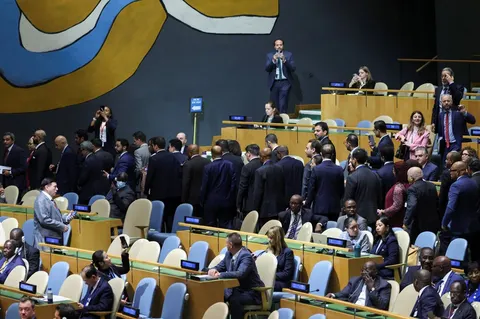
The United States, which paid for the war and vetoed its ending, moved too. In December 2024, 17 per cent of Americans wanted military aid to Israel increased and 32 per cent wanted it cut, with 25 per cent for leaving it alone; on humanitarian aid to Palestinians, 24 per cent wanted more and 23 per cent less. By August 2025, 78 per cent supported a ceasefire, 42 per cent wanted military aid to Israel reduced against 13 per cent who wanted it raised, and 49 per cent said the Palestinians should have a state of their own against 17 per cent who said they should not. On 4 June 2025 the United States had cast the only vote against a Security Council resolution demanding an immediate, permanent ceasefire and the release of everyone held in Gaza, with the other fourteen members, Britain and France among them, in favour. In September 2026 Americans' sympathies were evenly split, 26 per cent with the Israelis, 25 with the Palestinians, 21 with both, and on 6 October 2026, the eve of the third anniversary, YouGov asked 6,424 American adults whether Israel was committing genocide against Palestinian civilians: 41 per cent said it was, 27 per cent that it was not and 32 per cent did not know. In the autumn of 2024, when Ipsos had asked people in 33 countries whether the conflicts in the Middle East would end in 2025, 22 per cent on average thought they would. In Britain the figure was 12 per cent, and the British were right.
The third year's coda
The third year did not end in Gaza. In June 2025 Israel attacked Iran, and for twelve days Iranian missiles came back: Statista's compilation of the Institute for National Security Studies' daily injury counts and Haaretz's fatality counts records 218 Israelis injured on 13 June, 377 on the 14th, 649 on the 15th, 428 on the 16th, and so on through the 24th, 3,508 in all, with 28 people killed over the twelve days, 24 of them in the first four, and two more who died of their injuries in July and October. The Tel Aviv index rose eight per cent while it lasted.
On 28 February 2026, four and a half months into the Gaza ceasefire, the United States and Israel went to war with Iran again, and Statista now files the consequences under that name. Its first tally, to 13 April 2026, counts 35 Israelis killed, 24 civilians and 11 soldiers, and 7,738 civilians and 78 soldiers injured, mostly by missile and rocket fire from Iran and Lebanon; 6,295 people were displaced from damaged homes, 1,535 of them in Tel Aviv, 1,510 in Arad, 1,150 in Dimona and 515 in Beit Shemesh. Separately, in the fifty days of protest inside Iran between 28 December 2025 and 15 February 2026, the Human Rights Activists News Agency verified 6,488 protesters killed, 236 children, 207 members of the security forces and 76 bystanders, figures it describes as the minimum. Statista's page on Israel's defence budget notes that the new war 'may further inflate military spending above the allocated amount'.
Three years on, the register stands at 74,032 recorded dead in Gaza, more than 32,000 of the identified among them women and children, with the independent estimates higher; 1,129 or 1,193 dead in the West Bank, depending on who counts; about 1,200 dead in Israel on the first day and 474 soldiers since; 82 per cent of a territory's buildings damaged or destroyed; a famine declared and lifted, and a population projected to be two thirds in crisis by the year's end; an economy at less than a quarter of its size. On the other side of the ledger stand a military budget trebled, a deficit of eight per cent, a defence industry's record year and an American cheque of $12.5bn. Between 59,000 and 83,000 Israelis a year have been determined to have left, and in Israel two thirds want the war to end while a quarter are prepared to concede that the people it was fought against have a right to a state.
A note on the numbers
Every figure above is dated to the observation it describes, not to the page that carries it, and most come from one of a dozen compilers: the Gaza Ministry of Health as relayed by the UN Office for the Coordination of Humanitarian Affairs; the UN Satellite Centre; the Integrated Food Security Phase Classification; the Palestinian Central Bureau of Statistics; the International Monetary Fund and World Bank; the Stockholm International Peace Research Institute; the Israeli Ministries of Defense and Finance, Central Bureau of Statistics and Bank of Israel; the Council on Foreign Relations and the Congressional Research Service; and the polling of INSS, the Israel Democracy Institute, the Jewish People Policy Institute, Pew, YouGov, Ipsos, Infratest dimap, Forschungsgruppe Wahlen and Elabe. Statista, the commercial aggregator through which many of them were first located, was read in a signed-in account on 10 October 2026 and checked against the original publishers; where its text misstates its own tables, as on the housing-damage and emergency-hunger figures, the tables and the originals have been followed. Its pages that refer to the Israelis held in Gaza use the word 'hostages'; this feature does not.
The casualty register is cumulative and counts only deaths from trauma reported to the ministry; it excludes the dead of hunger, disease and the collapse of medical care, and differences between monthly snapshots include late registrations. The two Lancet studies are historical estimates with confidence intervals and cannot be added to it. The identified breakdown by age and sex applies to the 60,199 bodies identified by 31 July 2025 and the 71,444 by 31 December 2025, not to the full register. The Israeli figures for 7 October exclude soldiers killed in Gaza, who are counted separately, and the four published tolls for that day differ by scope and source. West Bank figures come in two series, the Red Crescent's via OCHA and OCHA's own, with different verification rules. The damage percentages come from assessments with different dates, units and denominators, structures in one, housing units in another, and are not additive; the IPC's phases describe food insecurity, its malnutrition classifications something else, and the Global Report on Food Crises measures the peak month of a year rather than its average. Palestinian national accounts, debt, poverty and life expectancy from international sources combine the West Bank and Gaza; the Gaza-only figures are the bureau's. Israel's military spending is given by SIPRI in current dollars and as a share of GDP, by the Finance Ministry as actual outlay, by Statista's hub as averages and totals without stated periods, and by the Bank of Israel as increments above pre-war plans; the figures are not interchangeable, and the two Statista totals for the 2026 defence budget, 142bn and 110bn shekels, remain unreconciled. Arms-transfer shares from SIPRI are volumes in trend-indicator value, not money, and three different year-windows appear above. US aid is in constant 2024 dollars by fiscal year on the Statista series and in nominal dollars from the CRS. Polls are reported with their fieldwork dates and samples; each asks its own question and none is a trend with any other.
Sources, with the date of the data: OCHA, Reported Impact Snapshot, Gaza Strip, 30 September 2026; OCHA snapshot 3 June 2026 via Statista; OCHA snapshot 6 August 2025, identified fatalities; OCHA snapshot 4 February 2026, workers killed; OCHA West Bank snapshot, August 2026; OCHA humanitarian situation report, 2 October 2026; OCHA Update 357, displacement, 12 February 2026; UNOSAT damage assessment, imagery 16 June 2026; RDNA and Education Cluster figures in OCHA's 6 May 2026 snapshot; IPC Gaza analysis, 23 July 2026; IPC special snapshot, December 2025; Statista, food insecurity and malnutrition, January 2026; Statista infographic on the Global Report on Food Crises 2026; Gaza Scorecard, April 2026; OCHA Update 306, July 2025, MSF survey; Jamaluddine et al., The Lancet, January 2025; Spagat et al., The Lancet Global Health, February 2026; CPJ register review, September 2026; Statista, infographic on journalists killed, RSF; Statista, Palestinian and Israeli fatalities to 14 January 2026; Statista, 7 October fatalities by age, INSS; Statista, status of Israelis held in Gaza, MFA; Statista German edition, casualties to 12 August 2026; Statista German edition, OCHA casualty database 2008 to 2026; Statista, damage estimates, May 2026; Statista German edition, damage, January 2026; Statista German edition, electricity hours; PCBS, Performance of the Palestinian Economy 2025; PCBS population estimates; World Bank Macro Poverty Outlook, April 2026; World Bank Palestinian Economic Monitor, May 2026; Statista, Palestine GDP per capita, IMF; Statista, Palestine debt to GDP; Statista, life expectancy West Bank and Gaza, World Bank; Statista, Palestinian workers in Israel, INSS; Statista, military expenditure share of GDP, SIPRI; SIPRI, military expenditure 2025; SIPRI, arms transfers 2025; Statista, MoD war expenditure 2024; Statista, monthly war costs; Statista, defence budget and spending 2017 to 2026; Statista, budget allocation 2024 to 2026; Statista, economic impact hub; Bank of Israel Annual Report 2025, chapter 6; Statista, Israel budget balance, IMF; Statista, Israel real GDP growth, IMF; Statista, Israel GDP, IMF; Statista, stock-market impact of conflicts, TASE; Statista, monthly tourist arrivals, CBS; CBS, tourist entries 2025; Statista, goods exports 2000 to 2025; Statista, goods exports by partner 2024; Statista, exports to the EU; Statista, imports 2016 to 2025; Statista, Israel-US monthly trade; Statista, quarterly exports of goods and services; CBS, provisional goods trade 2025; CBS Table E4, emigrants and returnees; Statista, recent emigrants; Statista, net migration; Statista, Law of Return immigration, CBS; Israel MoD, export record 2025; Israel MoD, exports 2024; Statista, defence exports by region 2025; Statista, defence export value 2014 to 2025; Statista German edition, arms export destinations, SIPRI; Statista, arms exports by category, SIPRI; Statista, annual arms exports, SIPRI; Statista German edition, arms import suppliers, SIPRI; Statista, arms imports 2020 to 2025; Statista, defence goods imports; Statista, air-force munitions contracts 2024; Statista, defence industry hub; Statista, US military aid 1970 to 2025, CFR; CRS, US Foreign Aid to Israel, May 2025; Statista, Israeli opinion on ending the war, INSS; IDI, September 2025; INSS, February 2026; INSS, three years since 7 October, September 2026; JPPI Israeli Society Index, September 2026; Pew, US assistance and aid, September 2026; Pew, views of Israel in 36 countries, June 2026; Statista, Netanyahu favourability, Pew; Statista German edition, IDI ceasefire-deal poll, January 2025; Statista Gaza hub, July 2023 Palestinian polling; Statista German edition, ZDF recognition poll; Statista German edition, ARD recognition poll by party; Statista German edition, pressure on Israel, July 2025; YouGov, Britons on recognition, September 2025; Ipsos, British attitudes, September 2025; Elabe/BFMTV, French opinion on recognition; Statista, US opinion on military aid, December 2024; Statista, US opinion on humanitarian aid; Economist/YouGov, August 2025; Economist/YouGov, September 2026; YouGov daily question, 6 October 2026; Statista, UN Security Council vote, June 2025; Statista, expectations of conflicts ending, Ipsos; Statista, Israeli casualties in the Iran war, June 2025; Statista, Israeli casualties in the US-Israel war with Iran, 2026; Statista, displaced in Israel by city, 2026; Statista, Iranian protest deaths, HRANA.