Israel’s Assault Has Left More Than 99 per Cent of Gaza at Risk of Contamination, Researchers Find
Tests found faecal bacteria in nearly one in five wells sampled this summer. As families face another winter among the ruins, researchers are calling for independent access to establish which water sources, homes and fields are safe to use.
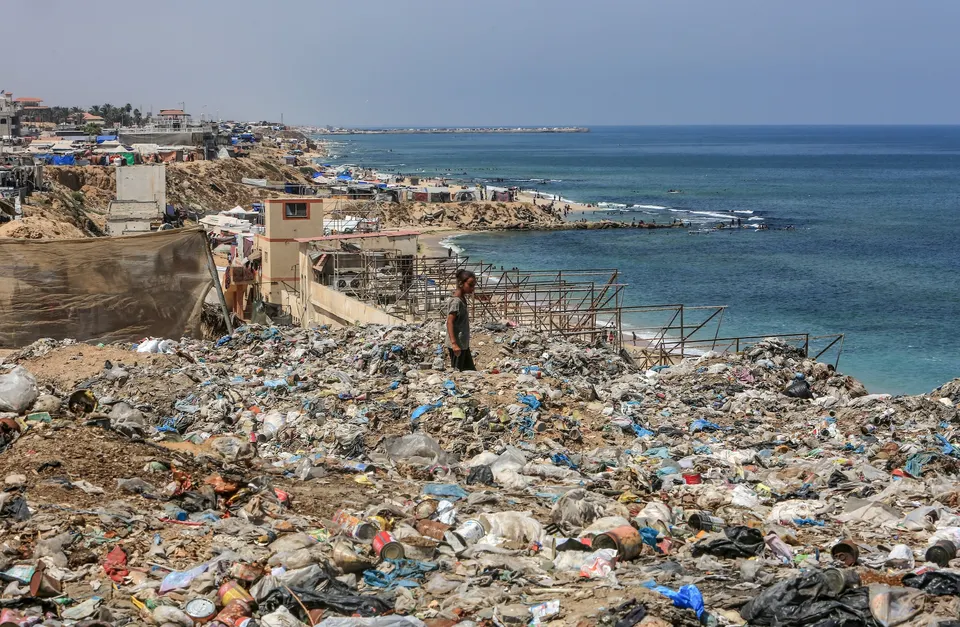
In Gaza City, a basin built to collect rainwater now holds sewage. When the first heavy November rains came, only two of its six pumps were working. Across Gaza, even before the storms, 45 per cent of households surveyed in October said there was sewage or sludge within ten metres of their shelter.
A report published on 23 November by Oxfam and the Conflict and Environment Observatory finds that Israel’s military assault has left signs of potential contamination across more than 99 per cent of the Gaza Strip. Families can encounter the same hazards several times in a day, drawing water from a well, breathing dust from a demolished building or clearing a field to plant food. Children and pregnant women are among those at greatest risk.
The researchers used satellite images and records of strikes, fires and destruction to map where pollutants are likely to have spread. They identified Gaza City, Jabalia, Khan Younis, Rafah and the Salah al-Din Road among the places where several hazards overlap. The map shows where people may be exposed. Establishing which chemicals are present in a particular well or field, and at what concentrations, requires sampling on the ground. Oxfam says Israeli restrictions on independent access, testing equipment and specialists have prevented a territory-wide assessment.
Amitabh Behar, Oxfam International’s executive director, accused Israel of committing “environmental war crimes threatening life now and for generations to come”. International humanitarian law protects drinking-water installations, crops and agricultural land indispensable to civilian survival. A UN commission of inquiry has separately found that Israel committed genocide in Gaza, a finding Israel rejects. South Africa’s genocide case against Israel remains before the International Court of Justice.
What the water tests found
Some of the clearest evidence comes from the wells themselves. Tests in July 2026 detected faecal coliform bacteria, an indicator of contamination by human or animal waste, in 19 per cent of 79 groundwater wells sampled across Gaza. In 2021, the reported proportion was 2 per cent. The figures come from separate surveys, but the July results establish that contamination had reached groundwater that Palestinians depend on.
A separate World Health Organization analysis covered 4,978 samples of water intended for drinking or domestic use in 2025. More than 77 per cent failed to meet health standards and more than 8 per cent contained E. coli. The surveys could reach no sampling sites in Rafah, leaving a gap in the evidence from one of the most heavily damaged parts of Gaza.
By early November, all six of Gaza’s wastewater treatment plants were out of operation. Oxfam estimates that approximately 40 million litres of raw sewage are entering the Mediterranean each day. A further 15 million litres a day escape the collection system through cesspits and other leaks. Sewage can seep into the aquifer from which wells draw water, while heavy rain can carry it through streets and into shelters.
At the Sheikh Radwan basin in Gaza City, UNICEF had spent more than a year seeking approval to bring in repair equipment. On 10 November, its spokesman James Elder said the Israeli military authority responsible for humanitarian coordination had rejected a $3 million repair plan on security grounds. By then, emergency crews had already used suction trucks to remove water mixed with sewage from 58 shelters across Gaza.
The danger in clearing 68 million tonnes of rubble
The UN Environment Programme estimated in September 2025 that the destruction had generated 61 million tonnes of debris. By April 2026, a joint assessment by the UN, the European Union and the World Bank put the figure at more than 68 million tonnes. It estimated that removing and managing the rubble alone would cost more than $1.7 billion.
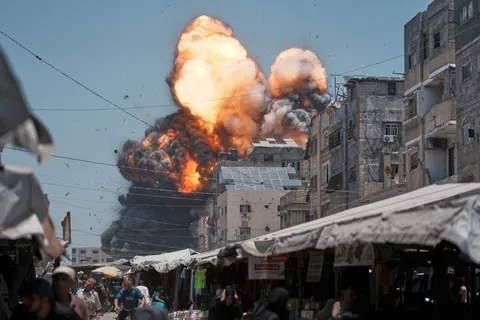
Where that rubble came from matters. In Gaza’s eight longstanding refugee camps, older buildings were more likely to have asbestos in their roofing sheets. Wrecked industrial premises may contain chemicals, while damaged solar installations can release heavy metals. Wind, passing vehicles and clearance work can lift contaminated dust back into the air. People removing debris from their own homes face exposure alongside the crews clearing roads.
Asbestos fibres released when damaged material is broken up can cause lung cancer and mesothelioma, illnesses that can take decades to appear. The immediate task for clearance teams is to identify hazardous material before concrete is crushed for reuse. They must also contend with unexploded munitions and recover the remains of people still buried in the wreckage.
What remains for Gaza’s farmers
For farmers, even reaching a field again leaves the question of what can safely be grown there. The researchers identified particular risks around Beit Hanoun, Wadi Gaza and north-east of Khan Younis. Soils there contain more clay, which can retain pollutants long after debris has been removed. Testing would help farmers decide where they can sow and which plots need treatment first.
Satellite analysis by the UN Food and Agriculture Organization and the UN Satellite Centre found that, by 24 June, just 448 hectares of Gaza’s cropland remained both accessible and undamaged, about 3 per cent of the total. Oxfam is calling for a Palestinian-led assessment and clean-up alongside reconstruction, with access for the specialists and equipment needed to examine wells, fields and residential areas.
Taysir Dahdouh, who grew cucumbers and tomatoes before the war, described what he found when he returned. “Even the steel frames of the greenhouses disappeared, along with our homes, belongings, and irrigation pipes.” Working with basic tools, he and his family managed to bring about a tenth of a hectare back into production. Another farmer, Wajiha Dahdouh, explained why they had come back at all. “We came back to support ourselves and return to farming so we could survive.”
Sources and attributions
Oxfam and the Conflict and Environment Observatory, 23 November 2026. Lama Abdul Samad, Martin Butcher and Gabriel Naumann set out the mapping method, well tests, sewage estimates, soil risks and recommendations in Environmental War Crimes. Behar’s remarks appear in the accompanying statement.
Matthew Taylor, The Guardian, 23 November 2026. The original report includes comments from Behar and Abdul Samad. It records that the Israeli government was approached for comment.
UN Office for the Coordination of Humanitarian Affairs. Its February water-quality update gives the WHO sample results and the gap in Rafah. Its 8 November flood report and 18 November situation report document sewage removal and conditions around shelters.
UNICEF, 9 November 2026, statement on the flooding and the Sheikh Radwan pumps. Emma Farge, Reuters, 10 November 2026, James Elder’s account of the repair proposal and the Israeli authority’s stated grounds for rejecting it.
UN Environment Programme, September 2025, second environmental assessment of Gaza, including debris estimates and the risks in refugee camps and industrial areas. World Health Organization, August 2026, asbestos and its health effects.
World Bank, European Union and United Nations, April 2026. The Gaza Strip Rapid Damage and Needs Assessment gives the revised rubble estimate, the projected clearance cost and provisions for recovering human remains.
Food and Agriculture Organization and UN Satellite Centre, August 2026, cropland damage and access assessment. The United Nations published the accounts of Taysir Dahdouh and Wajiha Dahdouh.
International Committee of the Red Cross, customary law on objects indispensable to civilian survival. The UN commission’s June findings, Israel’s response and the International Court of Justice’s procedural order provide the legal context.