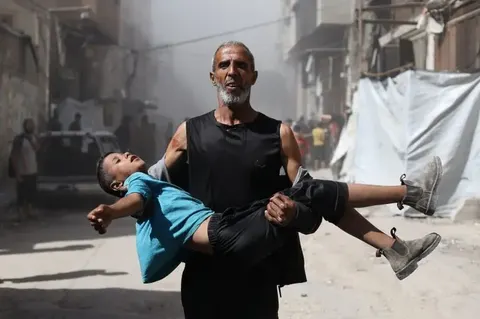
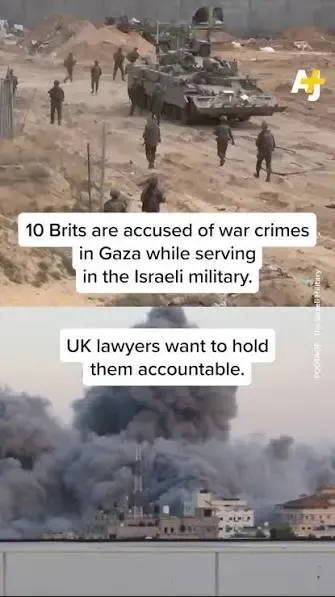
Israeli Soldiers Describe How Palestinian Families Came to Be Counted as ‘Collateral Damage’
In the documentary NAZA, 24 Israeli military insiders describe how decisions to bomb homes in Gaza were made. More than 1.5 million people have seen the film in cinemas worldwide. In Israel, where it has yet to receive a public cinema screening, Benjamin Netanyahu has demanded the prosecution of those who spoke.
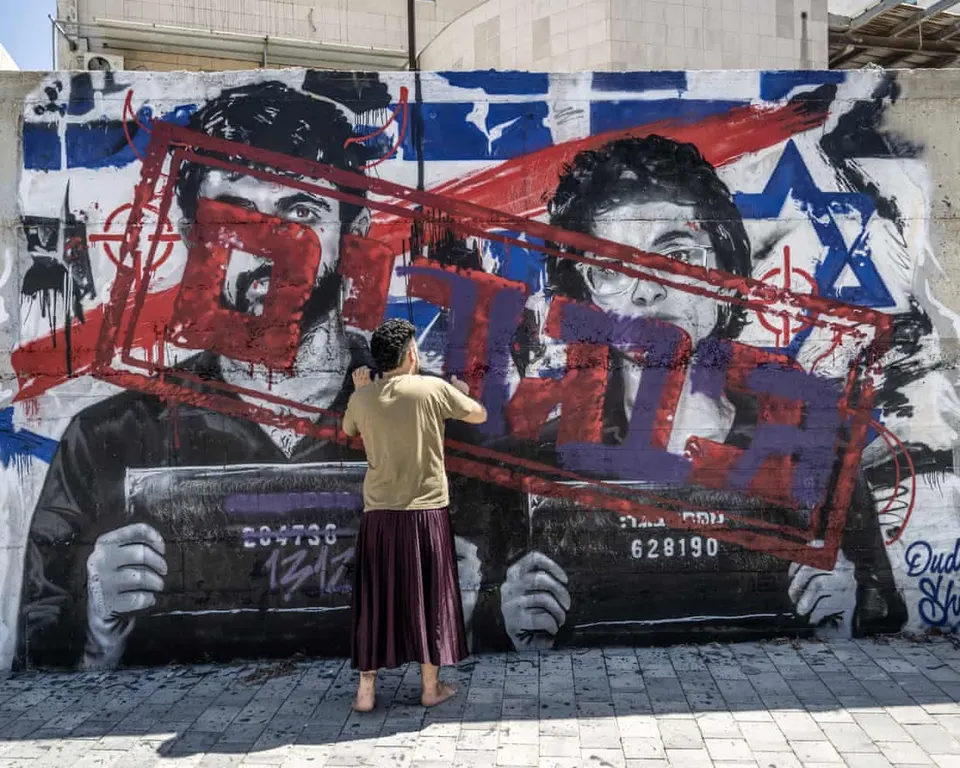
One of the Israeli soldiers interviewed in NAZA remembers finding a photograph on a Palestinian man’s phone. The man was smiling on his balcony with his two young daughters. By the time the Israeli military bombed the apartment, the soldier says, the father had gone out. He had left his phone behind. Both girls were still at home.
The soldier recalled hearing a woman on the phone begging for someone to save her daughter, who was alive and burning. He said both girls died. He did not know what became of their father.
Filmed anonymously on Tel Aviv rooftops, the soldier is one of 24 Israeli military personnel who spoke to directors Yuval Abraham and Rachel Szor about the bombardment of Gaza. The title is an abbreviation of nezek agavi, Hebrew for collateral damage. In the conversations the soldiers describe, it was a number attached to a proposed strike. Before a bomb fell, someone had already estimated how many civilians it might kill.
One interviewee recalled what that meant when the target was a junior member of Hamas. “Twenty NAZA became the benchmark. We’d take down lower ranks in Hamas without a second thought. They were official orders,” he said.
The Israeli military disputes that account. It acknowledges that commanders worked with numerical thresholds for expected civilian harm. It says those figures determined how senior an officer had to be to approve a strike, and that the officer still had to assess whether the expected harm was excessive in relation to the military advantage. What divides the witnesses and the military is what happened when a proposal reached that officer’s desk.
When the target went home
Abraham began investigating Israel’s targeting practices well before making the film. In April 2024, six Israeli intelligence sources described a system called Lavender that flagged Palestinians suspected of belonging to Hamas or Palestinian Islamic Jihad. Some said that, in the first weeks after the Hamas-led attack of 7 October 2023, personnel routinely accepted its recommendations after only cursory checks. Intelligence staff also described waiting for suspects to return home, where they were easier to locate and where their families were likely to be sleeping.
A separate investigation later examined dozens of military records and drew on interviews with more than 100 Israeli soldiers and officials. It traced a change in authority to an order issued at 1pm on 7 October, while fighting was still under way in southern Israel. Mid-ranking officers could now authorise attacks on a much wider range of targets, including low-ranking fighters, even when they risked killing as many as 20 civilians.
The most serious numerical allegation in NAZA concerns a single proposed attack. One participant said approval had been given to risk killing 500 civilians for one target. The military explicitly denies ever planning, approving or carrying out a strike in Gaza with anything approaching that expected toll. The figure is a witness’s account of what commanders were prepared to authorise. The film does not establish that 500 people died in such an attack.
The military says its intelligence personnel often saw only the early stages of planning and could mistake a preliminary estimate for the final decision. The film-makers say their sources included people who took part in final authorisations. They say they checked testimony against classified documents, investigated individual strikes and interviewed more than 100 people familiar with the systems, including senior commanders.
The names behind the figures
In Gaza, families have been able to establish who died, often in exacting detail, while learning little about who ordered the attack or why. On the evening of 10 October 2023, Suleiman Salman al-Najjar, a car dealer and mechanic in Deir al-Balah, went to hospital for treatment for kidney pain. On his way home he stopped to speak to a friend. They heard an explosion. Someone came to tell him it was his house.
The strike killed 21 members of the al-Najjar family and three neighbours. Among the dead were Suleiman’s wife, Susanne, their sons Yazan, 14, and Nadim, 20, and their daughters Farah, 23, and Safa, 17 months. “Only the body of my son Nadim was recovered whole,” he said. “My baby girl, Safa, we only found her hand.”
Amnesty International investigators examining that strike found fragments of a US-made bomb guidance kit. They interviewed survivors and relatives and checked satellite images of the site. They found no indication of a military objective there. Their investigation did not establish what targeting process Israel had used against the house. The military had yet to answer their questions when they published their findings.
A film Israelis are arguing about before they can see it
By mid-November, NAZA had played in 47 countries and won the special jury prize at Venice. The directors offered it to Israeli cinemas free of charge. By 18 November, none had shown it publicly. Yet when Nadav Weiman, a former Israeli soldier who runs the veterans’ organisation Breaking the Silence, visited friends and neighbours in Tel Aviv on Yom Kippur, he found almost everyone talking about it. Even in his left-leaning neighbourhood, much of what he heard was hostile.
Weiman says more than 200 soldiers have given his organisation testimony about their service in this Gaza war. He sees a particular significance in hearing Hebrew-speaking intelligence personnel describe work they carried out from desks in Israel. These are people their neighbours might know from the technology industry or from the parties they vote for. Since the backlash against the film, he says, soldiers approaching his organisation have sought stronger assurances that their identities will be protected.
They have reason to take the risk seriously. On 11 October, Netanyahu called on the attorney general, the military chief of staff and the head of the Shin Bet security service to identify and prosecute the participants. He cited possible security offences and criminal defamation. He had already proposed stripping Israelis who defame soldiers abroad of their citizenship. Outside Szor’s parents’ home, demonstrators called for the death penalty for traitors.
The contest over who gets to see the testimony has also moved online. Israeli embassies promoted a rival production called NAZA: The Real Story. The Israeli embassy in Washington said the foreign ministry had no role in making it. Advertising records examined in November showed that Israel’s government communications agency had funded at least 19 adverts directing people to the rival film’s website. In tests in October, researchers asking ChatGPT and Grok where to watch NAZA found that the tools repeatedly sent them to the other production.
Abraham and Szor’s film is due to stream free in early December, giving Israelis the chance to hear the soldiers in their own words. For Weiman, that was always the audience that mattered most. As he put it, “it’s a movie about us, we need to change.”
Sources and attributions
Michael Segalov’s interview with Nadav Weiman, The Guardian, 18 November 2026. Weiman discusses the reaction in Tel Aviv, testimony collected by Breaking the Silence and soldiers’ concerns about identification.
Inside NAZA, the documentary no Israeli cinema will show, Velvet Winter, ABC News, 15 October 2026. The report records the soldier’s account of the father and his daughters and the participants’ words about the 20-person benchmark and the disputed figure of 500.
‘Lavender’: The AI machine directing Israel’s bombing spree in Gaza, Yuval Abraham, +972 Magazine and Local Call, 3 April 2024. Israel Loosened Its Rules to Bomb Hamas Fighters, Killing Many More Civilians, Patrick Kingsley and colleagues, The New York Times, 26 December 2024. The two investigations document accounts of home targeting and the change in commanders’ authority.
The Israeli military’s full response to NAZA and the film-makers’ account of how they verified the testimony, IDF Spokesperson and Peter Beaumont, The Guardian, both 1 October 2026. These set out the competing accounts of approval thresholds, witness access and the alleged 500-person estimate.
Investigation into two Israeli airstrikes on family homes in Deir al-Balah, Amnesty International, 5 December 2023. Includes Suleiman al-Najjar’s testimony, the names and ages of relatives killed, and the weapons analysis.
Netanyahu’s demand for prosecution, Sarah Moskowitz, The Jerusalem Post, 11 October 2026, and reporting on the threats against the directors, Lorenzo Tondo, The Guardian, 12 October 2026.
Israel promotes film that mimics NAZA documentary, Louisa Loveluck, The Guardian, 8 October 2026, and investigation into the promotion of the rival documentary, Clément Pouré, Mediapart, 14 November 2026. The latter examined advertising records and tests by AI Forensics.
Official Venice Film Festival awards, La Biennale di Venezia, 12 September 2026. How and where to watch NAZA, The Guardian, 12 November 2026. The Guardian produced the documentary and supplied the cinema attendance, distribution figures and streaming timetable.