‘We Are Dead in Gaza’: Three Years of Destruction, Displacement and the Struggle to Survive
A year after a ceasefire took effect, Palestinians in Gaza are still being killed, displaced families are struggling to obtain food and water, and Israeli aircraft continue to circle overhead, according to testimony broadcast on the third anniversary of 7 October. From Gaza City, journalist Akram al-Satarri described a territory where the destruction of homes, the separation of families and the search for missing bodies continue to shape daily life.
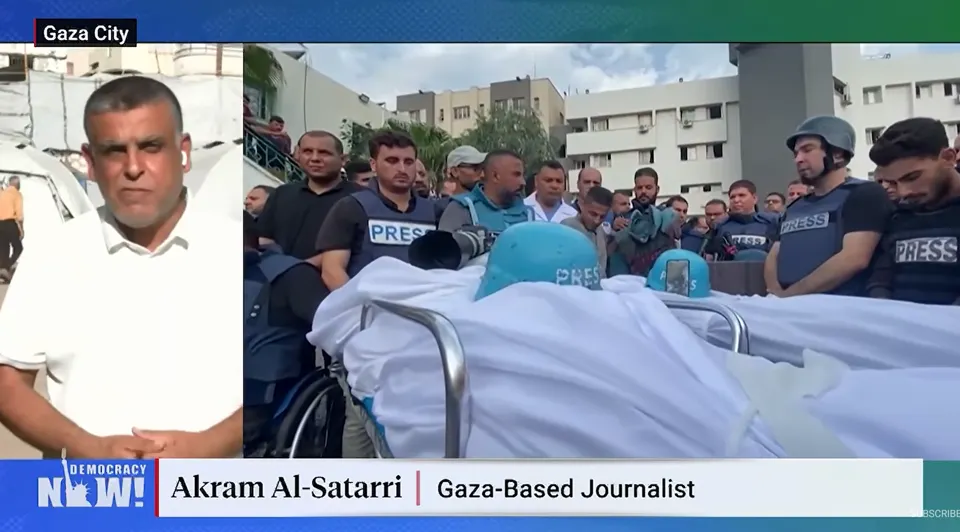
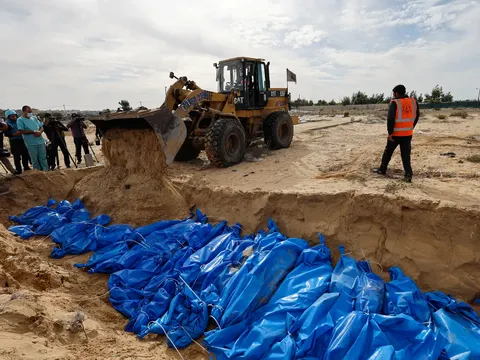
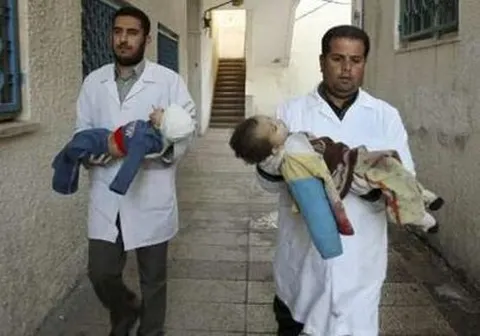
More than 74,000 Palestinians have been killed by Israel over the past three years, according to Gaza’s Health Ministry, as cited in the programme. The figure may substantially understate the total: al-Satarri described thousands of people whose bodies had not been recovered. The period followed the Hamas-led attack on Israel on 7 October 2023, which killed nearly 1,200 people. The programme described that date as the beginning of Israel’s genocide in Gaza and reported that the killing continued despite the ceasefire introduced about a year earlier. Al-Satarri’s account was of continuing air activity, fresh fatal strikes and families living in tents without minimum standards of safety or shelter. For the Palestinians interviewed, the anniversary arrived amid the continuing destruction of the ordinary conditions of life: a home, enough food, safe drinking water and the ability to keep a family together. For Akram Abu Jarad, a displaced Palestinian from Beit Hanoun interviewed in Gaza City on 7 October, the experience was one of exhaustion and deprivation. His testimony was brief, but encompassed the daily struggle of living without a home or reliable access to essentials: “The worst 3 years that have passed in our lives. There is no life, no living, no food, no basic necessities of life. We wait for water from 5:00 to 10:00, and we are living in the streets homeless, tired, worn out. I mean, a life worse than this we are not living, my friend. We are dead in Gaza.” Al-Satarri, who had worked as both a journalist and a humanitarian worker, described how the destruction had altered every part of Palestinian life. Alongside the loss of homes and access to food, he spoke of families separated across Gaza’s borders, unsafe water and bereaved people trying to recover the remains of those they loved. Interviewer Amy Goodman introduced him and asked: “We go now to Gaza City, where we're joined by journalist Akram al-Satarri. I want to thank you so much for being with us. We spoke to you a few years ago as a journalist. You then went on to work with humanitarian aid organization for several years. Now we're back being able to speak to you in Gaza City. Can you describe what's happening on the ground? We just reported that as Israelis mourned the dead at the music site in southern Israel, they could hear the booms of Israeli airstrikes on the Gaza Strip right nearby. Tell us what's happening where you are, Akram.” Al-Satarri answered: “Well, October 7th was a day when Gaza changed once and for all. The way Palestinians have been living has changed. The way Palestinians have been managing their life has changed as well. The way Palestinians were defining their life has changed. The Palestinians now are living in a de facto that has redefined everything. Their understanding of life, their way of running and managing that life, their way to access things, their way to live, their way to stay in homes, their way to live in tents, every single aspect of the life of the people of Gaza has changed once and forever. “Around 85% of the built environment in in Gaza is already destroyed. Around 74% of the land of the Gaza Strip is also uh controlled by uh Israel and the IDF. Gazans have been struggling to access water and to access food. They have been facing significant public health hazards because of the fact that they were consuming water that was not properly uh treated. Organizations have been struggling for the sake of helping the people of Gaza. Statements were made by international and UN figures, diplomats all over the world condemning the situation that has been going on, calling for Gazans to live and lead a normal life. “Unfortunately for the for the third year now and on October 7th, Gazans are reminded by the fact that they have been living in death and fear, destruction and displacement. “Another Gazan was killed a couple of hours ago in Khan Yunis refugee camp. 60-years-old Gazan that was targeted by IDF. Yesterday another Palestinian was targeted in Al-Shati, the beach camp, by another drone strike and he also lost his life. Several people were injured. “The people who are living in the tents with no even minimum standard for living are living in exacerbating safety and security risks. They significant proportion of them is still not re-union with their families that are outside of the Gaza Strip. And some of them also significant part of them, around 8,000 families are not aware about the whereabouts of the bodies of their missed family members. Around 250 journalists were killed. “So, as you said, 74,000 Gazans were confirmed to be dead while the number is much higher. Around 8,000 peoples are not 8,000 Gazans are dead, but they the bodies are not discovered yet. “The Gazans who were worried about their dears were organizing mass funerals for 150 bodies, for two bodies, where the memories that were remaining from the people, where their remains, their clothes, their shoes, their watches, and anything simple yet can give some comfort to the ones who were not sure about the whereabouts of the bodies of their dears. “The life in Gaza has changed forever. People are still struggling and people are today reminded since they last night, they reminded that the Israeli Air Force is still hovering all around different parts of the Gaza Strip and that the IDF is still hunting Gazans, disturbing the already disturbed life, spreading death and displacement once and once again.” His description of mourning extended beyond the recovery of bodies. Clothes, shoes and watches had become precious remnants for families struggling to establish what had happened to their relatives. In his account, displacement meant both the loss of a place to live and separation from the people around whom a life had been built. The interview then turned to those documenting the destruction. Al-Satarri argued that Palestinian journalists faced danger because their reporting exposed atrocities and provided material used by international organisations and investigators. That was his assessment of why journalists had come under attack. Goodman asked: “Akram, I'm wondering if you can respond to the United Nations Human Rights Chief Volker Turk, who's called Gaza a death trap for journalists. You have been a journalist in Gaza for years. As you said, you lost 250, more than 250 colleagues. What has this meant as the Israeli Prime Minister Benjamin Netanyahu does not allow in international journalists and then the Israeli military kills hundreds of Palestinian journalists.” Al-Satarri replied: “The situation in Gaza is catastrophic as an overall situation when it comes to the general population, but there are some specific job-related hardships when it comes to the journalists. They were always there. They were the first responder along with the medical teams to cover the truth about the bombardments. And also, they were the footage that were providing was used by very significant committees that were fact-finding and were hoping that they would condemn the occupation. “Now, that made them also bear the brunt of most of the hostilities that were taking place in the Gaza Strip. That made them a target, which were they were not supposed to be a target. They were targeted while doing their job. “Their job proved to be a dangerous job for the occupation because it has been exposing some and most of the atrocities that have been taking place. They have discovered the truth. They have also They have widespread presence worldwide even when they are very dedicated local Palestinian journalist. And the footage that have been provided They have been provided was used and is still being used by diplomats, by INGOs, by UN agencies. “And that's why I believe they were classified as an enemy, and they have been paying that very heavy price that could reach their life being claimed by the ongoing war that has been merciless when it comes to the to them, when it comes to the paramedics, when it comes to the medical teams, and when it comes to also humanitarian crews who were trying to reach out for the people in need and alleviate a bit of their suffering.” His work in humanitarian relief had also brought him into contact with released Palestinian prisoners whose physical and psychological condition left them struggling to recognise their families or move independently. He described trying to help people who had lost limbs, while aid organisations worked to supply a wider population deprived of food and shelter. Goodman’s final question concerned the human cost of that work and his movement between journalism and humanitarian assistance: “Akram, you have worked in the humanitarian field for the last few years. According to the UN, over 560 humanitarian workers have been killed in Gaza in the last 3 years. What has been most shocking to you about what you witnessed during this work and what made you decide to go from being a journalist to a humanitarian worker and now back to being a journalist?” Al-Satarri answered: “As a matter of fact, I indeed was working for a humanitarian organization. I was hoping that by working with that organization, I'd be able to support the humanitarian effort. I would be able to contribute to alleviation of the suffering of the people. And yes, indeed, I was very close to the people. Some of the ex-prisoners who were released, not being very well oriented to the situation. Some of them were with psychological situation. Some of them were unable to identify their families. Some others were not able to move. Some of them lost their limbs. I was there. I was hoping that I would help. And I was indeed helping with that organization, seeing the people, recording their experiences, extending a helping hand when needed. “The organization was also helping the general population by empowering them, providing them with a very essential supplies. And I also managed to find my way to still try to help people and extend a helping hand to them even with me outside of that organization. “I believe the humanitarian situation is very catastrophic and it is one of the direct results of October 7th. For such a significant period of time, people were not allowed to access any kind of food supplies whatsoever in the Gaza North and some other times it throughout the full Gaza Strip. People were deprived of from the shelter. People were deprived from the non-food items. More importantly, the tents that they used as a temporary shelter for the people of Gaza. “The toll that has been endured by the humanitarian workers is also very heavy. More than 500 people were killed. Most of them were killed during their job, during the service, during reaching out to the community or coming back from the internally displaced people camps. “They were killed while cooking the food for the people in need when the food was extremely scarce. They were killed when they were reaching out for the children who are most vulnerable, for the elderly people, for the women, for the IDPs in general who are also, even if they are young, even if they are men, they are also vulnerable because of the very scarce situation that was endured in Gaza that is still very relevant to the to the day to to today to the day. “So, the situation is extremely dire. The humanitarian workers have been trying to help and support the people, and they have already paid a heavy price, and they're still continuously paying that heavy price. Some of them were injured, some others were not lucky enough to survive, but most of them are still determined to continue delivering the mandate and continue reaching out and supporting the people of Gaza. “Despite the very difficult situation in Gaza, despite the fear of death and destruction, despite the fear of injury, despite the very lacking situation they have been living when it comes to fuel, when it comes to movement of cars, when it comes to the condition of streets and buildings and camps, the humanitarian workers are courageously continuing to deliver their mandate, continuing to work, and continuing to see of their colleagues dying and being buried without giving up that mandate and without giving up that noble mission. “Something that should be acknowledged, something that should be appreciated, and they all know very well that they have been serving this noble notion of supporting and uplifting people and providing them with very with their very basic human right of access to food and supplies in a very critical conflict zone.” Goodman closed the interview: “Akram al-Satarri, we want to thank you so much for being with us. Be safe. Gaza-based journalist joining us today from Gaza City.” Across the two accounts, survival depended on tasks that had become exhausting and dangerous: finding water, obtaining food, reaching displaced families and recording what was happening around them. Al-Satarri’s closing tribute was to aid workers who continued after seeing colleagues killed and buried. Abu Jarad’s testimony conveyed the toll on those they were trying to help: people still alive, but describing a life stripped of its most basic necessities. Source: Gaza testimony and Amy Goodman’s interview with Akram al-Satarri, Democracy Now!, 7 October 2026, together with the accompanying programme description supplied by the user. The original programme identifies the displaced resident as Akram Abu Jarad. The description attributes the death toll to Gaza’s Health Ministry and dates the ceasefire to about a year before the broadcast. https://www.democracynow.org/2026/10/7/israel_gaza_genocide