Three Years After the Gaza D Notice Britain Still Faces Questions Over Its Secret Military Role
Independent journalist Matt Kennard’s renewed publication of a warning to editors has revived scrutiny of British military secrecy. Parliamentary records and subsequent disclosures reveal blocked questions, extensive surveillance and footage withheld long after the flights ended, while the precise role of Special Forces remains unconfirmed.
Three years after British editors were warned against publishing claims about Special Forces deployments in the Middle East, the public record has expanded considerably, without producing a full account of Britain’s military and intelligence involvement in the Gaza war.
Ministers have acknowledged surveillance flights and intelligence sharing with Israel. MPs have repeatedly sought details of operations, aircraft movements and potentially important footage. In one significant Commons exchange, a deputy speaker confirmed that the government had blocked questions on a specific category of activity at British military bases.
The surveillance programme was officially brought to an end in October 2025, but requests for access to its records were still being rejected in July 2026. A proposal for an independent inquiry remains before Parliament, without having established the investigation its supporters want.
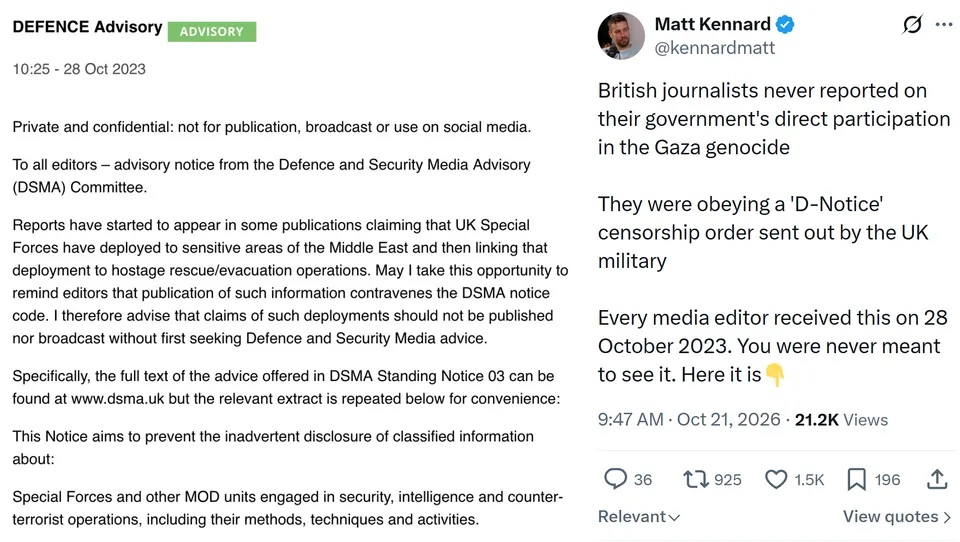
The issue has returned to attention through a post by independent investigative journalist Matt Kennard, dated 21 October 2026, reproducing an advisory sent to editors on 28 October 2023. Kennard accused British journalists of concealing their government’s involvement in what he called the Gaza genocide, describing the document as a censorship order.
“They were obeying a ‘D-Notice’ censorship order sent out by the UK military,” he wrote. “You were never meant to see it.”
The document is evidence of an intervention in reporting, corroborated by contemporary publication and the advisory committee’s own minutes. Its significance nevertheless requires precision: a D notice has no legal force of its own, and this particular warning does not establish that British Special Forces fought in Gaza or took part in any specific Israeli attack.
The more substantial story lies in the relationship between that request for editorial restraint and a succession of official refusals to provide information. Together, they have left unresolved questions about what was done in Britain’s name, what information was passed to Israel, and how the consequences were assessed.
The warning sent to editors
The advisory was timed at 10.25am on 28 October 2023 and signed by Brigadier Geoffrey Dodds, the retired officer serving as secretary of the Defence and Security Media Advisory Committee, usually known as the DSMA Committee.
It carried an instruction at the top: “Private and confidential: not for publication, broadcast or use on social media.”
Addressed to all editors, it said reports had begun appearing about UK Special Forces deploying to sensitive parts of the Middle East, with those deployments being linked to hostage rescue or evacuation operations. Newspaper claims at the time had placed the Special Air Service, or SAS, on standby in Cyprus for possible operations involving hostages in Gaza.
Dodds wrote: “I therefore advise that claims of such deployments should not be published nor broadcast without first seeking Defence and Security Media advice.”
The letter invoked Standing Notice 03, which protects classified information about Special Forces and intelligence operations, including their methods and techniques. Its stated concern was that disclosure could advantage an adversary, endanger national security and increase the risk to British lives.
The wording matters. It sought consultation before publication of claims about deployments and operations; it did not say that all reporting on British military assistance to Israel was prohibited. Nor did it confirm the reports that had prompted the intervention. Gaza and Israel were not named in the letter itself, although the contemporary context linked it to the hostage crisis.
The notice was also less secret in practice than its confidentiality label suggests. Its contents were published on 28 October 2023 by a recipient who explicitly declined to seek the requested advice. Kennard subsequently circulated an image of the advisory in July 2025, before returning to it in his October 2026 post.
His latest intervention therefore revives a documented episode rather than revealing a notice that had remained wholly unknown for three years. What has remained much harder to establish is the extent to which individual editors changed, delayed or abandoned reporting because of it.
What a D notice actually does
A D notice is the familiar name for Britain’s system of confidential national security advice to the media. Its origins date to an agreement between defence authorities and press representatives in 1912. The notices were renamed Defence Advisory notices in 1993, and the present Defence and Security Media Advisory name was adopted in 2015.
There are five standing notices covering broad categories of sensitive information. These include military operations, weapons, intelligence methods, important installations and the identities or personal details of people in sensitive roles. A letter such as the October 2023 advisory applies that standing framework to a particular issue.
The committee’s official description is unequivocal about its legal status: “The system is voluntary, it has no legal authority.” Its guidance says the final decision on publication “rests solely with the editor or publisher concerned”.
An advisory does not itself create an offence, impose a fine or operate as a court injunction. Editors can reject the advice, including after consulting the secretary.
Other laws remain relevant. A government department may separately seek an injunction or pursue legal action where it believes a legal basis exists. Compliance with DSMA advice does not provide immunity under the Official Secrets Act. Those legal powers are distinct from the advisory committee’s authority, which its own guidance describes as “argument and persuasion”.
The system is jointly operated by officials and senior media representatives. Its chair is the Ministry of Defence’s Director General Security Policy; its membership includes representatives from major broadcasters, newspapers and media organisations. The media side selects the vice chair. The secretariat is supported by the Ministry of Defence while formally serving both sides.
This arrangement makes the role of editors central to the controversy. Calling the letter a legally binding censorship order would misdescribe its power. Describing it as voluntary does not settle whether confidential pressure, accepted conventions or deference to security officials can restrict reporting in practice.
The stated safeguards are significant. The committee says political embarrassment is not a valid reason for withholding information, and its general guidance recognises the legitimacy of debate about defence policy. It is also supposed to consider whether information is already widely public.
Public scrutiny of those safeguards is limited by confidentiality. The committee says it is not subject to the UK or Scottish freedom of information legislation. Although it publishes minutes and summaries, discussions with editors are confidential, leaving readers without a comprehensive account of which stories were challenged or how disputes were resolved.
What the committee later disclosed
The committee’s own records corroborate an intervention at the time of the Gaza warning. Minutes of its meeting on 31 October 2023 record that a supplementary notice concerning movements of UK forces in the Middle East had been issued after the reporting period ended on 17 October and before the meeting took place.
The minutes do not reproduce the 28 October letter, but they independently place a relevant advisory within the same short period.
At its meeting on 25 April 2024, the committee recorded two supplementary notices during the preceding reporting period, which encompassed the Gaza war and attacks on shipping in the Red Sea. Both concerned Special Forces operations, including tactics, techniques and procedures.
The committee described those interventions as an example of how “sensitive information can be protected without disrupting news of significant public interest”. That is its assessment of the process; the published minutes do not provide the underlying drafts and editorial exchanges that would allow an independent evaluation of that claim.
A further regional intervention appeared in the November 2024 minutes. As the war extended into Lebanon, supplementary advice concerned small groups of deployed personnel. The committee recorded: “This proved effective, and the story of concern was not repeated.” Its accompanying summary linked the advice to possible British evacuation operations in Lebanon, distinguishing it from a general restriction on coverage of Gaza.
The latest published minutes reviewed for this feature, covering the period to April 2026, record no new supplementary notices during that reporting period, while individual requests for advice continued. The absence of a new circular does not mean the standing notices ceased to apply.
Equally, the passage of three years does not create an automatic expiry date for every operational secret. Notice 03 covers information about completed operations where disclosure might still endanger people or reveal usable methods. That is different from saying a statutory ban on discussing Gaza has remained in force for three years.
Parliament asked about the operations
Scrutiny in Parliament has largely concerned the activities behind the secrecy, rather than a dedicated investigation into the October 2023 notice itself.
On 4 December 2023, Jeremy Corbyn asked the government about the purpose of British military participation in the region and sought a clear assurance: “Can he assure us that there are no British soldiers on the ground in Gaza?”
Foreign Office minister Leo Docherty rejected Corbyn’s description of Israel’s conduct and said Israel’s objective was to defend itself against Hamas. He did not provide the requested assurance about British soldiers. That omission left the question unresolved; it was not confirmation that troops were present.
The following day, defence minister James Heappey answered an even more direct written question from Kenny MacAskill, then the Alba MP for East Lothian. MacAskill had asked whether British Special Forces were on the ground in Gaza as of 27 November 2023.
Heappey replied: “It is longstanding Government policy not to comment on Special Forces.”
In a separate answer to MacAskill that day, Heappey said: “The UK military has not been involved in combat operations in Gaza.” That broad denial did not disclose whether Special Forces had deployed elsewhere in the region or performed other duties.
There was more explicit acknowledgement elsewhere. On 6 February 2024, Heappey answered MacAskill’s question about “whether intelligence on military operations has been shared with Israel during the conflict in Gaza”. His reply began: “Yes”, before referring to his December statement on the hostage rescue activity.
The admission establishes intelligence sharing within the declared mandate; it does not establish that Britain supplied targeting information for attacks on civilians.
The most consequential evidence of a restriction on parliamentary questioning emerged under the subsequent Labour government.
In October 2024, John McDonnell asked whether Israeli Air Force aircraft had landed at RAF Akrotiri since 7 October 2023. Answering on 14 October, defence minister Luke Pollard cited policy and operational security.
He said the Ministry of Defence “will neither confirm, deny, nor comment on any foreign nations’ military aircraft movement or operations within UK airspace or UK overseas bases”.
On 14 May 2025, Labour MP Kim Johnson told the Commons that she had tried to table a question about the use of Akrotiri by Israeli bomber aircraft and had been blocked. She challenged the restriction, noting that other questions about the base had previously been accepted.
Deputy Speaker Judith Cummins confirmed where the restriction originated: “It is not the Table Office but the Government that have blocked questions on this specific subject.”
Cummins also made clear that other questions about Akrotiri could still be in order. The record therefore supports a specific government block on a category of questions, rather than the sweeping claim that MPs were barred from asking anything about the base.
This was separate from the DSMA system. The media advisory addressed editors; the parliamentary restriction arose from the government’s position on answering particular operational questions. Treating them as one legal mechanism would obscure how the different barriers to scrutiny actually worked.
What emerged about surveillance and intelligence
Britain’s Gaza surveillance operation was publicly announced on 2 December 2023. The government said aircraft would operate over the eastern Mediterranean, including Israeli and Gazan airspace, to locate hostages taken in the Hamas led attacks of 7 October.
The original announcement stated: “Surveillance aircraft will be unarmed, do not have a combat role, and will be tasked solely to locate hostages.”
Ministers said only information relating to hostage rescue would be passed to the relevant authorities. The announcement was reported at the time, an important qualification to any suggestion that all British military activity connected with Gaza disappeared from the news.
Subsequent analysis revealed a much larger and more sustained operation than a single announcement could convey. The research charity Action on Armed Violence identified at least 606 RAF reconnaissance flights over or near Gaza between 3 December 2023 and 25 July 2025, alongside another 17 missions by American contractors.
Those are minimum counts reconstructed from observable flights, rather than a complete operational total supplied by the Ministry of Defence. Public tracking often disappeared as aircraft approached Gaza, limiting what could be established about their precise routes, sensors and tasks.
Outsourcing became a further part of the story in summer 2025, when the use of an American contractor associated with Sierra Nevada Corporation became public. A subsequent investigation identified an aircraft belonging to the same contractor operating from Akrotiri near Gaza in December 2024, raising questions about when the arrangement began and who directed the earlier missions.
The presence of an aircraft before an Israeli strike cannot by itself show that its intelligence was used in that attack. Flight records document movements; they do not reveal the contents of intelligence transfers or the decisions made by their recipients.
Another disclosure in June 2024 concerned people on the ground in Israel. A senior Israeli official described British and American intelligence collection and analysis teams assisting with information about hostages throughout the war. The account also said those teams were not involved in planning or carrying out the rescue operations.
The British personnel’s agencies and units were not identified. Suggestions that the team included SAS personnel therefore remained inference, while the Ministry of Defence declined to discuss intelligence speculation. The report widened the picture of possible British involvement without establishing British participation in combat inside Gaza.
MPs pursued the distinction between the declared purpose and the possible uses of the information. Richard Burgon asked whether British surveillance intelligence had been used in Operation Arnon, the Israeli hostage rescue at Nuseirat on 8 June 2024.
In his answer on 4 November 2024, Pollard said: “Our mandate is narrowly defined to focus on securing the release of the hostages only, including British nationals.” He declined further comment on “detailed intelligence matters for operational security reasons”. The specific question about Nuseirat remained unanswered.
On 9 June 2025, responding to Rachael Maskell, Pollard said: “The UK controls what information is passed to Israeli authorities.” He maintained that surveillance information was shared only for hostage rescue and “where we are satisfied that it will be used in accordance with International Humanitarian Law”.
That assurance set out the government’s position, without making the underlying assessments or intelligence available for public examination.
The flights ended but disclosure did not follow
An important change came on 16 October 2025, when the Ministry of Defence announced that Gaza surveillance flights had ceased following the peace agreement and hostage releases.
“The last flight took place on the 10 October 2025,” the statement said.
The statement repeated that the aircraft had been unarmed, had no combat role and had been tasked solely with locating hostages. It also maintained that Britain strictly controlled the information passed to Israeli authorities.
That declared end date has been repeated in parliamentary answers during 2026. Accounts of the controversy therefore need to distinguish the completed surveillance programme from continuing intelligence relationships, aircraft supplying British personnel, and other regional deployments.
The end of the programme did not bring publication of its records. In an answer on 20 October 2025, defence minister Al Carns rejected Burgon’s request for the flight path of the RAF surveillance aircraft operating over Gaza on 1 April 2024, saying disclosure could undermine the ability to respond to future hostage rescue situations.
On 26 January 2026, Carns gave a similar response to Liberal Democrat MP Susan Murray, who had asked what footage and imagery the department held from 31 March 2024 and whether it would be released.
“We will not comment further on detail relating to intelligence matters to protect operational security”, he said, also invoking the need to preserve the ability to respond to future hostage incidents.
On 6 July 2026, defence minister Louise Sandher-Jones rejected Neil Duncan-Jordan’s request for surveillance footage from 25 and 26 March 2025.
She replied: “I am unable to disclose the information requested as to do so would undermine Defence’s ability to respond to hostage rescue scenarios in the future.”
These answers show that the dispute had become a retrospective one. Ministers were protecting information from a programme they said had ended, invoking the possible consequences for future operations rather than the immediate security of the Gaza flights themselves.
The footage and the search for accountability
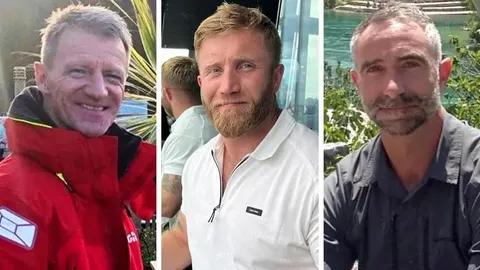
The 1 April 2024 mission has particular significance because Israeli forces killed seven World Central Kitchen aid workers that day, including the Britons John Chapman, James Kirby and James Henderson.
A freedom of information response disclosed in July 2024 confirmed that the Ministry of Defence held video from the RAF Shadow flight on that date. The department refused to release it on security grounds, prompting demands for disclosure from Henderson’s family.
The timing requires care. Available flight tracking suggested that the aircraft was returning to Cyprus, or had already landed, before the strikes. The existence of footage from the day therefore does not establish that Britain recorded the killings. It might contain relevant preceding events, but its coverage has not been made public.
Neil Henderson, James’s father, said: “This footage should not be kept hidden from our family.”
The potential value of surveillance records reaches beyond any one incident. Material gathered for one purpose can still be relevant to an investigation into another event, depending on what it actually captured. Establishing that relevance requires access by competent investigators, even where unrestricted public release would raise legitimate security concerns.
The government has said it would consider formal requests for information from the International Criminal Court. That position was already recorded in a parliamentary answer on 15 May 2024, before Labour took office.
“The UK would consider any formal request from the ICC for information”, Leo Docherty said. He also acknowledged Britain’s responsibility to investigate and prosecute core international crimes under the relevant legal framework.
A willingness to consider a request is not a public accounting of what material was preserved, reviewed or provided. The published answers do not establish the extent of any confidential cooperation, and a lack of public disclosure does not prove that no such cooperation took place.
Risk assessments remained hidden into 2026
The legal concerns surrounding British assistance intensified as the war continued. In September 2024, David Lammy announced the suspension of around 30 arms export licences after the government assessed the risk associated with certain exports to Israel.
Lammy said there was “a clear risk that they might be used to commit or facilitate a serious violation of international humanitarian law”. An exception remained for the international F35 programme, apart from direct exports to Israel for Israeli use.
The decision raised an obvious oversight question: how were comparable risks assessed when assistance took the form of intelligence or military cooperation?
In September 2025, the UN Independent International Commission of Inquiry concluded that Israel had committed genocide against Palestinians in Gaza.
“The Commission finds that Israel is responsible for the commission of genocide in Gaza,” said its chair, Navi Pillay.
Israel has denied genocidal intent. The commission’s finding is distinct from a final judicial determination in the case brought by South Africa at the International Court of Justice, which remains in progress. A May 2026 order scheduled further written pleadings for 2027 and 2029.
None of those developments establishes the criminal responsibility of a particular British official or service member. They make the decisions governing assistance, and the records capable of explaining those decisions, matters of substantial public importance.
A disclosure published on 15 October 2026 clarified part of the risk assessment picture. Following freedom of information requests by researcher George Havenhand, the Ministry of Defence confirmed that it had conducted Overseas Security and Justice Assistance assessments concerning assistance to Israel since 7 October 2023.
It withheld the requested numbers, dates and information about ministerial approvals. An internal review completed in August 2026 upheld that position. Separately, the Foreign Office disclosed updates to preliminary country assessments in May and November 2024 and April and June 2025.
The disclosure matters because it prevents a sweeping claim that no risk assessments existed. It does not establish whether the assessments covered the Gaza surveillance flights or associated intelligence sharing, or permit the public to judge their conclusions. The evidence supports a continuing transparency dispute, rather than a finding that the Ministry of Defence failed to conduct every required assessment.
New assurances and continuing military contacts
The government’s position continued to be challenged in 2026. At the Foreign Affairs Committee on 7 July, Hamish Falconer said that “there are no personnel involved in the conduct of hostilities, whether in Gaza, Lebanon or anywhere else the IDF is taking part”.
Officials also described a British presence in the Civil Military Coordination Centre, or CMCC, supporting planning for Gaza’s future. Falconer’s statement set out the government’s position at that hearing; it did not disclose the details of earlier operations.
That acknowledged deployment is separate from the allegations surrounding Special Forces in 2023. In January 2026, Carns had confirmed that a small British team was embedded in the centre while specifying: “The UK contribution to the CMCC does not include monitoring the ceasefire.”
On 8 September 2026, Apsana Begum again pressed the government about intelligence cooperation and the legal implications of the 2020 military cooperation agreement with Israel.
Foreign Secretary Ed Miliband replied: “We do not comment on intelligence and security matters”, while stating that “we are not involved in the occupation or actions in Gaza and the west bank”.
Begum’s question referred to allegations about surveillance flights during 2026. The exchange records the allegation and the government’s answer; it does not establish that the Gaza hostage surveillance programme resumed after its declared termination in October 2025.
The wider defence relationship nevertheless continued. Records reported on 3 November 2026 disclosed six official visits to Israel by British military personnel during January, February and May that year. They included senior Army and RAF officers. The precise dates and purposes of those visits were not disclosed, so the records establish contact without resolving what assistance or policy discussions it involved.
The advisory system itself also reached Parliament. Asked by Lord Storey for annual notice counts over five years, Lord Coaker replied on 7 July 2026: “The Ministry of Defence (MOD) does not hold this information”, directing him to the DSMA secretary and published reports.
The question concerned the system generally, rather than the Gaza advisory, but illustrated how its formally independent status shapes ministerial responses about its work.
The inquiry that has yet to happen
Corbyn tried to create a more comprehensive route to answers by introducing a Gaza public inquiry bill on 4 June 2025. His proposal sought examination of British military, economic and political cooperation with Israel, including weapons, surveillance aircraft and RAF bases, with power to question ministers and officials.
He accused ministers of withholding answers, telling the Commons: “Over the past 18 months, our questions have been met with evasion, obstruction and silence, leaving the public in the dark”.
The government rejected the proposal in principle. Answering Corbyn on 23 June 2025, Falconer said: “The government does not support the establishment of an independent public inquiry into the UK's involvement in Israeli operations in Gaza since October 2023.”
He maintained that the role of British military operations had already been set out.
The original bill fell at the end of the parliamentary session. Corbyn presented a new version on 22 June 2026. A second reading motion on 11 September met an objection, and the bill was listed for 4 December 2026. Hansard did not identify the member or members responsible for that objection.
The proposal remains a bill, rather than an established inquiry. Introduction and a first reading do not amount to Parliament commissioning an investigation.
Public pressure has also continued. A petition launched on 23 October 2026 calling for an independent inquiry had attracted more than 66,000 signatures when checked on 4 November. It seeks examination of weapons supplies, bases, surveillance intelligence and legal advice. The petition had passed the threshold for a government response, although no response was displayed at the time of checking.
What remains unanswered
Three years on, the evidence supports a more detailed account than either complete silence or complete disclosure. The advisory was exposed immediately, independent reporting continued, ministers acknowledged significant activity, and parliamentarians repeatedly tried to establish its scope and consequences.
Kennard’s renewed intervention focuses attention on the unresolved part of that record: the activities concealed behind the Special Forces policy, the confidential exchanges with editors, and the operational information ministers have declined to publish.
There is still no publicly substantiated account in the material examined establishing that British Special Forces fought in Gaza. Equally, the familiar refusal to comment cannot answer questions about deployment, authorisation or the boundaries of any mission. Reporting that uncertainty accurately leaves the demand for accountability intact.
The same applies to intelligence. The government has explained its stated purpose and asserted controls on sharing, while withholding much of the information needed to test those assurances. The public cannot determine from flight tracks alone what was collected, who received it or how it was used.
The outstanding questions are concrete: what role did British personnel perform; what intelligence reached Israeli authorities; what safeguards were applied and reviewed; what potentially relevant evidence was preserved; and what can now be disclosed without endangering people or legitimate future operations?
An advisory system intended to protect lives does not, by itself, answer any of those questions. The controversy persists because the original warning to editors has been followed by years of partial disclosure, while the proposed mechanism for a fuller public accounting has yet to become an inquiry.
Sources and attributions
Research checked through 4 November 2026. The following records and reporting support the article; qualifications in the copy distinguish official positions, reported findings and unresolved allegations.
Matt Kennard post on X — Matt Kennard, 21 October 2026. The supplied screenshot establishes the wording and displayed date of the post and reproduces the 28 October 2023 advisory. The post itself is an allegation about media conduct and British involvement, rather than proof of particular military operations.
British state tries to cover up its military operations in Middle East — Socialist Worker, Charlie Kimber, 28 October 2023. Contemporary account by a recipient, reproducing the advisory and explaining that the publication did not seek the requested advice. This corroborates the text and its immediate public disclosure.
EXPOSED UK government gagged the MSM over SAS involvement in Israel’s genocide in Gaza — Canary, Ed Sykes, 9 July 2025. Embeds Kennard’s earlier circulation of the notice image. Used for publication chronology, without adopting its stronger claims about universal compliance or proven SAS involvement.
About the system and Frequently Asked Questions — DSMA Committee, current guidance, accessed 4 November 2026. Explains the voluntary system, editorial responsibility, absence of legal authority, separate legal remedies and the exclusion of political embarrassment as a legitimate basis for advice.
History and Standing notices — DSMA Committee, current pages, accessed 4 November 2026. Supports the origins in 1912, the 1993 and 2015 changes of name, and the five standing categories.
How the system works and The Committee — DSMA Committee, current pages, accessed 4 November 2026. Governance, official and media participation, Ministry of Defence support, supplementary letters, confidentiality and freedom of information status. Exact membership counts are avoided because current pages differ.
Standing Notice 03 — DSMA Committee, current wording, amended November 2024. Scope of protection for Special Forces and intelligence methods, including completed operations. The reproduced 2023 notice predates the later wording changes.
Minutes of the meeting on 31 October 2023 — DSMA Committee, signed 13 December 2023, published January 2024. Paragraph 4 records a supplementary advisory concerning UK forces in the Middle East between 17 and 31 October. It corroborates an intervention in the relevant period without reproducing the exact letter.
Minutes of the meeting on 25 April 2024 — DSMA Committee, signed 9 May 2024, published May 2024. Paragraph 10 records two supplementary notices about Special Forces during the reporting period encompassing Gaza and the Red Sea, and the committee’s explanation of their intended effect. The present file directory date does not change the meeting date.
Minutes of the meeting on 5 November 2024 and Secretary’s summary for April to October 2024 — DSMA Committee, November 2024. Records a further advisory concerning vulnerable personnel and possible evacuation operations in Lebanon, and the committee’s statement that the report of concern was not repeated.
Minutes of the meeting on 30 April 2026 — DSMA Committee, published September 2026. Paragraphs 8 and 9 record continuing individual consultations and no supplementary notices during the latest reporting period covered by the minutes.
Gaza Humanitarian Situation — House of Commons Hansard, 4 December 2023. Jeremy Corbyn’s request for an assurance that no British soldiers were in Gaza and Leo Docherty’s response, which did not supply that assurance.
Special Forces question 3981 and Daily written answers including question 3980 — UK Parliament, Kenny MacAskill questions, James Heappey answers, 5 December 2023. The daily report’s page 22 records both the refusal to discuss Special Forces and the explicit denial of UK combat operations in Gaza. The latter describes the position at that date.
Gaza Israel question 12735 — UK Parliament, Kenny MacAskill question, James Heappey answer, 6 February 2024. Affirmative intelligence sharing answer referring back to the government’s hostage rescue statement. It is not an admission of providing civilian targeting information.
Israel Air Force question 5840 — UK Parliament, John McDonnell question, Luke Pollard answer, 14 October 2024. Refusal to confirm, deny or comment on foreign military aircraft movements at UK overseas bases, later cited in the parliamentary question restriction.
Points of Order — House of Commons Hansard, 14 May 2025. Kim Johnson’s complaint and Deputy Speaker Judith Cummins’s confirmation of a government block on a specific subject. Other Akrotiri questions remained potentially admissible.
UK military activity in the Eastern Mediterranean and UK to conduct surveillance flights over Israel and Gaza to help find hostages held by Hamas — UK government and Sky News, 2 December 2023. The announced surveillance programme, declared limitations and contemporary mainstream coverage. The announcement is distinct from alleged covert Special Forces activity.
Britain’s Gaza spy flights and the evidence they may hold — Action on Armed Violence, Iain Overton, 21 August 2026. Retrospective reconstruction identifying at least 606 RAF flights over or near Gaza, plus 17 contractor missions. These are observed minimums, not a complete official total; tracking cannot establish the intelligence supplied.
US flew spy flights for UK months before MoD admitted it — Declassified UK, Iain Overton, 12 August 2025. Contractor involvement and the earlier appearance of an aircraft in December 2024. Flight timing does not establish participation in an Israeli strike or who directed every earlier mission.
The British spy squad assisting Israel as it bombs Gaza and U.S. Intelligence Helped Israel Rescue Four Hostages in Gaza — Declassified UK, Matt Kennard, 11 June 2024, discussing New York Times reporting of 8 June 2024. Anonymous Israeli official’s account of British intelligence teams. The original Times page was not directly retrievable; the accessible account preserves the statement that the teams did not plan or execute rescues.
Hostage taking question 11669 — UK Parliament, Richard Burgon question, Luke Pollard answer, 4 November 2024. Asked specifically whether UK intelligence was used in Operation Arnon at Nuseirat. The answer repeated the hostage mandate without confirming or denying that specific use.
Gaza Surveillance question 56820 — UK Parliament, Rachael Maskell question, Luke Pollard answer, 9 June 2025. Government assurance about control of sharing and satisfaction that the information would be used in accordance with international humanitarian law.
Statement on UK military activity in the Eastern Mediterranean — Ministry of Defence and John Healey, 16 October 2025. Official announcement that the Gaza surveillance operation had ended, with the final flight on 10 October 2025. Subsequent 2026 answers repeat that date.
Gaza Air Force question 81335 — UK Parliament, Richard Burgon question tabled 13 October, Al Carns answer 20 October 2025. Refusal to publish the flight path for 1 April 2024 on grounds relating to future hostage operations.
Gaza Air Force question 106409 — UK Parliament, Susan Murray question, Al Carns answer, 26 January 2026. Request concerned footage from 31 March 2024, not 1 April. The answer declined further intelligence detail and reaffirmed the programme’s termination.
Gaza Surveillance question 14647 — UK Parliament, Neil Duncan-Jordan question, Louise Sandher-Jones answer, 6 July 2026. Refusal to release footage from 25 and 26 March 2025, invoking future hostage rescue capability.
UK covers up Gaza spy footage from day of aid worker massacre — Declassified UK, Phil Miller and John McEvoy, 22 July 2024. FOI confirmation of footage from 1 April and Neil Henderson’s comments. Coverage of the actual strikes is not established.
Gaza Armed Conflict question 24929 — UK Parliament, Martin Docherty-Hughes question, Leo Docherty answer, 15 May 2024. Commitment to consider formal ICC requests and acknowledgement of responsibilities concerning core international crimes. Establishes that this position predated the change of government.
UK policy on arms export licences to Israel and Suspension of licences for Israel — David Lammy and the Export Control Joint Unit, 2 September 2024. The risk assessment underlying the suspension of around 30 licences and the international F35 programme exception.
Commission of Inquiry report on genocide in Gaza and Israel has committed genocide in the Gaza Strip, UN Commission of Inquiry finds — UN Independent International Commission of Inquiry, report A/HRC/60/CRP.3 and accompanying statement, 16 September 2025. The commission’s conclusion on genocide and chair Navi Pillay’s statement. These are distinguished from the separate judicial proceedings at the International Court of Justice.
Presidency notes ICJ order of 21 May 2026 and ICJ order of 26 January 2024 — South African Presidency, 2 June 2026; International Court of Justice, 26 January 2024. Further pleading dates and the continuing proceedings; the earlier order also records Israel’s denial of genocidal intent.
What Britain will not reveal about its military assistance to Israel during the Gaza war — AOAV, Iain Overton, 15 October 2026; FOI research by George Havenhand. Confirms assessments existed; their coverage remains unclear.
Follow up to Israel Palestine conflict inquiry — House of Commons Foreign Affairs Committee, oral evidence, 7 July 2026. Questions 52 to 54 contain Hamish Falconer’s statement about British personnel and Rob Dixon’s explanation of the coordination centre presence.
Gaza Ceasefires question 103212 — UK Parliament, Andy Slaughter question, Al Carns answer, 12 January 2026. Confirms the small British team in the Civil Military Coordination Centre and specifies that its contribution does not include ceasefire monitoring.
Israel and Palestine — House of Commons Hansard, 8 September 2026. Apsana Begum’s challenge and Foreign Secretary Ed Miliband’s response. A question’s premise does not independently substantiate renewed Gaza surveillance flights in 2026.
British military made six official visits to Israel in first half of 2026 — AOAV, Iain Overton, 3 November 2026. Newly obtained Ministry of Defence records on visits in January, February and May. The purposes remain undisclosed; the visits do not themselves prove combat support.
DSMA Notices question HL1235 — UK Parliament, Lord Storey question, Lord Coaker answer, 7 July 2026. General question about annual notice counts and the minister’s direction to the committee. It did not specifically concern the October 2023 Gaza related advisory.
Gaza Independent Public Inquiry and Original bill status — House of Commons Hansard, 4 June 2025; parliamentary bill record, accessed 4 November 2026. Corbyn’s criticism of government responses, the introduction and scope of his first bill, and its subsequent lapse at the end of the parliamentary session.
Gaza Armed Conflict question 59282 — UK Parliament, Jeremy Corbyn question, Hamish Falconer answer, 23 June 2025. Explicit statement that the government did not support an independent public inquiry.
Gaza Independent Public Inquiry Bill 4183, Current bill news and Business without Debate — UK Parliament, presentation 22 June 2026; Hansard, 11 September 2026; status checked 4 November 2026. New bill, objection to second reading and listing for 4 December. The record does not identify the objector. The September date on the bill version is not its introduction date.
Launch a public inquiry into the UK’s role in Israeli operations in Gaza — UK Parliament petitions service, Jennifer Forbes, published 23 October 2026. Checked 4 November 2026: more than 66,000 signatures, threshold for a government response reached, no response displayed. Signature totals continue to change.