Palestine Action Trial Raises Questions Over Free Speech, Gaza, and Britain’s Role in Israel’s War
The prosecution of activists linked to Palestine Action has intensified debate in Britain over free speech, civil disobedience, and the UK’s relationship with Israel as the humanitarian catastrophe in Gaza continues to draw accusations of genocide from international legal experts, human rights organisations, and United Nations officials.
The case, heard at the Old Bailey in London, concerns activists accused of offences connected to direct-action protests targeting facilities operated by Elbit Systems UK, a subsidiary of the Israeli arms manufacturer Elbit Systems.
The proceedings have generated additional controversy because several of the activists were initially arrested or investigated under counter-terrorism powers before ultimately facing different criminal allegations in court. Supporters of the defendants argue this demonstrates an increasingly aggressive attempt by authorities to frame anti-war direct action and Palestine solidarity activism through the lens of national security and terrorism.
Critics of the prosecutions point out that while terrorism-related powers and rhetoric were reportedly used during arrests and investigations, many of the resulting prosecutions centred instead on offences such as criminal damage, burglary, aggravated trespass, or violent disorder rather than direct terrorism offences.
Campaigners backing the defendants say this pattern reflects the difficulty authorities have faced in persuading juries that the activists’ actions were motivated by terrorism rather than political opposition to Israel’s military campaign in Gaza and Britain’s support for it.
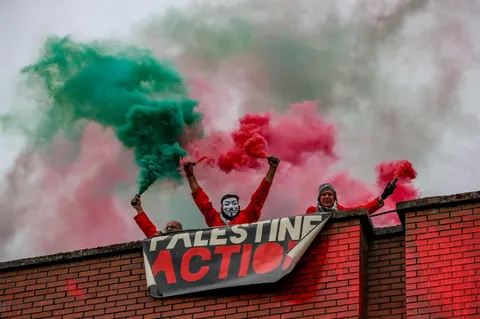
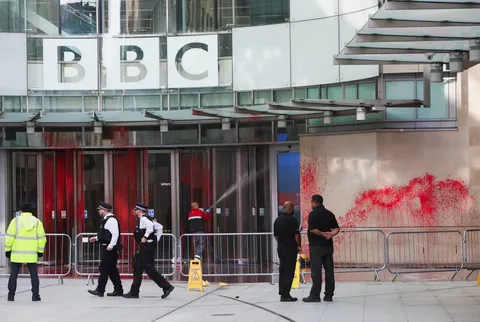
Government ministers and prosecutors reject those claims and maintain that criminal offences involving attacks on defence infrastructure and industrial facilities are serious matters regardless of political motivation. Palestine Action campaigns against Israeli weapons production in Britain and has carried out a series of actions involving factory occupations, vandalism, and disruption at defence facilities connected to Israeli military supply chains.
The trial has become politically explosive because supporters of the defendants argue the activists were attempting to prevent British complicity in war crimes being committed in Gaza.
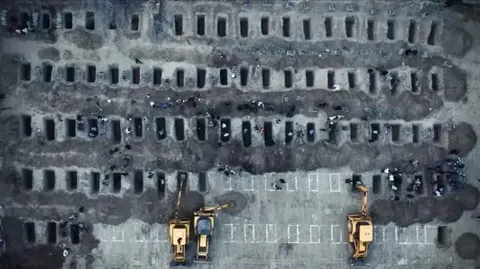
Israel’s military campaign in Gaza, launched after the October 7 attacks by Hamas, has killed more than 72,500 Palestinians, most of them civilians, according to figures reported by Reuters in May 2026 and attributed to Gaza health authorities. More than 830 Palestinians have also been reported killed since the October 2025 truce, compared with four Israeli soldiers, Reuters reported. The assault has displaced much of Gaza’s population and devastated civilian infrastructure including hospitals, schools, refugee camps, universities, water systems, and medical facilities.
United Nations agencies have repeatedly warned of catastrophic humanitarian conditions in the territory. Medical research published in The Lancet has also suggested that the true death toll may ultimately be significantly higher than officially recorded figures when indirect deaths caused by bombardment, starvation, disease, untreated injuries, and the collapse of Gaza’s healthcare system are included. The International Court of Justice ruled in January 2024 that South Africa’s genocide case against Israel was legally plausible and ordered provisional measures requiring Israel to prevent acts prohibited under the Genocide Convention.
Supporters of Palestine Action argue that British-made military components and weapons technology supplied through Israeli-linked defence firms operating on UK soil risk making Britain complicit in alleged violations of international law.
The activists themselves have consistently framed their actions not as ordinary criminality but as an attempt to stop what they view as mass atrocities against civilians in Gaza. Campaigners backing the defendants argue that acts of property damage against arms facilities are morally and legally distinct from violence against people, particularly when aimed at disrupting military supply chains connected to alleged war crimes.
Court Restrictions and Contempt Proceedings
That argument, however, reportedly faced severe restrictions during the trial.
According to reporting by multiple media outlets, defendants were allegedly barred from referring to Gaza as a genocide, from using terms such as apartheid, and from presenting extensive political arguments about Israel’s conduct during the proceedings. Supporters of the defendants say those restrictions prevented jurors from hearing the full moral and political context behind the activists’ actions.
The proceedings attracted additional controversy because barrister Rajiv Menon KC, who represented defendants in related cases, is himself facing contempt of court proceedings connected to comments allegedly made before jurors during an earlier trial.
Critics argue the contempt proceedings risk creating a chilling effect on criminal defence advocacy in politically sensitive cases.
Jury Rights and Allegations of Suppressed Defence Arguments
The issue of jury independence also emerged as a major point of contention.
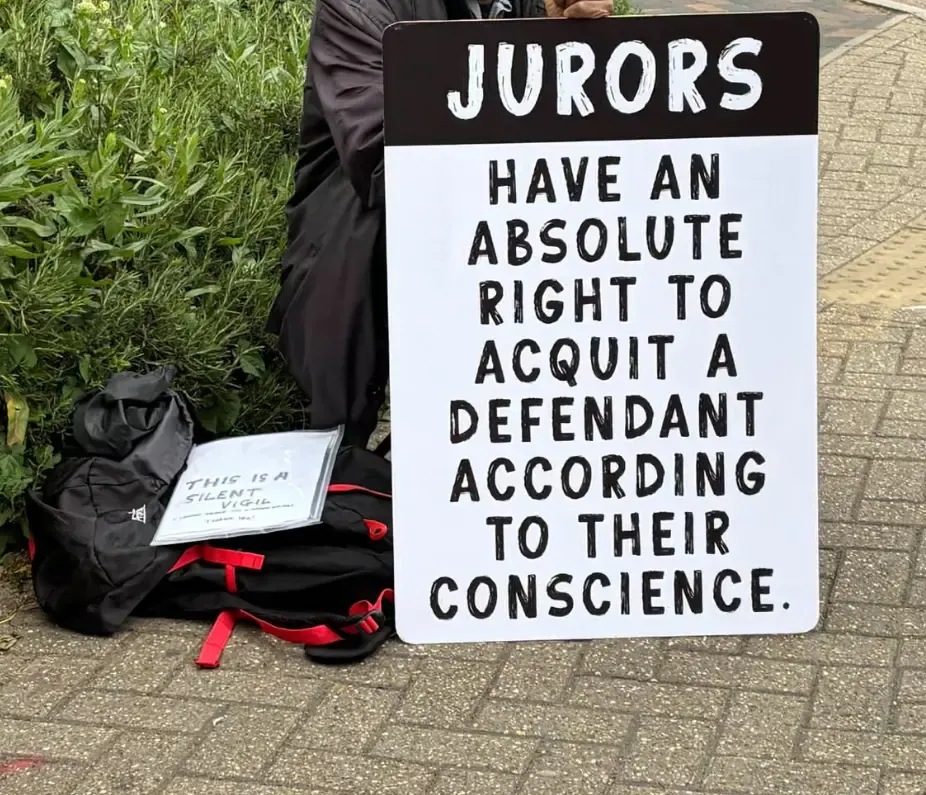
Court documents reported by journalists allegedly instructed parties not to invite jurors to apply the principle commonly known as “jury equity” or “jury nullification,” under which jurors may acquit defendants according to conscience even where technical breaches of the law are established.
Supporters outside court were reportedly warned against displaying signs encouraging jurors to follow their conscience, with some campaigners alleging individuals were threatened with arrest or detained for displaying placards referencing jury rights.
Commenting on the restrictions, journalist and author Max Blumenthal described the situation as extraordinary.
“Jurors are effectively being prevented from hearing that they have a historic right under British law to rule according to conscience,” Blumenthal said.
“Supporters outside court were reportedly being threatened or arrested simply for holding signs informing jurors of rights that have existed in British law for centuries. Critics see that as deeply alarming because previous juries acquitted Palestine Action activists after hearing arguments about Gaza and British complicity in Israel’s military operations.”
Blumenthal argued the restrictions appeared designed to deter future direct-action protest.
“What’s happening here is an attempt to make an example of these defendants,” he said. “In earlier eras states relied on public punishment and fear to enforce obedience. Critics believe these prosecutions serve a similar purpose: to warn others against taking disruptive action over Gaza or challenging Britain’s relationship with Israel.”
Civil liberties advocates argue the restrictions raise wider concerns about open justice, jury independence, and democratic accountability.
Critics of the government’s approach also point to wider efforts by the Labour government to curtail the role of juries within the British legal system.
In December 2025, Prime Minister Keir Starmer faced a significant rebellion from within his own party after proposals were unveiled to limit jury trials in England and Wales for offences carrying likely sentences of less than three years. Nearly 40 Labour MPs warned the government the plans threatened centuries-old legal protections and risked undermining public confidence in the justice system.
Former shadow attorney general Karl Turner described the proposed reforms as “unjust” and defended the principle that defendants should be judged “before a tribunal of their own people”, a right he said had existed for hundreds of years.
Critics of the Palestine Action prosecutions argue the restrictions imposed during the trial should be viewed within that broader political context, where longstanding protections surrounding juries, protest rights, and public dissent are increasingly under pressure.
Supporters of the government reject those claims and argue reforms to the justice system are necessary to address severe court backlogs and prevent victims waiting years for trials.
Growing Debate Over Civil Liberties in Britain
For many critics of Britain’s policy toward Israel, the case has become symbolic of a broader crackdown on anti-war protest and Palestine solidarity activism.
Commenting on the case, journalist and author Max Blumenthal argued that Western governments were increasingly restricting civil liberties in order to shield Israel from accountability.
“Western mainstream media doesn't report what's actually taking place right before our eyes, which is just a gigantic scheme to strip us of our rights in order to protect this psychotic little apartheid state which has no borders and is constantly expanding,” Blumenthal said.
“The UK doesn't have a freedom of assembly in its constitution or charter. It doesn't have free speech. So it's much easier for them to limit the rights of those who are trying to disrupt this genocidal regime and its special relationship and influence over our governments. You look at the UK, you're seeing what our governments would do if they could.”
Blumenthal’s remarks reflect the view among some Palestine solidarity activists that legal restrictions imposed during the trial form part of a broader effort to suppress dissent over Gaza and Britain’s relationship with Israel. Critics of that position argue the proceedings concern alleged criminal acts rather than political speech.
The UK government has faced mounting criticism over continued arms export licences, intelligence cooperation, and diplomatic support for Israel despite growing international alarm over conditions in Gaza. Human rights organisations including Amnesty International and Human Rights Watch have accused Israel of serious violations of international law during the conflict.
Within that context, Palestine Action supporters argue the activists were performing a civic duty by attempting to disrupt infrastructure connected to military operations that many legal scholars and campaigners believe may amount to genocide.
Divisions Over Palestine Action’s Tactics
Opponents of the group reject that argument entirely. Critics say Palestine Action’s tactics involve organised criminal damage, intimidation, and unlawful interference with businesses operating legally in the United Kingdom. Government ministers have repeatedly condemned direct-action tactics targeting defence facilities.
Nevertheless, previous juries in some Palestine Action-related cases have acquitted activists despite admissions of property damage, suggesting at least some members of the public are sympathetic to the motivations behind the protests once the political context is fully explained.
The current proceedings therefore sit at the intersection of several increasingly volatile debates in British society: the limits of protest, the role of conscience in criminal trials, Britain’s relationship with Israel, and whether citizens have a moral obligation to resist alleged crimes against humanity.
At the time of writing, sentencing decisions and related contempt proceedings remain ongoing.
Under UK contempt of court law, active criminal proceedings remain subject to reporting restrictions intended to avoid prejudicing future hearings or appeals. Publishers and journalists must therefore take care to distinguish between established facts, allegations, legal arguments, and political opinion when reporting on ongoing cases.