Gaza Anger Breaks Old Political Loyalties in Britain and Beyond
Labour’s electoral setbacks, an American protest vote and gains for the French left show how outrage over Gaza is reaching the ballot box — as Massive Attack’s Robert Del Naja is arrested outside Labour’s conference.
Ed Miliband tells campaigners “you were right” as Gaza reshapes voting patterns — but arrests outside Labour’s conference expose the continuing gulf between government rhetoric and demands for action.
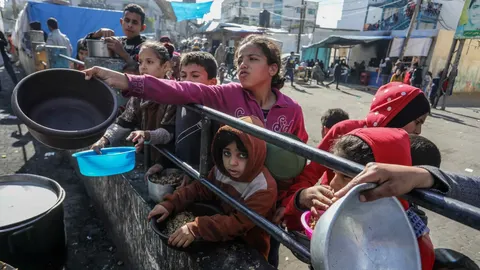
Gaza’s mass killing and destruction are breaking political loyalties far beyond Palestine, turning anger at Israel’s actions — and the governments supporting it — into electoral punishment. A UN commission of inquiry concluded in September 2025 that Israel had committed genocide in Gaza, a finding Israel rejects.
That pressure reached Labour’s conference in Liverpool on Monday, when foreign secretary Ed Miliband acknowledged the campaigners who had challenged the party’s position.
“I want to say to the millions of people in this country and indeed elsewhere who have been moved and outraged by the plight of the Palestinian people: we hear you, you were right.”
Describing Palestinian suffering as “a stain on the conscience of the world”, Miliband promised to ban imports from illegal Israeli settlements and disrupt the British finance, construction and services sustaining them.
The commitments go beyond restrictions on settlement goods, targeting the commercial infrastructure supporting the occupation. But they remain narrower than the comprehensive sanctions and two-way arms embargo demanded by campaigners.
Miliband condemned “ethnic cleansing by the settler terrorists” and referred to “evidence of war crimes in Gaza”. He did not describe Israel’s actions as genocide in the speech.
That caution contrasts with the language already used within Labour. In June 2025, Louise Haigh told MPs: “It is impossible to conclude that this is anything less than a genocide,” and demanded immediate sanctions.
Public opinion also underlines the pressure. A July survey of 2,125 British adults found that 50% believed Israel was committing genocide, against 17% who disagreed. Among those who voted Labour in 2024, the figure was 67%.
Aimee Shalan, the incoming director of the Palestine Solidarity Campaign, says Palestine has become a domestic electoral force.
“We’re seeing for the first time in British history Palestine become a domestic issue, electorally, at the national level and at the local level,” she said.
The evidence was visible even amid Labour’s 2024 landslide. Four pro-Palestinian independents defeated Labour candidates in Leicester South, Blackburn, Birmingham Perry Barr and Dewsbury and Batley.
“This is for the people of Gaza,” declared Shockat Adam after unseating senior Labour figure Jonathan Ashworth in Leicester.
In February 2026, Green candidate Hannah Spencer won Gorton and Denton, pushing Labour into third place after a campaign in which Gaza featured prominently. In May, pro-Gaza independents were among those making gains as Labour lost control of Birmingham council.
Shalan welcomed the settlement sanctions announcement but said it fell short of the movement’s demands for an end to British material support for Israel’s military operations.
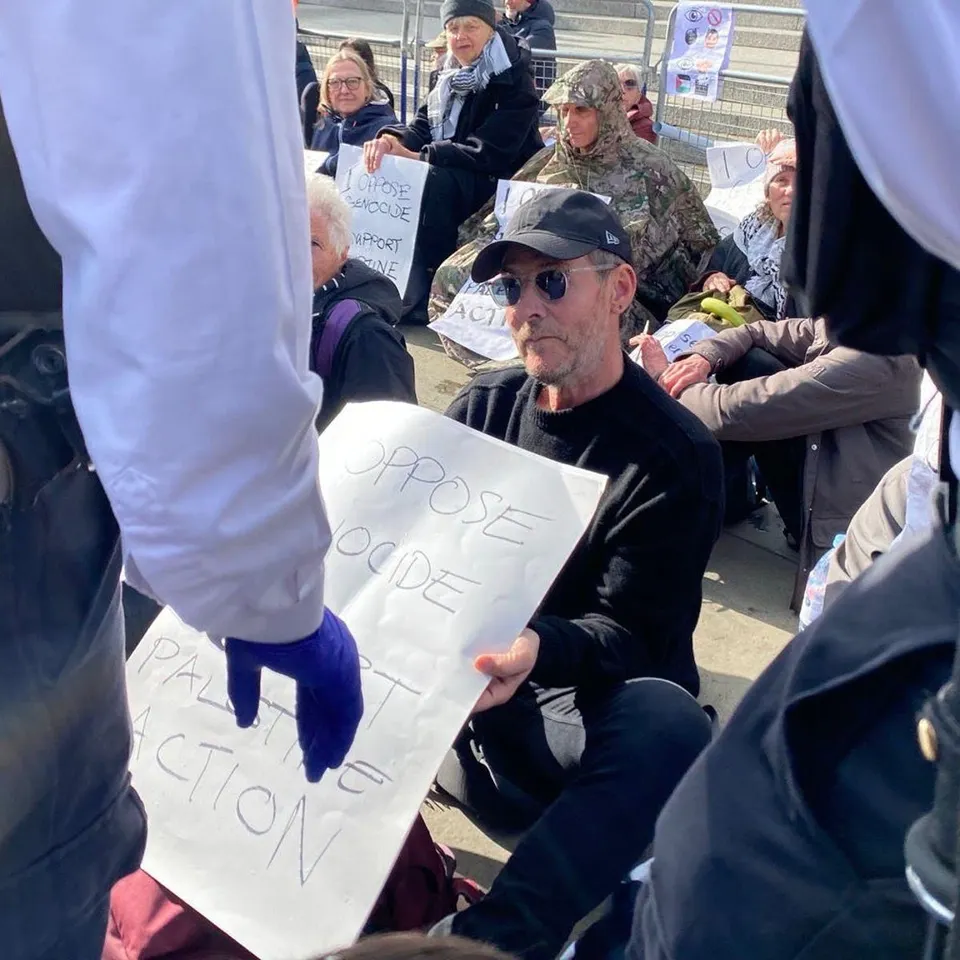
Outside the conference, arrests offered a stark counterpoint to Miliband’s acknowledgement.
Massive Attack vocalist Robert Del Naja, also known as 3D, was arrested in Liverpool on Saturday 26 September after displaying a sign reading: “I oppose genocide. I support Palestine Action.”
“I don’t recognise the offence,” he told officers in footage of his arrest. Police confirmed that a 61-year-old Bristol man had been arrested on suspicion of a terrorism offence after displaying material supporting the proscribed group.
Another 82 people were arrested during Sunday’s demonstration, with 79 reported for summons. Those detained included 94-year-old Jewish human rights barrister Margaret Owen. Palestine Action remains banned under counter-terrorism law; the Court of Appeal upheld its proscription in June.
Protesters also confronted Miliband in a Liverpool restaurant over the arrests. “They’re being arrested for holding pieces of paper, Ed. Do you understand?” one asked.
Del Naja has long been the subject of speculation that he is Banksy. However, an investigation published in March identified Banksy as Robin Gunningham and described Del Naja as a collaborator. His connection to the Walled Off Hotel, Banksy’s project beside Israel’s separation wall in Bethlehem, is documented: he contributed music to its mechanical piano programme when it opened in 2017.
Britain’s electoral backlash has parallels abroad.
In the United States, more than 100,000 Michigan voters chose “uncommitted” in the 2024 Democratic presidential primary amid a campaign against Joe Biden’s support for Israel. Dearborn, which had overwhelmingly backed Biden in 2020, subsequently voted for Donald Trump. Reporting from the city documented anger over Gaza as a central reason for abandoning the Democrats.
In France, La France Insoumise put Palestine at the centre of its 2024 European election campaign and strengthened its support in working-class suburbs. In La Courneuve, its vote rose from 16% in 2019 to more than 58%. But turnout gains were modest, and analysts cautioned against treating Gaza as the sole explanation.
These shifts show electoral consequences without establishing that Gaza alone decided national elections. Living costs, public services and opposition to the far right also influence voters.
For Shalan, the movement’s durability lies in its reach beyond demonstrations. PSC says its membership has more than doubled since early 2023 to nearly 17,000, with local branches organising in workplaces, universities and communities.
“People can’t unsee what they’ve seen,” she said. “People are finding ways to be mobilised in different spheres. And support for Palestinian freedom and justice will only continue to grow.”
Sources and attributions
Aamna Mohdin, The Guardian, 28 September 2026, interview with Aimee Shalan.
UN Independent International Commission of Inquiry, 16 September 2025, genocide findings; Reuters explanation and Israel’s response.
Reuters, 5 July 2024, pro-Gaza candidates and Labour’s election result; Sky News, constituency results.
The National, 27 February 2026, Gorton and Denton; The Guardian, 8 May 2026, Birmingham council.
NME, 27 September 2026, Del Naja’s arrest; Merseyside Police statements on Saturday’s arrest and Sunday’s protest.
Reuters, 13 March 2026, Banksy investigation; Pitchfork, 8 March 2017, Del Naja and the Walled Off Hotel.
Associated Press, Michigan’s “uncommitted” vote, 28 February 2024, and Dearborn’s presidential result, 11 November 2024.
Le Monde, 18 June 2024, LFI’s electoral strategy and its limits.
Ed Miliband, Labour conference speech, 28 September 2026, corroborating the speech extracts in the video transcript.
YouGov poll commissioned by the Council for Arab-British Understanding, fieldwork 2–3 July 2026, published 7 July. Weighted online sample of 2,125 adults representative of Great Britain.
Hansard, House of Commons, 4 June 2025: Louise Haigh’s genocide statement and call for sanctions.
Novara Media, 28 September 2026, on Margaret Owen’s arrest; Morning Star, 27 September 2026, confirming her age and profession. Arrest totals use Merseyside Police’s subsequent update.
An additional video transcript for the restaurant confrontation quotation; The Guardian, 28 September 2026, corroborating the confrontation with Miliband.