History Did Not Begin on 7 October: The Reports That Documented Palestinian Childhood Trauma Decades Earlier
Long before Hamas governed Gaza, researchers and humanitarian agencies were recording the consequences of Israeli bombardment, home demolitions, shootings and restrictions on daily life. Their findings give substance to Gabor Maté’s insistence that anyone trying to understand Palestinian suffering must examine the history before 7 October 2023.
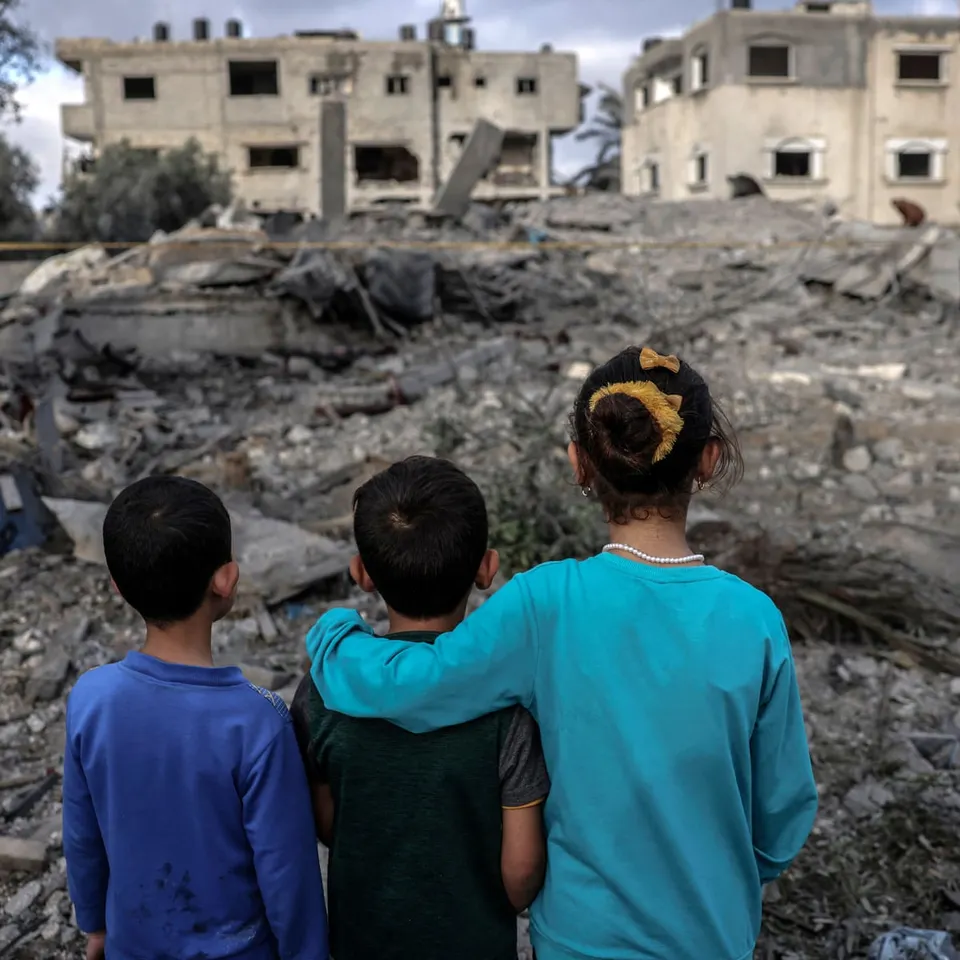
The children were having nightmares, wetting their beds, becoming frightened and struggling to concentrate. Some had lost their homes; others had watched people being injured or killed. Their parents were trying to raise them amid military incursions, restrictions on movement and the fear that familiar places could suddenly become dangerous.
These experiences were being documented in Palestinian communities two decades before the attacks of 7 October 2023 and Israel’s subsequent assault on Gaza. Some of the research reaches back to children interviewed after Israeli forces demolished their homes in 1993. miftah.org
For the physician and author Gabor Maté, that chronology is essential to understanding the psychological injuries inflicted on Palestinians.
“History did not begin on October the seventh,” he said in a January 2025 interview. His argument directs attention to what Israel had already been doing to Palestinian communities, and to research that recorded the consequences for children long before Hamas governed Gaza. PBS
Examining the studies behind his argument reveals a substantial documentary record: psychiatric research, parents’ accounts, assessments of demolished neighbourhoods and reports from the institutions responsible for educating and caring for Palestinian children.
Together, these documents establish something that an account beginning in October 2023 cannot explain: a substantial burden of childhood distress had already been recorded in connection with violence and restrictions that Palestinians experienced under Israeli occupation. The damage was recognised while it was happening, and warnings about its consequences were already reaching international institutions.
What the 2004 study actually found
In other remarks, Maté urges anyone who treats 7 October as the beginning of history to examine a 2004 study. The strongest match is a Gaza Community Mental Health Programme study by Samir Qouta and Eyad El Sarraj, surveying 944 participants aged 10 to 19.
On a scale measuring traumatic stress reactions, 15.6 per cent fell into the mild category, 49.2 per cent into the moderate category and 32.7 per cent into the severe category. The remaining 2.5 per cent were classified as having no or doubtful symptoms. Together, 97.5 per cent scored at least in the mild category.
This was a school survey of symptoms, and the authors restricted generalisation to children facing acute danger and military destruction. The findings do not establish that 97.5 per cent of all Palestinian children had a clinical diagnosis of post-traumatic stress disorder, or PTSD. Posttraumatic Stress Disorder
A review published in 2006 reproduced the same breakdown while examining the mental health consequences of war. It brought the Gaza findings into a wider discussion of civilian suffering across conflict settings. The review was repeating earlier evidence, rather than reporting a new survey of another group of children.
That publication history may explain the different years in Maté’s accounts. In January 2025, he referred to research published in 2006 reporting approximately the same proportion. He did not identify the review by title. pmc.ncbi.nlm.nih.gov
The 2004 paper preceded Hamas’s victory in the January 2006 Palestinian legislative election and its armed takeover of Gaza in 2007. It predates Hamas’s government in Gaza, although the organisation already existed. Israel’s blockade following the 2007 takeover belongs to a later stage of this history. Question of Palestine
Warnings that had already reached the world’s health authorities
An UNRWA health report submitted to the World Health Assembly in May 2004 described an April 2003 Gaza survey in which about one third of children required psychological intervention and almost half had moderate traumatic stress symptoms.
It also summarised separate March 2003 research on children under five. Parents reported aggression, poor concentration, bedwetting, nightmares and disturbances in eating and hygiene. A July 2003 study found that 90 per cent of participating parents reported similar symptoms.
These findings place the warnings before the 2004 publication, although the exact fieldwork dates of the 944-person study remain unverified. They also extend the record to children far too young to play any meaningful role in the confrontation. apps.who.int
An additional survey of Palestinian living conditions, published in October 2003, recorded parents’ observations of their children under 18. Some 46 per cent reported aggressive behaviour, 39 per cent nightmares, 27 per cent bedwetting and 38 per cent poor school results.
These were reports from parents, rather than clinical diagnoses, and the figures should be read that way. They describe the intrusion of the conflict into ordinary family life: sleep, behaviour, learning and relationships were all affected. They also provide a separate documentary basis for several of the symptoms Maté names when discussing the earlier Gaza research. miftah.org
The home demolitions that preceded the statistics
After Israeli forces demolished homes in Gaza’s El Ammal area on 10 February 1993, researchers interviewed affected families within ten days, sometimes in tents or among the ruins. They compared 38 children who had lost their homes, 36 who had witnessed demolitions and 50 in a comparison group.
Parents reported night terrors among 60.5 per cent of the children whose homes had been destroyed, compared with 4 per cent in the comparison group. Reported bedwetting affected 31.6 per cent of the first group and 12 per cent of the comparison group.
This small study measured immediate responses to a specific operation. Its findings placed the psychological aftermath of home demolition on the research record three decades before October 2023. hlrn.org
The question returned in research published in 2002. Investigators compared 91 children exposed to bombardment and home demolition with 89 children elsewhere in Gaza who had experienced other forms of political violence.
Traumatic stress reactions of clinical importance were recorded in 59 per cent of the first group and 25 per cent of the second. Children directly affected by bombardment and demolition also reported greater fear.
The comparison group was itself living in conditions of conflict. Some children who experienced events through adults and the media showed substantial anticipatory anxiety, a reminder that fear could spread beyond the immediate location of an attack.
The study therefore examined both direct exposure and the wider environment in which children learned that violence might reach them. Its findings linked the destruction of homes with elevated distress while recognising that children could also suffer without having their own houses hit. pubmed.ncbi.nlm.nih.gov
A separate study published in 2003 examined 121 children aged six to 16 living in an area exposed to bombardment. It recorded severe traumatic stress symptoms in 54 per cent and moderate symptoms in a further 33.5 per cent.
The researchers also found important relationships between children’s symptoms and their mothers’ psychological condition. Their analysis concerned the ability of a family to protect a child when both generations were exposed to danger. A parent struggling with fear, bereavement or the loss of a home had to provide reassurance while experiencing insecurity themselves. pubmed.ncbi.nlm.nih.gov
Rafah’s destruction was already a humanitarian emergency
The psychological warnings were followed by further destruction. In May 2004, Israeli military incursions in Rafah left 298 buildings demolished or uninhabitable and almost 3,800 people homeless, according to the joint humanitarian assessment prepared the following month.
The assessment recorded 1,497 buildings destroyed in Rafah since September 2000 and 15,009 people made homeless. More than four fifths of those displaced were already refugees.
Families were sheltering in crowded accommodation, schools, shops and other improvised spaces. The assessment warned that alternatives were becoming exhausted, while further destruction continued to create new needs.
These May 2004 events should not be treated as the specific exposures measured in earlier surveys. They demonstrate how the conditions producing distress continued after the warnings had been issued. The task facing aid workers was repeatedly enlarged by new displacement. ochaopt.org
An investigation later that year examined the demolition campaign through interviews, visits to affected areas and analysis of photographs and satellite imagery. Israeli military officials described demolitions as necessary to confront weapons smuggling tunnels and protect troops near the border.
Human Rights Watch concluded that those explanations did not justify the scale and pattern of destruction it documented, finding that many demolitions had occurred without military necessity.
The same investigation recorded the experiences of families living with gunfire and the threat of losing their homes. Psychiatrist Eyad Zaqout described the damage in terms that connected the buildings to the children inside them: “Destruction of the home means loss of trust, rendering children insecure.” hrw.org
Children were being shot at their school desks
On 7 September 2004, Raghda Adnan al-Assar was shot in the head at her desk in an UNRWA school in Khan Younis. She died on 22 September without regaining consciousness.
Ghadeer Jaber Mokheimer was shot in the stomach in her classroom on 12 October and died the next morning. UNRWA attributed the firing to an Israeli military position.
The agency also reported that Hoda Darwish had been blinded by a shot to the head in her classroom in March 2003, attributing it to an Israeli observation post.
“Schools should be havens of peace,” said UNRWA commissioner-general Peter Hansen. The agency warned that parents feared for children both travelling to school and inside classrooms. Question of Palestine
UNRWA also said Israeli authorities had responded to its complaints by denying that firing had occurred or citing security requirements. For families, the incidents undermined the reassurance a school was supposed to offer. Question of Palestine
A childhood interrupted beyond the moments of violence
Daily restrictions damaged the routines through which children might otherwise have found stability. Across 95 UNRWA schools in the West Bank, serving about 60,000 pupils, an aggregate 1,475 school-days were lost during the 2002–2003 academic year. An average of 145 teachers each day could not reach their schools.
The disruption accompanied a sharp decline in educational results. Between 2000–2001 and 2003–2004, the proportion passing grade-six mathematics in those schools fell from 68.7 per cent to 33.6 per cent. These were children trying to learn amid checkpoints, detours, closures and military activity. Question of Palestine
By September 2004, another assessment reported that almost 200,000 Palestinian children had lost school days during the preceding year because of curfews and closures. Around 300 schools had been damaged over years of conflict, while 580 had been forced to close periodically during the previous year.
Home learning materials and remedial classes helped children continue their education, but the need for them illustrated the scale of disruption to ordinary teaching. A child’s deteriorating school performance could reflect both psychological distress and the practical loss of access to lessons. Question of Palestine
UNRWA also recorded 2,416 working days lost by its West Bank health staff in 2003 because of movement restrictions, and falling vaccination coverage in some localities. apps.who.int
The pressure on families was also economic. An assessment completed in October 2004 estimated that 47 per cent of Palestinians lived below the official poverty threshold of US$2.10 a person per day. Average incomes had fallen by more than a third since the start of the second intifada.
At the peak of the 2002 curfews, almost 900,000 West Bank residents in 74 communities were affected. Restrictions impeded work, trade and everyday social contact, while families’ reserves and informal support arrangements were stretched.
Israel argued that movement restrictions protected its citizens and settlers. The economic assessment identified the closure system as the immediate driver of the crisis. For parents, the consequences included dwindling resources with which to feed, educate and reassure their children. documents1.worldbank.org
Treatment while the danger continues
The early research also examined whether children’s symptoms could improve when their circumstances changed.
In an account published in 2003, child psychiatrist Panos Vostanis described a follow-up of 234 children after a period of reduced conflict. The proportion showing the measured traumatic stress reactions fell from 41 per cent to 10 per cent over a year.
The finding offered grounds for hope: improvement was possible, and exposure to violence did not condemn every affected child to permanent psychiatric illness.
Vostanis also described preliminary findings from interventions during renewed conflict. Group support and school-based psychological education had not produced the hoped-for improvement in symptoms, despite children’s satisfaction with individual treatment. He emphasised the limits of clinical work when safety and basic needs remained insecure. PMC
Mental health professionals in Gaza were making a corresponding argument about services. In November 2004, Abdel Hamid Afana, Qouta and El Sarraj called for care to be integrated into communities and primary health services, with better training and earlier recognition of distress.
Their proposals also addressed the political environment sustaining the harm. Treatment, in their analysis, had to accompany changes to the conditions in which people were living. Counselling could provide support, but the effort to protect children required attention to the violence and deprivation affecting their families. Humanitarian Practice Network
That argument gives practical meaning to the concern about continuing trauma. Recovery depends in part on whether the danger has actually diminished. Children facing repeated threats may have little opportunity to regain a sense of security before the next event occurs.
What the figures can and cannot tell us
A systematic review published in 2021 brought together 28 studies representing more than 15,000 Palestinian children and adolescents. It estimated a pooled PTSD prevalence of 36 per cent, with individual studies ranging from 6 to 70 per cent.
The authors warned that differences in sampling, assessment methods and the timing of exposure made the studies highly variable. Those estimates concern thresholds for PTSD and should not be equated with the much broader proportion reporting mild or greater symptoms in the 2004 survey.
There is no single percentage that can describe every Palestinian child, in every location, across decades. The consistent concern across the research is substantial distress in populations exposed to political violence, together with the need to understand the circumstances and methods behind each figure. journals.plos.org
The children’s lives also contained aspirations and resources that symptom counts cannot describe. A contemporary survey of approximately 4,300 Palestinians aged 10 to 24 found that education was the leading concern for 58.9 per cent, while 91 per cent expressed optimism about the future. Question of Palestine
Those responses matter alongside the accounts of suffering. Recognising trauma should preserve the individuality and agency of the people concerned, including their ambitions, relationships and efforts to continue learning.
The biological question Maté raises
Maté also points to research involving Syrian children when discussing the lasting effects of war.
One relevant study, published online in November 2024, examined 1,507 Syrian refugee children and adolescents aged six to 19 living in settlements in Lebanon. It found associations between exposure to war and differences in DNA methylation, chemical markings involved in the regulation of genes.
The finding concerns an epigenetic association. The study did not show that war changed the underlying DNA sequence, establish that the changes would be passed to descendants or prove that particular illnesses would follow.
It nevertheless adds a biological dimension to the investigation of childhood adversity. The psychological, social and physical consequences of violence can be studied together, while claims about inheritance or inevitable lifelong damage require evidence beyond this particular research. JAMA Network
Maté’s own comparison is also personal. A Jewish survivor of Nazi persecution in infancy, he describes having wet his bed until he was 13, an experience he connects to his early trauma. He uses that memory to insist that the suffering of Palestinian children should be recognised with the same seriousness accorded to other children exposed to overwhelming threat.
The history that disappears when the clock starts in 2023
For Maté, the question extends beyond whether Palestinian suffering has been measured to whether that suffering is acknowledged.
“Not only is Palestinian trauma denied, even Palestinian existence is denied,” he says in the remarks calling attention to the 2004 study. He argues that such denial adds to the injury experienced by people whose lives and losses are being dismissed.
The reports examined here establish the earlier experiences themselves. They document children whose homes were demolished, families displaced repeatedly, pupils harmed in classrooms and communities whose access to work, education and care was restricted. The research on psychological distress belongs within that material history.
In his January 2025 interview, Maté acknowledged the trauma caused by the October attacks and argued against limiting concern to a single population. We cannot, he said, “restrict our empathy to one side.” PBS
The studies cannot explain the motives or actions of particular people who participated in the October 2023 attacks. They establish an earlier history of harm, documented while those children were still growing up and while changes to their circumstances might alter their futures.
Raghda and Ghadeer were already dead in 2004, and Hoda had already been blinded. Their families were living with those losses nineteen years before the attacks of October 2023. Question of Palestine
Maté’s challenge is to read the records with those children in view. Their experiences belong in any account of the conflict that seeks to explain what happened to Palestinian families, how Israeli actions affected their lives, and why the history of their suffering cannot begin on 7 October.
Sources and attributions
Prevalence of PTSD among Palestinian children in Gaza Strip. Samir Qouta and Eyad El Sarraj, Arabpsynet Journal, issue 2, April–June 2004. See Table 2. The publisher’s PDF was unavailable when checked.
Mental health consequences of war: a brief review of research findings. R. Srinivasa Murthy and Rashmi Lakshminarayana, World Psychiatry, February 2006, 5(1):25–30. The Palestine section reproduces the symptom breakdown. Its reference 41 points to El Sarraj and Qouta’s 2005 chapter, “The Palestinian Experience”; it is not an independent replication of the 944-person study.
Report of the Director of Health, UNRWA, for 2003. Transmitted by WHO, 3 May 2004, A57/INF.DOC./1; particularly paragraph 7.
Palestinian Public Perceptions on Their Living Conditions, Report VI. IUED, Graduate Institute of Development Studies, Geneva, October 2003. Section 8.2.3 records parental observations of children’s symptoms. Alternative PDF copy.
House Demolition and Mental Health: Victims and Witnesses. Qouta, Punamäki and El Sarraj, Journal of Social Distress and the Homeless, 1998, 7(4):279–288. See Table II.
Emotional problems in Palestinian children living in a war zone: a cross-sectional study. Abdel Aziz Thabet, Yehia Abed and Panos Vostanis, The Lancet, 25 May 2002, 359:1801–1804.
Prevalence and determinants of PTSD among Palestinian children exposed to military violence. Samir Qouta, Raija-Leena Punamäki and Eyad El Sarraj, European Child & Adolescent Psychiatry, December 2003, 12:265–272. Study of 121 children and relationships with maternal symptoms.
Rafah Humanitarian Needs Assessment. UNRWA and OCHA, 6 June 2004. Provisional estimates of buildings destroyed or rendered uninhabitable, displaced families and unmet needs. Buildings, households and displaced people are separate measures.
Razing Rafah: Mass Home Demolitions in the Gaza Strip. Human Rights Watch, 17 October 2004. Original investigation, Israeli military explanations, the organisation’s findings and Eyad Zaqout’s account. Legal assessments are attributed to the organisation.
Child Shot in UNRWA School Dies. UNRWA, 13 October 2004. Related statement, 27 September 2004.
International Children’s Day: Fact Sheet. OCHA, 1 June 2004. School access, examination results and findings from the PCBS/UNICEF/UNFPA youth survey.
More than 1 million Palestinian children return to school. UNICEF, 6 September 2004. Interrupted schooling, damaged schools and measures supporting children’s education.
Four Years: Intifada, Closures and Palestinian Economic Crisis. World Bank, October 2004. Economic conditions, poverty, curfews and restrictions on movement, particularly the executive summary and chapters 1 and 3.
Impact of trauma on Palestinian children’s mental health: lessons from the Gaza studies. Panos Vostanis, International Psychiatry, October 2003, 1(2):5–6. Follow-up findings, preliminary intervention results and the relationship between treatment and children’s circumstances.
Mental health needs in Palestine. Abdel Hamid Afana, Samir Qouta and Eyad El Sarraj, Humanitarian Practice Network, 18 November 2004. Contemporary proposals for community care and changes to the conditions affecting mental health.
The Question of Palestine: Timeline of Events. United Nations. Supports the distinction between the 2006 legislative election and Hamas’s 2007 takeover of Gaza.
Prevalence of post-traumatic stress disorder among Palestinian children and adolescents exposed to political violence: A systematic review and meta-analysis. Nisreen Agbaria and colleagues, PLOS ONE, 26 August 2021. Pooled estimates and limitations associated with differing study designs.
War Exposure and DNA Methylation in Syrian Refugee Children and Adolescents. Demelza Smeeth and colleagues, JAMA Psychiatry, published online 20 November 2024; print edition February 2025, 82(2):191–200. Free accepted manuscript. Relevant to Maté’s biological argument; the exact Syrian paper intended in the supplied recording has not been conclusively established.
Gabor Maté’s interview with Michel Martin. Amanpour & Company, PBS, 28 January 2025. Source of the opening quotation, the reference to a 2006 publication and the appeal for empathy. His call to examine the 2004 study, his childhood account and his quotation about denial come from the transcript supplied for this article; that recording’s original source and date have not been independently identified.