‘Opposing Genocide Is Not a Crime’: Tony Greenstein Hails Terrorism Acquittal and Condemns Britain’s Gaza Crackdown
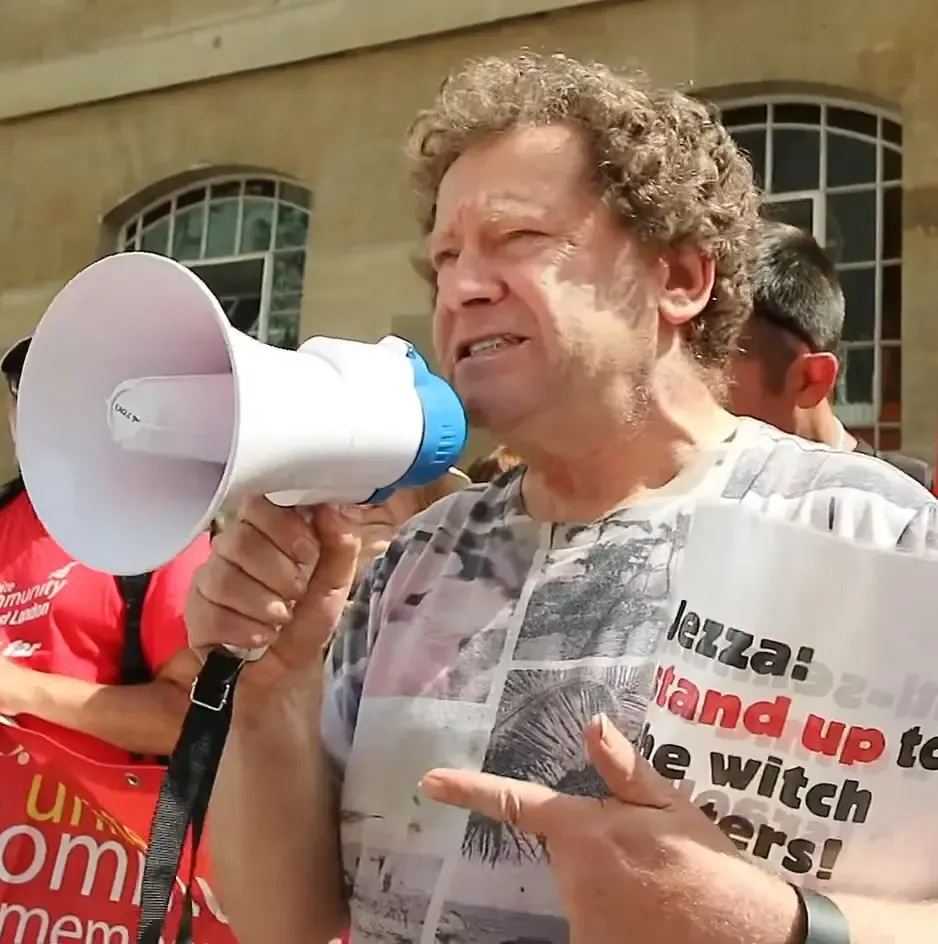
After a jury cleared the Jewish socialist activist of inviting support for Hamas, Greenstein used a speech outside Kingston Crown Court and a subsequent interview on The Katie Halper Show to attack the Terrorism Act, defend Palestinian resistance, and accuse Israel and its Western allies of weaponising Holocaust memory.
A unanimous jury verdict at Kingston Crown Court has given Tony Greenstein an emphatic answer to a prosecution that threatened to imprison him for up to 14 years over three social media posts published on 7 October 2023.
The writer and veteran Palestine campaigner, aged 72, was cleared on 21 August of inviting support for Hamas, a proscribed organisation, after jurors deliberated for just over two hours.
The legal question was narrow: whether Greenstein’s words amounted to an invitation to support the organisation. The political argument that followed was anything but narrow.
Outside court, and later during an appearance on The Katie Halper Show, Greenstein presented the acquittal as a defeat for what he regards as the use of terrorism legislation to criminalise opposition to Israel’s assault on Gaza. He also returned to the most contentious theme of his public writing: his comparison of Zionist ideology and Israeli conduct with European racial nationalism and Nazism.
The jury did not rule on the truth of Greenstein’s historical claims, on the legality of Israel’s conduct in Gaza, or on whether Hamas should remain proscribed. It decided the charge before it and found him not guilty.
That distinction is essential, but it does not diminish the political force Greenstein drew from the verdict.
A verdict Greenstein called a victory against political prosecution
Greenstein opened his speech outside court by accusing the British government of reversing the proper relationship between crime and accountability.
Ministers, he argued, continued to support Israel while campaigners, protesters, and direct action defendants were pursued under terrorism legislation.
“We have a government which pursues support for genocide at the very same time as it prosecutes those who are opposed to genocide.
“Whether it’s Palestine Action, the Filton 25, and myself, these prosecutions for terrorism of people who are not terrorists are increasingly being seen through by juries.”
His description of Israel’s actions as genocide was his own political and legal characterisation, one used by many Palestinian organisations, international lawyers, genocide scholars, and human rights campaigners, but rejected by Israel.
The criminal trial did not determine that wider dispute. Greenstein nevertheless placed it at the centre of his response, insisting that the prosecution had tried to turn antiwar speech into evidence of terrorism.
“The judge was not happy. If it had been a judge only trial, as David Lammy would have liked, then I would have been convicted without a doubt.
“But a jury of 12 men and women decided that I was not a terrorist and that terrorism is not opposition to genocide in Gaza.”
That formulation went beyond the precise terms of the verdict, but it captured the meaning Greenstein attached to it.
In court, the prosecution had alleged that his posts inviting readers to share material about a “Gaza ghetto uprising”, together with a linked blog that praised the planning and audacity of the Hamas led attack, amounted to an invitation to support Hamas.
Greenstein’s defence was that praising or supporting a particular act by a group was not the same as supporting the organisation itself, still less inviting others to do so.
In his closing address, Greenstein put the distinction directly to jurors:
“The charge is not holding an opinion. The charge is inviting other people to support an organisation, Hamas.
“Those are two different things, and every single question in this trial lives in the distance between them.”
He also told the jury that the phrase “please share” meant read and circulate his article, not join or support Hamas.
“Why should I invite people to support a group that I don’t support and never have supported? It is illogical.
“I would probably support the devil against the Israeli army. That doesn’t mean I support the devil itself.”
‘Opposing genocide is not a crime’
Greenstein connected his own acquittal to the position of other defendants facing prosecutions linked to Palestine solidarity and direct action.
Referring to the Filton defendants, whose cases arise from an action at an Elbit Systems facility, he urged supporters not to treat his verdict as an isolated personal reprieve.
“We have to take heart from this because there are many other people who are still on trial, the Filton 25.
“And we have to defend each and every one of them because opposing genocide is not a crime. Supplying arms to Israel to perpetrate a genocide is a crime, and that is the nature of our judicial system. They prosecute the wrong people.”
He then named senior Labour figures, demanding that Foreign Secretary David Lammy, Prime Minister Keir Starmer, former Home Secretary Yvette Cooper, and others be imprisoned for what he alleged was their part in enabling Israel’s campaign.
No such finding has been made against those politicians, and Greenstein’s demand was political rhetoric rather than a statement of existing criminal liability.
“I want to see David Lammy, Keir Starmer, Yvette Cooper, and the rest of them inside for having helped Israel perpetrate a genocide.”
An attack on the Terrorism Act itself
The second part of Greenstein’s courthouse speech moved from his prosecution to the architecture of the Terrorism Act 2000.
Hamas remains proscribed in the United Kingdom, and Section 12 makes it an offence to invite support for a proscribed organisation.
Greenstein argued that the breadth of terrorism law allows the state to apply the label to movements of resistance according to political convenience.
“The Terrorism Act is not about terrorism. The Terrorism Act is about terrorising people in this country.
“Throughout the trial, I’ve said Hamas was not a terrorist organisation. It was a resistance organisation.
“It doesn’t therefore mean I supported it politically, because I made it clear to the jury that I didn’t.”
His rejection of the terrorist designation plainly conflicts with British law and with the position of the government.
His central legal defence, however, did not require the jury to agree with him on proscription. It required jurors to decide whether the Crown had proved that his own words invited support for Hamas.
They concluded that it had not.
“Under the Terrorism Act, the so called definition of terrorism would have made the French partisans and the Warsaw Ghetto resistance also into terrorists if the government had so desired.
“It’s an act of repression. It’s an act used against Muslims, of course, in this country.
“Those who introduced the Act, Jack Straw and Tony Blair, were the very ones who were responsible for terrorism. So they created the very thing they then said they were going to try and deal with.
“The Terrorism Act has to go.”
From the courthouse to The Katie Halper Show
The video of Greenstein’s speech travelled far beyond the crowd at Kingston Crown Court.
Former England footballer and broadcaster Gary Lineker reshared a clip on Instagram, giving the remarks a national audience and triggering criticism focused especially on Greenstein’s statement that “Zionism is in the tradition of the Nazis who persecuted Jews”.
The acquittal itself received limited national coverage until the argument became a story about Lineker’s repost.
On The Katie Halper Show, in an episode titled Israel MELTS DOWN After Jewish Writer’s Nazi Comparison, host Katie Halper thanked Lineker for amplifying the speech and asked Greenstein to explain the comparison.
She also foregrounded the personal history from which he speaks: his father was an Orthodox rabbi, his family lost relatives in the Holocaust, and Greenstein describes his opposition to Zionism as a Jewish antifascist position rather than a rejection of Jewish identity.
‘My opposition to Zionism was because I was Jewish’
At Kingston Crown Court, Greenstein said he had placed that identity before the jury and presented it as the moral source of his politics.
“I stood here as a Jewish person and I made it clear to the jury that my opposition to Zionism was because I was Jewish, and that Zionism is in the tradition of the Nazis who persecuted Jews.”
In the later interview, he expanded the argument into a sweeping critique of racial nationalism.
His comparison is fiercely disputed and is treated by supporters of Israel and many Jewish organisations as an antisemitic inversion of Holocaust history.
Greenstein rejects that charge and argues that the comparison concerns ideology, state structure, and methods of dehumanisation, not an equation of every historical detail.
“It’s quite clear, and it should be to anyone today, that Zionism owes much of its ideology to Nazi ideology, and not just Nazi ideology, the whole ideology of racial nationalism that percolated through Europe in the 1930s and before: racial purity.”
He cited Israel’s religious personal status system and the absence of a general civil marriage procedure inside the country as evidence of enforced communal separation.
Israel recognises many marriages performed abroad, including interfaith marriages, but couples from different religious communities generally cannot obtain a civil marriage within Israel.
Greenstein placed that legal reality within a much broader accusation about racial separation and social intimidation.
“Marriage or sexual relations between Jews and non Jews in Israel is a very strong taboo. It’s called national treason.
“And you have gangs, fascist gangs, going around attacking Arab men who they think want to establish friendships or anything else with Jewish women.
“So that is the ideology of Zionism, the separation off, the creation, if you like, of the Hebrew Reich.”
Gaza, public opinion, and the language of extermination
Greenstein’s most severe claims concerned the conduct of the Gaza war and the political culture sustaining it.
He pointed to calls by Israeli officials and public figures to invoke Amalek, to starve Gaza, or to remove Palestinians from the territory.
He also referred to a 2025 survey associated with Penn State sociologist Tamir Sorek, although he compressed several different results into a single claim.
“Where would you start? In the Gaza war, extermination.
“Sixty per cent of Israelis, according to the Pennsylvania State University poll by Professor Sorek, support the extermination of every Palestinian in Gaza; the summoning to their memory of Amalek, the tribe that was wiped out; saying it would be quite moral to starve two million Palestinians, but unfortunately the world won’t let us.
“Well, the world has, unfortunately.”
The underlying March 2025 survey covered 1,005 Jewish Israeli internet users and examined what its author called “eliminatory attitudes”.
Widely reported results included 82 per cent support for expelling Palestinians from Gaza and 47 per cent agreement with a question invoking the biblical destruction of Jericho and the killing of all inhabitants.
Those findings are disturbing, but they are not identical to the single 60 per cent claim Greenstein made on air.
Sorek’s academic abstract also found that respondents who saw the Holocaust as a defining event were less likely to support eliminatory positions, a qualification absent from the programme discussion.
“Starving a population is a tactic that was used on the Jewish ghettos in Poland.
“Some Israelis are open. They say we have to learn from the Nazis. There have even been calls for gas chambers, ironically.
“Where do you start with the comparisons?”
Greenstein contrasted the secrecy surrounding much of the Nazi extermination programme with Israeli soldiers’ publication of material from Gaza on social media.
Historians would challenge any suggestion that ordinary Germans were untouched by antisemitism or that Nazi persecution was wholly hidden, but Greenstein’s purpose was to argue that contemporary dehumanisation has become unusually public and socially rewarded.
“Israeli soldiers post on TikTok videos and clips of their deeds, the burning of hospitals and the targeting of children and all the rest of it.
“One doesn’t excuse at all what the Nazis did, but the reality is that Israel has inherited, it says it’s inherited the memory of the Holocaust dead, but it’s inherited the memory of those who killed the Holocaust dead.
“That’s what we should bear in mind.”
Greenstein continued:
“It is a racial state which is out of control, and the West certainly supports it by pretending that Israel is a normal liberal democracy.
“That is the big lie at the heart of Western propaganda, that Israel is a normal state, when it’s anything but a normal state.”
The Holocaust comparison that may be condemned but is not illegal
Halper asked why comparisons between contemporary Israeli policy and Nazi policy are treated as beyond the boundary of legitimate speech, while Israeli leaders and supporters have repeatedly described Hamas as the new Nazis.
The International Holocaust Remembrance Alliance’s working definition lists, as a possible contemporary example of antisemitism, “drawing comparisons of contemporary Israeli policy to that of the Nazis”.
The definition is nonbinding and explicitly requires context. Making such a comparison is not, by itself, illegal in Britain.
“It is obvious to 99 per cent of the population that the Palestinian peasants and inhabitants of Gaza are the victims; that the people who wear the shiny boots, who have the tanks, who have the planes, are the new Nazis, not the victims of the IDF.
“But to our ruling class, of course, it’s important to perpetuate the myth that Israel represents the Holocaust dead.”
Greenstein then moved from Gaza to the history of Zionism during the Holocaust and to the treatment of Jews arriving in Israel from Arab countries.
He referred to humiliating pesticide spraying imposed on some immigrants, and he repeated disputed allegations about Zionist involvement in attacks intended to accelerate Jewish emigration from Arab states.
These claims occupy a deeply contested field of scholarship and political memory.
On the programme, they served his broader argument that state building was prioritised over the safety and dignity of Jewish communities outside Palestine.
“Their sole aim was building a Jewish state.
“If they regretted however many had been killed, it was because they’d lost the potential immigrants, and so they had to have Arab Jews, who weren’t really the same racial stock, you understand?
“So they had to be de Arabised.”
Marek Edelman and the Warsaw Ghetto argument
Halper also raised Marek Edelman, the Bundist and last surviving commander of the 1943 Warsaw Ghetto Uprising, whose political legacy Greenstein used in his defence.
Edelman remained critical of nationalism and, in 2002, addressed an open letter to Palestinian armed organisations as “commanders of the Palestinian military, paramilitary and guerrilla organisations”.
Greenstein argued that this history undermined attempts to present Jewish resistance to Nazism as a retrospective endorsement of Zionism.
“The last surviving commander of that uprising was a man named Marek Edelman.
“And in his old age, Edelman wrote to the Palestinian resistance and addressed them as fellow fighters, much to Israel’s annoyance.
“It was Edelman who described Gaza as a ghetto. I used his comparison for years before October 2023.”
For Greenstein, the reference was not ornamental.
It supported the very distinction on which his defence rested: solidarity with the resistance of an oppressed population did not require political support for the organisation leading a particular action.
He told the jury that the same capacious statutory concept of terrorism could have been turned against the Warsaw Ghetto fighters or the French Resistance if a government had chosen to proscribe them.
A Jewish argument conducted against Jewish institutions
The conversation ended by considering the widening distance between established Jewish organisations that identify closely with Israel and younger or unaffiliated Jews who describe themselves as non Zionist or opposed to Zionism.
Greenstein claimed that 40 per cent of young American Jews now fall into those categories and that the proportion is higher in Britain.
Halper cautioned that institutional visibility can obscure the views of Jews who are not attached to synagogues or communal bodies.
That disagreement explains why Greenstein’s intervention provokes such sharply opposed responses.
His critics see the Nazi comparison as a desecration of Holocaust memory and a form of antisemitic discourse, even when voiced by a Jewish speaker.
Greenstein sees the refusal to compare as the desecration: a demand that Jewish suffering be isolated from universal antiracist conclusions and converted into ideological protection for a state.
“People are beginning to understand now that their claims of concern about antisemitism are false.
“Jewish people, 40 per cent of young Americans say they’re anti Zionist or non Zionist. It’s actually higher in Britain.
“You wouldn’t know that from the Jewish organisations.”
A narrow acquittal with a much wider political afterlife
The acquittal establishes one important fact: 12 jurors were not sure that Greenstein had invited support for Hamas and therefore returned a unanimous verdict of not guilty.
It does not grant legal immunity to every statement made in solidarity with Palestinians, nor does it settle the boundaries of Section 12 for future cases.
It does, however, expose the distance that can open between prosecutorial interpretation and the meaning ordinary readers place on political speech.
Greenstein has used that distance to launch a broader challenge to the British state, to the terrorism framework built under Tony Blair, to Labour’s support for Israel, and to the institutional policing of Holocaust analogy.
The result is deliberately confrontational.
It is also inseparable from the identity he placed before the jury: the son of a rabbi, the descendant of relatives murdered in the Holocaust, and a Jewish socialist who insists that the lesson of that catastrophe is resistance to racial states rather than allegiance to one.
“We have to take heart from this. Opposing genocide is not a crime.
“The Terrorism Act has to go.”
Sources
The Katie Halper Show: Israel MELTS DOWN After Jewish Writer’s Nazi Comparison
The Canary: Gallery applauds as Tony Greenstein is unanimously acquitted of inviting support for terrorism
Tony Greenstein: Supporting Palestine is no crime
NewsCord: The jury said not guilty. The papers reported Gary Lineker
Penn State: The Bible, the Holocaust, and eliminatory stands among Israelis: a survey analysis