Briton Pictured Beside Burning Gaza School Faces Call for War Crimes Inquiry
A Declassified UK investigation places a British soldier at a burning school in southern Gaza. A UN investigator says the evidence warrants a police inquiry, while footage supplied by the Israeli army in response was traced to a different school.
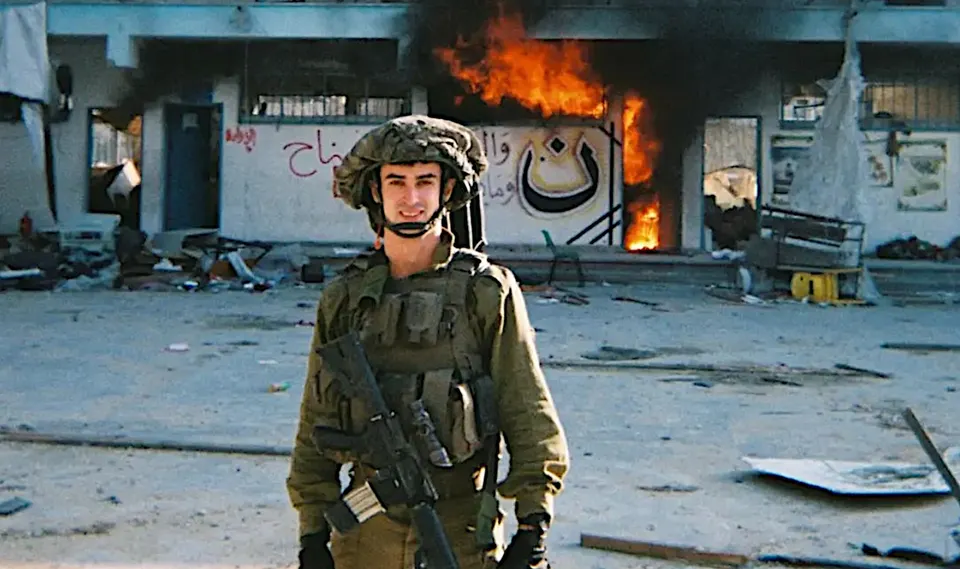
A British national photographed beside a burning school in Gaza should be investigated by the Metropolitan Police’s war crimes unit, a leading UN human rights investigator has said, following an investigation into his service in the Israeli military.
Jonathan Burman appears in photographs taken at Al-Farabi school in Bani Suheila, east of Khan Younis, where Palestinian civilians had sought shelter before Israeli troops moved into the area. The images form the centre of an investigation published by Declassified UK on 13 October, combining social media posts, satellite imagery, military records and witness testimony.
Chris Sidoti, a member of the UN Commission of Inquiry on the Occupied Palestinian Territory and Israel, said the material justified further investigation. He explicitly distinguished that assessment from a finding that Burman had committed a crime.
“We say that the evidence is sufficient to support further investigation and prosecution where warranted,” Sidoti told Declassified.
Asked whether the Metropolitan Police should examine the case, he replied: “In the case that you’ve described, yes.”
The investigation leaves critical questions unresolved: when exactly the photograph was taken, how the fire began, who ordered or carried out any destruction, and what Burman himself did. But it establishes a location and a line of inquiry that Sidoti says British investigators should pursue.
Burman did not respond to Declassified’s request for comment.
The investigation began with photographs posted to Burman’s private Instagram account and supplied to the journalists by a source. One showed him outside the burning school; others placed him amid extensive destruction in Gaza, including damaged residential buildings.
In another image, he wore a Manchester United scarf against a backdrop of rubble. Further posts appeared to show him serving in Lebanon and Syria.
Declassified traced his journey from schooling in the Manchester area to a gap year in Israel in 2018–19, followed by a move there and enlistment in the Israeli army. Its researchers believe he was called up as a reservist after the Hamas-led attacks of 7 October 2023.
The investigation linked him to the 55th Reserve Paratrooper Brigade. Analysis of Israeli military documents by the Hind Rajab Foundation, which pursues legal accountability for alleged Israeli war crimes, suggested that he served in B Company of its 66th Battalion.
Identifying the burning building required more than recognising a school façade.
Working with the civilian-harm monitoring organisation Airwars, the journalists compared Burman’s photographs with Reuters footage showing a devastated school. Distinctive Arabic lettering on the walls provided an initial match. The layout then helped narrow the search: a curved main building, resembling a U or C, alongside a separate building set at an angle.
Those features were compared with satellite imagery of Bani Suheila. Airwars identified the site as Al-Farabi school.
That finding placed the photographs within a wider account of civilian displacement. In the accompanying written investigation, Ayman Sahmoud described sheltering there with his family and seeing two people killed when the main gate was bombed. Randa Abu Assi said she and her son were wounded by shrapnel before fleeing. Their accounts describe events around the December assault; they do not identify Burman as responsible.
Contemporaneous Arabic reporting examined by Declassified also described Palestinians being detained and mistreated after Israeli troops entered the school in mid-December 2023.
The timing of Burman’s presence remains a separate question.
The journalists initially examined whether his photograph coincided with that raid. However, tracing the movements of the formation to which his company was attached suggested he may have been stationed at the school later, in January 2024. Satellite images examined in the documentary showed military vehicles around the site, consistent with its use as an Israeli military position.
That possible sequence matters. A fire during an assault and the deliberate burning of a building already under military control raise different factual questions. Investigators would need to establish the circumstances, any claimed military necessity and individual responsibility.
The photographs alone cannot settle those questions.
The Israeli military’s response introduced a further discrepancy. Asked to explain Burman’s photographs, its spokesperson referred Declassified to a statement dated 13 December 2023 about troops fighting an armed group inside a school in Khan Younis, accompanied by video footage.
Airwars checked the footage and identified a different school, approximately two kilometres from Al-Farabi.
The material therefore did not substantiate an explanation for the fire at the school in Burman’s photographs. Declassified reported that the army had not provided evidence explaining or justifying that blaze.
The documentary also examines the atmosphere within the battalion through the testimony of Yuval Green, a former medic who served in it. The written investigation makes clear that Green was in another company and did not recall meeting Burman.
His testimony concerns conduct and attitudes he witnessed during his own service. It does not establish what Burman did at Al-Farabi.
Green described a climate in which anger after 7 October became bound up with dehumanisation of Palestinians and, among some soldiers, ambitions to expel them from their land.
“People have been apathetic towards the suffering of Palestinians for so long,” he said. “They had no idea what was going on in Gaza.”
He said some soldiers were driven by extremist religious ideas and spoke openly about killing Palestinians, forcing them out and taking their land.
Shown the photograph outside the burning school, Green said it brought him back to one of the worst periods of his life.
“This destruction … it’s so difficult to see,” he said.
His own breaking point came when soldiers were instructed to burn houses they had occupied.
“Fifty days after we went into Gaza, they’re telling us to burn down the houses we were at,” Green recalled. “And I go to my commander and I ask him, ‘Why are we burning down those houses?’ And he has no good answer. Absolutely no good answer.”
He described the environment as one in which soldiers felt free to steal and destroy without consequences.
“But this war zone is a wild west. No rules, absolute apocalypse,” he said.
Green told his commander that he would leave if the houses were burned.
“I’m not willing to be a part of it. This is the last straw.”
The houses were burned, he said, and he left.
His condemnation of those actions was accompanied by a rejection of attacks on civilians on 7 October. Green described that day as a profound trauma and warned against confusing solidarity with Palestinians with support for violence.
The legal questions raised by the destruction extend beyond whether a building had previously been used by armed fighters. Under Article 147 of the Fourth Geneva Convention, extensive destruction of protected property, carried out unlawfully and wantonly without military necessity, constitutes a grave breach. Applying that standard requires evidence about the specific act and its circumstances.
British nationality also provides a potential route to domestic accountability. Section 51 of the International Criminal Court Act 2001 allows prosecution in England and Wales for genocide, crimes against humanity and war crimes committed abroad by UK nationals, subject to the applicable legal requirements.
The Crown Prosecution Service’s published guidance assigns investigation of such allegations to the Metropolitan Police’s specialist war crimes team. It sets out an initial assessment of matters including the suspect’s identity and location, access to witnesses and the feasibility of gathering evidence.
Sidoti said the techniques used in Declassified’s investigation resembled those employed by the UN commission itself.
“The methodology that Declassified UK has used is exactly the methodology that we use in conducting our own investigations,” he said.
He described soldiers’ social media posts as an important source of evidence, sometimes placing their authors at locations where serious crimes may have occurred.
“It’s almost confessional information and in many cases it is confessional,” he said of such material generally.
That observation was accompanied by his explicit qualification that neither the journalists nor the commission were declaring Burman guilty. His call was for the evidence to be examined through an investigation and, where justified, prosecution.
The commission concluded in September 2025 that Israel had committed genocide against Palestinians in Gaza. Israel rejected that finding. The commission’s assessment is distinct from a criminal court verdict against any individual.
The British dimension reaches beyond one photograph or one soldier.
Data obtained from the Israeli military and published by Declassified in February 2026 identified 2,069 personnel with British citizenship as of March 2025: 1,686 British-Israeli dual nationals and another 383 who also held a third nationality. Those figures concern service in the Israeli military; they do not establish that every individual served in Gaza or committed an offence.
In July, Declassified reported that the Metropolitan Police had agreed to conduct a fresh scoping exercise concerning four British nationals after previously declining to proceed with allegations submitted by human rights lawyers. A scoping exercise assesses whether an investigation is feasible; it is not a charge or a finding of guilt.
Burman’s social media, meanwhile, indicated that he had visited Britain as recently as May 2026.
For Sidoti, the prospect of a national returning to a country able to investigate makes accountability a practical question.
“There should be an investigation and prosecution where warranted,” he said.
At Al-Farabi, the evidence begins with a photograph of a British soldier beside a burning school. The next step would be to establish how it came to be burning, who was responsible and whether the destruction was criminal. Sidoti’s challenge to the British authorities is to pursue those questions.
Sources and reporting credits
The principal source is the supplied transcript of Declassified UK’s documentary and its accompanying investigation, “Revealed: The British man who fought for Israel in Gaza”, by Hamza Yusuf, Dania Akkad, Shaimaa Marwan and Phil Miller, published 13 October 2026. Interviews and requests for comment described above were conducted by Declassified UK.
Additional background: Declassified’s reporting on British nationals in the Israeli military; its report on the Metropolitan Police’s renewed scoping exercise; Fourth Geneva Convention, Article 147; International Criminal Court Act 2001; CPS war crimes referral guidelines; UN commission’s September 2025 genocide finding and Israel’s response.