‘These Crimes Are Ongoing’: NAZA Directors Defy Threats as Gaza Killing Systems Reach New York Screens
Yuval Abraham and Rachel Szor have brought Israeli military insiders’ accounts of mass civilian killing to an American audience, confronting citizenship threats, official denunciations and the responsibility of the country funding Israel’s armed forces.
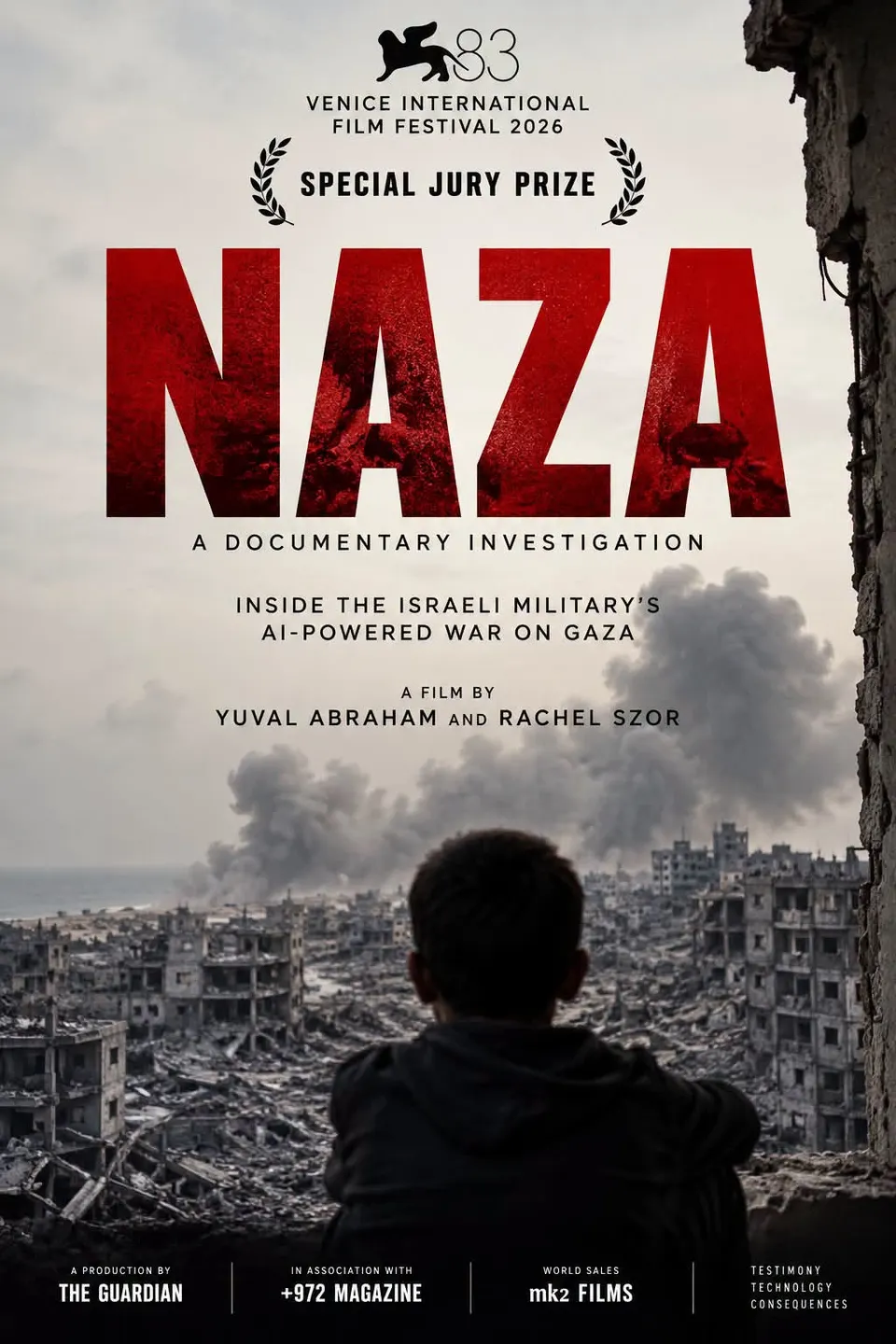
The Israeli film-makers behind NAZA arrived at their documentary’s New York premiere with a warning for the audience: the killing described by the soldiers on screen was continuing, and the United States was helping to pay for it.
“These crimes that you saw are ongoing,” Yuval Abraham told the New York film festival on Saturday, 26 September. “They’re ongoing because it’s what our country is doing, and because of what your country is supporting and funding.”
Beside him, co-director Rachel Szor described the secrecy surrounding the military systems their film examines. “Our country is doing so much to hide these systems,” she said. “It’s not a world that is open even to the Israeli public.”
Their appearance at Lincoln Center came amid threats from senior Israeli officials to revoke their citizenship and a campaign of intimidation that has reached their families. Prime Minister Benjamin Netanyahu has likened their documentary to a missile attack on Israel. The military rejects its allegations.
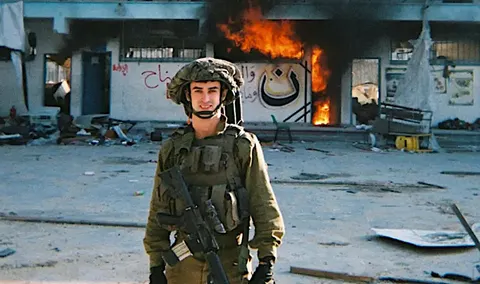
At the centre of the confrontation are the accounts of 24 Israeli soldiers and intelligence personnel involved in operations in Gaza. Their testimony describes the surveillance, calculations and decisions preceding airstrikes that killed Palestinian civilians, including families inside their homes.
NAZA takes its name from a Hebrew military abbreviation for collateral damage: in the film’s account, the civilians expected to die when a target is attacked. It turns that bureaucratic language into a question about responsibility. Who identified the target? Who knew children were present? Who decided their deaths were acceptable?
Drawing on three years of investigative reporting, the film brings together the directors of No Other Land with the producing and directing team behind The Zone of Interest. It is produced by the Guardian and James Wilson, with Jonathan Glazer as executive producer.
Abraham and Szor were two of the four directors of No Other Land, the documentary about Palestinian displacement in the occupied West Bank that won the documentary Oscar in 2025. Their new film received the Special Jury Prize at Venice on 12 September, following a premiere greeted with a 25-minute standing ovation.
The directors describe NAZA as an investigation of established policy and routine practice. Their interviews concerned soldiers who monitored Palestinians, estimated civilian losses and authorised attacks. Some spoke from guilt or shame; others expressed pride in their work.
One officer described hearing ordinary domestic life through surveillance: conversation between spouses, a television, a baby crying. He then authorised bombing.
“You understand that the objective is to destroy,” the officer said, in testimony recounted by the directors.
Abraham and Szor characterise the mass killing of civilians as a “premeditated, calculated, and intentional act”. Their conclusion is that the deaths were deliberately accepted and authorised. That is the proposition Israeli officials dispute. The testimony raises questions about decisions taken with advance knowledge of the people likely to die.
Much of the investigative groundwork predates the film. In November 2023, Abraham’s reporting described “Habsora”, or “The Gospel”, a system using artificial intelligence to accelerate the generation of potential targets.
Sources said target files included estimates of civilian deaths and that commanders had greatly loosened restrictions on the harm they would accept. The investigation described attacks on residential buildings and homes at a scale that faster target production helped make possible.
An April 2024 investigation, based on six Israeli intelligence sources, examined another system, “Lavender”. It reported that the programme had flagged as many as 37,000 Palestinians as suspected militants for possible targeting. That figure described people selected by the system, not a verified death toll.
One source described spending about 20 seconds checking a proposed target. “I had zero added value as a human, apart from being a stamp of approval,” he said.
Sources reported an error rate of roughly 10% and alleged that an accompanying system, “Where’s Daddy?”, tracked selected people to their family homes.
Two sources said that, during the war’s early weeks, permission extended to killing 15 or 20 civilians in attacks on a junior operative. Other accounts described authorisations involving more than 100 civilians for a senior commander.
The military disputed the investigation. It said analysts independently verified targets and assessed the expected military advantage and civilian harm.
The distinction between computer assistance and human responsibility runs through the controversy. The allegation is that people built and operated systems that made lethal decisions faster, while accepting extremely high civilian losses.
In its response to NAZA, the Israeli military said humans selected and approved attacks. It challenged the credibility of anonymous interviewees whose identities and military roles were unavailable for public examination, and said it was considering legal action, including over possible disclosure of classified information.
A more specific defence came from Sarit Zehavi, a former intelligence officer who says she helped establish civilian-protection procedures. In a published response, she argued that casualty estimates on planning documents were intended to trigger safeguards, including warnings, different weapons or cancellation.
Zehavi explicitly based her criticism on promotional material. Her argument nevertheless identifies a central evidential dispute: whether civilian-loss calculations functioned as meaningful restraints, and how the procedures she describes compare with the conduct recounted by the film’s participants.
International humanitarian law requires forces to distinguish civilians from military targets, take feasible precautions and avoid attacks whose anticipated civilian harm would be excessive relative to the concrete and direct military advantage expected. A casualty estimate is therefore relevant to the legal assessment; recording one does not, by itself, establish that an attack is lawful.
The film also arrives amid findings that extend well beyond individual strikes. On 23 June, the UN Independent International Commission of Inquiry said Israeli authorities and forces had deliberately targeted Palestinian children, committing genocide, crimes against humanity and war crimes in Gaza. It identified the targeting of children as evidence of genocidal intent.
Those are findings of a UN investigative commission, a different process from a judgment by an international court. Israel rejects the genocide accusation. Netanyahu reiterated that rejection in his UN General Assembly address on Thursday, 24 September, two days before the premiere.
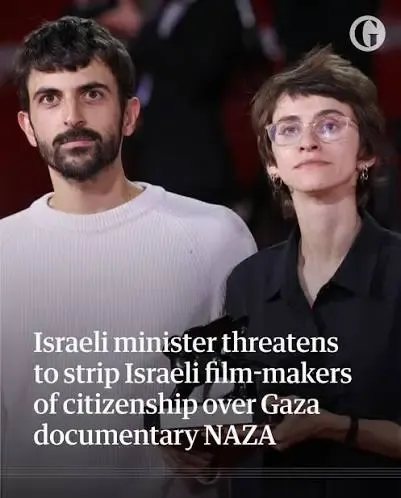
The political response to NAZA has increasingly focused on punishing its makers.
Culture minister Miki Zohar accused Abraham and Szor of “treason against the state” and called for their citizenship to be revoked. Netanyahu subsequently announced that he would seek legislation against Israelis who defame soldiers abroad.
On Friday, in an interview with the conservative weekly Makor Rishon, Netanyahu again advocated citizenship revocation and compared the film’s impact to “launching dozens of ballistic missiles” at Israel.
At the New York screening, Abraham called that comparison “the criminalization of journalism and of this kind of work”.
Netanyahu is proposing new legislation; there has been no reported revocation of either director’s citizenship.
The intimidation has also moved beyond statements by ministers. In a joint appeal published on 18 September, the Committee to Protect Journalists and ten other press-freedom organisations documented a demonstration outside Szor’s family home, threats to gather at addresses associated with Abraham’s family, and a break-in at the offices of +972 and Local Call.
The coalition, which included Reporters Without Borders, PEN America and the International Press Institute, called on Israeli authorities to protect the directors and their relatives and end the official campaign against them. It warned that citizenship threats over journalistic or artistic expression raised concerns under Article 15 of the Universal Declaration of Human Rights.
More than 1,500 Israeli film professionals, 43 Israeli human-rights organisations and leaders of major international film festivals have rallied to the directors’ defence.
The threats also give practical force to the dispute over anonymity. Participants in NAZA were filmed secretly on Tel Aviv rooftops, with their identities concealed. Abraham told the New York audience that confidentiality was essential to securing their testimony.
“Throughout the history of investigative journalism, very often granting confidentiality to sources is a means to pursue the truth,” he said. “This film could not have been made any other way and because the crimes are ongoing, we felt that it was important to make it.”
Protecting sources necessarily limits what viewers can independently check about them. It places particular responsibility on the journalists and producers to verify their accounts. Neither the danger faced by the speakers nor the official denunciations, on their own, settle whether a particular allegation is true.
For Palestinians, the international attention raises another question: why have accounts from inside the Israeli military acquired an authority that testimony from Gaza’s survivors has so often been denied?
Mahmoud Mushtaha, a Palestinian journalist who lived through the destruction, wrote that NAZA revealed a part of the violence he could not see from Gaza: the decisions made before the bombs arrived. The soldiers’ descriptions brought back relatives and friends he had lost.
His response also recorded testimony about authorisations to kill as many as 500 civilians in pursuit of a senior target. For Mushtaha, such numbers could not be separated from individual people and the families waiting for them.
“For me, they are people I knew and loved, whose calls I waited for, whose absence will forever be part of our lives,” he wrote.
Palestinian writer Ayat Abou Shmeiss made a related point in an essay on 23 September. She said an airstrike that killed 35 people had taken members of her own family, and that she did not intend to watch the film.
She did not accuse its makers of stealing Palestinian voices. Her objection was to the wider habit of treating Israeli recognition as the moment Palestinian experience becomes credible.
“The Palestinian did not lack a voice until the Israeli soldier arrived and spoke,” she wrote.
Her challenge was directed towards what follows that recognition: responsibility and action to prevent further harm.
The difficulty of scrutinising events inside Gaza also remains central. In a separate announcement on 24 September, CPJ said Israel continued to bar journalists and researchers from entering the territory independently, describing the restrictions its own investigators faced.
That barrier does not mean Gaza has gone unreported. Palestinian journalists, photographers, medical workers and survivors have documented the violence throughout. It does mean foreign newsrooms cannot freely enter, interview witnesses and investigate sites for themselves. NAZA adds testimony from within the Israeli military to a record Palestinians have already spent years building.
In New York, the directors brought the discussion back to the audience’s own government.
“These soldiers are talking about what has been done with the taxpayer money of the people sitting here,” Abraham said.
The standing US assistance framework provides for $3.8bn a year through 2028, including $500m annually for missile defence. That annual figure does not capture all additional wartime assistance.
The choice of words at Lincoln Center made the directors’ argument explicit: Americans were being asked to consider their connection to the military operations described on screen.
Outside the premiere, a small group of demonstrators carried Israeli flags and invoked the Hamas-led attacks of 7 October 2023. A truck displayed an accusation that NAZA was propaganda.
Abraham addressed that argument directly. He condemned the October attacks, which killed about 1,200 people, most of them civilians, while rejecting their use as justification for killing Palestinian civilians.
“It’s in the film and it’s completely unjustified,” he said of the massacre. “But it also cannot justify what you’ve seen in the film. It doesn’t justify the slaughter of so many civilians in Gaza.”
The exchange went to the moral argument the film-makers were making: acknowledging the suffering of Israelis cannot require the abandonment of Palestinians.
The film’s audience is now set to expand rapidly. New York’s IFC Center lists its opening for Wednesday, 30 September. An expansion to Los Angeles and other major US markets is scheduled for 9 October, followed by a wider national release.
The announced international rollout covers 56 territories, with free global streaming planned for late November.
The film has also been offered to Israeli distributors and cinemas, while the Guardian is exploring ways to make it available in the occupied Palestinian territories. A domestic cinema release in Israel has yet to be confirmed in the announcements.
At Lincoln Center, Abraham’s closing argument returned to the political use of grief.
“I don’t want to live in a world where rightful empathy to Israeli victims is weaponized by leaders like Netanyahu – cynical people who promise nothing other than perpetual occupation and war,” he said.
“It’s weaponized to mean a lack of empathy to Palestinians, to mean this continuous killing and murder of people. I don’t think we should want to live in such a world. I think we should all refuse to play this zero-sum game.”
Sources and attribution
The New York premiere quotations and event details are drawn from Adrian Horton’s Guardian report. Additional reporting, testimony, responses and primary documents are linked below. The film’s allegations are distinguished from official responses and the findings of the UN commission. The 37,000 figure refers to people reportedly flagged by a targeting system in the 2024 investigation, not a death toll. The UN speech on Thursday, 24 September preceded the Saturday premiere by two days. This feature does not claim original interviews or a viewing of the complete film.
- Adrian Horton, Guardian, 27 September 2026: premiere report and quotations; full text supplied by the reader
- Film at Lincoln Center: NAZA programme and production credits
- La Biennale di Venezia: official awards, 12 September 2026
- Yuval Abraham and Rachel Szor, +972 Magazine, 10 September 2026: directors’ account
- Yuval Abraham, +972 Magazine / Local Call, 30 November 2023: The Gospel investigation
- Yuval Abraham, +972 Magazine / Local Call, 3 April 2024: Lavender investigation and military response
- dpa via WELT, 14 September 2026: Israeli military response
- Sarit Zehavi, Times of Israel Blogs, 17 September 2026: defence of casualty-assessment procedures
- International Committee of the Red Cross: distinction, proportionality and precautions
- UN Independent International Commission of Inquiry, 23 June 2026: findings on Palestinian children
- CPJ and ten partner organisations, 18 September 2026: joint appeal and documented intimidation
- Mahmoud Mushtaha, +972 Magazine, 11 September 2026: Palestinian response to the film
- Ayat Abou Shmeiss, +972 Magazine, 23 September 2026: Palestinian testimony and accountability
- CPJ, 24 September 2026: independent access restrictions described in its research review
- Council on Foreign Relations: US aid to Israel
- IFC Center: NAZA opening date
- Screen, 18 and 24 September 2026: US and worldwide distribution plans
- Guardian / mk2 Films, 24 September 2026: release announcement
- Screen, 18 September 2026: US cinema rollout