Israel Hires Conservative Data Broker for $500,000 Campaign to Reshape US Opinion
A newly disclosed agreement requires Starboard to measure the cost of changing Americans’ attitudes. The company advertises access to more than 25 million conservatives, while related filings reveal a much larger Israeli influence effort involving political marketing, evangelical audiences and artificial intelligence.
An intermediary acting on behalf of the Israeli government has signed a $500,000 agreement with an American media and marketing company that advertises access to more than 25 million conservatives, commissioning a campaign designed to measure how effectively digital content can change public opinion.
The agreement brings Starboard, a business associated with conservative publications and the former ownership of social media platform Parler, into an expanding network of contractors working to improve Israel’s standing abroad.
Signed on 13 October and filed with the US Justice Department on 28 October, the contract provides for a 120 day persuasion programme involving audience development, content distribution and repeated polling. Its final assessment is to include a measure described as “Cost-Per-Converted-Voice”.
That language gives an unusually direct expression to the campaign’s purpose: establishing how much it costs to move someone’s opinion.
The agreement sits within a much larger effort involving advertising platforms, influencers, religious organisations and political consultants. Public records document substantial advertising approvals, a planned $900,000 creator campaign and tens of millions of dollars received by a company led by Donald Trump’s former campaign manager.
Separate investigations have exposed covert operations using fictitious Americans to promote messages favourable to Israel. A recently published European investigation has also identified evidence pointing to Israeli production of an extensive anti-Muslim advertising campaign, while leaving its commissioner and financier unresolved.
Together, the records reveal a substantial market for influencing foreign audiences. They also show why identifying the payer, the contractor, the content and the campaign’s actual results requires examining each operation separately.
Putting a price on persuasion
Starboard’s agreement is with LDRS Group LLC, an intermediary using the Leaders brand and acting on behalf of the State of Israel.
Ryan Coyne signed for Starboard, while Udi Mendelovits, identified as LDRS Group’s chief financial officer, signed for the client. The American company registered under the Foreign Agents Registration Act as Olympic Media LLC, doing business as Starboard LLC.
The programme begins with constructing audiences and polling panels, establishing baseline measurements and developing content. It then moves into continuing distribution, testing and adjustment, with polling intended to track changes in sentiment.
The final report is supposed to assess the relationship between expenditure and persuasion. But the public agreement does not define the threshold for a “converted” opinion, specify the survey questions or provide a numerical target against which success could be judged.
Those omissions matter. A person expressing a slightly more favourable view in a survey, agreeing with one argument or supporting a particular policy could represent very different outcomes.
The $500,000 is the agreement’s contractual value. Starboard’s initial registration reported no receipts or registrable activity before filing, so the disclosure does not establish that the entire amount had already been paid or that the campaign had achieved results.
The scope also expressly excludes paid influencer marketing. Although the broader Israeli effort includes creator recruitment, Starboard’s particular assignment is framed around audience construction, content and measurement.
Its registration identifies email, social media and other digital media, with English language material directed towards the general population. The contract itself does not restrict the audience to conservatives or specify particular publications, platforms or mailing lists.
Starboard’s commercial position nevertheless makes its relationship with conservative audiences central to understanding why it would be an attractive contractor.
A business built around conservative audiences
Starboard promotes its ability to reach more than 25 million “verified conservatives”. That is the company’s marketing claim, rather than an independently audited count of people who will receive material under the Israeli contract.
Its publishing and promotional network includes American Wire, BizPac Review and PolitiBrawl. PolitiBrawl’s Substack profile lists more than 1.3 million subscribers.
The company advertises email and text messaging, video advertising, creative testing, media buying and analytics. Its pitch includes distributing clients’ material through its publications, YouTube audiences and partner platforms.
Its portfolio features Trump, Turning Point USA and Republican politicians including Jim Jordan, Matt Gaetz and Elise Stefanik. Its government affairs business explicitly promotes its understanding of the Trump administration.
BizPac Review’s advertising materials offer a more detailed view of the commercial machinery. The publication advertises millions of monthly visitors, more than two million Facebook followers and an email audience of approximately 240,000 subscribers. Its services include sponsored content, targeting by location and interest, and petitions designed to build email lists.
Those capabilities offer several possible routes for reaching politically engaged Americans. The public contract does not establish which of them Starboard will use for Israel.
Nor does the agreement establish that any particular article or video published by a Starboard associated outlet was commissioned by the Israeli government. Demonstrating that would require a connection between the material and the paid assignment.
The transparency question is especially relevant where publishers present themselves as independent voices challenging established institutions. Readers may understand a publication’s political perspective while remaining unaware of a separate commercial relationship involving a foreign government.
Parler changed hands, but marketing data remained
Starboard’s connection to Parler adds another dimension to its audience business.
The platform developed a following among conservatives and people who believed mainstream social networks were suppressing their views. It became embroiled in controversy after the attack on the US Capitol on 6 January 2021, when its moderation practices came under scrutiny and major technology companies withdrew services.
Starboard acquired Parler in April 2023. Coyne presented the purchase as an opportunity to connect its audience with his company’s advertising and publishing operations.
A subsequent sale was announced in late 2023, with the platform’s technology and intellectual property transferred to PDS Partners in January 2024. Coyne said Starboard retained data used for email and text message marketing.
Later corporate records provide further clarity about the platform’s ownership. A November 2025 investment memorandum identifies Parler Technologies Inc and names Yasser Elgebaly as its chairman, chief executive and controlling voting shareholder.
Those developments separate the current platform from the company that signed the Israeli persuasion agreement. Parler itself is not a party to the disclosed Starboard contract.
The retained marketing information remains relevant to Starboard’s business history, but the filing does not establish that Parler derived data will be used in this campaign. It also excludes Starboard’s pre-existing data and intellectual property from the material transferred as contractual deliverables.
Access to an audience, ownership of a platform and delivery of a particular advertising campaign are distinct questions. The available documents establish some of those relationships while leaving the campaign’s eventual targeting undisclosed.
Why the American right has become a priority
The contract arrives as Israel faces deteriorating public opinion in the United States, including among younger Republicans.
A Pew Research Center survey conducted in March 2026 found that 60 per cent of Americans held an unfavourable view of Israel, compared with 53 per cent a year earlier.
Republicans and Republican leaning independents remained more supportive overall, with 58 per cent expressing a favourable view and 41 per cent an unfavourable one. But among Republicans aged 18 to 49, 57 per cent viewed Israel unfavourably.
A separate Pew survey conducted in May asked specifically about Israel’s government. Only 28 per cent of Republicans under 35 viewed it favourably, compared with 68 per cent of Republicans aged 50 and over.
These are different questions and age groups, but both indicate a pronounced generational divide within the party.
Gallup’s February 2026 polling also recorded the disappearance of Israel’s clear advantage in Americans’ sympathies. Forty-one per cent said they sympathised more with Palestinians, compared with 36 per cent who sympathised more with Israelis. The difference was not statistically significant, making the loss of Israel’s previous lead the firmer conclusion.
The war involving Iran has created another source of tension. A Reuters/Ipsos survey conducted from 6 to 9 November found that 71 per cent of Americans supported Congress passing legislation to end the conflict.
Republicans were closely divided on that question, with 51 per cent supporting such legislation and 47 per cent opposing it. At the same time, 71 per cent of Republicans approved of US strikes on Iran. Support for bringing a war to an end therefore cannot automatically be read as rejection of its original military action.
For Israeli policymakers, however, the polling presents a clear challenge: support within the American right is less uniform than its longstanding political alliance might suggest.
“This is in response to collapsing public support that extends all the way into conservative and evangelical communities that have long been seen as the electoral lynchpin for Israel’s political support within the U.S.,” said Eli Clifton, cofounder and senior adviser at the Quincy Institute for Responsible Statecraft.
The campaign also operates against the backdrop of increasingly severe international findings about Gaza. In September 2025, a United Nations commission of inquiry concluded that Israel had committed genocide there. Israel rejected the finding and accused the commission of bias.
That was an investigative commission’s conclusion, distinct from a judgment by an international court. Its publication nevertheless intensified the political and reputational pressure that Israel’s communications programmes seek to address.
Netanyahu’s “eighth front”
Benjamin Netanyahu has publicly described the struggle for international opinion as another front in Israel’s conflicts.
Addressing evangelical leaders in Florida in December 2025, he identified an “eighth front” involving the views of people in the West, particularly younger Americans and the “conservative wing of the United States”.
The financial commitment behind that objective has grown substantially.
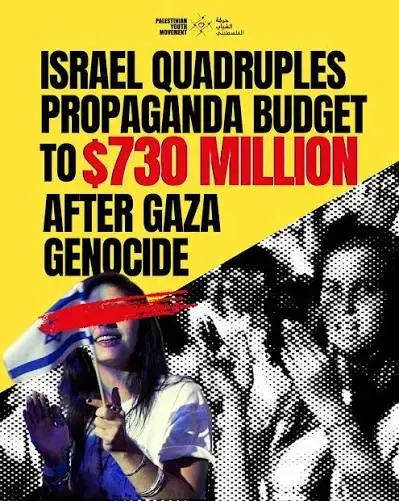
Israel’s 2026 public diplomacy package has been widely reported at 2.35 billion shekels, approximately $730 million. The official budget material includes one billion shekels in authority to enter longer term commitments, an important distinction when assessing how much represents spending in a particular year.
The package is also global. It cannot all be treated as money spent influencing Americans.
Israeli officials have defended the emphasis on social media and visits by foreign delegations. Israel Bachar, the country’s consul general in Los Angeles, has argued that bringing people to Israel can improve their understanding and support.
Critics of the approach question whether communications spending can overcome objections to the policies being communicated. Nicholas Cull, a scholar of public diplomacy at the University of Southern California, has argued that an unpopular underlying policy presents a problem that a larger publicity budget cannot readily solve.
The financial figures in this field require particular care. A national allocation, an advertising approval, a contractor’s booked order and a bank receipt measure different things. They may also overlap, making it misleading to add every disclosed sum into a single total.
Advertising that challenged the Gaza famine finding
The government’s purchase of advertising space provides one of the clearest documented examples of the scale involved.
An Israeli procurement approval dated 17 June 2025 authorised 90 million shekels for Google’s Display & Video 360 service and 60 million shekels for YouTube. Together, the Google allocations amounted to 150 million shekels, reported at the time as approximately $45 million.
The same approval provided 10 million shekels for X, then listed as Twitter, and a combined seven million shekels for Outbrain and Teads. The full authorisation was approximately $50 million and covered the period from 17 June to 31 December 2025.
These were approved amounts. The document is not a payment ledger establishing that the entire allocation was spent.
Its stated scope included publicity surrounding Operation Rising Lion, Israel’s June 2025 military campaign against Iran, and continuing government activity. The full Google allocation therefore cannot accurately be described as exclusively a budget for denying famine in Gaza.
But that advertising infrastructure did carry famine denial messages.
Paid videos published through Israel’s Foreign Ministry showed markets and restaurants, ending with the assertion: “There is food in Gaza. Any other claim is a lie.”
The advertisements appeared in multiple languages and targeted audiences in countries including Britain, the United States, Germany, Austria, Italy and Poland.
Investigators traced footage to restaurants’ social media accounts and obtained accounts of shortages, closures and prices beyond the reach of many residents. The presence of food in selected shops or restaurants did not establish that the wider population could obtain adequate nutrition.
Sponsored search results also directed people looking for the famine assessment towards an Israeli government rebuttal. Other campaigns challenged UNRWA and attacked critics of Israeli policy.
On 22 August 2025, the Integrated Food Security Phase Classification initiative had confirmed famine, with reasonable evidence, in Gaza Governorate as of 15 August. It projected expansion to other governorates, rather than declaring that every part of Gaza had already met the famine threshold.
Israel rejected that assessment. The prime minister’s office argued that the report ignored aid deliveries and improvements in supplies, while Israeli officials disputed its methodology.
The dispute was therefore being conducted through both official statements and paid distribution designed to place Israel’s response before international audiences searching for information about the humanitarian crisis.
The intermediaries organising the work
Several of the contracts involve commercial intermediaries between the Israeli government and the companies delivering material to audiences.
Leaders, Starboard’s client, had previously arranged creator activity on behalf of Israel’s Ministry of Foreign Affairs.
An agreement with Davis Media NY dated February 2024 provided for managing up to ten talents, each producing five pieces of content a week. Its payment structure included a $10,000 monthly management fee and 15 per cent of talent contract costs.
The associated disclosure described work relating to hostages and humanitarian awareness.
Havas Media Germany has acted as another significant intermediary, arranging contracts for Israel’s government advertising agency, known as LAPAM, and other Israeli government communications work.
The Starboard agreement contains an unexplained footer referring to “Starboard x Havas Frankfurt”. However, its named contracting parties and signatures are Starboard and LDRS Group. The footer alone does not establish a contractual role for Havas in that particular assignment.
Other filings provide much clearer evidence of Havas’s involvement, including the Esther Project and the work of Brad Parscale’s Clock Tower X.
What the Esther Project documents actually show
The Esther Project was organised through Bridges Partners LLC, a company established in Delaware in June 2025 and jointly owned by Uri Steinberg and Yair Levi.
Its FARA filing identifies the Government of Israel through Havas Media Group Germany as the foreign principal and names the Ministry of Foreign Affairs as the represented government body.
An attached order dated 16 June 2025 sets out a $900,000 schedule running from June to November.
The plan combined initial development, production, influencer payments and final delivery. Its recruitment stages envisaged five or six creators beginning work, followed by three successive groups of three or four. That produces the frequently cited total of 14 to 18 intended participants.
The schedule anticipated approximately 25 to 30 posts a month across the group during July, August, September and October. November was designated for final payments, a campaign summary and final content delivery.
Those are planned deliverables. They do not establish that every proposed creator was recruited or every post produced.
The widely repeated claim that influencers received approximately $7,000 per post also needs qualification. That figure came from an estimate based on the campaign budget, disclosed expenses and the expected number of posts.
The documents bundled influencer and production costs. They did not disclose a standard individual rate of $7,000, or establish that each participant received that amount.
The subsequent financial filings make the distinction between the plan and its implementation particularly important.
The original registration disclosed a $199,985 advance received in July 2025. A later statement covering the six months ending March 2026 reported no new receipts and described Bridges’ role as facilitating cultural interchange. The company stated that it had no role in developing, creating, promoting or disseminating content.
For the following six months, ending September 2026, Bridges reported no services, receipts or disbursements.
The public record therefore documents an Israeli government sponsored creator plan and some financial activity, while leaving significant questions about the content ultimately delivered, the participating influencers and the fulfilment of the entire $900,000 schedule.
Photographs of an influencer meeting Netanyahu, or evidence that someone took a sponsored trip to Israel, do not by themselves identify that person as an Esther Project contractor.
Parscale’s operation has grown far beyond its original $6 million
Clock Tower X, led by Trump’s former campaign manager Brad Parscale, provides a more substantial example of documented contractor receipts.
Its original September 2025 agreement with Havas provided for $1.5 million a month over four months, producing the widely reported initial value of $6 million.
A December amendment increased the stated funding pool to $9 million, including additional digital advertising money. That was a revision to the arrangement, rather than evidence of a separate $9 million payment on top of the original $6 million.
Subsequent disclosures show a much larger flow of money.
Clock Tower X reported $15 million in receipts for the six month period ending 31 March 2026, followed by $25.5 million for the period ending 30 September. Together, the two statements record $40.5 million received.
Later orders also set out monthly amounts of $4.5 million for work during 2026, including extensions covering November and December.
Those orders and the receipt statements describe overlapping financial activity. Adding them together would inflate the apparent total.
The original filed scope proposed at least 100 original content assets and 5,000 variations a month, with at least 80 per cent of the material directed towards Generation Z. It also set a target of 50 million impressions a month across formats including social video and podcasts.
These were contractual objectives, rather than independently verified achievements.
The documents also referred to integrating messaging through Salem Media’s conservative and Christian media operations. Parscale and Salem have subsequently characterised the arrangement as advertising expenditure rather than instructions to editorial staff.
That response matters when considering the relationship between paid placements and the editorial output of a media company. The public contracts do not establish that every discussion of Israel across the network was directed by the Israeli government.
Trying to influence the information AI systems encounter
Clock Tower X’s original filed scope also included an ambition to affect how artificial intelligence systems describe Israel.
Its language referred to deploying websites and content to “deliver GPT framing results on GPT conversations”.
The apparent objective was to populate the online information environment with material favourable to Israel, alongside work on search visibility and digital distribution.
That is an attempt to influence the material an AI system might encounter. The contract does not establish a direct agreement with an AI provider, privileged access to a model or the ability to determine its answers.
Nor does it demonstrate that the proposed activity changed any particular response.
The distinction is relevant because the technology now plays two different roles in influence work. Contractors may seek to influence information available to AI systems, while operators can also use those systems to generate articles, comments and fabricated identities.
The latter use was documented in an earlier operation attributed to the Israeli firm Stoic.
The fake account network targeting Americans and Canadians
In its May 2024 threat report, Meta described removing 510 Facebook accounts, 11 Pages, one Group and 32 Instagram accounts associated with an operation it traced to Stoic, a political marketing and business intelligence firm in Tel Aviv.
The accounts posed as Jewish students, African Americans and concerned local citizens. They commented beneath posts by media organisations, public figures and US lawmakers, directing readers towards material operated by the network.
Messages included support for Israeli military action, demands for hostage releases, criticism of UNRWA and claims that Muslims threatened liberal values in Canada.
The operation’s deception extended beyond invented biographies. Investigators documented an altered photograph in which a banner referring to Britain had been changed to read “Shariah for Canada”, helping present material from another country as evidence of a Canadian threat.
OpenAI separately attributed an operation it called Zero Zeno to Stoic. It said its models had been used to generate articles, comments and fictional personas, with some accounts replying to other accounts controlled by the same operation to create an appearance of engagement.
The reported government funding connection rested on a different body of evidence.
An investigation based on documents and four current or former Israeli officials identified the Ministry of Diaspora Affairs as the body commissioning the US campaign and put its allocation at approximately $2 million.
The reported targets included Black and Democratic members of Congress, among them Hakeem Jeffries and Raphael Warnock, with messages encouraging continued military support for Israel.
The ministry denied involvement and denied any connection to Stoic. The company did not respond to requests made for the original reporting.
Meta’s and OpenAI’s technical findings independently identified the contractor and its methods. Their published reports did not establish the government funding relationship.
They also described limited success. Meta said it disrupted the network before it gained meaningful engagement among authentic communities, while OpenAI found no evidence of substantial amplification by people outside the operation.
These findings establish a specific example of manufactured identities being used to promote political messages. They do not establish that Starboard’s disclosed persuasion programme uses those methods.
The European campaign and its unresolved sponsor
A separate investigation published in October 2026 has raised questions about a much larger advertising operation targeting Muslims, migrants and Qatar.
Researchers Marc Owen Jones and Sohan Dsouza documented a campaign promoting a version of the Great Replacement conspiracy theory in which Qatar was portrayed as secretly directing Muslim immigration and an attempted takeover of Europe.
Their British analysis recorded more than 154 million exposures to material targeting the UK between 2024 and 2026, and more than £500,000 in British Facebook advertising during 2024.
The exposure figure combines different measures, including advertising impressions, platform reach and video views, with repeat exposure and overlapping audiences.
The campaign’s timing included a concentrated burst before Britain’s local and London mayoral elections in May 2024. Its material circulated before the anti-Muslim riots following the Southport murders, but the research does not establish that these advertisements caused the violence or changed election outcomes.
The researchers found evidence pointing to production in Israel. This included Hebrew labels embedded in video editing metadata, a Sunday to Thursday production pattern, a compatible change in computer clock settings and Wikipedia edits associated with an Israeli internet address.
Their combined assessment was that production occurred in Israel. They explicitly left the ultimate client unidentified.
Meta had independently documented the first network in 2024, identifying links to LT Media, a Vietnamese business it believed was operating for customers. It recorded approximately $1.2 million in advertising expenditure, without identifying those customers.
The campaign subsequently reappeared through changing accounts and advertising intermediaries.
Its scale and persistence raise substantial questions about the platforms that accepted the advertising and the identity checks attached to buyers. But the evidence currently available does not establish Israeli government commissioning or financing.
There is also no demonstrated contractual or financial connection between this operation and the Starboard, Esther or Clock Tower X arrangements.
Churches, congregations and visiting delegations
Christian audiences have remained a recurring focus of Israel’s public diplomacy effort.
One disclosed initiative involving Show Faith by Works proposed advertising around churches and colleges, including the use of location based targeting during worship times.
The proposal attracted attention because the selection of a congregation for advertising did not necessarily involve its participation.
Canyon View Vineyard Church in Grand Junction, Colorado, said in December 2025 that it had been unaware of the proposed targeting, had not authorised or participated in the campaign and had received no payment. It also said it did not know whether any advertisements had actually run.
The company’s leader, Chad Schnitger, subsequently said the geofencing element was being abandoned over security concerns. Other elements, including a mobile museum and Bible study activity, continued.
The original targeting proposal therefore should not be presented as proof that every listed church received advertisements, endorsed the campaign or remained part of an active geofencing programme.
Visits to Israel offer another route to religious audiences.
In November 2026, Israel’s Foreign Ministry announced a delegation of approximately 500 African American and African Christian leaders, with an ambition to bring thousands more in the following year.
Such visits are openly presented as opportunities to develop relationships and understanding. Their inclusion in the broader communications effort shows the variety of methods being used, from personal experience and religious networks to purchased advertising and digital audience analysis.
The available material does not establish a connection between that delegation and Starboard’s new contract.
What the disclosures establish
The public record provides substantial evidence that Israel has funded and commissioned efforts to influence overseas opinion through commercial intermediaries, paid content arrangements, advertising and outreach.
It also documents covert activity attributed to an Israeli contractor, alongside a separately reported government funding allegation that the ministry concerned denied.
The European investigation adds evidence about production location and distribution, while leaving the ultimate sponsor unknown.
Those differences are essential to an accurate account. A disclosed advertising order, a contractor’s receipt statement, a platform’s attribution and a forensic inference about production each establish a different part of the story.
Registration under the Foreign Agents Registration Act is a disclosure mechanism. It does not by itself mean the registered work is unlawful, and the government’s receipt of a filing does not certify every claim made in it.
For Starboard, the immediate unanswered questions concern implementation: which audiences will be selected, what data will be used, which messages will reach them and how any resulting material will identify its sponsor.
The company’s commercial reach explains its potential value to an Israeli government concerned about weakening support among conservatives. The contract’s polling and cost calculations show that the client wants evidence of persuasion.
Whether that persuasion occurs remains unproven. The disclosed agreement establishes who commissioned the work and what it could cost, while the content audiences will encounter and the results of the experiment remain to be seen.
Sources and attributions
Original reporting and supplied material: Israel Targets U.S. Conservatives in Influence Operation, Murtaza Hussain, Drop Site News, 11 November 2026. This was the article supplied for expansion and is the source of Eli Clifton’s quoted comments. Earlier coverage appeared in Israel Hires Trump Fundraising Vendor for Persuasion Pilot, Sludge, 2 November 2026. dropsitenews.com
Starboard’s agreement and registration: US Justice Department, Exhibits A and B, registration 7788 and initial registration statement, filed 28 October 2026. These establish the parties, dates, contractual value, scope, exclusions and initial disclosures. efile.fara.gov
Starboard’s commercial claims: Digital marketing services, government affairs services and BizPac Review advertising information. Audience figures and capabilities are the companies’ own promotional claims. starboard.co
PolitiBrawl: Substack profile and About page, supporting the subscriber figure and the publication’s positioning. substack.com
Parler’s sale and retained information: WIRED’s report on Parler’s relaunch, Makena Kelly and William Turton, 20 March 2024; and Parler’s Series A private placement memorandum, 14 November 2025. These support the January 2024 transfer, retained marketing information and later corporate control disclosures. www.wired.com
American opinion: Pew Research Center, Negative views of Israel, Netanyahu continue to rise among Americans, especially young people, Laura Silver, 7 April 2026; and Republicans’ views of some countries and international organizations differ widely by age, Jonathan Schulman and William Miner, 16 October 2026. The surveys distinguish views of Israel from views of its government. www.pewresearch.org
Sympathies and Iran polling: Gallup, Israelis No Longer Ahead in Americans’ Middle East Sympathies, Benedict Vigers, February 2026; and Reuters/Ipsos post-election survey topline, fieldwork 6–9 November 2026. Gallup cautioned that the difference in sympathies was not statistically significant. news.gallup.com
UN commission finding and Israeli response: Israel has committed genocide in the Gaza Strip, UN Commission finds, 16 September 2025, and Israel’s official response. www.un.org
Netanyahu’s statement: Prime minister meets evangelical community leaders in Florida, reproduction of the Prime Minister’s Office statement, 31 December 2025. israel.com
Public diplomacy budget and debate: Official Foreign Ministry budget proposal for 2026, in Hebrew; and report on the expanded public relations budget, Asaf Elia-Shalev, Jewish Telegraphic Agency, republished by The Times of Israel, 30 April 2026. The official material distinguishes expenditure from authority for longer term commitments; the reporting supplies Bachar’s and Cull’s assessments. www.gov.il
Digital advertising authorisations: Israeli government procurement notice 4000604070, published 26 June 2025, and its underlying exemption committee protocol, dated 17 June. The protocol groups Outbrain and Teads under one seven million shekel authorisation, avoiding the double count suggested by the webpage’s separate listings. mr.gov.il
Famine denial advertising: Google’s $45 Million Contract With Netanyahu’s Office to Spread Israeli Propaganda, Jack Poulson and Lee Fang, Drop Site News, 3 September 2025; Fact check: Israel spends vast sums on propaganda ads, Kathrin Wesolowski, DW, 8 September; and The new front of war: Inside Israel’s digital “hasbara” offensive, Eurovision News Spotlight, 12 September. These document actual advertisements, targeting and investigation of their footage. dropsitenews.com
Famine assessment and rebuttal: IPC Gaza analysis released 22 August 2025 and Prime Minister’s Office statement on the IPC report, 22 August 2025. Integrated Food Security Phase Classification
Leaders and Davis Media: Davis Media NY’s filed agreement with L.D.R.S Group, agreement dated February 2024 and filed 12 October 2025. efile.fara.gov
Esther Project’s original plan: Bridges Partners’ registration statement and Exhibits A and B, filed 26 September 2025. The attached order establishes the $900,000 schedule and planned recruitment and posting volumes. efile.fara.gov
Origin of the per-post estimate: Israel is paying influencers $7,000 per post, Nick Cleveland-Stout, Responsible Statecraft, September 2025. The article’s calculation is an estimate from pooled expenditure, rather than a disclosed individual payment rate. Responsible Statecraft
Esther Project’s subsequent disclosures: Bridges Partners’ supplemental statements filed 30 April 2026 and 19 October 2026. These support the later description of its role and the reported absence of activity during April–September 2026. efile.fara.gov
Clock Tower X’s initial scope and amendment: Agreement filed 18 September 2025 and amendment filed 26 December 2025. The initial scope appears as a draft attachment within the filed agreement; its production and audience figures are objectives, not verified results. efile.fara.gov
Clock Tower X’s receipts and later orders: Supplemental statements filed 18 May 2026 and 30 October 2026 record $15 million and $25.5 million in receipts respectively. Orders filed 7 June and 5 October 2026 support the later monthly arrangements. The receipt statements and contractual orders overlap and have not been added together. efile.fara.gov
Parscale and Salem’s explanation: New details emerge around Israel’s massive influence operation in the US, Lazar Berman, The Times of Israel, 19 July 2026, summarising the reporting and published responses about advertising and editorial activity. www.timesofisrael.com
Christian outreach: The Eighth Front: Inside Israel’s $1 Billion Influence Campaign, Nick Cleveland-Stout, Quincy Institute, 24 July 2026; Canyon View Vineyard Church’s statement, 22 December 2025; and Foreign Ministry announcement of the visiting Christian delegation, 4 November 2026. Quincy Institute for Responsible Statecraft
Stoic’s accounts, methods and reach: Meta’s First Quarter Adversarial Threat Report, May 2024, accessed through a copy hosted by Teyit; OpenAI’s May 2024 disclosure and Zero Zeno case study. These establish the platforms’ attribution and their limited impact assessments. md.teyit.org
Reported ministry funding and denial: Israel Secretly Targets U.S. Lawmakers With Influence Campaign on Gaza War, Sheera Frenkel, The New York Times, 5 June 2024, read through its NYT News Service syndication in the Miami Herald. This is the source for the approximately $2 million allocation, officials’ accounts, congressional targets and ministry denial. eedition2.miamiherald.com
Altered Canadian imagery: Inauthentic campaign amplifying Islamophobic content targeting Canadians, Ali Chenrose, Atlantic Council’s Digital Forensic Research Lab, 28 March 2024. DFRLab
European campaign investigation: Manufacturing the “Great Replacement”, Marc Owen Jones and Sohan Dsouza, 29 October 2026; and the investigation’s British findings, Marc Owen Jones, The Nerve, 6 November 2026. These support the production assessment, British exposure figures and explicit uncertainty about the ultimate client. thegreatreplacement.dysinfluence.com
Independent corroboration of the earlier European network: Meta’s Second Quarter Adversarial Threat Report, August 2024, accessed through a PDF mirror. It identifies LT Media and approximately $1.2 million in advertising expenditure, without attributing the network to the Israeli government. manuals.plus
FARA’s function: US Department of Justice, Foreign Agents Registration Act frequently asked questions.