“Israel Would Say”: BBC Gaza Interviews Put the Meaning of Impartiality Under Scrutiny
A new investigation into BBC coverage raises questions about the weight given to Israeli explanations, the treatment of humanitarian witnesses and whether official denials receive the same scrutiny as allegations of grave crimes. The archived broadcasts reveal a complex picture, including troubling interventions, substantive rebuttals and forceful challenges to Israeli claims.
When Bernie Sanders called for an end to American military assistance to Israel’s “extremist” government on Newsnight on 4 November 2026, Victoria Derbyshire supplied the response its ministers might offer.
“The Israeli government would deny that they are extremists,” she said.
Sanders answered that he believed many people shared his assessment, then described Israel’s treatment of Palestinians as genocidal. The interview subsequently returned to American presidential politics.
The sequence matters. Derbyshire’s intervention addressed Sanders’s description of the government as extremist, before he made the genocide allegation. Yet it brought into focus a broader editorial question: what does a presenter contribute by supplying a denial that the audience could reasonably anticipate, and what evidence should accompany it?
A publicly posted summary of a BBC complaints reply records the corporation defending the intervention.
“We reject the suggestion that highlighting the fact that the Israeli government would dispute Mr Sanders’ description was inappropriate,” the response states.
That defence concerns the Sanders exchange. The wider question extends across interviews with doctors, humanitarian officials, Palestinian analysts and Israeli critics of their own government: when a presenter introduces the position of an absent party, does that intervention help viewers examine the evidence, or leave the guest carrying the burden of challenging an official explanation?
A disparity in the language of balance
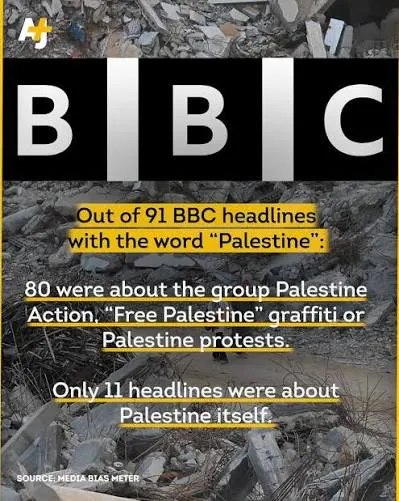
Researchers searched captions from 51,303 archived BBC News channel programmes covering 7 October 2023 to 4 November 2026. Their current count identifies 252 distinct interviews supplying Israel’s position to critics, against 15 supplying a Palestinian position to defenders. Estimated rates per airing were 9.8% and 1.5%, using denominators estimated from a weighted sample of 84 interviews.
A broader reading of 130 eligible interviews found opposing positions mentioned to 26% of critics and 29% of defenders, approximately 38% each after weighting. Separately, across 1,618 written articles, criticism of Israel received an Israeli counterposition in 49% of coded claims; Israeli claims received a Palestinian or UN counterposition in 38%.
The headline count covers selected formulations, not every challenge. Its categories include humanitarian witnesses among critics; the estimates and caption interpretation require caution. Stored article texts stopped at 2,000 words. The Sanders interview was excluded because its subject was US elections.
The distinction between forms of questioning is central to assessing these findings. A presenter can challenge an Israeli official through a document, a photograph, a legal principle or a persistent follow-up without introducing any of those interventions as a Palestinian position.
Equally, inserting a government’s explanation into an interview does not establish that the explanation has been tested. That requires examining what the guest alleged, what the presenter supplied in response, and what viewers were subsequently told.
The siege, the stated target and the civilian population
An early example came on Verified Live on 9 October 2023, when Jan Egeland, secretary general of the Norwegian Refugee Council, condemned the attacks on Israeli civilians before describing Israel’s response as collective punishment.
The presenter asked why he used that term, explaining that “the Israeli government would argue that they are going after Hamas”.
Egeland’s answer distinguished the stated military objective from the announced measures. A blockade of food, water, electricity and fuel would affect an entire population, he argued, including children and people dependent on functioning hospitals.
He was allowed to develop that answer, and the discussion continued into aid policy and relief operations. The exchange therefore shows an Israeli justification being supplied by the interviewer and substantively challenged by the guest.
Its significance lies in the question being tested: whether naming Hamas as the intended target could answer an allegation about measures imposed on civilians.
The following day, analyst Tahani Mustafa faced a different exchange. She placed the violence in the context of occupation and blockade, while the presenter raised the brutality of Hamas’s attack, the taking of hostages and Israel’s asserted right to defend itself.
When Mustafa said Israeli forces had failed to distinguish civilians from fighters, the presenter replied: “They would reject that.”
Mustafa responded that factual evidence mattered and brought up the Israeli defence minister’s use of the words “human animals”. Shortly afterwards, the presenter said the programme had run out of time and moved to the weather.
The incriminating language was heard, but the guest introduced it after the presenter had supplied the rejection. That ordering illustrates why the selection of an official’s words can be as consequential as the decision to include an official position at all.
On 11 October, former Israeli negotiator Daniel Levy confronted the same underlying problem. He condemned the attacks on Israeli civilians as war crimes while criticising Western support for what he described as apparently premeditated Israeli war crimes.
The presenter put Israel’s argument that it was defending itself and targeting Hamas.
“Do you really keep a straight face when you say that?” Levy replied.
He pointed to the announced deprivation of essentials for a whole civilian population and rejected the idea that either occupation or the atrocities of 7 October justified attacks on civilians.
The presenter then asked what Israel should do instead, allowing Levy to discuss diplomacy, Palestinian rights and failed political opportunities.
His response exposed the logical gap at the centre of these exchanges. A government’s account of why it is fighting does not, by itself, settle whether the methods it employs are lawful.
When the official explanation becomes the final word
The position of a denial within an interview can also affect what the audience receives.
On 5 June 2025, emergency doctor James Smith discussed the consequences of restrictions on aid and medical access to Gaza. The presenter supplied Israel’s position that it was trying to provide assistance but that Hamas was taking supplies intended for the population.
Smith said he had not witnessed that diversion and criticised the arrangements through which aid was being distributed.
After he described civilians being drawn into dangerous aid distribution locations, the presenter closed the interview by supplying the Israeli account that soldiers involved in recent shootings had felt threatened. Smith received no further opportunity to answer that point.
The surrounding programme complicates any claim that the Israeli explanation went entirely unchallenged. In the following report, correspondent John Sudworth explained that the United Nations disputed claims of significant diversion of aid by Hamas.
The broadcast thus contained contrary evidence, while the interview itself ended with an official justification. Both elements belong in an assessment of what viewers were shown.
Hunger and a revealing counterexample
The handling of hunger claims provides another useful test because it involves questions that can be investigated: what supplies entered, what reached civilians, what medical workers observed and how those findings related to official assertions.
On 25 May 2025, Save the Children’s Rachael Cummings was asked to respond to Israeli claims that food was plentiful, people were not starving and assistance was being looted.
She answered from her experience in Gaza, describing malnourished children and the consequences of inadequate water, sanitation and humanitarian supplies.
Immediately afterwards, former Israeli prime minister Naftali Bennett faced sustained questioning. When he denied starvation, the presenter challenged him with figures on malnutrition and food insecurity, accounts from doctors and aid agencies, and the discrepancy between cumulative aid totals and the more recent blockade.
The questioning also addressed civilian deaths and the consequences of moving people into areas without adequate shelter or water.
That sequence is a substantial counterexample to any sweeping assertion that Israeli defenders escaped scrutiny. It demonstrates why an assessment of impartiality must examine the substance of the questions alongside the language used to introduce them.
The same principle applies to humanitarian witnesses. Their professional experience can provide direct evidence about conditions, while broader claims about military intent or responsibility may require additional investigation. Effective questioning distinguishes those categories and makes clear what is known, what remains disputed and what would establish the answer.
Treating every statement as an interchangeable political position risks obscuring those distinctions. A clinical observation of malnutrition and a government’s explanation for restricting supplies address related but different questions.
Hospitals and the limits of a military explanation
On 13 April 2025, World Health Organization spokesperson Margaret Harris was interviewed after an Israeli strike on Al Ahli hospital in Gaza City.
As she discussed the protection of healthcare, the presenter introduced Israel’s claim that the site had been a Hamas command centre.
Harris explained that the WHO did not conduct the forensic investigation necessary to establish that allegation. She nevertheless set out the continuing requirements governing action against medical facilities, including the protection and safe movement of patients.
The preceding BBC coverage had explicitly stated that Israel had not provided evidence for its claim. Viewers therefore heard both the military assertion and a qualification about its evidential basis.
This was a more informative sequence than an unsupported exchange of accusation and denial: it identified the disputed factual claim and allowed the discussion to move to the obligations that would remain even if military use were established.
Hospitals enjoy special protection under international humanitarian law. That protection can be lost in specified circumstances involving harmful military use beyond their humanitarian function, but such a finding does not remove all restrictions on an attack.
Warning requirements, proportionality and precautions remain relevant, as does the safety of patients and medical staff. Treating wounded combatants does not, in itself, strip a hospital of protection.
These distinctions are essential to meaningful reporting. Whether a military has identified a legitimate objective, whether it has demonstrated that claim, and whether a particular attack complied with the law are separate questions.
The same applies to siege warfare. Starving civilians as a method of warfare is prohibited. An assertion that deprivation is intended to weaken enemy forces does not justify imposing its effects indiscriminately on civilians.
Civilians who remain in a besieged area also retain their protection unless and for such time as they directly participate in hostilities. Their presence alongside fighters does not automatically transform them into lawful targets.
A presenter can therefore examine an Israeli security explanation while also testing it against the rules governing the treatment of the population.
The other statements that belong in the picture
Official denials form only part of the public record.
On 9 October 2023, then defence minister Yoav Gallant announced a siege cutting electricity, food and fuel. In the same early period, President Isaac Herzog said of Gaza: “It is an entire nation out there that is responsible.”
On 13 October, energy minister Israel Katz issued a statement moving between the destruction of Hamas and an instruction for Gaza’s civilian population to leave. Its final sentence threatened deprivation until “they leave the world”. The shifting pronouns require care; they should not be silently rewritten into a more explicit statement than the original.
The International Court of Justice reproduced statements by these officials in its provisional measures order of 26 January 2024. That order required Israel to take measures under the Genocide Convention, including preventing prohibited acts and enabling urgently needed assistance. It did not decide the merits of the genocide case.
Context also includes qualifications and competing interpretations. Herzog later acknowledged innocent Palestinians who opposed Hamas.
Benjamin Netanyahu invoked Amalek in a letter to soldiers and commanders on 3 November 2023. A subsequent UN commission examined that biblical reference and its implications for the soldiers receiving it. The commission’s interpretation must be distinguished from Netanyahu’s actual wording.
In September 2025, the commission concluded that Israeli authorities and forces had committed genocide in Gaza, assessing both conduct and statements as evidence of intent. It also found incitement in statements by Herzog, Netanyahu and Gallant.
Those were findings by an international commission of inquiry, distinct from a court judgment. Israel has rejected accusations of genocide.
Another statement directly relevant to discussion of hunger came from finance minister Bezalel Smotrich in August 2024. He suggested that allowing two million civilians to die of hunger until hostages were returned could be “justified and moral”.
The European Union condemned the remarks and demanded that the Israeli government distance itself from them. Its response also called for humanitarian access and compliance with international legal obligations.
Statements of this kind do not eliminate the need to establish facts about individual incidents. They do, however, provide material against which explanations of policy and intent can be examined.
When a minister’s denial is relevant enough to introduce into an interview, other statements bearing directly on the allegation may be relevant too. Selecting the reassuring formulation while omitting the threatening one can leave viewers with an incomplete account of the government’s own position.
That is an editorial judgment requiring explanation, especially where the interview concerns deprivation, displacement or the treatment of civilians.
What impartiality requires
The professional case for putting an absent party’s position to an interviewee is straightforward. Serious accusations should be examined, and audiences should understand relevant responses.
A government’s absence from the studio does not remove the need to represent its position accurately. An interviewer who introduces that position is not necessarily endorsing it.
But impartiality also requires judgment about evidence and weight.
Ofcom’s Broadcasting Code requires news to meet standards of both due accuracy and due impartiality. It expressly explains that impartiality does not require an equal division of time between every view or the inclusion of every aspect of every argument.
Context matters, and views and facts must not be misrepresented. Significant perspectives must receive appropriate weight.
Those requirements leave room for rigorous assessment of an official assertion. They do not oblige a presenter to treat a documented finding, a witness account, a political opinion and an unsupported denial as equally established.
The BBC’s own 2019 editorial guidelines similarly described impartiality as more than a simple balance between opposing viewpoints. They required consistent scrutiny of power, recognised that serious allegations might require a response, and said contributors expressing contentious views should be challenged while receiving a fair opportunity to answer.
The practical question is how those principles operate together.
If a presenter introduces an allegation that aid has been stolen, useful scrutiny includes asking what evidence supports it, how extensive the alleged diversion is and whether the claim explains the shortage under discussion. A witness may be able to describe what happened in a hospital or distribution centre without being able to establish events throughout the territory.
Likewise, an official who says civilians were warned to leave can be asked whether they could realistically do so, where they were expected to go and what happened to those unable to move.
Such questions help an audience evaluate the explanation. Merely establishing that an explanation exists provides considerably less information.
The weight placed on Palestinian witnesses
The conditions under which Gaza was reported make these distinctions especially consequential.
In July 2025, BBC News joined the Associated Press, AFP and Reuters in warning that their journalists in Gaza were increasingly unable to feed themselves and their families. The organisations described reporters facing the same circumstances as the people whose suffering they were documenting, and called for adequate food supplies and access.
The BBC was therefore publicly acknowledging the threat of starvation to people on whom international reporting depended.
In September 2025, BBC News chief executive Deborah Turness supported a further joint appeal for international journalists to be admitted to Gaza. She recognised that a small number of Palestinian journalists had carried the reporting burden at a severe personal cost.
Those statements describe the situation at the time of the appeals. They also show why the treatment of local testimony deserves close attention.
Restrictions on access create real verification difficulties. They can limit a newsroom’s ability to inspect a location, interview multiple witnesses or compare competing accounts. Those constraints should be explained precisely.
They also make it necessary to distinguish between evidence that has not been independently checked and an official denial that has not been independently substantiated. Both may require qualification.
A Palestinian journalist, an international surgeon and a government spokesperson can each provide relevant information, but their relationship to the events and the basis of their knowledge may differ substantially. Viewers benefit when those differences are made explicit.
The editorial task becomes harder when witnesses are themselves hungry, displaced or bereaved. Their circumstances do not make every interpretation conclusive, but neither do they reduce direct observation to a political claim awaiting an automatic rebuttal.
An examination of practice, beyond a count of phrases
The archived exchanges support a serious examination of how the BBC handles official explanations. They also resist a single description of its behaviour.
Some presenters supplied a denial at the close of an interview. Others invited a response that allowed an official claim to be challenged in detail. Some surrounding reports introduced evidence absent from the interview itself, while other exchanges subjected Israeli figures to persistent questioning.
These differences matter because the effects of an intervention depend on its purpose, placement and follow-through.
A fuller editorial assessment would consider the material available at the time, the precise allegation being answered, the evidence offered for the official response and the opportunity given to address it. It would also examine whether comparable standards were applied across guests and programmes.
That process should be capable of identifying weaknesses without assuming a hidden motive, and of recognising strong journalism without allowing it to settle every criticism of other broadcasts.
The responsibility extends to the selection of official language. A government can deny wrongdoing while its ministers make statements that bear directly on the allegation. Reporting those contradictions helps audiences understand what is being disputed and why.
For viewers trying to assess the destruction of hospitals, restrictions on food or allegations of genocide, the existence of an Israeli denial is only one part of the story. The broadcaster’s value lies in establishing what supports that denial, what challenges it and what remains unresolved.
An official explanation becomes informative when it is examined against the evidence. The question facing the BBC is whether that examination has been applied consistently enough to justify the authority with which its presenters speak.
Sources and attributions
BBC: The Would Say Files — NewsCord, Nima Akram, first published 5 November 2026, subsequently expanded; current version accessed 10 November 2026. Source of the aggregate findings and methodology. The complete statistical analysis was not independently reproduced. NewsCord
“Why are we still doing this?”: Victoria Derbyshire criticised over defence of Israel — Laura Pollock, The National, syndicated through inkl; publication date not displayed in the accessible copy. Supports the sequence of the Sanders exchange. The 4 November 2026 broadcast date is also recorded in the associated campaign. The full original interview was not independently retrieved. inkl.com
How they replied — NewsCord, entry labelled November 2026. Reproduces the BBC’s defence of the Sanders intervention. The site describes its records as automated summaries of correspondence shared by campaign participants. The original correspondence was not independently inspected; no exact response date is displayed. This is not a BBC response to the complete statistical investigation. NewsCord
Verified Live, 9 October 2023; Verified Live, 10 October 2023; BBC News, 11 October 2023 — Original BBC broadcasts preserved by the Internet Archive. Caption transcripts support the Egeland, Mustafa and Levy exchanges, including their responses and surrounding questions. archive.org
BBC News, 5 June 2025, 10am BST — Internet Archive. Supports the James Smith interview and the subsequent John Sudworth report describing the UN’s position on alleged aid diversion. archive.org
BBC News, 25 May 2025, 2pm BST — Internet Archive. Supports the Rachael Cummings exchange and the sustained questioning of Naftali Bennett immediately afterwards. archive.org
BBC News, 13 April 2025, 6pm BST — Internet Archive. Supports the Margaret Harris interview and the preceding qualification that Israel had not provided evidence for its hospital allegation. archive.org
South Africa v. Israel: Order of 26 January 2024 — International Court of Justice, reproduced by the Southern African Legal Information Institute. Supports the official statements and the distinction between provisional measures and a judgment on the merits. saflii.org
Legal analysis of the conduct of Israel in Gaza pursuant to the Genocide Convention — UN Independent International Commission of Inquiry, 16 September 2025, document A/HRC/60/CRP.3. Supports the commission’s findings, its assessment of Netanyahu’s Amalek reference and Herzog’s qualification. The ICJ and commission date Herzog’s initial remarks differently; the feature therefore identifies the month. refworld.org
Statement on Minister Smotrich’s remarks regarding starving civilians — European External Action Service, 7 August 2024. Supports the description of Smotrich’s remarks and the EU’s condemnation. EEAS
The protection of hospitals during armed conflicts, 6 November 2023, and The protection of the civilian population during sieges, 5 February 2024 — International Committee of the Red Cross. Legal context for medical facilities, warnings, proportionality, starvation and civilian protection. ICRC
Section Five: Due impartiality and due accuracy — Ofcom, updated 20 October 2025. Supports the account of broadcasting requirements. BBC Editorial Guidelines: Impartiality — 2019 edition, used as historical context rather than presented as the complete current rulebook. ofcom.org.uk
Joint statement on Gaza from AFP, AP, BBC and Reuters — 24 July 2025; and BBC, AFP, AP and Reuters launch film calling for Gaza access — 25 September 2025. Support the organisations’ statements about hunger, Palestinian journalists and access at those dates. The Associated Press
Research note: Broadcast reconstructions use accessible archived captions, which contain transcription errors and repeated words. Selected surrounding exchanges were checked to avoid presenting an isolated intervention as the entirety of a programme. The analysis of editorial implications is distinguished from the reported statistical findings and does not constitute a regulatory determination.