Obama Criticises Israel as His Own Record Comes Under Scrutiny
The former US president’s acknowledgement of Palestinian dispossession has renewed scrutiny of the military aid and diplomatic protection he provided to Israel, and of the distance between his early conversations with Palestinian Americans and the policies he pursued in office.
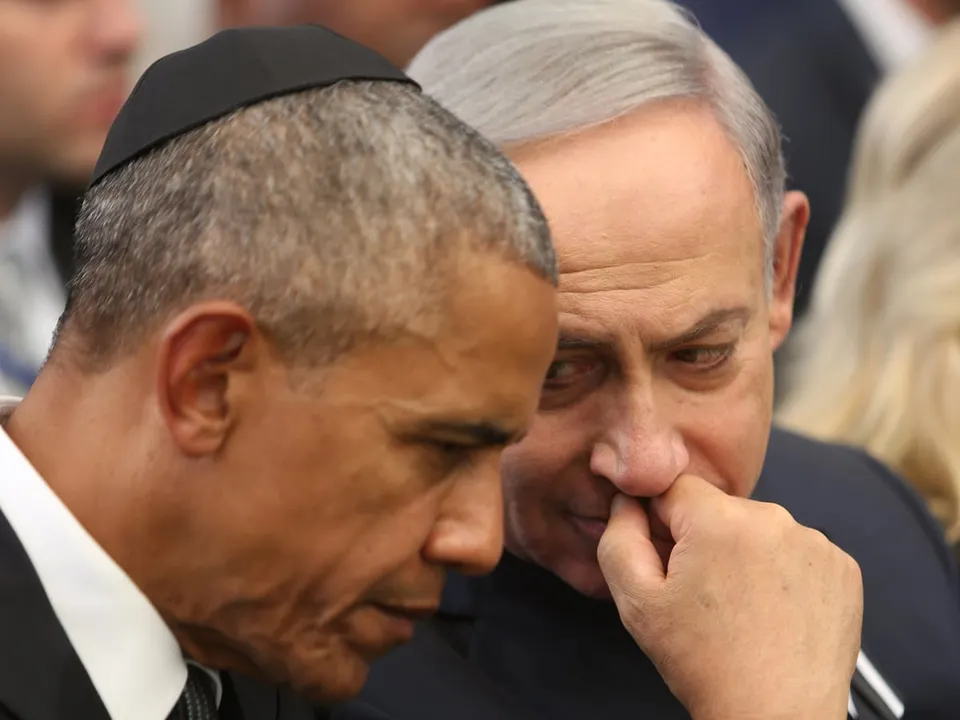
Barack Obama has urged Israel to confront the dispossession of Palestinians and recognise that military strength brings moral responsibility, reopening questions about the decisions he made during eight years as US president. His Belfast remarks have drawn an angry response from Benjamin Netanyahu, while placing renewed attention on a contradiction in Obama’s own record: his acknowledgement of Palestinian injustice coexisted with sustained American military and diplomatic support for Israel.
Speaking with writer and journalist Susan McKay in Belfast on 13 October 2026, the former US president acknowledged centuries of persecution of Jews, their search for safety and their historical connections to the land. He then recognised the injustice experienced by Palestinians who were displaced.
During his presidency, Washington vetoed a Security Council resolution condemning Israeli settlements and concluded a $38 billion military assistance agreement intended to outlast his time in office. Those decisions give his present appeal for restraint a significance extending beyond the words themselves.
The tension was visible before Obama entered the White House. Palestinian writer Ali Abunimah had heard him advocate a more evenhanded American approach and later recalled Obama apologising for not saying more about Palestine during a Senate primary campaign. Abunimah’s account provides a firsthand record of the expectations Obama raised, and the disappointment that followed his movement into national politics.
What Obama said in Belfast
On the history of the conflict, Obama acknowledged Jewish persecution and Palestinian dispossession:
“The fact is that the Jewish people for millennia were oppressed, discriminated against, killed. Europe was responsible for much of that. They understandably sought a refuge in a place where they had historic ties. That is undeniable. What is also undeniable is that they took the land of people and they were expelled. And those people understandably said, ‘This is an injustice and I want my land back.’”
He also addressed the responsibility that accompanies military superiority:
“At some point to break the cycle, the stronger party has a responsibility by virtue of its strength. If the attitude of Israel is now that, ‘We are the strongest army, most technologically advanced in the region, then our security is dependent on us simply doing whatever we please and taking whatever we want, and not making any concessions to anyone.’ That may work short term. It is a disaster for you long term.”
Obama said Israel and its citizenry needed to “rethink, reimagine” how they would live in the region. He asked:
“Are you just going to be behind walls and wipe out everybody around here, or are you going to find some just way of defending yourself while still acting in an ethical, moral way?”
Obama also said Palestinians would have to recognise that they could not defeat Israel through military means, adding:
“which means that we have to look to other examples of how changes come about, based on moral claims and ethical claims, and mobilizing and nonviolent strategies, and that’s going to take some time.”
The Belfast discussion also included Obama’s criticism of the consequences of Hamas’s attacks on 7 October 2023. His argument placed obligations on both sides, while emphasising the greater responsibility of the party with overwhelming military power.
His argument was that military dominance could not resolve the underlying political problem. Israelis and Palestinians would continue to inhabit the same region, making the rights and security of each population unavoidable questions for the other. Reporting from the event also recorded his immediate priorities: relieving suffering, ending violence, stopping further encroachment into the West Bank and helping Gaza rebuild.
Netanyahu answered on 16 October with an English language video invoking Jewish history and attachment to Judea. “Our history is not a colonial enterprise,” he said. “Our land is not stolen land.” He attributed the failure of peace to enemies who refused to accept Jewish statehood and presented Israel’s struggle as part of a shared defence of Western civilisation.
The disagreement concerns the consequences attached to competing historical narratives. Obama’s account acknowledged that Jewish persecution and Palestinian dispossession could both be real. Netanyahu’s response invoked an ancestral connection to reject the description of Israel’s history as colonial.
Obama’s emphasis on the responsibilities of the stronger party also raises a question about Washington’s use of its own power. The United States supplied Israel with weapons and repeatedly intervened on its behalf; the standard Obama invoked therefore bears directly on the choices made by his administration.
The history behind the dispute
The dispute over Obama’s comments reaches into the history of colonisation and displacement, including language used by early Zionist institutions themselves. A contemporary English translation of the Basel Programme, adopted at the First Zionist Congress in 1897, called for “the colonization of Palestine by Jewish agricultural and industrial workers” as one means of establishing a Jewish home secured by public law.
Theodor Herzl’s 1896 work, The Jewish State, also presented the proposed project in terms familiar to European imperial politics. He envisaged a Jewish state in Palestine as part of a European defensive outpost, using the phrase “a rampart of Europe against Asia”. These texts give historical substance to an argument that cannot simply be dismissed as a recent invention by Israel’s opponents.
They do not erase the different motives and experiences of the people who subsequently arrived in Palestine. Some were committed to a nationalist project; others were seeking refuge from persecution and, later, the Holocaust. Recognising the danger from which refugees fled does not resolve the separate question of the rights of the people already living in the territory.
Britain’s Balfour Declaration of 2 November 1917 illustrates the political imbalance. It supported a national home for the Jewish people in Palestine while promising protection for the civil and religious rights of the territory’s existing non Jewish communities. It made no equivalent explicit promise of Palestinian national rights. The distinction was written into the terms of the declaration itself.
European and American responsibility also belongs in that history. The United States Holocaust Memorial Museum records that most of the 32 countries represented at the July 1938 Evian conference refused to admit more Jewish refugees despite expressing sympathy for their plight. Britain and the United States could have admitted more people fleeing Nazi persecution.
That history places European persecution and the failure of other states to provide refuge alongside the consequences Palestinians experienced. The experience of persecution explains the urgency of seeking safety, but it cannot by itself establish a right to dispossess another population.
Around 750,000 Palestinians fled or were expelled during the war surrounding Israel’s establishment in 1948, the catastrophe Palestinians call the Nakba. In its commemoration in May 2026, the United Nations described the displacement as the beginning of a refugee crisis that remains unresolved.
Contemporary territorial rights are also governed by international law. In its advisory opinion of 19 July 2024, the International Court of Justice concluded that Israel’s continued presence in the Palestinian territory occupied in 1967 was unlawful and that new settlement activity must cease. The opinion concerned the occupied territory, including East Jerusalem; it was not a ruling against Israel’s existence. Historical attachment did not displace the court’s assessment of occupation, annexation and Palestinian rights.
Ali Abunimah and the Obama he remembered
One of the clearest accounts of Obama’s earlier engagement with Palestinians comes from Ali Abunimah, the Palestinian writer and cofounder of The Electronic Intifada. In his March 2007 essay, “How Barack Obama learned to love Israel”, Abunimah drew on his own encounters with Obama to examine the gap between the politician he had heard in Chicago and the presidential candidate addressing supporters of Israel.
Abunimah recalled first meeting Obama when the then Illinois state senator spoke at the University of Chicago, almost a decade before the essay appeared. He described being impressed by Obama’s political outlook, intelligence and charisma. He subsequently encountered him approximately half a dozen times, often at Palestinian and Arab American community events.
Among the occasions Abunimah identified was a community fundraiser in May 1998 at which the Palestinian intellectual Edward Said was the keynote speaker. He also recalled hearing Obama during his unsuccessful congressional campaign in 2000, at a fundraiser hosted by a University of Chicago professor. On that occasion and others, Abunimah wrote, Obama criticised American policy and advocated a more evenhanded approach towards Palestinians and Israelis.
The most revealing exchange in Abunimah’s account took place in the winter of 2004 at a gathering in Chicago’s Hyde Park neighbourhood. Obama was seeking the Democratic nomination for a US Senate seat. Abunimah described greeting him as he came in from the cold and took off his coat, and recalled Obama responding warmly before volunteering an apology:
“Hey, I’m sorry I haven’t said more about Palestine right now, but we are in a tough primary race. I’m hoping when things calm down, I can be more up front.”
According to Abunimah, Obama also referred to his activism and the columns he was contributing to the Chicago Tribune criticising Israeli and American policy. His encouragement was explicit: “Keep up the good work.”
These were Abunimah’s recollections of personal conversations, published while Obama was pursuing the Democratic presidential nomination. They show why Palestinian Americans who had encountered him could expect a different approach from the familiar positions of American national politics. They also place his later public commitments beside the expectations he had encouraged in those exchanges.
Abunimah’s own conclusion was that “access to people with power alone does not translate into influence over policy”. He argued that organised constituencies, fundraising and political mobilisation mattered more than sympathetic conversations. That was his explanation of the trajectory he had witnessed, and it remains distinct from the documentary record of Obama’s public commitments.
The move into national politics
Contemporary reporting provides evidence of Obama’s cultivation of a different constituency. A May 2003 article in The Forward described his efforts to attract supporters of Israel, named business leader Penny Pritzker among his backers and reported his support for legislation permitting Illinois to invest in Israel bonds.
By July 2006, Obama was among the sponsors of Senate Resolution 534, condemning Hezbollah and Hamas and supporting Israel’s exercise of its right to defend itself during the fighting in Lebanon and Gaza. The resolution placed him within a broad congressional consensus supporting Israel.
At AIPAC’s Chicago policy forum on 2 March 2007, he described Israel as “our strongest ally in the region and its only established democracy”. He made his commitment to military assistance explicit:
“At the same time, we must preserve our total commitment to our unique defense relationship with Israel by fully funding military assistance and continuing work on the Arrow and related missile defense programs.”
He said those programmes would help Israel retain its military advantage and deter and repel attacks from as far as Tehran and as close as Gaza. He also said Washington should not dictate Israeli security decisions, declaring: “No Israeli Prime Minister should ever feel dragged to or blocked from the negotiating table by the United States.”
The political development is clear, even if no single donor relationship can explain it. Obama’s public commitments increasingly reflected the established American security partnership with Israel. Placed alongside Abunimah’s recollections, those commitments show the distance between the conversations that encouraged Palestinian advocates and the policies Obama pledged to pursue as a national leader.
Obama articulated the limits of his position himself. In an interview with Jeffrey Goldberg published by The Atlantic on 12 May 2008, he recalled telling Palestinian students in Ramallah: “If you’re waiting for America to distance itself from Israel, you are delusional.” That was his own account of an earlier conversation, offered as reassurance about the firmness of his commitment.
At AIPAC on 4 June 2008, after becoming the presumptive Democratic nominee, he pledged to implement the existing $30 billion military assistance agreement and preserve Israel’s military advantage. He also declared: “Jerusalem will remain the capital of Israel, and it must remain undivided.” He subsequently described that formulation as poor phrasing and said he had not intended to prejudge issues that the parties would have to negotiate.
The promise of Cairo and the settlement veto
Obama’s presidential rhetoric did acknowledge Palestinian suffering. In Cairo on 4 June 2009, he spoke of displacement and the humiliations of occupation, supported Palestinian statehood and declared: “The situation for the Palestinian people is intolerable.” He called for settlement construction to stop and urged Palestinians to abandon violence.
Those remarks matter when assessing the Belfast controversy. The problem was already part of Obama’s public account while he held office. The sharper question is why his acknowledgement of Palestinian rights failed to produce sufficient pressure to protect them.
His initial pursuit of a settlement freeze secured a partial Israeli moratorium. When that expired, the administration failed to obtain an extension and changed its diplomatic approach. By December 2010, it had abandoned its immediate effort to secure a renewed freeze.
The limits of American opposition became particularly visible on 18 February 2011. Fourteen members of the UN Security Council supported a draft resolution condemning Israeli settlement activity. The United States vetoed it, arguing that the measure would make negotiations harder despite Washington’s own stated opposition to continued settlement construction.
The decision exposed a weakness in an approach that relied on negotiations while resisting an international attempt to address conduct undermining them. Israel faced criticism from Washington, but Washington prevented that criticism from becoming a Security Council resolution.
By the end of Obama’s presidency, the outcome was measurable. In a speech on 28 December 2016, Secretary of State John Kerry said the settler population in the West Bank, excluding East Jerusalem, had increased by 100,000 since Obama took office in 2009. Kerry warned that settlement expansion was making a viable Palestinian state harder to achieve.
For Palestinians, the years of negotiations therefore coincided with changes on the ground that weakened the prospect those negotiations were supposed to deliver. An assessment of American policy has to account for that outcome alongside the language of its diplomatic statements.
The diplomatic and legal routes Washington resisted
The administration’s objections extended beyond resolutions on settlements. Palestinians attempting to gain recognition through international institutions repeatedly encountered American opposition.
Addressing the UN General Assembly on 21 September 2011, Obama affirmed that Palestinians deserved a state but rejected the idea that UN declarations could deliver peace. His administration insisted that statehood had to emerge through negotiations with Israel.
On 29 November 2012, the United States was one of nine countries voting against granting Palestine nonmember observer state status. The measure nevertheless passed by 138 votes to nine, with 41 abstentions. It was a diplomatic initiative pursued through an international institution, and Washington opposed it.
The same approach shaped its response to the International Criminal Court. On 16 January 2015, the State Department strongly criticised the prosecutor’s decision to open a preliminary examination of the situation in Palestine. Washington disputed Palestine’s eligibility to join the court and said it would continue opposing action against Israel there as harmful to peace.
The administration’s stated rationale was that direct negotiations offered the route to a durable settlement. In practice, Palestinians were urged to pursue political change peacefully while efforts to improve their international standing or seek legal accountability were treated as obstacles to the process Washington preferred.
That approach gave Israel considerable protection from external pressure while leaving Palestinian statehood dependent on an agreement with the state exercising control over the occupied territory. Negotiations were presented as indispensable, even as settlement expansion weakened the territorial basis for their promised outcome.
The contradiction over peaceful pressure
Obama’s position on boycotts and divestment makes the tension especially explicit. At AIPAC on 4 March 2012, he set out his administration’s diplomatic and political defence of Israel:
“When one-sided resolutions are brought up at the Human Rights Council, we oppose them. When Israeli diplomats feared for their lives in Cairo, we intervened to save them. When there are efforts to boycott or divest from Israel, we will stand against them. And whenever an effort is made to delegitimize the state of Israel, my administration has opposed them. So, there should not be a shred of doubt by now. When the chips are down, I have Israel’s back.”
Those words now sit alongside his appeal in Belfast for Palestinian strategies based on moral claims and nonviolence. In an analysis published on 27 October 2026, journalist Owen Jones argued that the comparison exposed a contradiction: Palestinians were urged to embrace nonviolence while an American president opposed prominent methods of peaceful pressure. His criticism concerned the gap between that advice and the policies accompanying it.
Boycotts and divestment seek to change behaviour by withdrawing purchases, investment or institutional cooperation. Their immediate mechanism is public and economic pressure. Whatever objections an administration may have to a particular campaign’s objectives, opposing those methods narrows the means available to people seeking change without armed force.
Obama did not oppose every conceivable form of peaceful Palestinian political activity. His Cairo and UN speeches supported institution building and negotiations. The relevant distinction is that he backed a diplomatic process while resisting several tools through which Palestinians sought to alter the balance of that process.
The practical question concerns the means available to people seeking to advance their rights. If a population is urged to reject violence while major attempts to secure recognition, legal scrutiny or economic pressure are resisted, its ability to influence the political process is constrained. Calling for nonviolence is more credible when accompanied by a willingness to protect peaceful protest and accept the political consequences of peaceful organising.
Gaza in 2014 and the continuation of military support
The human consequences of the relationship were visible during the 2014 Gaza war. The UN commission investigating that conflict recorded 2,251 Palestinian deaths, including 1,462 civilians. Among those killed were 551 children. Its report also recorded six civilians killed in Israel and 67 Israeli soldiers.
The scale of destruction extended far beyond the death toll. OCHA reported more than 11,000 Palestinians injured, over 1,500 children orphaned and approximately 18,000 housing units destroyed wholly or partly. At the height of the fighting, about half a million people were displaced inside Gaza.
During the conflict, the Pentagon authorised Israel to replenish tank ammunition and illumination rounds from American stocks held in Israel. A Congressional Research Service account also documented subsequent tensions over weapons transfers, including additional scrutiny and a reported delay involving Hellfire missiles. Those details show friction within the relationship, alongside the continuation of substantial military support.
The distinction matters for assigning responsibility. Routine military transfers did not necessarily receive personal approval from Obama, but they occurred within the system of assistance maintained by his administration. The political question concerns that system and the circumstances in which it continued supplying a military whose operations were causing extensive civilian harm.
Washington also opposed the international inquiry. On 23 July 2014, the United States cast the only vote against the Human Rights Council resolution establishing a commission to investigate violations in the occupied Palestinian territory. Twenty nine states supported the measure and 17 abstained. The resulting investigation examined the conduct of Israeli forces and Palestinian armed groups.
Military assistance and diplomatic protection operated together. American support helped preserve Israel’s capacity to wage war, while American diplomacy resisted an international mechanism intended to examine the conduct of that war. Expressions of concern about civilians did not become a sustained break in the security relationship.
A military commitment extending beyond his presidency
The most durable statement of Obama’s policy came near the end of his second term. On 14 September 2016, his administration concluded a ten year memorandum of understanding pledging $38 billion in military assistance to Israel for the fiscal years 2019 to 2028. It comprised $33 billion in foreign military financing and $5 billion for missile defence.
The White House described it at the time as the largest single pledge of military assistance in American history. It was a commitment for future years, with funding subject to the US appropriations process, rather than $38 billion delivered during Obama’s presidency. Its significance lay in providing a framework for sustained support long after he left office.
Jones’s analysis also challenged an assessment of Obama based primarily on his difficult personal relationship with Netanyahu. Whatever their disagreements, the administration left behind an expanded military assistance commitment. A strained relationship between leaders did not produce a corresponding withdrawal of the principal material support Israel received from Washington.
There was, however, a significant departure from earlier diplomatic protection. On 23 December 2016, the United States abstained on Security Council Resolution 2334, allowing it to pass with 14 votes in favour. The resolution reaffirmed that settlements in territory occupied since 1967, including East Jerusalem, had no legal validity and demanded an end to settlement activity.
That decision belongs in any serious assessment of Obama’s record. His administration eventually allowed the Security Council to state a position it had blocked the council from advancing in 2011. The abstention demonstrated that American protection was a policy choice capable of being changed.
It also came in the final weeks of his presidency, after the larger military commitment had been agreed. Acknowledging the importance of the resolution still leaves the central question intact: why did opposition to settlements produce so little sustained pressure during the years in which their population continued to grow?
The danger facing Palestinian protest
Gaza’s Great March of Return in 2018 exposed the dangers facing Palestinian demonstrators and the limits of assuming that peaceful action alone would secure a hearing for their demands. Those events occurred after Obama had left office, so they illustrate a wider problem rather than a decision of his administration.
A UN commission examined the demonstrations between 30 March and 31 December 2018. It recorded 189 Palestinians killed during those demonstrations, including 183 killed by live ammunition; 35 of the fatalities were children. The commission found reasonable grounds to believe that Israeli personnel had killed and injured civilians who were neither directly participating in hostilities nor posing an imminent threat.
The investigators acknowledged significant violent acts at some demonstrations, but concluded that the protests were civilian in nature and did not amount to military campaigns. They also criticised incendiary kites and balloons and the failure of Gaza’s authorities to prevent them. Israel rejected the findings as biased and said they did not adequately account for threats from Gaza.
The commission’s findings show why appeals to nonviolent action must address what happens when civilian demonstrators face lethal force. The responsibility of governments advocating peaceful change includes scrutiny of the force used against protesters and support for their ability to organise and make political demands.
Accountability after Gaza
The destruction of Gaza since October 2023 has given questions of accountability a more urgent context. In September 2025, the UN Independent International Commission of Inquiry concluded that Israel had committed genocide against Palestinians in Gaza. Israel rejected the report, accused the commission of bias and maintained that its campaign targeted Hamas while seeking to reduce civilian harm.
The commission’s finding is distinct from a judgment by an international court. Separately, on 21 November 2024, the International Criminal Court issued arrest warrants for Netanyahu and former defence minister Yoav Gallant over alleged war crimes and crimes against humanity, including starvation as a method of warfare. The warrants were not convictions, and the allegations announced with them were not genocide charges.
These developments intensify the questions raised about earlier American policy, but responsibility still needs to be assigned with care. Obama left office in January 2017. Decisions made by subsequent American and Israeli governments were their own, and the record does not establish that every later atrocity followed inevitably from his policies.
The longer historical question concerns the conditions American policy helped sustain. A government repeatedly supplied with arms and defended against international pressure has less reason to believe that another expression of American concern will carry serious consequences. Obama’s current warning about the dangers of military superiority therefore invites examination of his own contribution to sustaining that superiority and limiting the pressure attached to its use.
There is evidence that the American political environment is changing. Gallup reported on 27 February 2026 that 41 per cent of Americans sympathised more with Palestinians and 36 per cent more with Israelis. The difference was not statistically significant, but it marked a change from the clear Israeli lead in previous years. Among Democrats, the figures were 65 per cent for Palestinians and 17 per cent for Israelis.
Those findings indicate that Palestinian suffering and Palestinian rights command a different place in American debate. They do not establish that any particular sanctions or arms policy will follow. Changes in public sympathy still have to be translated into decisions by governments and legislators.
Obama’s Belfast remarks may help widen that debate, particularly by recognising that the persecution of Jews and the dispossession of Palestinians must both be confronted. Their political value, however, cannot substitute for an assessment of his exercise of power.
The record shows a president who understood that occupation inflicted injustice, publicly opposed settlements and urged Palestinians to pursue peaceful change. It also shows an administration that sustained military assistance and resisted several of the diplomatic, legal and economic methods through which Palestinians sought accountability.
Abunimah recorded Obama’s hope that he could speak more openly about Palestine once electoral pressures eased. More than two decades after that conversation, the former president’s Belfast comments put that question of candour back in public view. A credible reckoning also requires an explanation of the choices he made while holding power.
The responsibility that comes with strength applies to Obama’s own years in office as much as to the Israeli government he now challenges.
Attributions
The following sources support the quotations, historical account and analysis in this feature. Contemporary reporting supplies the Belfast remarks, while original speech transcripts, official records and firsthand accounts support the historical sections. Ali Abunimah’s personal recollections are drawn from his March 2007 essay. Dates distinguish events from later publication or republication.
Marc Rod, “Obama scrutinizes Israel’s founding, says Palestinians want their land back”, Jewish Insider, 15 October 2026.
Lazar Berman and staff, Netanyahu’s response to Obama’s remarks, The Times of Israel, 16 October 2026.
Fact sheet on the memorandum of understanding reached with Israel, Obama White House archive, 14 September 2016.
Gerry Moriarty, “Obama tells Belfast event democracy not inevitable but keeps Trump criticism subtle”, The Irish Times, 14 October 2026.
United States Participation in the United Nations, Security Council resolutions, US Department of State archive, 2011 record, including the vote of 18 February 2011.
Ali Abunimah, “How Barack Obama learned to love Israel”, The Electronic Intifada, 4 March 2007; full text consulted in the ZNetwork reprint dated 6 March 2007.
The Basel Programme, contemporary English translation, The Posen Library, originally published in The Jewish Chronicle, 3 September 1897.
Theodor Herzl, The Jewish State, section “Palestine or Argentine”, Project Gutenberg, English edition of the original 1896 work.
Balfour Declaration, Yale Law School, Avalon Project, 2 November 1917.
“The Evian Conference”, United States Holocaust Memorial Museum, Holocaust Encyclopedia, historical account of July 1938; accessed 28 October 2026.
Khaled Khiari, Statement commemorating the 78th anniversary of the Nakba, United Nations, 15 May 2026.
Advisory opinion on the legal consequences of Israeli policies and practices in the occupied Palestinian territory, press release 2024/57, International Court of Justice, UN reproduction, 19 July 2024.
E J Kessler, “Illinois Senate Candidates Eyeing State’s Jewish Voters”, The Forward, 9 May 2003.
Senate Resolution 534, 109th Congress, agreed text and cosponsors, US Government Publishing Office, 18 July 2006.
Barack Obama, Remarks at the AIPAC Policy Forum in Chicago, The American Presidency Project, 2 March 2007.
Jeffrey Goldberg, “Obama on Zionism and Hamas”, The Atlantic, 12 May 2008.
Barack Obama, Remarks to the AIPAC Policy Conference in Washington, The American Presidency Project, 4 June 2008.
Barack Obama, Interview with Fareed Zakaria on Global Public Square, CNN, transcript reproduced by The American Presidency Project, 13 July 2008.
Barack Obama, Remarks at Cairo University, Obama White House archive, 4 June 2009.
Philip J Crowley, Daily press briefing on the settlement moratorium and negotiations, US Department of State, transcript reproduced by GlobalSecurity, 8 December 2010.
John Kerry, Speech on Middle East peace, full transcript, The Times of Israel reproduction, 28 December 2016.
Barack Obama, Address to the United Nations General Assembly, Obama White House archive, 21 September 2011.
General Assembly vote according Palestine nonmember observer state status, United Nations, 29 November 2012.
Jeff Rathke, Statement on the ICC prosecutor’s decision, US Department of State, UN reproduction, 16 January 2015.
Barack Obama, Remarks at the AIPAC Policy Conference, Obama White House archive, 4 March 2012.
Owen Jones, “Obama’s EXPLOSIVE Israel Speech Exposes His Own Hypocrisy”, The Owen Jones Podcast, Acast, 27 October 2026.
Report of the independent commission of inquiry on the 2014 Gaza conflict, A/HRC/29/52, United Nations Human Rights Council, June 2015.
“Key figures on the 2014 hostilities”, United Nations OCHA, 23 June 2015.
US Foreign Aid to Israel, RL33222, sections on stockpiles and weapons transfers, Congressional Research Service, EveryCRSReport reproduction, 10 June 2015.
Human Rights Council establishes an independent international commission of inquiry, United Nations, 23 July 2014.
US Foreign Aid to Israel, RL33222, aid memorandum and congressional approval, Congressional Research Service, EveryCRSReport reproduction, 22 December 2016.
Security Council adopts Resolution 2334 as United States abstains, United Nations, 23 December 2016.
Independent commission of inquiry on protests in Gaza presents its findings, OHCHR, UN reproduction, 28 February 2019.
Commission urges review of rules of engagement before Gaza protest anniversary, OHCHR, UN reproduction, 18 March 2019.
Overview of February 2019, including Israel’s response to the protest inquiry, United Nations OCHA, 18 March 2019.
“Israel has committed genocide in the Gaza Strip, commission finds”, UN Independent International Commission of Inquiry, 16 September 2025.
Israeli government response rejecting the commission’s genocide report, Israel’s mission in Geneva, UN reproduction of a non UN document, 16 September 2025.
ICC issues arrest warrants for Benjamin Netanyahu and Yoav Gallant, International Criminal Court, UN reproduction, 21 November 2024.
Benedict Vigers, “Israelis No Longer Ahead in Americans’ Middle East Sympathies”, Gallup, 27 February 2026.