Gaza, the October 7 Warnings and the Human Cost of Israel’s Security Strategy
The disputed warnings before October 7 place Israel’s intelligence failures alongside the destruction of Gaza and the civilian, diplomatic and political consequences of its operations across the region.
On 16 September 2025, the independent commission established by the United Nations Human Rights Council concluded that Israel had committed genocide against Palestinians in Gaza. Its assessment, covering events from October 2023 to July 2025, examined killings, serious bodily and mental harm, the conditions imposed on the population and measures affecting births. Israel rejected the report. The conclusion was an investigative finding by the commission, distinct from a judgment of the International Court of Justice. www.un.org
A year later, investigations into the warnings preceding the Hamas assault reopened questions about the political judgments behind Israel’s security failure. Reports published in September 2026 alleged that Benjamin Netanyahu had received an explicit warning from the president of the United Arab Emirates shortly before the attack and had failed to share it with senior security officials. Netanyahu denied the account and subsequently sued over its publication. www.timesofisrael.com
Those disclosures became a central theme of a Briefing Room monologue by former CIA officer John Kiriakou, who argued that intelligence failures often begin with leaders refusing to reconsider assumptions already embedded in policy.
His argument developed a tension evident in an earlier appearance on the Dalton Fischer Podcast. In an excerpt published on 4 September 2025 under the title “This Is Why People Fear The Mossad”, Kiriakou described Israel’s foreign intelligence service as the “best in the world”, while criticising its methods and its relationships with partner agencies.
The two assessments were connected in his telling. An intelligence service could demonstrate extraordinary technical skill, recruit valuable sources and pursue adversaries abroad, yet still operate within a political system that misunderstood a threat or accepted grave risks to civilians.
Kiriakou’s perspective comes from a CIA career that US Justice Department records place between 1990 and 2004. His accounts of dealings with Israeli intelligence belong to that professional experience; his assessments of the later operations in Dubai, Lebanon and Iran were made after he had left the agency. www.justice.gov
The warnings that travelled through several channels
The warning story began before the alleged conversation between Netanyahu and the Emirati president.
Sufian Abu Zaida, a former Palestinian Authority minister, described a negotiating channel involving Hamas leader Yahya Sinwar that had operated since March 2022. In an interview covered by The Times of Israel on 25 September 2026, Abu Zaida identified himself as the intermediary previously referred to in reporting by the pseudonym “Coal Eyes”.
He said he met Sinwar on 14 September 2023 and received a warning of an approaching “earthquake” if negotiations remained blocked. The discussions concerned, among other issues, an exchange involving Palestinian prisoners and Israelis held in Gaza. Abu Zaida displayed what he said was a dictated message and described passing the warning to Israeli interlocutors in Arabic and Hebrew the following morning. His account placed a threatening message inside an existing negotiating channel weeks before the attack. www.timesofisrael.com
The more politically explosive allegation concerned what happened at the level of national leaders.
On 8 September 2026, Haaretz journalists Shlomi Eldar and Ruth Yuval reported that UAE President Sheikh Mohamed bin Zayed had warned Netanyahu in a lengthy telephone conversation shortly before 7 October that Hamas was preparing a major escalation. Their account alleged that Netanyahu did not brief Israel’s security chiefs about the warning.
The Times of Israel reported separate corroboration from an Emirati source. It also drew an important distinction: the Shin Bet had already received and discussed an earlier message from Sinwar. The allegation against Netanyahu concerned an additional warning delivered personally by the Emirati president, rather than the complete absence of prior intelligence within Israel’s security services. www.timesofisrael.com
That distinction changes the nature of the failure under examination. The question is how separate pieces of information were assessed and combined, and whether a message from a foreign head of state would have challenged the prevailing view that Hamas could be contained.
A New York Times investigation published on 25 September 2026 added testimony and documentary scrutiny. Reporters Adam Rasgon, Mark Mazzetti and Ronen Bergman described accounts from two people concerning the Emirati warning, while five former senior Israeli officials said it had not been passed to security chiefs.
The newspaper also examined minutes of an Israeli security meeting held on 1 October 2023. The minutes contained no mention of the alleged presidential warning. They recorded Netanyahu urging calm in Gaza amid concern that escalation could damage efforts towards normalisation with Saudi Arabia. The warning described in the investigation did not specify whether the threatened attack would take the form of rocket fire or a ground invasion. www.inquirer.com
Netanyahu rejected the central claim. His office denied that the reported conversation with the Emirati president had taken place during the period in question and said relevant intelligence had been handled through established channels. On 29 September 2026, he filed a defamation lawsuit seeking 2.6 million shekels from media organisations and journalists over the reporting, according to The Jerusalem Post. Haaretz stood by its account. www.timesofisrael.com
The UAE’s public response was guarded. In comments reported by The National on 19 September, an official source said security information was handled through the relevant institutions rather than through national leaders. That statement did not publicly authenticate the alleged presidential call. It left a gap between the accounts attributed to sources and the position the Emirati authorities were prepared to state openly. www.thenationalnews.com
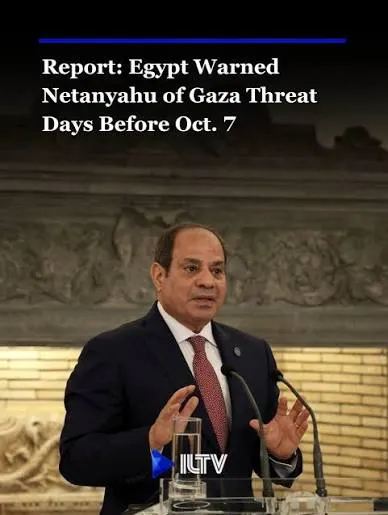
There were also reports of warnings from Egypt. On 11 October 2023, Michael McCaul, then chairman of the US House Foreign Affairs Committee, said after a classified briefing that Egypt had warned Israel three days before the assault. Contemporary reporting by The Times of Israel recorded uncertainty over who had received the message and whether it had reached Netanyahu personally. Netanyahu denied receiving such a warning. www.timesofisrael.com
Taken together, these accounts justify scrutiny of how warnings were handled. They do not establish that Netanyahu knew the details of the coming operation or deliberately allowed it to happen. A warning that Hamas intended a major escalation, knowledge of a specific invasion plan and an intention to permit an attack are different propositions.
The assault itself killed approximately 1,200 people and resulted in the abduction of 251, according to the Israeli official account. The victims were attacked across several locations in southern Israel, including communities and the Nova music festival. govextra.gov.il
For Kiriakou, the emerging reports raised a familiar intelligence question: whether decision makers had become so committed to an existing interpretation of an adversary that contradictory information failed to alter their response.
The political assumptions behind “buying quiet”
The warning controversy cannot be separated from the policy that preceded it.
For years, Israeli governments permitted Qatari money to enter Gaza under arrangements intended to support civilian needs and reduce instability. A New York Times investigation published in December 2023, and reproduced by The Irish Times, described Netanyahu’s role in allowing and encouraging funding that helped sustain the territory’s administration.
The money supported fuel purchases, salaries and assistance to families. Israeli intelligence officials cited in the investigation argued that this also freed resources Hamas could use elsewhere. Netanyahu’s office defended the arrangements as humanitarian measures, while Qatar rejected the suggestion that its assistance financed Hamas’s military activity. www.irishtimes.com
The policy rested partly on the expectation that economic incentives and the responsibilities of governing Gaza would constrain Hamas. Kiriakou argued that such arrangements also served an Israeli political interest: maintaining the division between Hamas in Gaza and the Palestinian Authority in the West Bank.
That argument had appeared in Israeli reporting well before the war. On 12 March 2019, The Jerusalem Post’s Lahav Harkov reported a source’s account of remarks Netanyahu had made at a Likud meeting. The source paraphrased him as linking support for financial transfers to Hamas with a strategy of preserving the separation between Gaza and the West Bank and obstructing Palestinian statehood. The published formulation was a participant’s paraphrase, rather than a verbatim transcript of Netanyahu’s words. www.jpost.com
The funding arrangements therefore carried competing explanations: humanitarian relief, an effort to maintain calm and a political calculation about Palestinian division. Those explanations could coexist, but they produced different expectations about what Hamas would do.
The later warning reports put those expectations under pressure. If leaders believed Hamas had too much to lose from a major confrontation, a threat arriving through a negotiating channel might be interpreted as bargaining. A warning from a regional partner might be absorbed into the same framework.
That is a possible explanation for the handling of the intelligence, rather than proof of any individual’s intention. Establishing responsibility requires identifying what officials received, what they believed and what decisions followed.
A former CIA officer’s memory of another catastrophe
Kiriakou reached for the period before 11 September 2001 to explain how an intelligence system could register danger without preventing disaster.
He recalled a briefing on 6 July 2001 in which Cofer Black, then head of the CIA’s Counterterrorist Center, warned visiting intelligence officials that an attack appeared imminent. In Kiriakou’s account, the agency did not know precisely where or when it would occur, and Black pressed foreign partners for any sources or information that might help.
That particular briefing is Kiriakou’s recollection. The broader atmosphere is documented in the 9/11 Commission’s July 2004 report, whose chapter on the months before the attacks describes mounting threat reporting, fragmented information and failures to translate warnings into an effective response. Its heading, “The System Was Blinking Red”, captured the gulf between recognising danger and understanding the operation being prepared. 9-11commission.gov
Kiriakou also described the shock inside the CIA when the attacks occurred and the sustained work that followed. His comparison with October 7 concerned institutional judgment and political accountability. He expressly identified al Qaeda as responsible for 9/11 and rejected claims blaming Israel or Jewish people.
The comparison has limits. The agencies, adversaries, warning channels and political circumstances were different. Its relevance lies in the questions that survive a catastrophic failure: who possessed which information, who could have acted on it, and whether the official record permits those decisions to be examined.
The struggle over that record can continue for decades. On 8 September 2026, New York City announced the settlement of two lawsuits brought by 9/11 Health Watch and an initial release of approximately 170,000 pages of records. Mayor Zohran Mamdani’s administration also announced $34 million in funding for a public records portal, with further releases planned. The material included records concerning environmental conditions and the response to the attacks. www.nyc.gov
Such disclosures do not settle every allegation about a disaster. They make it possible to test official explanations against documents that were previously difficult to obtain. That is also the importance of the meeting minutes, testimony and communications at the centre of the October 7 investigations.
Lebanon and Iran: reach, destruction and civilian risk
The ability to collect intelligence and strike an adversary remained central to Kiriakou’s assessment of Israel, even as he criticised the consequences.
In Lebanon, the Israeli strike that killed Hezbollah leader Hassan Nasrallah on 27 September 2024 demonstrated the reach of Israel’s military and intelligence apparatus. It also brought that capability into a densely populated urban setting.
Associated Press reporting placed the attack in Haret Hreik, in Beirut’s southern suburbs, where several apartment buildings were destroyed. Israel said it had struck Hezbollah’s headquarters beneath residential buildings. Reuters reported the following day on the confirmation of Nasrallah’s death and the scale of the blow to the organisation. www.pbs.org
Kiriakou’s judgment in the Fischer interview was blunt: “It decapitated Hezbollah. It was also a war crime.”
The first statement described his assessment of the strike’s organisational impact. The second was his legal and moral characterisation, rather than a court finding.
The legal issues turn on the circumstances of the attack. The International Committee of the Red Cross explains that the prohibition on disproportionate attacks concerns civilian harm expected to be excessive in relation to the concrete and direct military advantage anticipated. The assessment must consider what was foreseeable when the attack was planned and launched. ihl-databases.icrc.org
Commanders must also take feasible precautions to reduce civilian harm. The presence of a military objective in or beneath a residential area does not remove the obligations owed to the people living around it. Those obligations make the choice of weapons, the anticipated effects on surrounding buildings and the available alternatives central to scrutiny of such a strike. casebook.icrc.org
Similar questions arose during Israel’s attacks on Iran in June 2025.
On 14 June, the Israeli military announced that nine senior scientists and experts associated with Iran’s nuclear programme had been killed in the opening strikes. It described the operations as air force attacks guided by military intelligence and alleged that those targeted had important roles in developing nuclear weapons capabilities. www.idf.il
Public accounts of the number killed subsequently differed. An Associated Press report on 24 June quoted Israeli ambassador Joshua Zarka saying at least 14 nuclear scientists had been killed. Reuters reported on 27 June that an Israeli official put the number at 11. The figures came from different statements at different points in the campaign. www.timesofisrael.com
Kiriakou described a wider campaign of threats and coercion. He alleged that Israeli personnel speaking Persian contacted scientists and their families, offering opportunities to leave Iran or warning that they would be killed. His assertion that every scientist had been contacted was broader than the publicly documented evidence discussed alongside his account.
The Washington Post reported on 23 June 2025 that a recorded call threatened an Iranian general. www.washingtonpost.com
Evidence of civilian deaths emerged more fully after the fighting. In an investigation published on 17 December 2025, Bellingcat and its reporting partners examined strikes on residential buildings associated with targeted scientists. Using imagery, death notices and cemetery records, the investigation documented civilian deaths beyond the intended targets and the destruction of homes in the attacks. www.bellingcat.com
The status of the scientists themselves also required scrutiny. The ICRC’s explanation of direct participation in hostilities distinguishes activities that can cause civilians to lose protection from the broader work that supports a state’s military capacity. Scientific expertise or employment in an industry associated with defence does not, by itself, resolve whether an individual is lawfully targetable. The person’s actual role and conduct matter. www.icrc.org
For relatives and neighbours, the question is more immediate. Even when an individual constitutes a lawful target, that does not make everyone nearby a target as well. The obligation to assess civilian harm remains.
Kiriakou’s criticism centred on that human cost. His admiration for intelligence skill did not soften his account of what happens when operations reach people through their homes and families.
Dubai’s cameras and a locked hotel room
The operation that most clearly illustrated Kiriakou’s fascination with Mossad’s methods took place far from an active battlefield.
Mahmoud al Mabhouh, a senior Hamas figure, was killed in a Dubai hotel on 19 January 2010. His body was discovered the following day. A reconstruction published by The National on 17 February traced suspects through airport arrivals, hotel corridors and surveillance footage.
One detail especially interested Kiriakou: the room was secured from inside when the body was discovered. The National’s account recorded the internal latch and chain, a feature that complicated the initial appearance of the death. www.thenationalnews.com
Dubai’s extensive surveillance system also made the operation unusually visible after the event. Police assembled a chronology of movements, disguises and apparent coordination. On 24 February, they announced that the number of identified suspects had risen to 26, encompassing people allegedly involved in different parts of the operation. www.wam.ae
Dubai police attributed the killing to Mossad. Contemporary Reuters reporting recorded Israel’s refusal to confirm or deny involvement. www.the-independent.com
The diplomatic consequences extended beyond that accusation because the operation involved passports bearing the identities of people who were not accused of participating.
In a statement to the British Parliament on 23 March 2010, Foreign Secretary David Miliband said the investigation into the misuse of British passports provided compelling reasons to believe Israel was responsible for that misuse. Twelve British citizens had had their identities used. Britain required an Israeli embassy official to leave. hansard.parliament.uk
Australia reached its own conclusion about passport fraud. Addressing Parliament on 24 May, Foreign Minister Stephen Smith said the investigation left no doubt that Israel was responsible for the abuse of Australian passports. Australia also required the withdrawal of an Israeli official. www.openaustralia.org.au
These findings concerned the use of passports and stolen identities. They gave the governments a documented basis for diplomatic action without resolving every operational detail of the killing.
Kiriakou’s account also drew on a visit to Dubai’s police command centre. He described watching a traffic incident unfold on a screen while emergency services were already responding. Contemporary reporting from 2005 documented the development of a Siemens supported command system linking police operations and surveillance. His recollection conveyed the impression of an unusually integrated system, although his broader claims about its comprehensiveness remained his own assessment. gulfnews.com
The Dubai case contained both operational success and extensive exposure. Al Mabhouh was killed, but the police reconstruction revealed movements and methods, while the passport investigations damaged relations with friendly governments.
An earlier operation in Jordan showed how much more seriously an assassination attempt could unravel.
On 25 September 1997, Israeli agents attempted to poison Hamas leader Khaled Meshaal in Amman. Two agents were captured. The Clinton Presidential Library’s historical account describes the ensuing confrontation, in which King Hussein pressed for an antidote and US President Bill Clinton became involved. www.clintonlibrary.gov
A Reuters retrospective published on 31 July 2024 recounted how the crisis threatened Israel’s relationship with Jordan and ended with Israel supplying the antidote and releasing Hamas founder Sheikh Ahmed Yassin. Meshaal survived an operation that produced a diplomatic emergency for the government that authorised it. www.reuters.com
Fischer introduced a different kind of allegation during his conversation with Kiriakou: a story, which he said came from a documentary, about an informant persuaded to help arrange an ambush and then killed despite assurances of protection. The retelling supplied no name for the informant, identifiable documentary or sufficiently clear location to establish the episode independently. Kiriakou did not present it as an operation he had witnessed.
Its place in the conversation was nevertheless revealing. The discussion repeatedly returned to the vulnerability of people who work for intelligence services, and to the possibility that an agency’s operational priorities can overwhelm obligations to the individuals it recruits.
Allies, espionage and the limits of trust
Kiriakou’s criticism was particularly sharp when he discussed intelligence liaison.
“I’ve never had a positive encounter with Mossad,” he told Fischer, describing what he regarded as an aggressive service willing to recruit sources among people connected to friendly governments. His judgment was drawn from personal experience and was broader than any single publicly documented case.
The historical record does establish that close diplomatic and security relationships have not prevented espionage.
Jonathan Pollard, a civilian US naval intelligence analyst, was arrested in November 1985 after supplying American secrets to Israel. The FBI’s account places the beginning of his espionage in 1984. An Israeli government statement issued on 12 May 1998 identified Lakam, a separate Israeli intelligence organisation, as the body that handled him. Pollard’s case therefore illustrates Israeli espionage against an ally, while the organisational distinction matters when discussing Mossad specifically. www.fbi.gov
Surveillance has also operated in the other direction. In December 2015, Reuters reported a Wall Street Journal investigation alleging that the US National Security Agency monitored Netanyahu and other Israeli officials during the dispute over the Iran nuclear agreement. The account concerned reported American surveillance, rather than a public acknowledgment by the NSA. uk.investing.com
Kiriakou said spying on Israel had been prohibited during his own CIA service. That recollection describes the rules as he understood them in his working environment; it does not establish an enduring prohibition across every American agency and administration.
His discussion of intelligence cooperation also touched on the Five Eyes partnership. Its foundations long predate 9/11. An NSA historical account published on 5 February 2021 traced the British and American relationship to wartime cooperation and the agreement signed in March 1946 that developed into the UKUSA framework. www.nsa.gov
The distinction helps explain the world Kiriakou was describing. Intelligence partnerships can be deep, durable and operationally essential while still containing restrictions, competing priorities and mistrust. His broader contention was that an ally’s willingness to cooperate should never be confused with an abandonment of its own interests.
The pressure for political consequences
By September 2026, scrutiny of Israeli policy had also produced new diplomatic proposals concerning settlements in the occupied West Bank.
In a joint declaration on 8 September, 12 governments said they would introduce, or actively consider, further restrictions connected to settlements. The measures concerned economic activity associated with settlements rather than a comprehensive prohibition on trade with Israel. www.gov.uk
In the British Parliament that day, Foreign Secretary Ed Miliband set out proposed restrictions involving settlement goods, services and advertising. He described plans for legislation over the following six to nine months, making clear that the full package was a programme to be implemented. His statement also set out the British government’s assessment that settler violence and forced displacement were contributing to ethnic cleansing in parts of the West Bank. www.gov.uk
The announcement prompted criticism from US ambassador Mike Huckabee. Axios reported that Huckabee’s criticism had not been coordinated with the White House or State Department. www.axios.com
For Kiriakou, such developments formed part of a larger argument about the consequences of security policy. He questioned the assumption that tactical victories, assassinations or the removal of leaders necessarily produce lasting security. His experience of the American response to 9/11 informed that criticism, particularly his concern that the policies adopted after an attack can create consequences extending far beyond its perpetrators.
His account remains one participant’s interpretation of a secretive profession. The public record is more varied: investigative reporting, official denials, military statements, parliamentary findings, court proceedings, casualty investigations and documents released years after the decisions they describe.
Together, those records complicate any simple account of an omnipotent intelligence service. In Jordan, an operation failed and forced a diplomatic retreat. In Dubai, a killing was followed by exposure and passport investigations. In Lebanon and Iran, successful attacks on intended targets raised questions about the people killed or endangered around them. Before October 7, the issue was whether available warnings challenged assumptions at the top of government.
The story returns to Gaza because the consequences of those decisions extend far beyond the institutions that made them. The reporting on prewar warnings does not resolve responsibility for the conduct of the subsequent war, and operational achievements elsewhere do not answer the findings concerning Palestinian civilians.
What the investigations have begun to establish is a more concrete record of responsibility: who received information, what they communicated, which risks they accepted and how their decisions were defended afterwards. The remaining gaps concern choices made by identifiable officials and institutions, with consequences for people who had no part in making them.