Gaza’s Flooded Tents Expose a Winter Disaster Foretold
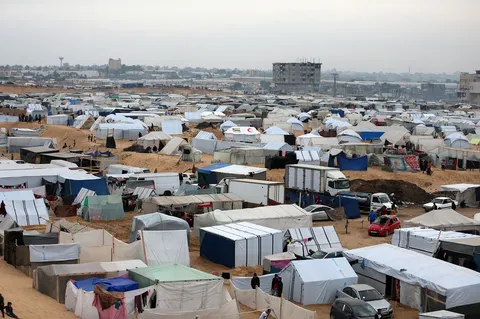
Heavy rain has inundated displacement camps across Gaza, leaving families struggling to find dry shelter and protect their children from cold and disease. The emergency follows weeks of detailed warnings about deteriorating tents, unsafe buildings, restrictions on essential supplies and a severe shortage of funding for winter protection.
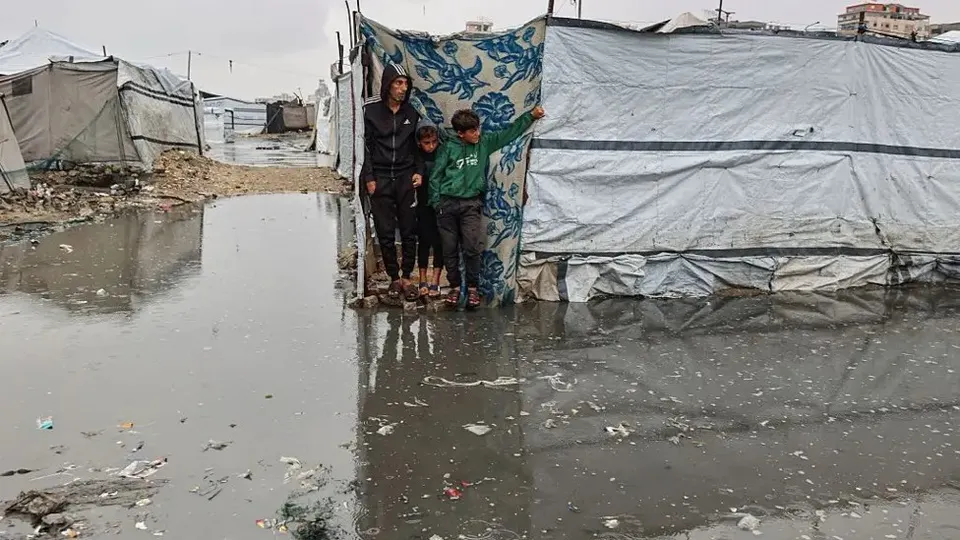
As rain flooded the makeshift camps where Gaza’s displaced families have been trying to survive, Maryam Odeh faced a question from her children that she could not answer.
“We no longer know how to protect our children,” said Odeh, 34, who lives with her family in Deir al Balah. “My children ask me where we will sleep tonight, and I have no answer.”
Across the territory, families struggled to remove water from their tents and salvage belongings as bedding and clothing became soaked. Gaza’s government media office estimated that approximately 70,000 tents had flooded within 12 hours on 7 November, although the figure has not been independently verified. Civil Defence spokesman Mahmoud Bassal said emergency teams received more than 1,500 distress calls overnight while lacking the equipment and resources needed to respond adequately. www.al-monitor.com
Jonathan Veitch, UNICEF’s representative for Palestine, described aid workers being stopped in the street by people pleading for assistance.
“We’re providing all the assistance that we can but we’re getting stopped on the street as we’re driving now because people are begging us for help,” he said.
The desperation was immediate, but the conditions behind it had been documented well before the storm. Humanitarian agencies had identified extensive flood exposure, exhausted shelter stocks and large numbers of families living in structures that could offer little protection when winter arrived.
The rain has exposed the distance between those warnings and the protection available to people who have already endured repeated displacement.
A danger identified before the rain
By September, UNICEF estimated that more than 1.76 million people, approximately 84 per cent of Gaza’s population, were living in overcrowded displacement sites or damaged and inadequate accommodation. The agency warned that families were entering winter with little protection from the elements. www.unicef.org
During October, UN humanitarian assessments identified approximately 950,000 people living in displacement sites at medium to high risk of flooding. More than 400,000 of them were in locations assessed as high risk.
A further assessment identified about 44,000 people living in more than 2,300 structurally unsafe buildings. These figures described exposure before the storm, rather than the number of people whose shelters flooded on 7 November. They nevertheless showed the scale of the danger facing families with few places to move.
Preparations were constrained by shortages of heavy machinery and materials, restrictions on access to suitable land and a lack of viable relocation alternatives. Moving a family required somewhere safer for it to go, together with shelter and access to essential services. www.ochaopt.org
The International Organization for Migration identified another fundamental weakness: 54 per cent of tents and makeshift shelters were in poor or very poor condition.
Emergency tents generally last between six and 12 months, the agency said. Prolonged displacement therefore creates a continuing need for replacement and repair. A tent that initially offered some protection can deteriorate while its occupants remain unable to return home or obtain more durable accommodation. iom.int
A vast gap between need and available supplies
An assessment issued immediately before the storm recorded outstanding needs, as of 1 November, for approximately 121,000 tents, 561,000 tarpaulins, 57,000 emergency shelter kits and 1.7 million mattresses.
Shelter partners’ stocks inside Gaza stood at approximately 2,800 tents, 76,000 tarpaulins and 4,993 mattresses, with no emergency shelter kits available. These figures described remaining needs and supplies available at that point, rather than the total volume of assistance delivered over the preceding year.
The estimated winter response required US$267.9 million, with US$186.5 million still unfunded, leaving a gap of almost 70 per cent.
Larger quantities of supplies were in procurement pipelines, but funding constraints, purchasing lead times, entry restrictions and delayed Israeli approvals meant they might arrive only in the second half of winter. www.ochaopt.org
For a family whose bedding is already soaked, the distinction between supplies being planned, purchased, approved and delivered has immediate consequences. Protection depends on material reaching the household in time to be used.
Veitch said UN budget cuts had reduced the availability of tarpaulins, plastic sheeting and tents, forcing agencies to make increasingly difficult decisions about where to concentrate assistance.
“We have to be much more choosy about where we’re going to be supporting,” he said. “But unfortunately, heavy flooding this morning means that nearly everyone needs help.”
For its own winter programme across Gaza and the West Bank, UNICEF had appealed for US$97.5 million to protect 540,000 children and their families. The programme covers October 2026 to March 2027 and includes clothing, thermal blankets, shelter reinforcement and measures to reduce flooding. www.unicef.org
Shelter materials stopped at the crossing
The restrictions affecting preparations are documented through specific consignments.
In September, the UN’s humanitarian coordination office recorded an unsuccessful request to bring nearly 37,000 pieces of timber and 660 emergency shelter kits into Gaza. The goods had already been rejected at Kerem Shalom on 26 August and 2 September. A renewed coordination request was also denied, reportedly for security reasons.
The restrictions limited efforts to reinforce makeshift shelters and repair partially damaged homes, reducing the options available before winter. www.ochaopt.org
In an October warning, IOM said approximately 8,600 emergency shelter kits were ready outside Gaza but continued to be turned away by Israeli authorities.
“Shelter materials must enter quickly, predictably and at the scale required,” said Amy Pope, the agency’s director general.
Humanitarian teams were using locally available and salvaged materials where possible, but IOM said these efforts could provide only limited temporary support. iom.int
The September and October figures describe different snapshots and potentially overlapping consignments. They do not establish a cumulative total of everything refused entry. They do, however, identify actual humanitarian goods whose delivery was obstructed while agencies were warning about the approaching rains.
Israel says restrictions on certain items are intended to prevent their use for military purposes. The humanitarian consequence of those decisions depends on what alternatives remain available to families and the organisations trying to protect them.
Why engine oil matters to a flooded camp
Veitch also identified restrictions on heavy machinery and engine oil as factors worsening the emergency.
Engine oil is essential to maintaining the generators that power water wells, desalination facilities, sewage pumping stations and hospitals. It is also needed for vehicles and machinery used in rubbish collection, rubble clearance and aid transport.
In September, UN monitoring showed that 13,445 litres had received Israeli approval since 1 March, while 92,778 litres remained pending. The figures excluded oil for bakeries and should be read as a September snapshot. They illustrated a maintenance bottleneck affecting essential services before the winter emergency. www.ochaopt.org
By early November, the UN was warning that systems for pumping floodwater and sewage were already failing. www.ochaopt.org
Keeping a camp habitable requires more than material over a family’s head. Water must be able to drain away, sewage must be contained, waste must be removed and the machinery supporting those services must remain operational.
When those systems fail, the effects reach inside the shelter. Water can accumulate around tents, belongings become harder to keep dry, and families face greater exposure to contaminated surroundings.
Cold, disease and the danger of damaged buildings
The risks to children had already been demonstrated during the previous winter.
UNICEF said at least 11 children, including infants, reportedly died from hypothermia during the winter of 2025–26. It warned that infants, young children and those with existing health conditions faced heightened risks from cold exposure, respiratory infections and waterborne diseases. www.unicef.org
“We saw last year what winter does, and we had deaths from hypothermia last year,” Veitch said. “We can expect the same again unless we have very, very urgent action now.”
Palestinian Health Minister Majed Abu Ramadan warned on 7 November that damaged water and sewage networks, accumulated rubbish, overcrowding, malnutrition and limited access to treatment were combining to increase the danger.
He highlighted the risk of respiratory infections, including influenza and pneumonia, alongside contamination of food and water. Children, older people, pregnant and breastfeeding women, and people with existing illnesses were among those facing particular vulnerability.
His warning concerned the conditions that could drive further illness; it did not establish that a new outbreak had already been caused by this storm.
The response he called for included weather resistant shelter, insulation, blankets and winter clothing, together with safe drinking water, waste removal, sewage repairs and improved drainage. english.wafa.ps
Buildings damaged during the war present another threat. Two people were reported injured when a wall of a previously bombarded building collapsed in northern Gaza during the rain. english.wafa.ps
For families seeking refuge from leaking tents, damaged buildings can appear to offer greater protection while exposing their occupants to structural failure. The earlier identification of thousands of unsafe buildings underlined the difficulty of finding accommodation that was both accessible and secure.
Gaza’s government media office reported injuries, some critical, from collapsing walls and roofs during the storm. Initial reporting had not identified fatalities from the flooding at the time of publication, but the immediate absence of a reported death toll did not remove the continuing danger from cold, unstable structures and worsening sanitation. www.channelnewsasia.com
Israel’s account of its winter preparations
In a statement issued on 6 November, before the flooding, the Israeli military defended its preparations for winter.
It said more than 85,000 tents and more than 8,000 trucks carrying winter supplies had entered Gaza since its winter preparation programme began. Equipment covered by roughly half of approved requests had yet to arrive, it said, partly because of logistical and budget difficulties that it maintained were unrelated to Israel.
The statement also said entry of 12 sewage vacuum trucks had been approved and that engine oil had entered for medical facilities. It disputed claims that Israeli policy was the principal cause of shortages and blamed Hamas’s refusal to disarm for obstructing progress. m.www.idf.il
Those cumulative delivery claims measure something different from the UN’s assessment of remaining needs and available stocks. Evaluating the adequacy of the response requires knowing how much usable shelter families have now, where supplies have been distributed and how quickly damaged accommodation can be replaced.
Approval, arrival at a crossing, collection inside Gaza and delivery to a household are separate stages. An overall delivery figure cannot by itself establish whether the families standing in flooded camps have received what they need.
A ceasefire that has left families exposed
The October 2025 ceasefire was supposed to create a route towards Gaza’s reconstruction. Negotiations over Hamas’s disarmament and Israeli troop withdrawal have remained unresolved, while rebuilding has made little headway. www.al-monitor.com
Continued violence has added to the insecurity. Gaza’s health ministry reported on 7 November that the overall death toll since October 2023 had reached 74,640, with 175,947 people injured. Its reported toll since the ceasefire stood at 1,610 deaths and 5,819 injuries.
The ministry’s latest bulletin included newly recorded deaths, people who had died from earlier wounds, recovered bodies and retrospective additions to the cumulative register. The figures describe the wider toll of the war and continuing violence. Telegram
For displaced families, the continued absence of secure accommodation means that the dangers associated with war persist through the changing seasons. The loss of a home also means losing the walls, roof, drainage and basic services that would ordinarily offer protection from winter weather.
Gaza City council member Mustafa Qazzaat said the territory urgently needed 200,000 prefabricated homes, alongside machinery to clear rubble, reopen roads and restore electricity and heating. His stated requirement reflects the demand for more durable accommodation after prolonged reliance on emergency shelter. www.channelnewsasia.com
The urgent need for a dry place to sleep
The flood has brought together problems that agencies had been warning about separately: deteriorating tents, inadequate replacement stocks, unsafe buildings, failing drainage, restricted supplies and an underfunded humanitarian response.
Addressing one part of that chain leaves families exposed if the others remain unresolved. A replacement tent needs a suitable location; dry bedding needs protection from water entering again; and a safer camp needs functioning sanitation and access to healthcare.
The warnings issued before the storm make the timing of assistance central to the story. Supplies that arrive after a family has lost its shelter can support recovery, but protection depends on reaching people before the next period of rain and cold.
For parents such as Odeh, the measure of that response will be whether their children have somewhere secure to sleep, with bedding that remains dry and a shelter that holds when the rain returns.
Sources and attributions
BBC News, Emer Moreau, 7 November 2026: Tens of thousands of tents flooded after heavy rains in Gaza. The article supplied for this feature provides Jonathan Veitch’s testimony about conditions, aid restrictions, budget cuts and the danger of further hypothermia deaths, together with residents’ accounts.
AFP, 7 November 2026, published by CNA: Heavy rains leave tens of thousands without shelter in Gaza. Supports the accounts of Maryam Odeh, Civil Defence spokesman Mahmoud Bassal and Gaza City council member Mustafa Qazzaat, alongside reports of injuries and families leaving flooded camps.
Reuters, Dawoud Abu Alkas and Nidal al-Mughrabi, 7 November 2026, republished by Al-Monitor: Heavy rain floods tents housing Gaza displaced people, aid shortages hamper response. Supports the attributed flooding estimate, the initial absence of reported flood fatalities and the stalled reconstruction context.
UN Office for the Coordination of Humanitarian Affairs, report dated 5 November 2026, published 6 November: Humanitarian Situation Report. Supplies the November shelter figures, winter funding gap, procurement constraints and warning about failing pumping systems.
UN Office for the Coordination of Humanitarian Affairs, report dated 15 October 2026, published 19 October: Humanitarian Situation Report. Provides the earlier flood exposure estimates, unsafe building figures and constraints on relocation.
UN Office for the Coordination of Humanitarian Affairs, report dated 11 September 2026, published 12 September: Humanitarian Situation Report. Documents rejected timber and shelter kits, engine oil approvals and the dependence of essential services on generators and machinery.
UNICEF, 17 September 2026: UNICEF calls for urgent funding to protect 540,000 children in the Gaza Strip and the West Bank this winter. Supports the accommodation assessment, UNICEF’s winter programme and the reported deaths of at least 11 children from hypothermia during the previous winter. Its appeal covers a separate, overlapping programme and has not been added to the broader winter funding requirement.
International Organization for Migration, statement datelined 9 October 2026: Nearly 2 Million in Gaza Need Urgent Shelter Assistance as Winter Looms: IOM Chief Warns. Supports shelter condition estimates, the expected lifespan of emergency tents and the account of approximately 8,600 shelter kits awaiting entry. The webpage header says 7 October; the statement’s dateline, also used by OCHA, is 9 October.
IDF Spokesperson, 6 November 2026: How is the IDF Preparing Humanitarian Efforts for Winter in Gaza?. Provides the Israeli military’s account of deliveries, approvals and obstacles to winter preparations. Those figures are presented as its claims.
WAFA, 7 November 2026: Health Minister warns of disease outbreaks among displaced people in Gaza amid winter rains and Heavy rains flood thousands of displacement tents across Gaza, two injured in building collapse. Support the public health warning and the reported injuries from a collapsing wall.
Palestinian Ministry of Health in Gaza, statistical bulletin dated 7 November 2026: Official ministry channel. Provides the updated casualty figures and their recording categories, superseding the earlier totals in the supplied BBC extract.