London Arrests Expose a Global Crackdown on Gaza Solidarity
The detention of 139 people outside the US embassy is the latest episode in a wider pattern of restrictions on those demanding action over Gaza. From terrorism offences and immigration detention to protest bans and criminal proceedings over memorials, governments are making solidarity carry a heavy personal cost.
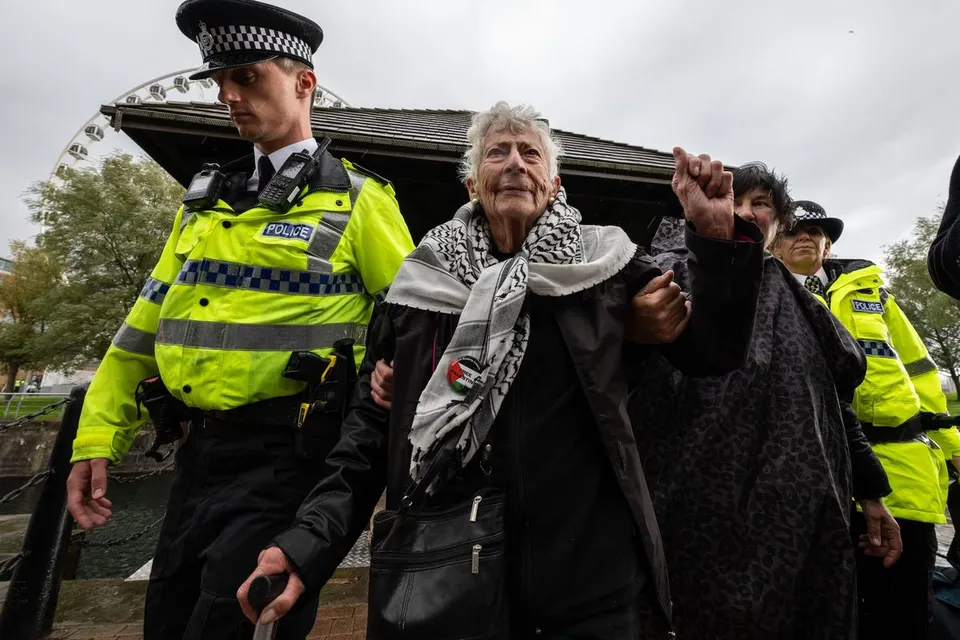
Police arrested at least 139 people outside the US embassy in London on Saturday, most on suspicion of expressing support for a proscribed organisation, as demonstrators challenged the ban on Palestine Action.
Pensioners, clergy and other campaigners were among hundreds who gathered in Battersea with placards declaring: “I oppose genocide, I support Palestine Action.” Before the demonstration, the Metropolitan Police had warned that people helping organise the event, giving instructions or providing logistical support could also face arrest.
Commander Adam Slonecki described those attending as “essentially meeting to purposefully commit a crime”. The force said it was enforcing the law and preventing offences, while organisers accused it of suppressing peaceful protest.
Among those taking part was Sue Morhall, a 79-year-old retiree who said she had already been arrested “five or six” times at previous demonstrations. She wanted political leaders, including Donald Trump, to understand the depth of opposition to what was happening in Gaza.
“It’s the principle, and this is one that I feel very strongly about,” she said.
The Rev Bill White, 72, explained his presence in terms of an obligation that outweighed the prospect of arrest. “There’s a bad law and it is wrong to criminalise people that are trying to prevent genocide,” he said. “How can I not be here?”
Their predicament reaches far beyond one London street or one British organisation. Across Europe, North America, the Middle East and Asia, people demanding protection for Palestinians and changes to their governments’ policies have encountered arrest, prosecution, restrictions on assembly and threats to their ability to study, work or remain in a country.
The methods differ between jurisdictions, and some restrictions have been rejected by courts. Together, the cases show how the effort to make Gaza politically impossible to ignore has become a struggle over the freedom to organise that pressure at all.
Gaza remains an urgent demand for actionThe protests persist against a humanitarian and political crisis that a ceasefire has failed to resolve.
On 26 October, the UN’s independent commission of inquiry said Israeli authorities and forces had continued committing genocidal acts in Gaza after the October 2025 ceasefire, with the intention of destroying Palestinians in whole or in part. Israel rejected the findings as part of a “misinformation campaign” aimed at demonising the country.
The commission’s conclusion is distinct from a final judgment by the International Court of Justice. South Africa’s genocide case remains in progress, with an order issued in May setting deadlines for further written pleadings in November 2027 and May 2029. Those are procedural deadlines, while the question of responsibility continues to be litigated.
For people seeking action now, the distance between the urgency of civilian protection and the timetable of international proceedings gives demonstrations, boycotts and demands for changes in government policy an immediate purpose.
Humanitarian assessments published this week described displaced families confronting another winter with inadequate shelter and essential services. Aid operations also remained exposed to danger: UNOPS reported three incidents over three consecutive days affecting its convoys and premises, including explosions, checkpoint detentions and bullets striking a guesthouse.
The campaign to keep Gaza heard therefore concerns practical demands: protection for civilians, reliable humanitarian access, accountability for abuses and an end to policies that protesters believe enable them.
Those demands have repeatedly brought campaigners into conflict with the authorities they are trying to persuade. In several countries, pressure directed at a government’s relationship with Israel has been answered through laws governing security, public order, immigration or political speech.
Terrorism powers enter the protestBritain’s proscription of Palestine Action took effect on 5 July 2025. Its consequences extend beyond people accused of the group’s direct actions to membership, specified forms of support and displays capable of indicating support.
The government argues that the organisation’s activities crossed the threshold into terrorism through serious damage to property, including attacks affecting defence infrastructure, and the promotion of further such actions. It maintains that lawful protest for the Palestinian cause remains protected.
That distinction is central to the government’s defence, but the consequences of proscription are visible among people whose alleged conduct consists of displaying a sign. The legal status of the organisation has created offences capable of reaching supporters who are not accused of taking part in an attack.
Home Office figures for the year ending June 2026 recorded 3,630 arrests linked to supporting Palestine Action out of 3,867 arrests classified as terrorism related, or 94 per cent of the total. The average age in the Palestine Action category was 59, compared with 28 for other arrests.
The figures describe arrests, not convictions, and the category cannot be treated as a measure of violent plots. Defend Our Juries says the subsequent cumulative total has exceeded 4,000 arrests, with some participants detained repeatedly.
Amnesty International has condemned the proscription as a disproportionate use of counterterrorism powers and urged the government to withdraw it. Its criticism concerns both the designation itself and the consequences for people peacefully opposing it.
The often quoted maximum sentence of 14 years also requires precision. That ceiling applies to membership and certain support offences under sections 11 and 12 of the Terrorism Act. Section 13 offences concerning certain displays of clothing or articles, or publication of images, carry a maximum of six months’ imprisonment.
For the section 12 offence of expressing a supportive opinion, prosecutors must establish the required recklessness about whether another person would be encouraged to support the proscribed organisation. Different conduct can engage different provisions, with different requirements and penalties.
The ban remains in force under Andy Burnham’s government while its legality is contested. The High Court ruled the decision unlawful in February, but the Court of Appeal overturned that judgment in June.
A Supreme Court hearing is scheduled for 4 and 5 November. Permission to appeal was granted on the limited question concerning whether the home secretary followed her published proscription policy, rather than on every ground advanced against the ban.
The litigation has therefore continued alongside enforcement. Demonstrators can be arrested under the designation while the decision that created their exposure remains subject to a further appeal.
The reach beyond the placardThe effects are also appearing in publishing and in disputed decisions about which expressions of support attract police action.
On 17 October, the Metropolitan Police said no further action would be taken over a social media post by Sarah Helm, the journalist and wife of national security adviser Jonathan Powell, because it did not meet the criminal threshold.
Her words were: “God help us authors who support Palestine and Palestine Action.” On Saturday, a demonstrator was reported arrested after displaying almost the same wording, substituting “retirees” for “authors”.
The different outcomes raise questions about consistent enforcement. Online words and a physical placard can engage different offences, and the wording alone does not establish that the legal circumstances were identical. The contrast nevertheless makes the police explanation of their decision important to public confidence in how the law is being applied.
For novelist Sally Rooney, the consequences have reached the availability of her books. After she stated that she intended to continue supporting Palestine Action financially, her publisher Faber concluded, with her agreement, that it could no longer supply her work in Britain because fulfilling its contracts could expose it to criminal liability.
Faber’s decision concerned the financial implications of Rooney’s political commitment, illustrating how a security designation can affect cultural activity well beyond a demonstration.
The choice of the US embassy also had a concrete political context. On 26 August, the US Treasury imposed counterterrorism financial sanctions on Palestine Action under Executive Order 13224, explicitly describing its action as complementing British proscription.
The American measure blocks relevant assets and restricts transactions. It is distinct from Britain’s proscription offences, and Treasury says constitutionally protected political speech is not a basis for its sanctions.
Even with those legal differences, the consequences of the organisation’s designation now reach across the Atlantic. Campaigners opposing the British ban confront a financial measure backed by the United States as well as domestic criminal law.
Immigration status becomes a means of pressureIn the United States, the response to Palestinian solidarity activism has reached the question of who is permitted to remain in the country.
A federal district court found in September 2025 that senior officials had deliberately used immigration enforcement to chill protected expression supporting Palestinian rights. After hearing witnesses and considering documentary evidence, the judge concluded that the policy violated the First Amendment and federal administrative law.
The court set the challenged enforcement policy aside in January 2026. The government’s appeal remains pending, while an appellate stay concerns a separate additional remedy for certain academic association members, rather than a reversal of the finding that the policy was unlawful.
The judicial record gives the charge of political suppression a foundation beyond the accusations of campaigners. It identifies deliberate official action against protected expression.
Mahmoud Khalil, a lawful permanent resident associated with Columbia University’s Palestinian solidarity protests, spent 104 days in immigration detention after his arrest in March 2025. He was held far from his family and missed the birth of his first child.
On 19 October 2026, he asked the Supreme Court to review a ruling restricting access to federal judicial scrutiny of his detention. Separately, he is appealing a final removal order. His legal struggle concerns immigration powers and constitutional protections; it is not a criminal conviction for his role in the protests.
Rümeysa Öztürk’s case showed how writing about Palestinian rights could also bring immigration enforcement. She was detained after coauthoring an opinion article in a student newspaper, before an immigration judge found that the government had no basis to deport her.
She completed her doctorate and returned voluntarily to Türkiye in April 2026 following a settlement. Her eventual departure on her own timetable followed a period in which an academic’s political expression had become the basis of a struggle over detention and removal.
Germany offers a related example. Berlin sought to withdraw an Irish activist’s EU free movement rights and threatened her with deportation over allegations connected to Palestinian solidarity protests, including a university occupation.
On 6 May 2026, Berlin’s Administrative Court ruled the measure unlawful. Investigations against her had been discontinued, without charges or convictions, and the court found no sufficiently serious actual danger to public order or security.
These measures place a particular burden on people whose residence is conditional. The possible price of public advocacy can include separation from family, disruption of education and the loss of a life built in another country, before the courts decide whether the state was entitled to act.
Restrictions on the places where dissent can be heardAcross Europe, a further struggle concerns whether demonstrations can occur where campaigners believe they will be politically effective.
In Paris, the police prefect banned a Gaza demonstration planned for 7 October 2026, citing the anniversary of the Hamas attacks, slogans opposing Zionism used at a previous event and wider tensions.
The Paris Administrative Court suspended the prohibition that day. The possibility that the date would cause offence did not itself establish a threat to public order, the judges found, while the cited slogans remained within freedom of expression.
That ruling exposed a gap between the authorities’ asserted reasons for stopping the demonstration and the evidence needed to justify doing so.
Other restrictions have survived judicial scrutiny. An Amsterdam court upheld the relocation of a Palestinian counter-demonstration away from Dam Square on 17 September, accepting concrete indications of possible disorder around a pro-Israel event.
Around 45 people were subsequently reported arrested after protesters entered the square despite the restriction and disrupted the gathering, with some spraying slogans on the ground. The case concerned a specific location restriction, and the contemporaneous account did not establish subsequent convictions.
Austria’s Constitutional Court similarly upheld a ban on a Vienna vigil planned for October 2023. Its 2025 decision considered the event’s advertised slogan and its immediate context after the Hamas attacks, rather than declaring all Palestinian solidarity assemblies prohibited.
These distinctions matter because the power to regulate an assembly and the abuse of that power cannot be treated as interchangeable. The French decision shows an attempted restriction failing the legal test; the Dutch and Austrian decisions show courts accepting particular official justifications.
In Italy, the consequences of protest extended into freedom of movement. After a demonstration around the Italy–Israel football match in Udine on 14 October 2025, at least 13 people were taken to a police station and ten received orders excluding them from the city for a year.
Amnesty International’s observers acknowledged that a small group tried to breach a police cordon, but said the use of tear gas affected the larger peaceful gathering. Investigators also criticised the lack of adequate individual assessment behind the exclusion orders.
One participant said the order forced him to resign from a job requiring him to be in Udine. The measure was an administrative restriction, with consequences for employment, rather than a criminal sentence imposed after a trial.
Pressure reaches the universityCampuses have become another setting in which demands for action over Gaza collide with institutional authority.
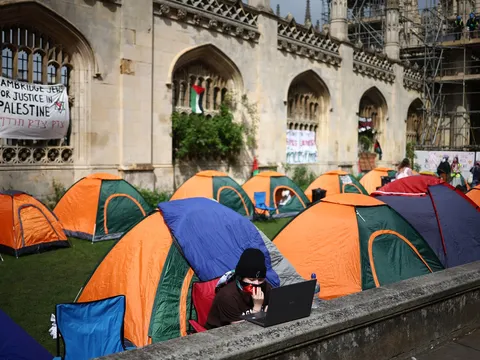
Columbia University confirms that more than 70 students were suspended or expelled in disciplinary determinations issued in July 2025. The university says the cases concerned the disruption of Butler Library that May and an encampment during Alumni Weekend in 2024, and that the decisions were independent of its settlement with the federal government.
The distinction is important: the university’s disciplinary process and Washington’s pressure are separate exercises of power. Columbia has nevertheless described the scale of the federal funding, accreditation and immigration risks it faced during its confrontation with the administration, demonstrating the government’s capacity to influence the environment in which institutions operate.
For students, the consequences of disciplinary proceedings reach their ability to continue studying. For universities, federal financial pressure affects the conditions under which contentious political activity is managed.
In Canada, the University of Toronto secured an injunction ending its Palestinian solidarity encampment in July 2024. Protesters left before the deadline rather than risk a confrontation with police, while continuing to demand changes to university investment policies.
At the University of Calgary two months earlier, police had cleared an encampment following a university trespass decision. Officers confirmed arrests and the use of less lethal munitions, saying remaining participants had thrown projectiles and engaged in assaultive behaviour.
The Canadian cases illustrate different outcomes, from compliance with an injunction to a contested police clearance. They also show how an institution’s control of its premises can determine the physical space available for a sustained campaign.
Attempts to restrict protest have continued beyond campuses. Ontario’s government sought an injunction against Toronto’s Al-Quds Day rally in March 2026, invoking antisemitism and public safety. A judge rejected the application and the demonstration proceeded.
Symbolic solidarity becomes a criminal caseSingapore’s proceedings demonstrate how assembly laws can reach activities far removed from a confrontation at a police cordon.
Charges brought in September 2026 included participation in a procession using watermelon umbrellas as symbols of Palestinian solidarity, the organisation of a Gaza kite flying event and a memorial at the National University of Singapore.
The events occurred in 2024 and early 2025. The campus memorial used shoes and a burial shroud to commemorate Palestinian students killed in Gaza.
Six people faced charges across several incidents, some concerning other causes. The Gaza cases involved alleged breaches of public assembly rules, with an additional racial harmony charge concerning a chant supporting Palestinian rights.
Three organisers of the earlier procession near the Istana had already been convicted and fined S$3,000 each in April 2026 for organising an unpermitted procession in a prohibited area.
The effect is to make the public expression of solidarity dependent on compliance with rules that can criminalise even a memorial or a symbolic gathering. The emotional distance between mourning dead students and facing a criminal prosecution becomes part of the pressure on others considering whether to take part.
Governments face dissent over their own ties to IsraelAction against Palestinian solidarity is also documented in countries whose political leaders publicly present themselves as defenders of Palestinian rights.
In Jordan, Ayman Sanduka received a prison sentence of five years over an October 2023 Facebook post addressed to the king and criticising the country’s diplomatic relationship with Israel. The conviction survived a State Security Court decision in September 2025 and a rejected cassation appeal that December.
Amnesty International, which calls for his release, characterises the case as punishment for protected expression. His prosecution demonstrates how advocacy connected to Gaza can become a confrontation over the permitted limits of criticism of national leadership.
Egypt has used prolonged detention and terrorism investigations against solidarity activity. On 17 March 2026, the Egyptian Initiative for Personal Rights said 131 people, including seven children, were held in pretrial detention across 13 cases linked to peaceful expressions of support for Palestine.
On 7 April, prosecutors ordered the release of four people detained in connection with protests in 2023. Those orders followed the March assessment and do not establish a new nationwide detention total.
A separate group of three Egyptian supporters of the Gaza March was arrested at home in June 2025 and placed under investigation for terrorism related offences. Amnesty’s annual account recorded them still in detention at the end of that year, while foreign participants in the planned march were detained and deported.
The state response thus reached both domestic solidarity and efforts by visiting campaigners to draw attention to Gaza. For those held before trial, the loss of liberty preceded any conviction.
In Morocco, 13 activists were arrested after a Palestinian solidarity sit-in outside Carrefour in Salé in November 2023, where they called for a boycott over alleged complicity in abuses against Palestinians.
They received suspended prison sentences of six months in December 2024 for organising and participating in an undeclared demonstration, with the sentences subsequently upheld on appeal. The terms were suspended, but the convictions placed a criminal penalty on the organisation of the protest.
In Türkiye, nine people were detained after challenging President Recep Tayyip Erdoğan at the TRT World Forum in November 2024 over alleged continuing trade with Israel. They were jailed pending trial and later released.
By June 2026, the prosecutor was asking for the defendants to be acquitted of the assembly-law charges because the required elements had not been established. Protesters outside the venue had complied with police intervention, while evidence did not show that those inside had heard an order to disperse.
The request for acquittal was a significant development, but it came after detention and prosecution. The political point of the demonstration had been to challenge the government’s own conduct, bringing the cost of solidarity back to decisions made at home.
Force and scrutiny in Australia and IsraelIn Australia, an official parliamentary answer recorded 27 arrests at the Sydney Town Hall protest associated with the Israeli president’s visit on 9 February 2026. Reported charges included assaulting police, resisting arrest and failing to comply with directions.
The operation is now under investigation by the independent Law Enforcement Conduct Commission. Its October update on Operation Makalu identified police planning, pepper spray, possible improper use of arrest powers and the use of force as subjects of examination.
The inquiry places the authorities’ conduct under scrutiny alongside the allegations against protesters. Its findings remain to be established.
Within Israel, opposition to the Gaza war has also encountered restrictions. In January 2025, the legal centre Adalah said its lawyers had represented people in more than 60 detention cases arising from Haifa protests since October 2023.
It described preventive bans, dispersals, confiscation of signs and arrests, and said courts had repeatedly ordered releases because police allegations lacked evidence.
A further dispute followed an antiwar demonstration in the Haifa district in April 2026. The Association for Civil Rights in Israel accused police of improper detention and the confiscation and destruction of a protester’s sign. Police disputed important parts of the account and said the demonstration had obstructed traffic and endangered the public.
The cases concern people attempting to demonstrate inside Israel, including Palestinian citizens. Their experience forms part of the same struggle to secure a public hearing for opposition to the war and its consequences.
The cost of demanding to be heardThe cases do not depend on identical laws or identical political systems. Their common feature is the range of consequences placed on people seeking to move Gaza from public concern to political action.
A sign can bring arrest under a terrorism statute. A newspaper article can precede immigration detention. A memorial can become a public order prosecution, while a boycott sit-in can result in a criminal sentence.
Court decisions and subsequent releases are an essential part of that record. They demonstrate that an arrest or an official allegation is not proof that a restriction was justified. They also leave intact the months of detention, the uncertainty and the disruption already experienced before a remedy was obtained.
For a campaign whose purpose is to influence policy while lives remain at risk, delay has political consequences. People who must defend their residence, education or liberty have fewer resources available for the demands that first brought them into public life.
Back in Britain, the absence of immediate arrests at Saturday’s parallel Edinburgh vigil did not mean scrutiny had ended. Police Scotland said inquiries were continuing to identify people seen wearing clothing or holding banners supporting a proscribed organisation.
The London demonstrators, meanwhile, acted with the knowledge that arrests had been threatened in advance. The Supreme Court hearing will address the legality of the government’s proscription decision, while the broader conflict extends beyond the fate of one organisation.
It concerns whether people can insist on action over Gaza without exposing their ability to speak, assemble, study, work or live with their families to escalating state pressure.
For White, the clergyman outside the embassy, the obligation remained personal. His question, “How can I not be here?”, expressed the conviction that has brought people back to demonstrations despite the prospect of punishment: that making Palestinian suffering heard is a responsibility which does not disappear when the state raises the cost of fulfilling it.
Sources and attributionsReporting and legal developments checked to 31 October 2026. Direct quotations from the London demonstrators are credited to Sammy Gecsoyler’s Guardian report. Non-English sources are paraphrased, with their original languages identified below.
London arrests and witness accounts. Sammy Gecsoyler, The Guardian, Almost 140 arrested at protest against Palestine Action ban outside US embassy in London, 31 October 2026. Supports the lead, attendance, organiser claims and quotations from Sue Morhall and the Rev Bill White.
Police warning before the London protest. Metropolitan Police, Met issues update ahead of planned Defend Our Juries activity this weekend, 30 October 2026. Primary statement concerning organisers, logistical support and Commander Adam Slonecki’s position.
Arrest total and Edinburgh inquiries. Associated Press, London police arrest 139 people outside US Embassy for supporting banned pro-Palestinian group, 31 October 2026; Matthew Fulton, STV News, Police probe to identify demonstrators wearing T-shirts and holding banners, 31 October 2026. Support the majority-offence qualification and continuing Scottish inquiries.
Latest UN commission finding. Independent International Commission of Inquiry, Israel has committed war crimes and crimes against humanity in the OPT amid continuing genocide in Gaza, 26 October 2026, and Report A/81/430, dated 14 October 2026. The continuing-genocide conclusion is attributed to the commission.
Israel’s response to the commission. Olivia Le Poidevin, Reuters, UN inquiry says Israel kept committing genocide in Gaza after truce, 26 October, updated 27 October 2026. Supports the contemporaneous Israeli rejection.
International Court of Justice timetable. ICJ, Order fixing time limits for the Reply and Rejoinder in South Africa v Israel, 21 May 2026. The dates in 2027 and 2029 concern written pleadings, not a scheduled final judgment.
Current humanitarian conditions. UN Office for the Coordination of Humanitarian Affairs, Humanitarian Situation Report 29 October 2026, posted 31 October 2026. Supports shelter concerns and incidents affecting UNOPS convoys and premises.
British arrest statistics. Home Office, Operation of police powers under the Terrorism Act 2000 to June 2026, 8 October 2026. The figures cover arrests in Great Britain, not convictions or necessarily distinct individuals.
Proscription offences and the government’s rationale. Home Office, Proscribed terrorist groups or organisations, consulted 31 October 2026; Crown Prosecution Service, Further prosecutions of Palestine Action supporters, 2025. Support the distinction between maximum penalties and the government’s account of serious property damage.
Requirements of the expression offence. UK Supreme Court, R v ABJ and R v BDN press summary, 26 February 2026. Supports the section 12(1A) recklessness requirement.
Palestine Action litigation. UK Supreme Court, Ammori v Secretary of State for the Home Department; Courts and Tribunals Judiciary, Court of Appeal judgment hearing, 15 June 2026; Scottish Courts and Tribunals Service, Case P1017/25. Support the procedural chronology, November hearing and limited appeal ground.
Human rights criticism of British proscription. Amnesty International UK, Response to the ruling on the proscription of Palestine Action, 15 June 2026. Supports the organisation’s attributed assessment.
Sarah Helm. Sky News, No police action against wife of PM’s adviser over Palestine Action post, 17 October 2026. The similar placard arrest is described in the Guardian report above.
Sally Rooney and Faber. ITV News, Sally Rooney’s books withdrawn from UK over her support of Palestine Action, 14 October 2026. Supports the publisher’s decision and its financial-support context.
US sanctions. US Department of the Treasury, Treasury Takes Action Against Violent Far-Left Terrorist Networks, 26 August 2026. Establishes the OFAC designation under Executive Order 13224 and its stated relationship to British proscription.
US judicial findings on immigration enforcement. US District Court for Massachusetts, AAUP v Rubio findings of fact and conclusions of law, ECF 261, 30 September 2025, and Annotated Judgment, ECF 313, 22 January 2026. Primary judicial findings and remedy.
US appeal status. Knight First Amendment Institute, AAUP v Rubio litigation record, including filings through 29 October 2026. Identifies the continuing appeal and the limited stay affecting the additional remedy; the institute represents the plaintiffs.
Mahmoud Khalil. Center for Constitutional Rights, Mahmoud Khalil asks Supreme Court to review his case, 19 October 2026. His legal team’s account supports the detention history, missed birth and separate habeas and removal proceedings.
Rümeysa Öztürk. American Civil Liberties Union, After earning PhD, Rümeysa Öztürk chooses her next chapter, 17 April 2026. Her legal team’s account supports the detention, immigration ruling, settlement and voluntary return.
Germany and residence rights. Berlin Administrative Court, Irish citizen does not lose EU free movement rights, 6 May 2026. Official court statement; German text paraphrased in English.
French protest ban. Paris Administrative Court, Suspension of the ban on the Gaza demonstration, 7 October 2026. Official reasons for suspending the prohibition; French text paraphrased.
Netherlands location restriction and arrests. Amsterdam District Court, Counter-demonstration may not take place on Dam Square, 17 September 2026; DutchNews, Pro-Palestinian protesters arrested at Israel event in Amsterdam, 18 September 2026. Distinguish the court ruling from the subsequent arrests.
Austria. Constitutional Court of Austria, Ban on the Palestinian solidarity assembly was constitutional, 28 October 2025, concerning the judgment of 24 September 2025 and proposed vigil of 11 October 2023. German text paraphrased.
Udine policing and exclusion orders. Amnesty International Italy, Human rights violations committed in Udine on 14 October, 11 November 2025. Observer findings and interviews, including the reported employment consequence; allegations of unlawful treatment remain attributed. Italian text paraphrased.
Columbia discipline and government pressure. Columbia University, Resolution Agreement Frequently Asked Questions, and Office of Rules Administration, Updates from the Rules Administrator, including the 22 July 2025 explanation. Support the disciplinary figures, underlying events, funding risks and the university’s account of the decisions’ independence.
Toronto encampment. Sheila Reid and Jordan Omstead, Canadian Press, Pro-Palestinian protesters leave UofT encampment ahead of court-ordered deadline, 3 July 2024. Supports compliance with the injunction and continued divestment demands.
Calgary clearance. Calgary Police Service, Protest camp removed from University of Calgary, 10 May 2024. Primary police account; allegations of projectiles and assaultive conduct are identified as such.
Ontario attempted rally prohibition. CityNews and Canadian Press, Al-Quds Day rally goes ahead after judge rejects injunction bid, 13 March, updated 15 March 2026. Supports the attempted restriction and its rejection.
Singapore charges and earlier convictions. Singapore Police Force, Six persons to be charged under the Public Order Act and other offences, 8 September, updated 29 September 2026. Primary account of the incidents and the April convictions.
Singapore memorial and proceedings. FIDH and OMCT, Criminal proceedings against human rights defenders over peaceful activism, 22 September 2026. Supports the memorial details and the distinction between Gaza and other protest cases.
Jordan and Ayman Sanduka. Amnesty International, Ayman Sanduka’s sentence upheld, 13 May 2026. Supports the Facebook post, sentence, appeals and attributed call for release.
Egyptian detention assessment. Egyptian Initiative for Personal Rights, Continued detention of 131 people including seven children over support for Palestine, 17 March 2026. Arabic statement paraphrased; the total is a dated snapshot.
Egyptian release orders. Mohamed Napolion, Al Manassa, Release ordered for four detainees in Palestine support cases, 7 April 2026. Identifies the four orders and their connection to the 2023 protests.
Egyptian Gaza March cases. Amnesty International, Egypt 2025 country report, consulted 31 October 2026. Covers June 2025 arrests, detention status at year end and deportation of foreign participants.
Morocco boycott sit-in. MENA Rights Group, Moroccan activists get suspended sentence over pro-Palestine sit-in, 23 June 2025. Supports the 13 defendants, arrest and sentencing dates, suspended terms and appeal outcome.
Türkiye prosecution. Semra Pelek, Media and Law Studies Association, Prosecutor seeks acquittal in Israel protest case, 18 June 2026. Court monitoring supports the detention history and prosecutor’s request, without asserting a final acquittal.
Australian arrest figures. New South Wales Parliament, Question and answer on the 9 February 2026 Town Hall operation, answer received 18 March 2026. Official arrest and charge information.
Australian policing inquiry. Law Enforcement Conduct Commission, Update regarding public examinations in Operation Makalu, 8 October 2026. Establishes the investigation’s scope, without anticipating findings.
Haifa protest detentions. Adalah, Demand to end suppression of antiwar protests in Haifa, 12 January 2025. The organisation’s legal account concerns over 60 detention cases, not necessarily unique individuals.
Disputed Israeli police conduct. Association for Civil Rights in Israel, Illegal police conduct at a peaceful protest, 10 May 2026. Presents the complaint and the police response concerning the April demonstration.