Britain Saw the Evidence of Gaza Atrocities and Kept the Arms Flowing
A Channel 4 investigation exposes the gap between warnings inside Whitehall and decisions to keep supplying Israel, raising questions about a system critics say demanded answers only the accused could provide.
Two days after Israeli forces killed three British aid workers in Gaza, David Cameron’s office recommended that Britain continue allowing weapons exports to Israel. In public, the foreign secretary was demanding an urgent investigation. Behind closed doors, his advice was that no existing export licences should be suspended.
The letter, dated 3 April 2024 and examined in Channel 4’s Dispatches investigation, captures the distance between ministers’ expressions of concern and the decisions that sustained Britain’s military trade with Israel.
For Neil and Trish Henderson, whose son James was among seven World Central Kitchen workers killed in the strikes, that distance is painfully personal. Shown the letter by the programme, they confronted an official argument that suspension would significantly affect British interests.
“What UK interests?” came the response. “I find that’s terrible.”
Britain’s Gaza Secrets Exposed, reported by Ramita Navai, examines hundreds of pages of internal assessments alongside testimony from bereaved families, doctors, lawyers and a former diplomat. Its central question is how a government receiving extensive evidence of civilian suffering repeatedly concluded that arms exports could continue.
The documents concern the Foreign Office’s International Humanitarian Law Compliance Assessment Cell, established to assess Israel’s conduct. Its work informed the foreign secretary’s advice on export licences, for which the business and trade secretary holds overall responsibility.
The distinction between assessing risk and proving a crime is fundamental. Under Britain’s export criteria, a licence should not be granted where there is a clear risk that the equipment might be used to commit or facilitate a serious violation of international humanitarian law. The decision is preventive: it does not require a criminal conviction before restrictions can be imposed.
Yet lawyers interviewed by Dispatches argue that the government’s approach to individual attacks demanded information so specific, and so dependent on Israel’s cooperation, that serious allegations could repeatedly be left unresolved.
Dearbhla Minogue, a lawyer involved in the Palestinian human rights organisation Al-Haq’s challenge to British arms exports, acknowledged that civilian casualties alone cannot establish whether an attack was unlawful. What was targeted, what military advantage was anticipated and what commanders knew about the danger to civilians all matter.
Her criticism was that Britain had taken that requirement to an extreme.
“They’re applying this test which is essentially incapable of allowing any kind of finding of breach unless the perpetrator tells you they breached IHL,” she said.
Asked whether the methodology allowed Israel to be found in breach, she replied: “Not unless they admit it themselves.”
William Schabas, a professor of international law shown the assessments by the programme, drew the same distinction between a prosecution and a decision about supplying weapons.
“This is not a trial where we’re trying to determine who’s going to go to jail for 10 or 20 years,” he said.
His assessment of the process was stark: “The British government has adopted what looks like a methodology but one designed to produce a result that no violations are taking place.”
The government’s published explanation offers a different account. In September 2024, it described gathering information from humanitarian organisations, diplomats, media reports and engagement with Israeli officials. It said assessments of particular attacks were hampered by contested information and difficulty obtaining details of intended targets and anticipated civilian harm. It also cited reports of Hamas operating among civilians and within civilian infrastructure.
That explains the evidential difficulty. The dispute exposed by Dispatches is whether those difficulties were given so much weight that the system failed to respond adequately to the risk of further violations.
Among the incidents examined was an Israeli strike on a compound housing British doctors in Al-Mawasi on 18 January 2024. The team was working with Medical Aid for Palestinians and the International Rescue Committee, and its location had been shared with the Israeli military to help protect it from attack.
One doctor described his disbelief: “I was just astonished. I couldn’t believe that we had been attacked.”
The programme reports that the relevant British assessment found insufficient information to decide whether incidents under review amounted to possible breaches of humanitarian law. Israel’s military told Dispatches that the compound strike remained under review.
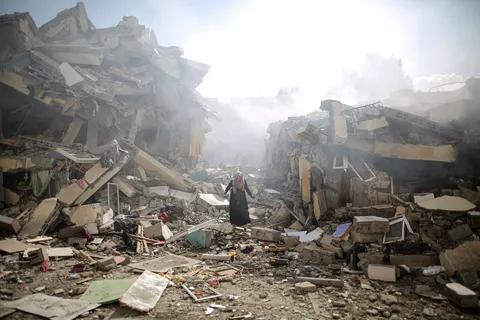
The documentary also follows a Palestinian woman living in London who discovered that footage of people buried beneath rubble showed the aftermath of a strike on her own relatives’ home. She said 48 family members had been killed.
“We have 48 birthdays,” she said. “We have 48 life dreams.”
Early reports of that attack appeared in an evidence log submitted to the government. According to the programme, the assessment cell made no specific finding on it.
The film places these accounts beside Cameron’s appearance before the Commons Foreign Affairs Committee in January 2024. Asked whether he had received legal advice indicating that Israel had breached international humanitarian law, he repeatedly resisted giving a direct answer.
“I can’t recall every single bit of paper that’s been put in front of me,” he said.
Dispatches reports that, the previous month, he had received two assessments identifying Israel’s blockade as a possible breach of humanitarian law. An email, it says, recorded that he had carefully considered the information in one of them.
The programme also quotes a subsequent assessment stating that officials could no longer conclude, on balance, that Israel was committed to compliance with humanitarian law in relation to the humanitarian situation. Cameron nevertheless maintained an overall assessment that allowed his recommendation against suspending exports to stand.
According to the investigation, reporting arrangements changed in March 2024 at Cameron’s request. Responsibility moved from the Foreign Office’s Middle East section to the political director’s office, while the reporting cycle lengthened from approximately two or three weeks to six. A source told the programme that regional experts were effectively sidelined.
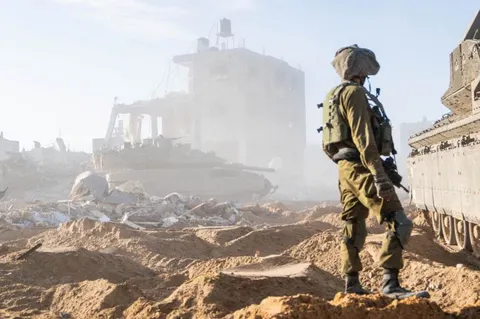
The World Central Kitchen killings soon brought the consequences of British policy into particularly sharp focus. James Henderson, John Antony Chapman and James Kirby were killed alongside four colleagues on 1 April 2024. The convoy’s movements had been coordinated with the Israeli military.
Israel subsequently said its forces had mistakenly believed the vehicles contained Hamas operatives, acknowledged grave failures and dismissed officers. Dispatches reports that the British assessment cell eventually recorded the attack as a possible breach of humanitarian law. Cameron’s recommendation against suspending licences had already been issued.
Another case produced a different assessment: the killing of Hind Rajab, the five-year-old Palestinian girl who pleaded by telephone for rescue from a car containing her dead relatives.
Hind and the two ambulance workers sent to rescue her were killed by Israeli forces. According to Dispatches, the British assessment nevertheless found insufficient evidence to establish a humanitarian-law violation. Schabas called that conclusion “a preposterous suggestion”.
The case has since moved beyond Israel’s earlier denials. On 19 August 2026, CNN reported that the Israeli military had acknowledged firing on the vehicle carrying Hind and announced a criminal investigation. It had previously maintained that its forces were neither near the car nor within firing range. That subsequent acknowledgement adds weight to questions about relying on Israeli accounts when assessing earlier allegations.
Inside Whitehall, the documentary describes mounting alarm. It reports that hundreds of Foreign Office employees signed letters expressing concern about possible British complicity, while some officials said they had been instructed not to use the terms “ethnic cleansing” or “genocide” in reports.
Former diplomat Mark Smith, who resigned in August 2024 over arms exports to Israel, said his requests for an explanation had been met with instructions to delete emails and stop questioning the policy.
“Delete these emails. You shouldn’t be asking this,” he recalled being told.
Smith had previously worked on arms-export assessments concerning the Saudi-led war in Yemen. He was not part of the team assessing Israel’s conduct, a limitation he explicitly acknowledged, but said the destruction visible in Gaza demanded answers.
“The nature of the assessment is such that you can kind of make it say whatever you want,” he told the programme. “And that is why the system is broken.”
Labour’s arrival in government in July 2024 brought a partial change. On 2 September, David Lammy announced the suspension of around 30 of approximately 350 export licences, following a finding that certain equipment risked being used in serious violations of humanitarian law.
The suspension covered items including components for military aircraft, helicopters and drones. Other licences covered equipment the government assessed was outside the Gaza conflict, including non-military goods.
Crucially, Britain continued exporting components into the multinational F-35 programme, except where they were destined directly for Israel. Ministers argued that stopping exports into the shared supply system would jeopardise the wider fleet and allied security. The exemption preserved a route through which British-made components could reach Israel’s fighter aircraft despite the government’s finding of risk.
Al-Haq’s legal challenge to that exemption failed in the High Court on 30 June 2025. The judgment centred on the government’s participation in the multinational defence programme and the constitutional limits of judicial intervention in foreign and security policy. It did not clear Israel of war crimes or determine that the suffering documented in Gaza was lawful.
The documentary’s most consequential questions concern genocide and the duty to prevent it.
A June 2024 assessment, reproduced in the High Court judgment, accepted that conduct capable in principle of meeting the physical element of genocide was occurring in Gaza. It nevertheless concluded that Israel was not acting with genocidal intent. Those are distinct elements: the assessment was not an admission that genocide had been established.
But prevention has its own threshold. The duty arises when a state knows, or should know, of a serious risk of genocide and requires it to use the means reasonably available to prevent it. The British government acknowledged that principle in the litigation. A final judicial ruling is not required before that duty arises.
In September 2025, the independent UN Commission of Inquiry concluded that Israel had committed genocide in Gaza, finding both prohibited acts and the necessary intent. Israel rejected the findings and accused the commission of advancing a narrative intended to delegitimise the state. The commission’s conclusion is an investigative finding, distinct from a court judgment.
Its chair, former UN human rights chief Navi Pillay, told Dispatches that governments could no longer claim they lacked the means to assess intent: the commission had examined the evidence and set out its reasoning.
“They don’t apply the same rules to their friends as they do to their enemies,” she said of Britain’s approach. “Why aren’t they preventing genocide?”
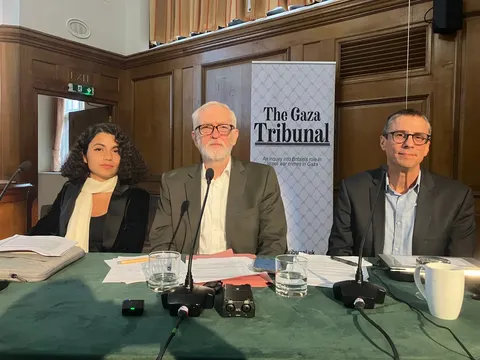
The Global Legal Action Network, which worked with Al-Haq, has since called for an independent inquiry into Britain’s response to Israel’s actions in Gaza. In a report released after the documentary, it argued that the assessment process, the F-35 exemption and the handling of genocide risk revealed failures of accountability.
For the families interviewed by Dispatches, those failures are measured in lives. Trish Henderson recalled her son telling her he would put more World Central Kitchen stickers on the roof of a vehicle, reinforcing the markings identifying the team as humanitarian workers.
It was the last time she spoke to him.
“He wasn’t out there fighting a war,” she said. “He was out there trying to help people.”
The documents now exposed leave ministers facing a question that public expressions of concern cannot resolve: why did warnings about the treatment of civilians, aid workers and detainees so often leave the case for continued arms exports intact?
Sources and further reading
Channel 4 Dispatches and Basement Films. Britain’s Gaza Secrets Exposed. Quotations and documentary findings are drawn from the supplied transcript. Production details and programme link: Read source
Foreign Commonwealth and Development Office. Summary of the IHL process, decision and the factors taken into account, 2 September 2024. Export responsibilities, risk criterion and government explanation of its assessment methodology. Read source
UK Government. UK suspends around 30 arms export licences to Israel for use in Gaza over International Humanitarian Law concerns, 2 September 2024. Scope of suspension and F-35 exemption. Read source
High Court. Al-Haq v Secretary of State for Business and Trade [2025] EWHC 1615 (Admin), 30 June 2025. See paragraphs 28–29 on the June assessment; 62–63 on the duty to prevent genocide; and 205–208 on the judgment’s scope and conclusion. Read source
CNN reporting published by KTVZ. Israeli military admits for first time to firing on car carrying 5-year-old Hind Rajab as it opens criminal probe, 19 August 2026. Read source
United Nations. Gaza: Top independent rights probe alleges Israel committed genocide, 16 September 2025. Commission findings and Israel’s response. Read source
Global Legal Action Network. New report: Exposing the UK arms trade accountability gap, 29 September 2026. Campaigners’ analysis and call for an independent inquiry. Read source