Gaza, Hiroshima and the Nuclear Arsenal Israel Will Not Acknowledge
Senator Lindsey Graham and AIPAC-backed congressman Tim Walberg invoked the atomic destruction of Japanese cities while defending Israel’s war in Gaza. Their remarks concerned a country widely assessed to possess nuclear weapons, raising questions about the political language surrounding an arsenal built in secrecy and protected by decades of American accommodation.
Less than a month after the 7 October 2023 attacks, Republican Senator Lindsey Graham invoked America’s use of nuclear weapons against Japan as he urged Israel to continue its war in Gaza.
“We used nuclear weapons against two Japanese cities,” Graham said in remarks reported on 6 November, drawing a comparison between Israel’s campaign against Hamas and American conduct during the Second World War.
The South Carolina senator rejected demands for a ceasefire and encouraged Israel to pursue its military objectives. “Do what you need to do, my friends in Israel,” he said, while also urging it to reduce civilian casualties.
The comparison would recur as the war continued. On 25 March 2024, Republican Representative Tim Walberg, an AIPAC-backed congressman from Michigan, responded to a question about American spending on a humanitarian aid pier for Gaza by invoking the two cities destroyed by atomic bombs.
“We shouldn’t be spending a dime on humanitarian aid. It should be like Nagasaki and Hiroshima. Get it over quick,” Walberg told a town hall meeting in Dundee, Michigan.
On 31 March, he denied advocating the use of nuclear weapons. He said he had intended a metaphor for swift victory in both Gaza and Ukraine, without putting American troops in danger, and argued that shorter wars would reduce civilian suffering.
Walberg’s connection to the American Israel Public Affairs Committee was a matter of documented electoral support. AIPAC’s political action committee reported a $5,000 contribution to Walberg for Congress on 7 June 2024, after his remarks. That payment went to his election campaign; the disclosure does not establish that AIPAC paid him personally or directed what he said.
Graham returned to the atomic bombing analogy on 12 May 2024, defending continued American weapons deliveries to Israel. He justified the destruction of Hiroshima and Nagasaki and urged Israel to “do whatever you have to do to survive as a Jewish state”.
The immediate dispute concerned conventional weapons and President Joe Biden’s decision to withhold a bomb shipment. Graham’s argument nevertheless used nuclear destruction as a precedent for the latitude he believed Israel should receive in conducting its war.
The capability behind the language
On the Israeli side, the nuclear possibility had been raised more explicitly during the first month of the conflict.
On 5 November 2023, Heritage Minister Amichai Eliyahu was asked in a radio interview about dropping a nuclear bomb on Gaza. “That’s one way,” he replied.
Prime Minister Benjamin Netanyahu repudiated the statement and suspended Eliyahu from cabinet meetings. Eliyahu subsequently described the nuclear reference as metaphorical. He belonged to neither the war cabinet nor the security cabinet and had no authority to order a nuclear attack.
Those distinctions matter. The American statements were not a collective declaration by senators to “nuke Gaza”, and the remarks of an Israeli minister outside the security decision process were not an announcement of an authorised operation.
Their significance lies in the relationship between political language and an actual military capability.
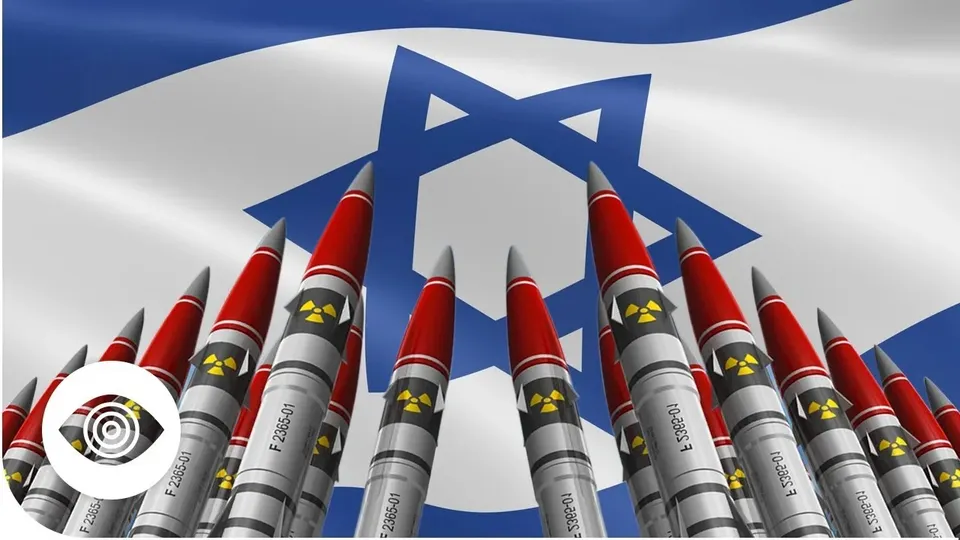
Independent nuclear researchers estimate that Israel possesses approximately 90 nuclear warheads. Successive Israeli governments have neither confirmed nor denied that arsenal, and no public inventory permits the estimate to be checked against an official declaration.
The weapons capability gives the rhetoric a material basis. It does not establish that a nuclear strike on Gaza was planned, approved or imminent. The concern is that politicians invoking Hiroshima and Nagasaki as examples of acceptable wartime conduct can make the destruction of a city sound like a legitimate route to victory.
For American lawmakers, such language also accompanies decisions about military assistance and diplomatic support. Their statements carry political weight even though they do not command Israel’s nuclear forces.
The humanitarian consequences would extend far beyond an intensified conventional bombing campaign. Nuclear use in a populated area would combine blast, extreme heat and radiation with the destruction of the medical services needed to treat survivors. The International Committee of the Red Cross warns that no adequate humanitarian response capacity exists for such an attack.
This is why the rhetoric warrants scrutiny without converting it into a claim that nuclear war was inevitable. The capability is widely assessed to exist; the political and military conditions governing its use remain concealed.
At the centre of that history stands the nuclear complex near Dimona, in Israel’s southern desert. An official once described it to an American ambassador as a textile plant. Its designation today is a nuclear research centre, while its role in the production of material for nuclear weapons is widely accepted among specialists.
Behind the buildings lies a history of French assistance, restricted American inspections, procurement controversies, unresolved intelligence disputes and the imprisonment of a technician whose photographs brought the public closer to the programme than official visits ever had.
The reactor behind the textile plant story
The origins of Dimona lie in the strategic relationship between Israel and France during the 1950s. The two countries were partners in the 1956 attack on Egypt, alongside Britain, during the Suez crisis. Their military intervention ended under intense international pressure, including opposition from Washington and Moscow.
A secret agreement in 1957 committed France to helping Israel build a reactor in the Negev. Historical accounts also describe French assistance with the concealed infrastructure needed to separate plutonium, a development with direct military significance. Construction began in 1958, with secrecy extending beyond the site itself into the international movement of equipment.
One published account describes specialised components, including the reactor tank, passing through French customs under a false Latin American destination. Such episodes illustrate the programme’s concealed origins, although individual recollections and later reconstructions do not all have the same documentary foundation.
American intelligence received clues well before the project became a public controversy. Former CIA photographic analyst Dino Brugioni later recalled that aerial images of the excavation had been shown to President Dwight Eisenhower in 1958 without prompting a decisive response. Historians have not located government records corroborating that particular recollection.
There was firmer evidence in the following year. A transaction involving Norway and Britain supplied Israel with 20 tonnes of heavy water, used in this type of reactor as a moderator and coolant. The American embassy in Oslo reported the Norwegian agreement in June 1959, but that correspondence did not reach senior officials until December 1960. The CIA had separately obtained information about the purchase, making the episode as much a problem of connecting intelligence as of obtaining it.
The most memorable explanation for the growing desert complex came during a helicopter flight in 1960. American ambassador Ogden Reid was accompanied by Israeli Treasury official Addy Cohen when the construction site came into view. Cohen described it as a textile plant.
Decades later, Cohen said the explanation had been improvised. An architect had designed textile factories around Dimona, and the association had supplied a convenient answer. Whatever its origin, the story helped obscure the purpose of a project that was already attracting foreign attention.
By December, the cover was failing. An American intelligence assessment dated 8 December 1960 concluded that “plutonium production for weapons is at least one major purpose” of the complex. Other explanations, including a metallurgical research installation, could no longer resolve the questions raised by its scale and configuration.
On 21 December, Prime Minister David Ben-Gurion acknowledged the reactor in parliament, presenting it as a project serving industry, agriculture, health and science. American diplomats complained about Israel’s lack of candour. A nuclear facility had finally been admitted, but its military purpose remained concealed.
Kennedy demands access
President John F. Kennedy treated the spread of nuclear weapons as a serious danger, including when the country seeking them was an American partner. The emerging confrontation over Dimona became one of the most sustained efforts by a US president to obtain reliable information about Israel’s nuclear intentions.
The first American visit took place on 20 May 1961. The site’s director, Manes Pratt, presented the project as preparation for a future civilian nuclear power programme. The visiting scientists encountered a largely inactive site, were not permitted to take photographs and were not given written documentation. They nevertheless accepted the account of peaceful purposes.
Kennedy wanted more than occasional reassurance. He pressed for regular visits, adequate time and access throughout the complex. In 1963, those demands produced an increasingly difficult exchange with Ben-Gurion.
On 15 June, Washington transmitted a letter for delivery to the Israeli prime minister. Kennedy sought an early visit, another the following year and inspections at six month intervals thereafter. He warned that American commitment and support could be “seriously jeopardized” if Washington could not obtain reliable information about Israel’s nuclear activities.
Ben-Gurion announced his resignation the next day, before the letter was delivered. The proximity of the two events is established; it does not establish that the letter caused his departure. Kennedy subsequently directed substantially the same demands to the new prime minister, Levi Eshkol.
Eshkol’s response on 19 August accepted a further visit, but did not explicitly concede the full schedule Kennedy had requested. The next inspection took place in January 1964, after Kennedy’s assassination in Dallas on 22 November 1963.
The correspondence documents a sharp disagreement between allied governments. It provides no evidence connecting Israel or the Dimona programme to Kennedy’s murder, despite speculation that has attached itself to the sequence of events.
Inspections with limits
American visits continued under President Lyndon Johnson, but the conditions fell short of an inspection system capable of compelling disclosure. The visits were announced in advance, the teams spent limited time on site and they depended heavily on explanations supplied by their hosts.
The 1964 visit lasted approximately eleven hours in a single day. In January 1965, the inspectors again had one day, with a request to continue into Saturday evening rejected. Reports expressed confidence that significant facilities had been examined and that an immediate weapons programme was not evident.
In 1991, journalist Seymour Hersh described a fabricated control room, false instrumentation, concealed lifts and rehearsed presentations designed to mislead American visitors. Those descriptions remain allegations from later investigative reporting; the surviving inspection records independently establish the restrictions and reassuring conclusions, rather than every claimed detail of the deception.
The conclusions were particularly striking in April 1967, when the visiting team reported that no irradiated fuel reprocessing plant existed or was under construction at Dimona. That was the infrastructure whose existence would have directly undermined Israel’s account of the site.
Other American officials were less reassured. Embassy science attaché Robert Webber had expressed suspicions, and Henry Kissinger, then outside government, told American diplomats in February 1965 that he strongly believed Israel was pursuing a nuclear weapons programme.
More pointed warnings reached the embassy in February 1967. Sources in Israel described a reprocessing facility and suggested that the country was close to producing a weapon. State Department intelligence officials regarded elements of those reports as plausible and wanted the next visit to examine them.
The April inspection nevertheless failed to resolve the central concern. The documentary record therefore shows a government receiving conflicting assessments, rather than a uniformly unsuspecting Washington. Restricted access, questionable reassurance and unresolved warnings coexisted as Israel approached the nuclear threshold.
The threshold crossed in 1967
Historians Avner Cohen and William Burr have concluded that Israel assembled two or three nuclear devices on the eve of the June 1967 war. Their reconstruction places that development only weeks after the American inspection that had found no reprocessing facility.
The prospect of an improvised nuclear demonstration during the crisis emerged much later through the testimony of retired Israeli officer Yitzhak Ya’akov. In interviews conducted by Cohen in 1999 and made public in 2017, Ya’akov described preparations for a possible explosion in Sinai intended to signal Israel’s capability in an extreme emergency.
The testimony has sometimes been presented as proof that a nuclear operation was ready for execution. Cohen’s own assessment is more cautious: he regarded the proposal as closer to a theoretical and technical exercise than a fully developed military contingency plan. Its seriousness, feasibility and degree of political approval remain disputed.
No such demonstration occurred. The war ended with Israel’s decisive conventional victory, leaving the reported nuclear capability outside public acknowledgement.
Dimona’s sensitivity nevertheless had a deadly illustration during the fighting. Israeli pilot Yoram Harpaz was shot down by his own country’s air defences after his aircraft approached the restricted area and was mistaken for an intruder. Accounts based on subsequently released military recordings indicate that his aircraft had suffered damage and lost communications.
A uranium cargo disappears
Maintaining a concealed nuclear programme also required acquiring materials and equipment. Several procurement episodes became public controversies, but their evidentiary records differ substantially. A disappearance at sea, an unresolved American inventory discrepancy and a proven export offence cannot simply be treated as interchangeable proof of a single operation.
On 17 November 1968, the freighter Scheersberg A left Antwerp with 200 tonnes of uranium concentrate, commonly known as yellowcake, ostensibly bound for Genoa. It never delivered that cargo to its declared destination and arrived at Iskenderun in Turkey on 2 December without it.
The affair became widely known in 1977. Investigative accounts described a Liberian shell company, a nominal commercial destination and drums bearing the label Plumbat. They reconstructed a transfer in the eastern Mediterranean to another vessel, allegedly under Israeli protection, and described a changed crew and missing logbook pages.
Those accounts implicated Israeli intelligence in obtaining the shipment for Dimona. Israel denied involvement. The disappearance and the reported operation became enduring parts of the programme’s history, while the detailed reconstruction remained dependent on investigations and sources that did not produce a comprehensive public judicial accounting.
The unresolved case in Pennsylvania
The controversy at the Nuclear Materials and Equipment Corporation, known as NUMEC, centred on highly enriched uranium processed at its plant in Apollo, Pennsylvania.
An audit in 1965 identified a substantial inventory discrepancy. Within the larger amount unaccounted for, approximately 94 kilograms, or 207 pounds, could not be attributed to known losses. Subsequent investigations examined further discrepancies and the possibility that material had been diverted to Israel.
CIA director Richard Helms asked the attorney general in April 1968 to investigate NUMEC president Zalman Shapiro, including the nature of his relationship with the Israeli government. In September that year, four Israeli visitors came to the plant for what was described as a discussion about generators.
One was Rafi Eitan, an intelligence operative who later became associated with the handling of Jonathan Pollard, the American naval intelligence employee who spied for Israel. Eitan’s presence attracted scrutiny, but the visit occurred after the original losses had been discovered and did not itself establish how any material might have been diverted.
The investigation produced enduring suspicion without a conclusive public resolution. Shapiro denied wrongdoing and was never charged. Poor accounting and losses associated with plant operations were offered as explanations, while intelligence officials drew different conclusions from the company’s connections and the missing material.
The FBI ended its active investigation in 1969, then reopened the matter in 1976. In 1977, national security adviser Zbigniew Brzezinski advised President Jimmy Carter that there was no evidence sufficient to prove a diversion. A CIA briefing recorded in February 1978 acknowledged “no hard evidence” while describing diversion as a “likely possibility” on the basis of the events and facts considered by the agency.
That distinction remains essential. The records support a serious, unresolved counterintelligence controversy; they do not justify presenting Shapiro’s suspected involvement as a crime proved in court. Nor did the investigations produce a generally accepted public account of where all the missing uranium had gone.
The export case with a Hollywood connection
A later procurement case resulted in a criminal conviction. In 1985, California engineer Richard Kelly Smyth was indicted over unlicensed shipments of about 800 krytrons to Israel. The devices were fast electrical switches with both conventional applications and potential uses in nuclear weapons.
Smyth fled the United States and remained a fugitive for sixteen years. After his arrest in Spain, he was extradited to the United States and pleaded guilty in December 2001 to an export offence and a false statement charge. Israel returned most of the devices and maintained that they had been intended for conventional purposes.
The receiving company, Heli Trading, was associated with Arnon Milchan, who later became internationally known as a producer of films including Pretty Woman and Fight Club. Milchan denied involvement in the disputed krytron transaction, although his intelligence connections would eventually become the subject of his own public account.
In a November 2013 television interview, he acknowledged years of work procuring arms and technology for Israel. “I did it for my country and I’m proud of it,” he said.
His admission illuminated the overlap between commercial activity and clandestine procurement. It did not establish that every allegation surrounding earlier transactions had been proved, or that Smyth’s conviction settled the ultimate use of every exported component.
Washington accepts nuclear opacity
By 1968, the CIA had concluded that Israel possessed nuclear weapons. That year, the Nuclear Non-Proliferation Treaty opened for signature, establishing a framework intended to prevent further spread of the bomb. Israel did not join.
The decisive political change came under President Richard Nixon. On 26 September 1969, Nixon and Prime Minister Golda Meir met privately at the White House. No written record of their private discussion has been made publicly available, but subsequent documents reveal a change in American policy.
Cohen and Burr’s reconstruction describes an understanding under which Israel would keep its capability undeclared and refrain from nuclear testing, while Washington would stop trying to force the issue through inspections and pressure to join the treaty. The last American visit to Dimona took place in 1969. Although some officials subsequently sought to revive visits, the inspection effort was abandoned.
The argument within the Nixon administration had been about how to respond to a capability increasingly regarded as real. Some officials favoured using American military assistance as pressure. Kissinger’s advice reflected a concern that public acknowledgement could itself destabilise the region and complicate American policy.
A draft memorandum warned that “public knowledge is almost as dangerous as possession itself”. Under that approach, keeping the arsenal outside official discussion became a practical objective of diplomacy.
Israel’s assurance that it would not be the first to “introduce” nuclear weapons into the Middle East allowed room for incompatible interpretations. Israeli ambassador Yitzhak Rabin associated introduction with a test or public declaration. American negotiators had sought a meaning that would cover possession of a weapons capability itself.
The ambiguity permitted assurances to be exchanged without requiring agreement on their essential meaning. Washington could continue to endorse nonproliferation while avoiding a public confrontation with an ally over a programme its own intelligence officers believed had already produced weapons.
In 1974, a secret American intelligence estimate stated that Israel had produced nuclear weapons. The relevant assessment was released through a freedom of information response in 1978, a disclosure the CIA subsequently characterised as a mistake. The private judgement had become visible, but the broader political accommodation survived.
The unresolved flash over the southern oceans
On 22 September 1979, a US Vela satellite recorded a double flash over the ocean near southern Africa and Antarctica. The optical signal resembled the signature of an atmospheric nuclear explosion. Forty one earlier comparable Vela detections had been associated with nuclear tests.
The event produced a major dispute inside the American government. Intelligence officials and some scientists considered a nuclear explosion the likely explanation. A White House panel led by Jack Ruina favoured a nonnuclear cause, including the possibility that a small meteoroid had struck the satellite and generated a misleading signal.
The panel’s explanation did not conclusively establish that a meteoroid impact had occurred. Equally, the signal did not produce an agreed public determination identifying a nuclear test and the country responsible.
Carter’s private diary shows his thinking moving towards the nuclear explanation. On 27 February 1980, he wrote: “We have a growing belief among our scientists that the Israelis did indeed conduct a nuclear test explosion.” His entry records a presidential assessment, rather than proof of the event or its authorship.
The controversy continued long after his administration. In 2018, researchers Lars-Erik De Geer and Christopher Wright reanalysed historical measurements of radioactive iodine in Australian sheep thyroids. They concluded that the findings were consistent with fallout from a nuclear explosion on the date of the Vela signal. Their work also considered evidence from underwater sound recordings.
That research strengthened the case advanced by those who believed a test had occurred. It did not independently identify Israel as the state responsible. Suggestions of Israeli involvement, potentially with South African assistance, remain a prominent interpretation of a publicly unresolved episode.
The Vela dispute nevertheless exposed a weakness in the arrangement built around opacity. A suspected test could force Washington to choose between a definitive public determination and the continuation of a policy that depended on avoiding one.
The political and legal value of silence
American nonproliferation laws introduced during the 1970s created restrictions on assistance in specified circumstances involving sensitive nuclear activities. Critics of Washington’s approach to Israel have long argued that official silence helps insulate the relationship from the scrutiny those laws were intended to impose.
The legal position requires greater precision than the claim that acknowledging Israel’s arsenal would automatically prohibit all aid. Relevant statutes contain particular triggers concerning enrichment and reprocessing transfers, certain illegal exports, transfers of nuclear explosive devices and nuclear detonations. Their application depends on statutory conditions, dates, presidential determinations and available exceptions or waivers.
Possession of an undeclared arsenal is therefore not, by itself, equivalent to a finding that every category of American assistance is unlawful. The possibility of political and legal consequences helps explain why recognition matters, but the law alone does not prove the motives behind successive presidents’ silence.
Reported presidential assurances reinforced the accommodation. Accounts describe letters under Bill Clinton beginning in 1998, followed by George W. Bush, Barack Obama and Donald Trump in 2017. Israeli and American officials have differed over how binding or extensive those assurances were. Their full terms have not been publicly established, so they should not be treated as a published agreement granting an unconditional exemption.
Whatever the precise language of private assurances, the observable policy endured: Israel retained its ambiguity, and Washington continued a close relationship without requiring a public declaration of the arsenal.
Vanunu brings the inside story into public view
The most consequential public challenge to Dimona’s secrecy came from Mordechai Vanunu, a technician who had worked at the complex for approximately nine years before leaving in 1985.
Vanunu described a modest building whose visible exterior concealed six underground levels. He said it housed the industrial operations associated with producing material for nuclear weapons. The account revealed an industrial weapons capability far beyond what those earlier inspection reports had acknowledged.
Before departing, he photographed the interior. The resulting collection of dozens of photographs showed equipment, working areas and material that specialists could evaluate alongside his testimony. It was an exceptional body of evidence from inside a programme otherwise reconstructed through intelligence disclosures and external observation.
After leaving Israel, Vanunu travelled abroad and reached Australia, where he worked washing dishes in Sydney. His story reached British journalists through a freelance intermediary, and he was brought to London in September 1986.
Nuclear specialists, including Frank Barnaby and Theodore Taylor, examined his account and photographs. The evidence suggested a substantially more developed weapons programme than the public had previously been able to document. Estimates derived from the disclosures placed the possible arsenal above one hundred weapons, although such calculations depended on assumptions about production and design.
While journalists prepared the investigation for publication, Vanunu met a woman in London who presented herself as an American tourist called Cindy. She encouraged him to travel with her to Rome, where she said her sister had an apartment.
On 30 September 1986, he flew to Italy. Inside the apartment, he was seized by Israeli agents, drugged and taken back to Israel. The woman who had befriended him was a Mossad operative, subsequently identified as Cheryl Ben Tov.
The disclosures were published on 5 October, after his abduction. For weeks, the authorities did not acknowledge that he was in their custody. Israel finally confirmed his detention in November, but kept the ensuing proceedings tightly controlled.
Vanunu found a way to communicate through that isolation. While being transported in a vehicle, he pressed his hand against a window for photographers. On his palm he had written that he had been abducted in Rome, along with the date and flight number. The image provided the public with a direct message about what had happened to him.
Following closed proceedings, he was convicted of treason and espionage and sentenced in March 1988 to eighteen years in prison. He spent more than eleven years in solitary confinement and was released on 21 April 2004 after serving his sentence.
His release did not end the restrictions. Orders limited his travel and contacts with foreigners, and subsequent breaches led to further legal proceedings. These were restrictions imposed after completion of the original sentence, rather than ordinary parole conditions.
Campaigners marking the fortieth anniversary of his abduction in September 2026 said he remained unable to leave Israel. The long continuation of those controls has itself become part of the dispute over whether protecting national security can justify restricting a former prisoner’s life decades after his disclosures.
Israeli authorities have treated Vanunu as a man who betrayed state secrets and endangered security. His supporters regard him as a whistleblower who enabled the public to scrutinise decisions taken in its name. Both positions concern the same act: bringing evidence of an undeclared nuclear programme out of the institution that had concealed it.
What can be seen today
Vanunu’s disclosures remain one of the most detailed public accounts of the programme’s interior, but they describe a facility as it existed four decades ago. They cannot establish what equipment is operating there now, how the programme has changed or how many weapons Israel currently possesses.
The leading public estimates remain around 90 warheads. The Federation of American Scientists and the Stockholm International Peace Research Institute both use that figure in their 2026 assessments. It is an analytical estimate based on incomplete information, rather than an inventory verified through inspection.
Larger figures in older accounts do not necessarily demonstrate that weapons were subsequently dismantled. Estimates can refer to different things, including the amount of material potentially available for weapons, assumptions about manufacturing and the number of warheads believed to have been assembled. They are not automatically comparable counts.
Satellite imagery has added a further question. Excavation identified around 2018 or 2019 developed into a substantial construction project near the existing reactor. Images taken in July 2025 showed intensified work and what appeared to be several underground levels.
Seven experts consulted about the images considered the work connected to the nuclear weapons programme, but differed about its purpose. Three favoured a new reactor; the others also considered a weapons assembly facility possible. Israel and the White House did not provide public explanations in response to the reporting.
The age of the original reactor, which began operating in the 1960s, makes replacement or major renewal a plausible question. The images do not establish that a replacement reactor is being built, and construction alone cannot prove that the arsenal is expanding. Maintaining an existing capability and enlarging it are different propositions that outside observers cannot reliably distinguish without further evidence.
The safeguards distinction is equally important. Israel’s separate Soreq research reactor is subject to IAEA safeguards and inspections. Dimona is not. Remaining outside the Nuclear Non-Proliferation Treaty does not mean Israel has no relationship with international inspectors; it means that the oversight applied to Soreq does not provide an accounting of the suspected weapons complex.
War reaches the cities around Dimona
On the evening of 21 March 2026, Iranian ballistic missiles struck the southern Israeli cities of Arad and Dimona, damaging homes and leaving nearly 200 people reported injured. Israel’s air defences had failed to stop at least two incoming missiles, bringing the violence of the war directly into residential neighbourhoods near the nuclear complex.
The International Atomic Energy Agency subsequently said it had received no indication that the Negev nuclear research centre had been damaged. Regional authorities reported no abnormal radiation levels.
Those statements concerned the immediate aftermath of the strikes. They did not amount to an inspection of the facility or a disclosure of what it contained.
Iranian state media described the attacks as retaliation for an attack on the Natanz nuclear site. That claim did not establish that Dimona’s nuclear complex had been hit.
The missile impacts raised a separate danger from the question of deliberate nuclear weapons use: the vulnerability of nuclear infrastructure during a widening regional war. They also demonstrated the limits of any assumption that possession of an undeclared arsenal provides complete protection against attack.
Residents were injured near a facility whose contents remain undisclosed, while the international nuclear agency assessed the immediate radiological picture without inspecting the complex.
An unequal nuclear order
Iran’s nuclear record requires scrutiny. It joined the Nuclear Non-Proliferation Treaty as a state without nuclear weapons and accepted safeguards obligations. Its failures to account fully for nuclear material and provide required cooperation have generated serious findings and disputes with the IAEA. Those obligations are real, regardless of the treatment of Israel.
In its report of 27 February 2026, the agency described continuing problems verifying Iranian facilities and nuclear material following the June 2025 attacks. The existence of inspections therefore should not be confused with a clean finding that all Iranian nuclear activity has been transparent or adequately explained.
At the same time, Israel’s decision to remain outside the treaty has left its principal nuclear complex beyond the comprehensive scrutiny demanded of Iran. That difference helps sustain the charge of a double standard, even though the two countries’ formal legal obligations are not identical.
Supporters of Israeli opacity argue that it enables deterrence while avoiding the additional provocation of a declared arsenal. Critics argue that it weakens confidence in nonproliferation rules by allowing a close American ally to retain capabilities that Washington insists its adversaries must never acquire.
Neither the claim that ambiguity has preserved peace nor the claim that it alone causes regional proliferation can be proved simply by recounting the programme’s history. What the record does show is that secrecy has insulated consequential decisions from public verification and, at crucial moments, from effective external challenge.
The Hiroshima and Nagasaki comparisons expose a further tension in that arrangement. Politicians can invoke the precedent of atomic destruction while the arsenal relevant to their rhetoric remains outside an acknowledged framework of public accountability.
Their statements do not establish an order to attack Gaza with nuclear weapons. They do make it necessary to examine the capability being invoked, the political permission such language may encourage and the consequences that any actual use would impose on civilians.
More than six decades after the textile plant explanation, the central uncertainty is no longer whether Israel possesses a significant nuclear capability. It concerns the size, condition and future of that capability, and the decisions governing its possible use.
The buildings can be seen from space. The weapons can be invoked in political argument. The public is still denied a reliable accounting of either the arsenal or the circumstances in which its leaders might consider using it.
Sources and attributions
The supplied transcript provided the narrative starting point for the historical feature. It carried a Kome.ai transcription footer, but the original programme, speaker, publisher and publication date were not supplied. The sources below provide verification and additional context. Publication dates are distinguished from the dates of the events described.
Nuclear rhetoric and campaign support
Graham’s early November 2023 remarks. Asher Notheis, Washington Examiner, syndicated by the Denver Gazette, 6 November 2023. Records Graham’s reference to American nuclear attacks on Japanese cities, his rejection of a ceasefire and his appeal to reduce civilian casualties. The feature uses the reporting date because the original broadcast date was not independently established.
Walberg’s March 2024 remarks and subsequent denial. Michigan Public, 30 March 2024, updated 31 March. Includes the statement made at the 25 March Dundee town hall and Walberg’s full denial that he intended to advocate nuclear weapons. A CNN broadcast transcript also records the video and its context.
AIPAC’s 2024 midyear contribution disclosure. Official congressional lobbying disclosure system, LD-203 report, entry 166. Records a $5,000 AIPAC PAC contribution to Walberg for Congress on 7 June 2024. This payment followed his March remarks. A contemporaneous April 2022 endorsement list compiled by J Street also identifies Walberg as an AIPAC endorsee; that list is corroborating material from another organisation, rather than an original AIPAC announcement. No comparable contemporaneous AIPAC funding claim about Graham is made in this feature.
Graham’s 12 May 2024 television exchange. Video and transcript of NBC’s Meet the Press, reproduced by RealClearPolitics. Establishes the atomic bombing analogy and its context in the dispute over restrictions on conventional weapons deliveries.
Eliyahu’s nuclear remark and the Israeli government’s response. Michael Bachner and ToI Staff, The Times of Israel, 5 November 2023. Records the Kol Berama interview, Netanyahu’s repudiation, the suspension from cabinet meetings and Eliyahu’s exclusion from the war and security cabinets. Reuters’ contemporaneous account also addresses his lack of nuclear decision authority and subsequent claim that the remark was metaphorical.
Humanitarian consequences of nuclear weapons. International Committee of the Red Cross, 6 August 2026. Supports the discussion of blast, heat, radiation, destroyed medical infrastructure, inadequate humanitarian response capacity and escalation risk.
Dimona’s origins and American inspections
The U.S. Discovery of Israel’s Secret Nuclear Project. Avner Cohen and William Burr, editors, National Security Archive, 15 April 2015. Declassified records and Addy Cohen’s interview concerning the French project, heavy water, early intelligence, the textile plant explanation and December 1960 disclosures.
Beyond Sand and Oil. Jack Caravelli, Praeger Security International, 2011, publisher preview, printed page 8. Supports the narrower account of specialised equipment passing French customs under a false Latin American destination.
Visit to Israel by U. M. Staebler and J. W. Croach. US Atomic Energy Commission report circulated 7 June 1961, preserved by the National Security Archive. Documents the first visit on 20 May 1961 and its conditions.
The Battle of the Letters, 1963. William Burr and Avner Cohen, National Security Archive, 2 May 2019. Supports Kennedy’s demands, the undelivered June letter and Eshkol’s response. The State Department telegram of 15 June 1963 supplies the official published text of the inspection demand.
Duplicity and Self-Deception. William Burr and Avner Cohen, National Security Archive, 10 November 2020. Documents the 1964 and 1965 visits, their limitations and doubts within the American government.
Reporting on the alleged inspection deception. Glenn Kessler, The Washington Post, 23 June 2025, reproduced by the National Security Archive. Corroborates the attribution of the fabricated control room and related allegations to Seymour Hersh’s 1991 book The Samson Option.
1960 Intelligence Report Said Israeli Nuclear Site Was for Weapons. William Burr and Avner Cohen, National Security Archive, 17 December 2024. Includes the 1967 warnings and inspection report, the historians’ reconstruction of the first devices and the later intelligence assessment released in 1978.
The 1967 Six-Day War. Avner Cohen, Wilson Center, 3 June 2017. Presents Ya’akov’s testimony and Cohen’s qualification that the proposed Sinai demonstration was closer to a theoretical exercise than an executable military plan.
Released recordings of the 1967 war. ToI Staff, The Times of Israel, 12 February 2017. Supports the account of Yoram Harpaz’s death near Dimona.
Procurement, opacity and the Vela dispute
The Plumbat uranium shipment investigation. TIME, 30 May 1977. Contemporary investigation of the missing cargo. The feature distinguishes the shipment’s disappearance from the reported intelligence operation.
The NUMEC Affair. Roger J. Mattson, Avner Cohen and William Burr, editors, National Security Archive, 2 November 2016. Supports the inventory discrepancies, investigations, differing assessments and absence of charges against Shapiro. The associated FBI memorandum of 11 September 1968 identifies the visitors; the CIA memorandum of 3 February 1978 records the qualified intelligence conclusion.
Smyth’s guilty plea. Jewish Telegraphic Agency, 31 December 2001; and UPI’s account of the export case, 28 December 2001. Support the criminal proceedings and the distinction between an export offence and disputed end use.
Milchan’s admission of intelligence work. Sky News, 26 November 2013, reporting his interview on the Israeli television programme Uvda.
Israel Crosses the Threshold. Avner Cohen and William Burr, National Security Archive, 28 April 2006; and Israel Crosses the Threshold II, Avner Cohen, Wilson Center, 12 September 2014. Support the 1969 policy debate and reconstruction of the Nixon and Meir understanding.
The Vela Incident. William Burr and Avner Cohen, National Security Archive, 6 December 2016; and The Vela Flash Forty Years Ago, William Burr, Avner Cohen and Richard Wolfson, 22 September 2019. Document the competing assessments and Carter’s private diary entry.
Radionuclide and hydroacoustic evidence concerning the Vela event. Lars-Erik De Geer and Christopher M. Wright, Science & Global Security, volume 26, number 1, 2018, pages 20–54. Original research reanalysing historical measurements; it does not independently establish Israeli responsibility.
22 USC section 2799aa and 22 USC section 2799aa–1. United States Code, accessed 7 November 2026 through Cornell’s Legal Information Institute. Support the qualified discussion of aid restrictions, statutory triggers and presidential determinations.
Reporting on presidential assurances concerning Israel’s arsenal. Adam Entous, The New Yorker, 18 June 2018. Describes the letters and competing interpretations of their terms; their full contents have not been publicly established.
Vanunu, the contemporary arsenal and regional war
Vanunu’s imprisonment and continuing restrictions. Amnesty International UK, 21 May 2014. Supports the abduction, imprisonment, solitary confinement and distinction between later restrictions and parole.
Memorandum Regarding Mordechai Vanunu. Israel Ministry of Justice, 22 September 1993, archived by the Nuclear Threat Initiative. Provides the government’s account of the prosecution and security rationale, and the publication and sentencing chronology. Its contested characterisations are treated as the government’s position. Vanunu’s original disclosures appeared in The Sunday Times on 5 October 1986.
Fortieth anniversary account of Vanunu’s abduction. Xanthe Hall, International Physicians for the Prevention of Nuclear War, 29 September 2026. Provides the dated campaigners’ account of continuing restrictions. It cites a July 2024 renewal as its latest specific renewal evidence; no fresh 2026 official order was independently established for this feature.
Status of World Nuclear Forces. Hans M. Kristensen, Matt Korda and colleagues, Federation of American Scientists, 2026 estimates; and SIPRI Yearbook 2026 Summary, June 2026, pages 10–11. Both estimate approximately 90 Israeli warheads. These are assessments, not an inspected inventory. SIPRI also states that there is no conclusive open-source evidence of an Israeli nuclear test.
Satellite observations of construction at Dimona. Jon Gambrell, Associated Press, reproduced by The Times of Israel, 3 September 2025. Supports the observations and differing expert interpretations. The function of the new construction remains unconfirmed.
Written question HL2766. UK Parliament, answered by Baroness Anelay of St Johns on 28 October 2015. Establishes safeguards and inspections at Soreq. The distinction between Soreq and Dimona was also reiterated in the September 2025 construction reporting.
Missile strikes on Arad and Dimona. Emanuel Fabian, Diana Bletter, Sam Sokol and agencies, The Times of Israel, 22 March 2026. Supports the strikes, civilian injuries, interception failures and Iran’s stated retaliation claim. Injury totals changed during reporting; the feature uses the later approximate total.
IAEA’s immediate assessment after the Dimona strikes. Reuters, reproduced by L’Orient Today, 21 March 2026. Records the agency’s statements about damage and radiation, based on information then available.
IAEA report on safeguards implementation in Iran. IAEA Director General, GOV/2026/8, 27 February 2026. Supports the discussion of Iran’s obligations and unresolved verification problems. Treaty membership is not treated as proof of complete compliance.