Ireland’s Protest Puts Sporting Boycotts in Focus as Gaza’s Athletes Are Killed and Stadiums Destroyed
Bowed heads and refused handshakes marked Ireland’s victory over Israel. Behind the protests lies the destruction of Palestinian sporting life: footballers killed, athletes losing limbs, and grounds reduced to rubble or turned into shelters.
The Republic of Ireland’s footballers declined the handshakes, bowed their heads during Israel’s national anthem and wore black armbands. Their goalkeeper Gavin Bazunu went further, withdrawing from the fixture because he believed participation would be wrong.
Ireland’s 3–0 Nations League victory in Debrecen on Sunday became the latest arena for a confrontation spreading across international sport: whether Israel should continue competing while its military campaign has killed Palestinian players, coaches and referees and devastated the places where they trained and played.
There was no exchange of pennants between captains Dara O’Shea and Manor Solomon. When Jack Moylan scored Ireland’s third goal, he removed his black armband and kissed it before kissing the national badge.
Head coach Heimir Hallgrimsson said the players had “raised awareness worldwide”.
“It has been so difficult for so many players,” he said afterwards. “I think these players have done that with all their actions, with all that they have been saying. No more than Gavin Bazunu, but the others have done it here on the pitch and how they have shown their actions, so I hope people understand that.”[1]
The gestures followed a lengthy squad meeting and a vote to fulfil the fixture. Bazunu’s withdrawal exposed the limits of that collective position: the team could agree to play without every player believing that playing was acceptable.
Bazunu will also sit out the return fixture on 4 October. “My decision is based purely on my personal belief that the killing of innocent people is wrong,” he said in his statement. He stressed that his objection concerned the atrocities, rather than the Israeli people or Jewish community.[22]
Hallgrimsson said nobody had questioned his right to take that stand and confirmed he would remain available for the intervening match against Austria.[1]
For Irish Sport for Palestine, which organised the Stop The Game campaign, the objective was a boycott. More than 160 Irish sportspeople signed an open letter urging the team not to play.
“Not playing the game would be the most sporting thing you could do,” the letter said.[23]
Ireland’s participation therefore left the campaign’s central demand unmet, however visible the players’ protest became.
The Football Association of Ireland had itself backed a call for UEFA to suspend Israel in November 2025. By July 2026, however, its delegates had voted to proceed with the fixtures amid warnings of “significant and lasting harm” to the association if it refused. Ireland’s nominal home match was moved from Dublin to Bačka Topola in Serbia, behind closed doors.[1,2]
The immediate controversy has centred on what Irish footballers should do. Palestinian sporting bodies have been documenting what has happened to their own.
On 31 August, Palestinian Sports Media Federation secretary-general Mustafa Siam reported that 1,014 members of Gaza’s sporting community had been killed, including players, coaches, referees and football officials. He described the crisis facing Palestinian sport as “existential”.[3]
A detailed Palestinian Football Association report covering the period to 12 February 2026 recorded 1,007 deaths across sports federations, clubs, youth institutions and scouting bodies. Its breakdown included 565 people associated with football and 125 with scouting and guiding; 45 of those killed were female. The category encompasses the people who organise and sustain sport as well as those who compete.[4]
Those attributed totals describe the destruction of a sporting community. The individual cases show how that destruction has unfolded.
Suleiman al-Obeid, a former Palestinian international known as the “Palestinian Pelé”, was killed in August 2025 while waiting for humanitarian aid in southern Gaza, according to the Palestinian FA, which attributed his death to an Israeli strike. He was 41.
UEFA’s tribute omitted the circumstances of his death. Mohamed Salah responded with a question: “Can you tell us how he died, where, and why?”[5]
Footballer Mohammed Barakat was killed in an Israeli airstrike in Khan Younis in March 2024. FIFA international assistant referee Mohammed Khattab was killed alongside his wife and four children in an Israeli attack in Deir al-Balah the previous month, according to reporting based on Palestinian football officials’ accounts.[6]
The losses extend across sporting disciplines. Karate champion Nagham Abu Samra suffered devastating injuries in an Israeli strike in December 2023, lost a leg and remained in a coma. She died in an Egyptian hospital in January 2024 after being evacuated for treatment.
Abu Samra had studied physical education and opened a gym where she taught karate to girls. Her father, Marwan, described the example she had set for children in her neighbourhood. “Nagham was an exceptional woman,” he said.
Hours before her death, as her condition deteriorated in hospital, he had said: “I feel like I'm losing her.”[7]
Even attempts to restart competition have been overtaken by further deaths. Jabalia Services defender Abdel Fattah Abu al-Aish was killed in an Israeli strike in Gaza City in late August 2026, Siam said. He had been preparing for the Thousand Martyrs’ Cup, a tournament scheduled to begin in September.[3]
Survivors face injuries that can end a sporting career and transform every aspect of daily life.
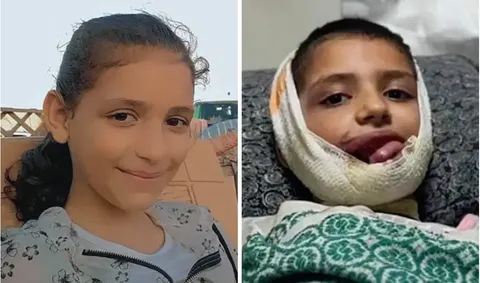
In April, Reuters described how football enthusiast Fadel al-Naji, 14, had lost both legs in an Israeli drone attack the previous September. His brother lost an eye.
“It is as if he is dying slowly, and I wish that they would fit him with prosthetic limbs,” his mother, Najwa, said. Prosthetic supplies were scarce under Israeli import restrictions, which Israel attributed to security concerns.[8]
In August, the Financial Times described how Rozan Khera, a committed runner, lost her left leg in Gaza City. “It was severed when I was still in bed,” she said. Her father, a football coach, lost both feet. Khera had begun playing amputee football, finding a way back into sport after injuries that had overturned her life.[9]
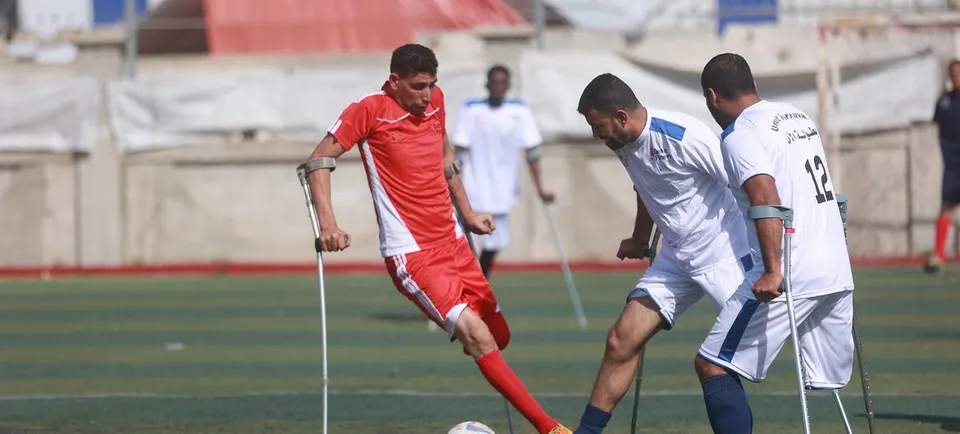
The toll on Palestinian sport also includes earlier rounds of violence. Footballer Mohammad Abu Jufail lost a leg during the 2014 Gaza war and subsequently returned to the game on crutches. He was among the players featured by UN News when amputee footballers gathered for a tournament in November 2025.
“The beginning was difficult; I had played with two legs, and now with one, using crutches,” he said.[10]
Such efforts depend on somewhere to play. Across Gaza, that basic requirement has become increasingly difficult to meet.
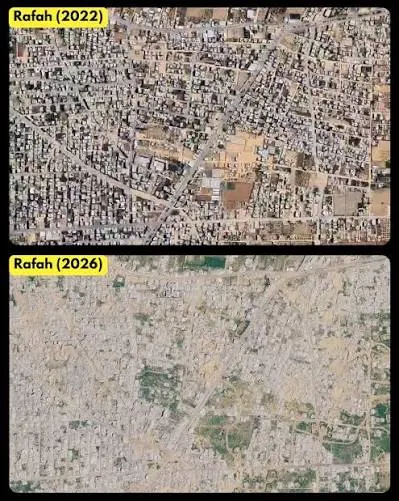
The Palestinian FA’s February 2026 assessment recorded 265 damaged sporting facilities: 184 completely destroyed and 81 partly destroyed. They included stadiums, club premises, indoor halls, football pitches, courts, swimming pools, gyms and Gaza’s only athletics track. Yarmouk, Palestine and Al-Durra stadiums had also become shelters for displaced people.[4]
A July report from the Organisation of Islamic Cooperation, citing the Palestinian Sports Media Union, put the number of destroyed sports facilities at 285. It used a later reporting date and did not provide the same complete-versus-partial breakdown.[11]
By late August, the Sports Media Federation reported that more than 50 of Gaza’s 56 sports clubs and about 20 small football pitches established with FIFA support had been destroyed. Only three surviving fields had been available for an official five-a-side competition launched in March.[3]
Yarmouk Stadium illustrates how completely a sporting landmark’s purpose can change. In December 2023, CNN geolocated footage there showing Palestinian detainees, including apparent children, stripped to their underwear in Israeli military custody. In June 2026, Reuters described the ground as a tent city for displaced families.[12,13]
The damage therefore extends beyond buildings. A destroyed club loses a meeting place, equipment, coaching routines and a route into organised sport for children. Rebuilding a pitch cannot replace the people who once taught them there.
The pressure for sporting sanctions has spread well beyond Ireland’s football team.
Ireland’s women’s basketball players refused pre-match handshakes with Israel before a EuroBasket qualifier in Riga in February 2024. They nevertheless played, and the teams exchanged handshakes when they met again in 2025. The distinction between a symbolic protest and refusing competition has remained central to the debate.[1]
Cycling produced one of the most disruptive confrontations. On 14 September 2025, pro-Palestinian demonstrations against Israel-Premier Tech’s participation forced the final stage of the Vuelta a España to be abandoned in Madrid. Jonas Vingegaard was declared the overall winner, while the podium ceremony was cancelled.[14]
The aftermath included a substantial change to the team itself. By the 2026 Tour de France, it was competing as NSN under new ownership and management and a Swiss licence. The change followed the previous season’s protests; it was not a suspension imposed on Israel by cycling’s governing body.[15]
Indonesia took a different course in October 2025, denying entry to Israeli gymnasts for the World Artistic Gymnastics Championships in Jakarta. The International Olympic Committee responded by urging federations not to stage events in Indonesia and suspending discussions about a possible Olympic bid until access for athletes of every nationality could be guaranteed.[16]
That episode demonstrated the potential consequences for a country excluding Israeli competitors. It also sharpened the argument over whose participation international sport’s institutions are willing and able to protect.
Palestinian amputee football coach Ali Abu Armanah told UN News in November 2025 that his team had been unable to travel to qualifying matches in Indonesia because of the conflict and the closure of the border crossing. The same report described local efforts to keep injured players competing in Gaza.[10]
Football’s response to Israel has included disciplinary action, although it has stopped short of suspension.
On 19 March 2026, FIFA found that the Israel Football Association had breached its rules on discrimination and fair play. It imposed a 150,000 Swiss franc fine, a warning and a prevention programme. The association was also instructed to display anti-discrimination banners at three senior FIFA competition home matches; a third of the fine was to fund the prevention measures.[17]
In announcing the decision, FIFA’s disciplinary committee said it “cannot remain indifferent to the broader human context” in which football operates.[17]
Separately, FIFA declined to act against Israeli clubs based in West Bank settlements, citing its position that the territory’s final legal status remained unresolved and complex. That was FIFA’s stated rationale for its sporting decision.[18]
The contrast invoked by boycott supporters is Russia. On 28 February 2022, FIFA and UEFA jointly suspended Russian national and club teams following the invasion of Ukraine. The organisations plainly possess the power to exclude teams when they decide circumstances warrant it.[19]
The longer historical precedent is apartheid South Africa. FIFA expelled its football association in 1976, while international campaigns against sporting contact formed part of the effort to isolate the apartheid state. The histories and regulatory grounds differ, but the precedent established that international sport could be used to exert pressure on a government.[20]
Israel denies committing genocide or war crimes and says its military operations are conducted in self-defence and in accordance with international law. By mid-September 2026, Gaza’s health authorities reported more than 73,000 Palestinians killed and more than 174,000 injured since October 2023.[1,21]
Within Irish football, even the language used to describe that destruction became contentious. Hallgrimsson’s remark that Ireland were “not playing with genocide” but “playing against genocide” drew an Israeli FA accusation of “ignorance, hypocrisy and stupidity”. The coach subsequently said genocide had been “a wrong word for me to use”; Israeli FA spokesman Shlomi Barzel withdrew “stupidity” but declined to apologise.[1]
The dispute over words will accompany the teams into their second fixture. So will the disagreement over whether playing while protesting is sufficient.
Ireland’s players made their objections visible in Debrecen. Bazunu expressed his by withdrawing. Across Gaza, the people whose losses underpin those decisions are attempting to rebuild teams with missing colleagues, damaged bodies and scarcely any grounds.
At the November 2025 amputee tournament, player Farah Youssef, who had lost a leg during an earlier conflict in Gaza, described playing as a way to recover something of her former life. Her message was simple: “continue the journey, don’t give up.”[10]
Sources and attribution
- BBC Sport, “Republic of Ireland ‘raised awareness worldwide’ in Israel game”, 27 September 2026, full text supplied with the commission. Match, post-match quotations, FAI decisions, basketball comparison and exchanges between the associations. Related BBC match report.
- FAI, 2025 AGM statement, confirming the motion requesting Israel’s suspension.
- Anadolu, interview with Mustafa Siam, 31 August 2026: reported 1,014 deaths, Abu al-Aish, club and pitch destruction, and resumed competition.
- Palestinian Football Association, detailed assessment, published 4 March 2026, covering losses to 12 February 2026. Figures cover the broader sporting, youth and scouting community, not exclusively professional athletes.
- Reuters, Salah’s response to UEFA’s tribute to Suleiman al-Obeid, 9 August 2025.
- Reuters, Palestinian football deaths, 23 June 2024, including Barakat and Khattab.
- The National, Nagham Abu Samra’s death and her father’s account, 12 January 2024.
- Reuters, Fadel al-Naji and shortages of prosthetic supplies, 16 April 2026.
- Financial Times, “The Gazan amputees turning to football”, 30 August 2026.
- UN News / United Nations in Palestine, amputee football tournament, 25 November 2025.
- OIC Palestine Observatory, 7 July 2026, citing the Palestinian Sports Media Union’s reporting to 3 July.
- CNN broadcast transcript, 27 December 2023, on footage geolocated to Yarmouk Stadium. CNN could not confirm the filming date.
- Reuters, Gazans watching the World Cup amid the ruins, 16 June 2026.
- Reuters, Vuelta’s abandoned finale, 14 September 2025.
- Reuters, republished by The Jerusalem Post, NSN’s changed ownership and identity, 3 July 2026.
- Reuters, IOC response to Indonesia’s visa ban, 22 October 2025.
- FIFA’s disciplinary decision announcement, 19 March 2026. The announcement stated that the decision was open to appeal.
- Reuters, FIFA’s settlement-club decision, 19 March 2026.
- UEFA, joint FIFA/UEFA suspension of Russian teams, 28 February 2022.
- UN Special Committee against Apartheid report, “Sports and apartheid”, recording FIFA’s expulsion of South Africa in July 1976; South African History Online, international sporting boycott.
- WAFA, Gaza health authorities’ cumulative figures, 14 September 2026: 73,786 killed and 174,771 injured.
- ITV News / PA, Gavin Bazunu’s statement, 27 September 2026.
- Reuters, republished by The Jerusalem Post, Irish athletes’ boycott letter, 21 September 2026.
The sporting death and facility totals above are attributed to the organisations that compiled or reported them. Their dates and categories differ; they have not been combined into a new total. The individual injury cases do not constitute a comprehensive tally of injured athletes.