‘It Will Shame the World’: Ireland’s Gaza Warning as New Google Earth Satellite Images Reveal Shattered Cities
Micheál Martin warns of a reckoning when Gaza’s full horrors are revealed. Satellite assessments document damage across more than four-fifths of its structures, while Israel’s restrictions on independent foreign reporting continue to obstruct scrutiny and families face another winter in tents and unsafe buildings.
The full exposure of what has happened in Gaza will shame the world, Ireland’s prime minister has warned, delivering an indictment of international failure as Israel continues to restrict independent foreign reporting from the devastated territory.
Addressing the UN General Assembly on 24 September, Taoiseach Micheál Martin warned of the reckoning to come “when the testimonies are heard, when the true horrors are finally and fully revealed, it will shame the world.”
His warning placed governments on notice: the eventual assembling of evidence would confront them with the consequences of suffering they had already witnessed and failed to stop.
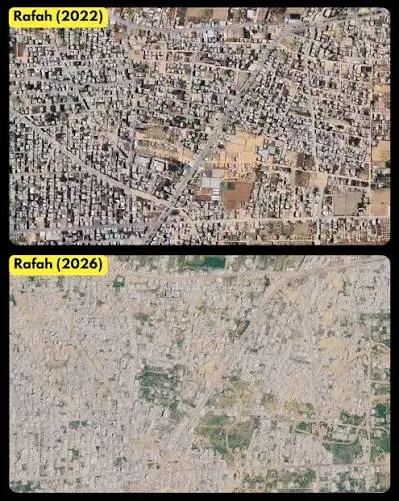
Part of that evidence is visible from space. Satellite imagery records neighbourhoods reduced to rubble, the spread of makeshift shelters and the disappearance of buildings that once contained homes, workplaces and public services. It also provides a way to examine places foreign correspondents cannot freely enter.
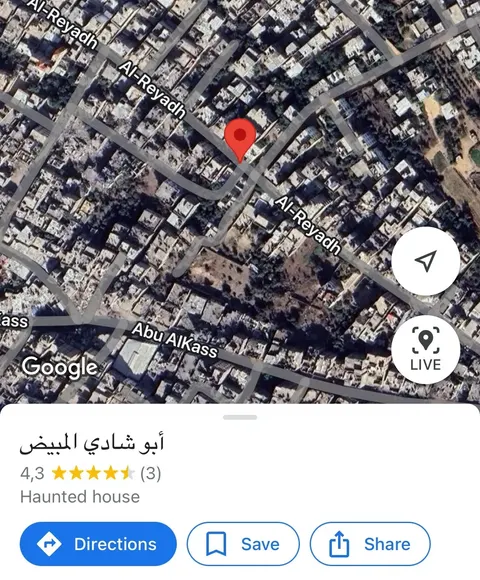
In a commentary on Google’s satellite maps, the narrator repeats: “Tents, tents, tents.” The account follows Gaza’s coastline, moving between the devastation of Rafah and the crowded shelters of al-Mawasi, then towards neighbourhoods transformed by destruction.
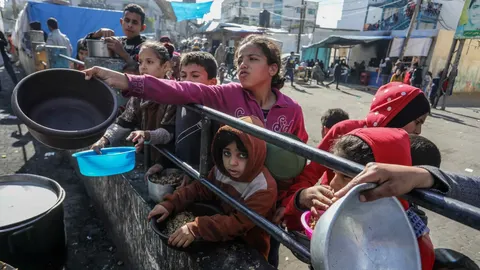
Behind the small shapes on the screen are households. “It’s not like just one person — full families,” the narrator observes.
The UN satellite record gives that view a measurable scale. Its comprehensive assessment using imagery from 16 June 2026 placed approximately 82 per cent of Gaza’s structures in categories ranging from possibly damaged to destroyed.
Of 201,290 affected structures, 134,422 were classified as destroyed, 13,848 as severely damaged, 28,096 as moderately damaged and 24,924 as possibly damaged. The assessment estimated that 328,627 housing units had been damaged. A structure can contain numerous individual homes.
UNOSAT cautioned that the analysis was preliminary and had not been validated in the field. Its comparison with October 2025 nevertheless showed a further nine per cent increase in structures classified as destroyed: a record of continuing deterioration after the ceasefire agreement.
The view from above cannot establish every circumstance of an attack, count the people beneath each tarpaulin or determine whether a building still standing is safe to occupy. Those questions require witnesses, investigators and access to the ground.
Israel has barred independent entry by foreign journalists since October 2023. The restriction affects Western correspondents and the wider international press, preventing news organisations from freely deploying additional teams to investigate attacks, interview survivors and examine conditions across the territory.
Some foreign journalists have entered on tightly controlled Israeli military visits. Those trips give the army considerable power over what visitors see and whom they meet.
A June investigation by Columbia Journalism Review described short military tours and requirements for broadcast footage to undergo security review. Israel says its restrictions protect journalists and troops, and that the footage checks prevent disclosure of sensitive military information.
The limits of such visits have themselves become a subject of investigation. After an Israeli-organised trip to the Kerem Shalom aid depot in August 2025, Australia’s ABC used satellite imagery to document extensive destruction in surrounding areas beyond what its correspondent had been shown.
Press organisations have challenged the continuing exclusion through the Israeli courts. In April, the Foreign Press Association, Committee to Protect Journalists, Reporters Without Borders and Union of Journalists in Israel sought an expedited decision after repeated government requests for delays.
“Let us into Gaza independently and immediately and work there alongside our Palestinian colleagues,” FPA chair Tania Kraemer said in their joint statement.
The following month, CPJ published an appeal by 61 members of the European Parliament for stronger action to secure foreign journalists’ access.
The demand received fresh diplomatic backing during the week of Martin’s address. On 24 September, Australia, Denmark, Egypt, Jordan, Kuwait, Qatar, Saudi Arabia and the UK issued a joint call for humanitarian access and health support. Among their demands was an explicit instruction: “Allow senior international delegations and journalists to access Gaza.”
The governments argued that access would help establish conditions on the ground almost a year after the ceasefire. Their appeal underlined the continuing gap between diplomatic commitments and independent scrutiny.
Palestinian journalists have provided an extensive record of the destruction. Their reporting, photographs and footage have reached international audiences through local and global news organisations, often while the reporters themselves face displacement, bereavement and physical danger.
The ban leaves those journalists carrying an extraordinary burden while preventing foreign colleagues from freely joining them. In its tally updated on 24 September, CPJ recorded 189 Palestinian journalists and media workers killed by Israel in Gaza. It warns that destroyed communications infrastructure, displacement, loss of life and restrictions on foreign access make verification exceptionally difficult.
The world has therefore seen a great deal through Palestinian reporting. What remains denied is the unrestricted access that would allow international teams to work alongside local journalists, follow additional leads and examine the full extent of the destruction independently.
Some of the evidence is also at risk of disappearing.
On 7 September, Francesca Albanese, the UN special rapporteur on the occupied Palestinian territory, warned that large-scale rubble clearance in areas under Israeli military control could destroy evidence and obstruct the recovery and identification of human remains.
“The implications are profound. Gaza’s rubble contains human remains and physical evidence relevant to the investigation of alleged international crimes, including genocide,” she said.
Removing debris without appropriate safeguards risks losing material that could establish how people died, identify victims and help determine responsibility.
For survivors, however, the ruins are also places where they must try to live.
Rafah embodies the repeated displacement behind the satellite images. By May 2024, it had become a refuge for more than 1.4 million people fleeing other parts of Gaza. Israel’s military operation brought another exodus and the seizure of the Gaza side of the crossing into Egypt. Families who had already abandoned homes elsewhere were again told to move towards a designated humanitarian area.
In August 2026, OCHA, the UN’s humanitarian coordination office, reported that almost the entire remaining population of 2.1 million was concentrated in less than half of the Gaza Strip, west of the military deployment boundary known as the Yellow Line.
The shelters visible along the coast are one consequence of those movements. Other displaced families occupy crowded collective shelters or damaged homes. Each form of accommodation brings its own risks, and civilians have repeatedly been attacked in places where they sought protection.
Amnesty International’s investigation into two attacks in May 2024 found that Israeli forces had failed to take all feasible precautions to protect displaced people. At the Kuwaiti Peace Camp in Tal al-Sultan, west Rafah, it documented at least 36 deaths, including six children, in an attack using two US-made GBU-39 bombs. At least four of those killed were fighters.
Two days later, Israeli tank fire in the al-Mawasi area of Rafah killed 23 civilians, including 12 children, Amnesty found. The organisation said both attacks should be investigated as war crimes. It also criticised Hamas and Islamic Jihad fighters for being located among displaced civilians, putting them at risk.
“Once again displaced Palestinian civilians seeking shelter and safety have paid with their lives,” said Amnesty’s Erika Guevara-Rosas.
On 10 September 2024, the UN human rights office reported another deadly attack on tents in al-Mawasi, this time in Khan Younis: at least 19 civilians killed and 60 wounded in an area Israel had designated a humanitarian zone. Israel said it had struck a Hamas command centre; Hamas denied that fighters were present.
“We were in humanitarian areas that were supposed to be safe,” Raed Abu Muammar told Reuters. He was holding his surviving baby daughter; another daughter had been killed.
The camps have also become places where the consequences of destroyed infrastructure accumulate. Overcrowding, unsafe water, limited sanitation and exposure to the weather turn temporary shelter into a continuing health risk.
OCHA’s report dated 11 September 2026 said 91 per cent of assessed households faced moderate to high water insecurity. Agencies preparing displacement sites for winter were repurposing wooden pallets and empty flour sacks, using the sacks as sandbags to reduce flooding.
The same report described efforts to secure entry for nearly 37,000 pieces of timber and 660 emergency shelter kits. The Norwegian Refugee Council put the timber figure at 36,960 and said Israeli authorities had approved the materials in August, then rejected their entry on 26 August and 2 September. A renewed UN coordination request was subsequently denied, reportedly on security grounds.
In the shelter assessment cited by NRC, nearly two-thirds of surveyed households lived in tents or makeshift shelters, more than half of which were in poor or very poor condition. Among households in damaged buildings, 71 per cent could not afford repair materials and 49 per cent said materials were unavailable locally.
“Families in Gaza face an impossible choice between a damaged building that could collapse and a tent that could flood,” NRC secretary general Jan Egeland said.
That danger became fatal before dawn on 16 September, when a war-damaged residential building collapsed in Gaza City’s Tal al-Hawa neighbourhood. OCHA reported 21 deaths, including 12 children, citing civil defence and local health authorities.
Talal Al Harazin, who had been living with his family in a tent beside the building, described the collapse to the UN.
“The dust was so thick that we could not even see our fingers,” he said.
OCHA reported that thousands of people were sheltering in hundreds of structures assessed as unsafe because better accommodation was unavailable. Rescue operations were constrained by shortages of heavy machinery and specialist equipment.
“No one should have to risk their life simply to find a safe place to shelter,” said Ramiz Alakbarov, the UN humanitarian coordinator for the occupied Palestinian territory.
His appeal called for urgent entry of machinery, fuel and equipment for rescue work, alongside tents and tarpaulins before the rains. A building can remain visible on a satellite map long after it has ceased to provide secure shelter.
The environmental damage extends beyond collapsed homes. In September 2025, the UN Environment Programme estimated that destruction had generated 61 million tonnes of debris. It warned that about 15 per cent could carry a relatively high risk of contamination from asbestos, industrial waste or heavy metals unless materials were properly separated.
UNEP also reported the loss of 97 per cent of tree crops and 82 per cent of annual crops since 2023. Collapsed sewage treatment, broken water networks and the use of cesspits threatened the aquifer on which much of Gaza depended.
Those are dated findings, but they identify damage that cannot be repaired by replacing houses alone. Water systems, soil, food production and waste disposal all form part of the reconstruction task.
“The situation is going from bad to worse,” UNEP executive director Inger Andersen said when the assessment was released.
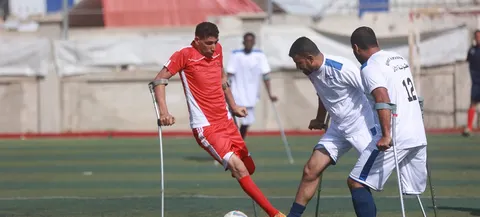
The eight-government statement issued during UN week described another dimension of that destruction: Gaza had no fully functioning hospital, it said, while at least 43,000 people faced life-changing disabilities without access to specialised care, prosthetics and rehabilitation.
Google’s maps make parts of this devastation accessible to anyone with an internet connection. Understanding what they show requires attention to when the images were taken.
The commentary alleges that Google deliberately delayed showing the destruction. The evidence supplied does not establish that claim. A visible join between images, or a change in colour across adjacent areas, cannot by itself demonstrate deliberate concealment.
Google explains that satellite and aerial views draw on multiple providers and combine photographs taken on different dates into mosaics. Lighting, weather and image age can vary across adjoining areas. The date of capture is also different from the date of publication.
Google Earth’s documentation says a displayed date may represent the beginning of a range and can change as a user moves across a mosaic. The images are not live.
There is also evidence of earlier updates. In May 2025, The Standard published comparisons using Google Earth imagery of Gaza, including December 2024 views of Jabalia and Beit Lahia and June 2024 views of Rafah and Khan Younis.
Without the original recording, its publication date and the acquisition dates of the precise areas shown, the commentary’s claim of a new update cannot be tied to a particular release. Uneven or outdated coverage still matters: an older photograph can leave viewers with an incomplete understanding of what survives.
Google’s relationship with Israel is the subject of a documented, separate controversy.
Project Nimbus, awarded to Google and Amazon in 2021, was a $1.2 billion agreement to provide cloud and artificial intelligence services to the Israeli government. Protests against that relationship led to the dismissal of more than 50 Google workers in April 2024, according to organisers cited by Associated Press.
Google said the dismissals concerned disruptive workplace conduct. Workers challenged the firings through a US labour complaint. The company also said Nimbus did not involve sensitive military or intelligence workloads.
The Washington Post subsequently reported that Google staff helped the Israeli military obtain AI tools during the war. That history warrants scrutiny, but it does not establish a connection between Nimbus and decisions about which satellite images appear in Google Maps.
The evidence of Gaza’s destruction has already informed findings extending far beyond the language of a map commentary.
In September 2025, the UN Independent International Commission of Inquiry concluded that Israel had committed genocide in Gaza, finding four of the five acts defined by the Genocide Convention. Its assessment addressed both conduct and intent, including the destruction of conditions necessary for Palestinian life.
Israel rejected the commission’s findings as biased and politically motivated. The commission’s determination is distinct from a court judgment; satellite damage figures alone cannot resolve every question of intent, targeting or responsibility.
Martin also warned that settlement expansion and violence in the West Bank were undermining Palestinian statehood. He described the displacement and destruction facing Palestinian communities as ethnic cleansing, while reaffirming Ireland’s support for two states and pointing to its action against settlement imports.
OCHA’s September reporting documented more than 1,600 settler attacks causing Palestinian casualties or property damage across 275 communities during 2026. It described families isolated by outposts and access restrictions, alongside damage to homes, farmland, water supplies and electricity infrastructure.
Martin’s warning about an eventual reckoning rests against this accumulating record: testimony from survivors, reporting by Palestinian journalists, humanitarian assessments and images showing what has happened to the land itself.
For families facing another winter, the choices remain brutally constrained: a tent exposed to the weather, a crowded shelter, or a damaged home whose walls may no longer hold. Satellite images show where those choices are being made. The collapse in Tal al-Hawa shows what a map cannot tell a viewer: which of the buildings still standing will be the next to fall.
Hassan Esdodi, a Palestinian correspondent for Japan’s Kyodo News, told Columbia Journalism Review that foreign colleagues should insist on being able to enter freely before returning after a military tour.
“Only then can you compare how much was covered up, how much was hidden, how much killing and destruction you couldn’t see before.”
Sources
- Micheál Martin’s UN General Assembly address, 24 September 2026 — UN transcript. The UN page uses automatic speech recognition; the quotation was cross-checked against VideoParliament’s Gaza section and Irish Times reporting.
- UNOSAT comprehensive damage assessment; imagery 16 June 2026. The numerical findings were also verified in OCHA’s 7 August 2026 report, which supplies the population-concentration figure.
- FPA, CPJ, RSF and UJI joint statement on independent press access, 15 April 2026.
- Columbia Journalism Review investigation into military press visits, 1 June 2026.
- ABC investigation using satellite images beyond an Israeli-controlled media visit, 10 August 2025.
- CPJ, European Parliament members urge foreign journalist access, 7 May 2026.
- Eight-government call on humanitarian access and health, 24 September 2026.
- CPJ journalist casualty record, updated 24 September 2026.
- UN Human Rights Special Procedures statement on rubble clearance, 7 September 2026, reproduced by YubaNet.
- Reuters, Rafah displacement and military operation, 8 May 2024.
- Amnesty International, investigation into attacks on displacement camps, 27 August 2024.
- OHCHR statement on al-Mawasi, 10 September 2024 and Reuters reporting on the strike.
- OCHA humanitarian situation report, 11 September 2026.
- Norwegian Refugee Council statement on shelter restrictions, 16 September 2026.
- OCHA humanitarian situation report, 18 September 2026, published 21 September.
- Ramiz Alakbarov’s statement on the building collapse, 16 September 2026.
- UNEP environmental assessment findings, 23 September 2025.
- Google Earth Help: how images are collected and Google’s explanation of satellite imagery, 5 October 2020.
- The Standard, Google Earth before-and-after comparisons, 20 May 2025.
- Associated Press, Google dismissals following protests, 23 April 2024.
- Reuters, former Google workers’ labour complaint and company response, 30 April 2024.
- The Washington Post, Google AI assistance to the Israeli military, 21 January 2025.
- OHCHR, UN commission’s genocide finding, 16 September 2025 and Reuters reporting, including Israel’s response.