The Warnings Before October 7: New Allegations Put Netanyahu’s Decisions Under Scrutiny
An alleged warning from the UAE president adds to the evidence of missed intelligence, failures in the military response and unanswered questions about the political choices surrounding the attack.
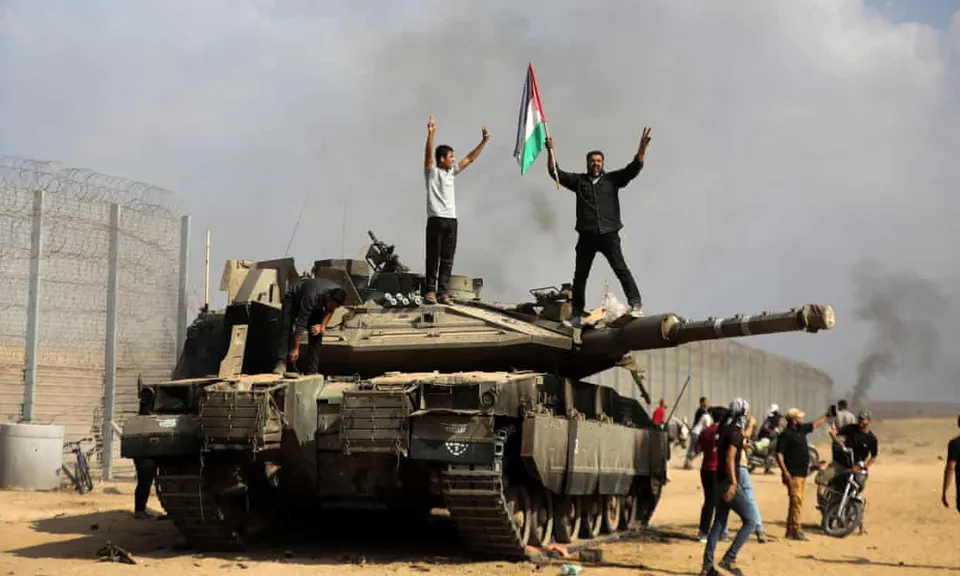
Ten days before the Hamas attack of 7 October 2023, the president of the United Arab Emirates allegedly delivered a personal warning to Benjamin Netanyahu: Hamas leader Yahya Sinwar was preparing a major operation that could bring bloodshed and destabilise the region.
The allegation, published by Haaretz on 8 September 2026, places a potentially consequential warning at the highest level of Israel’s political leadership. According to the investigation, Netanyahu reassured the Emirati leader that Israel was prepared, judged that any escalation was more likely to emerge in the occupied West Bank, and failed to inform senior security officials about the conversation. The reporting draws on Hostages: 843 Days of Abandonment, a book by journalists Shlomi Eldar and Ruth Yuval.
Netanyahu’s office denies that he spoke to the UAE president during the period in question or received such a warning. That denial is central to a dispute over what information reached the prime minister personally, how he assessed it, and whether other officials were deprived of intelligence that might have changed their decisions.
The new account joins a substantial record of warnings and operational failures. Together, they raise questions extending from the interpretation of Hamas training exercises to the hours in which Israeli communities waited for protection, and from orders issued during the attack to the objectives pursued in the wars that followed.
The evidence warrants a rigorous examination of responsibility. It does not establish that Netanyahu knew the attack’s exact date or deliberately allowed it to happen, a distinction that matters when assessing both the new allegations and the wider record.
The alleged warning from Abu Dhabi
According to the book’s account, UAE President Mohamed bin Zayed Al Nahyan spent approximately 45 minutes speaking to Netanyahu in late September 2023. His concern extended beyond an isolated border incident to the danger of a regional upheaval, including damage to the Abraham Accords, under which the UAE had normalised relations with Israel.
The reported warning originated in conversations involving Sinwar and a senior Fatah intermediary. Sinwar was said to have threatened an “earthquake” if stalled negotiations failed to advance. The intermediary relayed his concerns to an adviser to the Emirati president, who subsequently took the matter up with Netanyahu. The reporting cites three senior foreign officials briefed on the call and an adviser with direct knowledge of it.
The investigation’s chronology places a related warning with the Shin Bet, Israel’s domestic security service, in mid September, followed by a briefing to Netanyahu on 17 September. Ronen Bar, then the agency’s director, reportedly advocated military action or stronger defensive preparations, without a decision being taken. The alleged presidential call would therefore have reinforced a warning already circulating through intelligence channels.
The investigation also revisits an alleged warning from Egyptian intelligence chief Abbas Kamel. On 1 October, according to the reporting, Bar again proposed action against Hamas, but Netanyahu did not disclose the Emirati conversation during the security discussion. Officials subsequently said that knowledge of the foreign warnings might have changed their reading of the intelligence.
That is the central operational question raised by the allegation: whether information held by the prime minister could have altered decisions elsewhere in the state. A warning need not contain an attack date to justify checking assumptions, strengthening protection or revisiting an assessment that an adversary is deterred.
Eldar has defended the investigation as supported by recordings, documents and crosschecking. The authors’ claims about their evidence now face a direct contradiction from the prime minister’s office, making examination of the underlying records and testimony essential to resolving the dispute.
Former prime minister Naftali Bennett said the report was true, without explaining the basis of that knowledge. The UAE foreign ministry, meanwhile, declined to address the alleged conversation directly, saying it did not comment on speculation about exchanges between leaders and that relevant intelligence was communicated through established channels. Neither response resolves the factual dispute.
The attack plan and the warnings that followed
Long before the Emirati allegation emerged, reporting had challenged the idea that the attack was wholly beyond the imagination of Israel’s intelligence apparatus.
On 30 November 2023, The New York Times reported that Israeli officials had obtained a Hamas battle plan more than a year before the assault. Known as “Jericho Wall”, the document ran to roughly 40 pages and described rocket fire, drones disabling border surveillance and weapons systems, and armed incursions against military positions and communities. Officials nevertheless treated the scenario as exceeding Hamas’s capabilities.
In July 2023, an experienced analyst in Unit 8200, Israel’s signals intelligence organisation, warned that a Hamas exercise resembled the plan. Her assessment challenged a superior’s dismissal of the scenario and identified preparations for war. The reporting did not establish that Netanyahu personally saw the document, which did not provide the attack’s date.
This record exposes a problem beyond intelligence collection. Information about an adversary’s ambitions and rehearsals had been gathered, but its implications were resisted. The institutional question is how an assessment of limited capability became strong enough to override evidence that the capability was being developed.
A further document, dated 19 September 2023 and reported by Israeli public broadcaster Kan in June 2024, described preparations for an operation involving the capture of approximately 200 to 250 people. The reporting said it reached officials in the Gaza Division. Its existence does not establish that the prime minister read it, but it adds specificity to the evidence available within the military.
Female border observers also repeatedly reported suspicious activity and rehearsals, including drone training against a replica of an Israeli observation position. Their accounts raise a further question about whose expertise counted inside the military hierarchy. Personnel whose work involved sustained observation of the border described changes they considered significant, yet their concerns did not produce protection commensurate with the danger that materialised.
The warnings from Egypt became public almost immediately after the attack. On 11 October 2023, Michael McCaul, then chairman of the US House Foreign Affairs Committee, said after a classified briefing that Egypt had warned Israel three days before the assault. His statement lent weight to reports of an Egyptian alert, although it did not publicly establish the complete wording, recipient or operational detail. Israel disputed accounts that its leadership had received such a warning.
Broader strategic warnings had also reached Netanyahu. In May 2024, the military disclosed that four communications sent between March and July 2023 addressed the security implications of Israel’s internal divisions. These concerned how adversaries might interpret the crisis over the government’s proposed judicial overhaul. They were warnings about vulnerability, and should not be treated as four separate forecasts of the precise October 7 operation.
The night before and the disputed response
By the night before the attack, the issue had become immediate. Unusual activity, including the activation of Israeli SIM cards by Hamas operatives, prompted consultations among senior security officials. Limited precautions followed, including the dispatch of a small counterterrorism team and adjustments to aviation readiness, but no response capable of meeting the impending assault was put in place.
The military’s subsequent investigation described a profound underestimation of Hamas and a failure to interpret the accumulating indicators. Familiar explanations for individual signals helped officials discount the possibility that, taken together, they pointed to something much larger.
Netanyahu has argued that security chiefs did not wake him before the attack, and has suggested they feared he would order action that could trigger an escalation. That assertion about their motives remains his claim. Reporting has also placed his first conversation with military chief Herzi Halevi roughly three hours after the assault began, despite earlier telephone updates to the prime minister.
The prime minister’s own published schedule records an initial notification at 6.29am and a further call at 6.44am. It says he asked about reserve mobilisation during the second call, spoke with Defence Minister Yoav Gallant while travelling to military headquarters, and ordered full mobilisation during a meeting beginning at 9.55am. Kan’s reporting placed the first discussion with Halevi at approximately 9.45am. These accounts require reconciliation, including the difference between asking about mobilisation, ordering it and implementing it.
His office has also acknowledged that an intelligence officer in his apparatus received a memorandum about suspicious Hamas activity approximately three hours before the attack, but did not pass it on, citing its framing as insufficiently urgent.
The dispute over when Netanyahu was awakened cannot answer the broader question of what he did once informed. For people under attack, responsibility was measured in whether warnings became orders, whether orders reached units, and whether those units arrived while lives could still be saved.
Communities left waiting for protection
At Be’eri, the military’s investigation, released on 11 July 2024, found that residents and the local security team carried much of the defence during the first hours. Thirteen Shaldag commandos arrived at approximately 9.03am, but they remained the only army unit inside the kibbutz until around 1.30pm.
The inquiry also documented troops gathering outside the community while fighting continued. Some were waiting for commanders, some had evacuation duties, and others had withdrawn after casualties. The findings described failures of coordination and command, alongside decisions that left residents without adequate protection. These were findings about Be’eri, rather than a single timeline applicable to every community attacked that day.
Nir Oz suffered a different failure. According to the investigation reported on 14 March 2025, Border Police personnel entered at approximately 1.10pm, about 40 minutes after the last attackers were estimated to have left. Members of the army’s Egoz unit arrived at 1.47pm. Forces intended for the area had encountered fighting elsewhere and been diverted, leaving the kibbutz without reinforcements throughout the attack inside it.
Such findings establish grave failures without, by themselves, proving a centrally directed decision to withhold protection. Establishing how the collapse occurred requires the orders, communications and deployment decisions connecting political leadership, military headquarters and individual units.
Hannibal orders and the danger to captives
The conduct of Israeli forces during the attack raises another set of questions, particularly about efforts to prevent people being taken into Gaza.
The Hannibal directive was a controversial military procedure intended to prevent the capture of Israeli soldiers, even through actions that endangered their lives. Although formally revoked in 2016, the name and the practice associated with it resurfaced in accounts of October 7. Its implementation and interpretation must be distinguished from an established blanket order to kill every person being abducted.
A Haaretz investigation published on 7 July 2024 reported Hannibal orders at several military locations. It also identified an instruction issued at 11.22am: “Not a single vehicle can return to Gaza.” A military source told the newspaper that personnel understood such vehicles could contain Israeli captives. The reporting raised the possibility that preventing abduction had taken precedence over protecting people being carried away, while leaving the resulting casualty total unresolved.
In a Channel 13 interview circulated in March 2024, Israeli commander Bar Zonshine described acting against vehicles he believed might contain captured soldiers, accepting the possibility that his actions could kill them. His account provides evidence about one commander’s decisions and understanding of the situation.
One identified victim of probable Israeli fire was Efrat Katz, 68, who was taken from Nir Oz. An air force inquiry published on 5 April 2024 concluded that she was likely killed when an Israeli helicopter fired on a vehicle carrying militants and hostages. The military said its surveillance systems had not distinguished between them, and the air force commander found that the crew had acted in accordance with its orders.
That finding is evidence of a probable death caused by Israeli fire. It does not establish that the helicopter crew knew Katz was present or consciously applied a Hannibal order against her. Conflating those propositions would misstate what the inquiry found.
At Be’eri, Brigadier General Barak Hiram’s account of authorising an assault despite the risk to civilians generated scrutiny of tank fire around a house where hostages were held. The military later defended the commanders’ decisions and assessed that most hostages there were probably killed by their captors, while leaving aspects of the deaths unresolved. Those findings do not remove the need to examine the decision to use heavy weapons where hostages were present.
In a February 2025 interview with Channel 12, Gallant said he believed Hannibal instructions had been issued tactically in some places and not in others. His remarks support further scrutiny of local orders, but do not supply a complete account of who authorised each action or how many people died as a result.
These questions about Israeli actions coexist with the responsibility of Hamas and other attackers for killing civilians and taking hostages. A credible investigation must establish the circumstances of individual deaths and the decisions that contributed to them, without using one set of crimes or failures to obscure another.
A wider political and territorial agenda
The political consequences of October 7 reach beyond the events of that day. Within two days, Netanyahu was presenting Israel’s response in regional terms. On 9 October 2023, he said the campaign would “change the Middle East”, signalling an ambition extending beyond restoring security around Gaza.
Statements about Palestinian displacement also emerged early. Agriculture Minister Avi Dichter, a member of Netanyahu’s Likud party, described the campaign in November 2023 as “Gaza Nakba 2023”. The reference invoked the catastrophe of 1948, when hundreds of thousands of Palestinians fled or were expelled from their homes during the war surrounding Israel’s establishment.
National Security Minister Itamar Ben-Gvir subsequently promoted the departure of Palestinians from Gaza and the return of Israeli settlements. By January 2024, cabinet ministers were attending a conference advocating settlement in the territory and Palestinian emigration. These proposals gave concrete political expression to demands that the war produce a lasting transformation of Gaza’s population and control.
The issue remains current. On 4 September 2026, Reuters reported renewed proposals from Ben-Gvir and Defence Minister Israel Katz for the mass departure of Gaza’s Palestinians. Netanyahu has supported what he describes as voluntary emigration while distancing himself from proposals to reestablish Israeli settlements there. That distinction matters when attributing particular policies, even as the prospect of displacement raises profound questions about whether people living amid destruction have a meaningful choice.
The wider territorial questions also require specific evidence. Israel’s military presence in southern Syria, for example, has extended beyond its initial description as temporary: in January 2025, Katz said troops would remain on Mount Hermon indefinitely. Such decisions warrant scrutiny in their own right, alongside the wars involving Lebanon and Iran, without assuming that every subsequent development proves a plan formed before October 7.
For Palestinians, accountability also concerns the destruction inflicted on Gaza. In September 2025, a commission of inquiry established by the UN Human Rights Council concluded that Israel had committed genocide, citing prohibited acts and evidence of intent. Israel rejected the findings. The commission’s conclusion was an investigative finding, distinct from a final judgment by an international court.
The occupied West Bank belongs in this wider examination. Settlement expansion and violence against Palestinian communities have deepened concerns about permanent dispossession and the destruction of any prospect of Palestinian statehood. On 8 September 2026, France cited escalating settler violence and settlement expansion when announcing plans to ban imports from Israeli settlements.
The case for an independent inquiry
The relationship between wartime decisions and earlier territorial ambitions is therefore a legitimate subject of investigation. How far did October 7 become a justification for pursuing policies of displacement, annexation and settlement that political figures had previously advocated? Answering that question requires examining decisions made after the attack, while any allegation that Netanyahu deliberately permitted the assault requires separate evidence of advance knowledge and intent.
An independent inquiry would need to test what warnings existed, who received them, how they were interpreted and what action followed. It would also need to reconcile the prime minister’s timetable with military records, examine why reinforcements failed to reach communities, and establish the authorisation and consequences of orders that endangered captives.
The distinction between information being absent, being misunderstood and being withheld is fundamental to determining responsibility. So is the distinction between political leaders exploiting a catastrophe afterwards and having knowingly allowed it beforehand.
Nearly three years after October 7, the new allegation sharpens a question that the accumulated record has made impossible to dismiss: when warnings reached people with the power to act, why did those warnings fail to become protection for the people whose lives depended on them?