Israel’s Expanding ‘Yellow Line’ Deepens Fear and Displacement Across Gaza
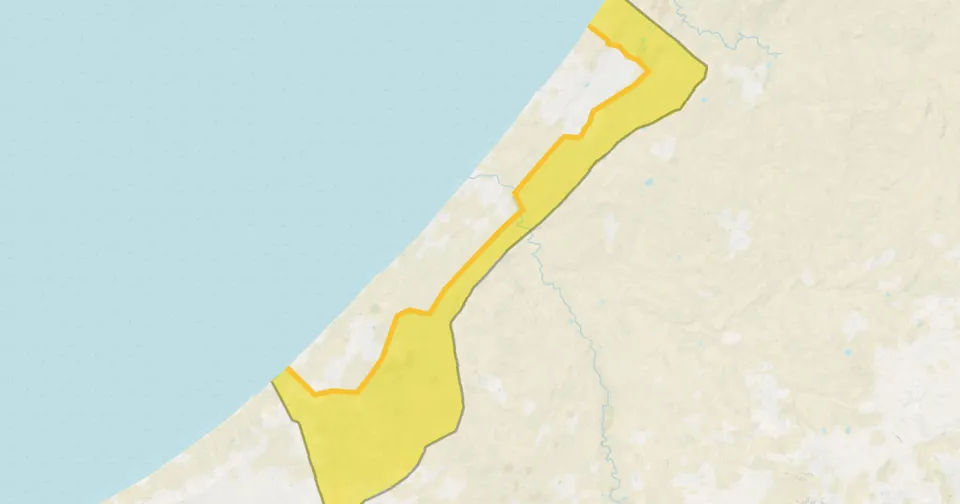
The fragile ceasefire line once intended to separate Israeli military positions from civilian areas in Gaza is steadily shifting, according to residents, aid agencies, and researchers, leaving Palestinians trapped in an increasingly dangerous state of uncertainty.
What was originally described as a temporary demarcation under a US-brokered ceasefire agreement has evolved into what many Gazans now call a moving frontier. Known locally as the “yellow line,” the boundary is marked in some places by yellow concrete blocks and military earthworks. Residents say it has advanced westward over recent months, bringing Israeli-controlled territory deeper into populated areas and exposing civilians to new risks.
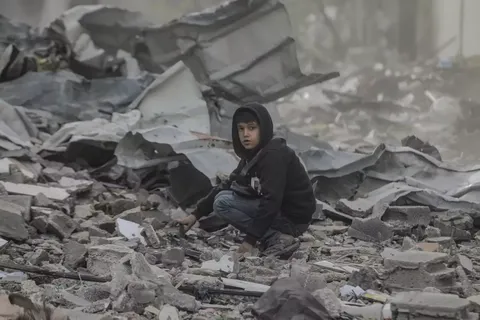
Across northern Gaza and Khan Younis, families report waking to discover that areas they believed were relatively safe had overnight become military exclusion zones.
For many civilians, the shift is not announced in advance. Instead, they become aware of it through the sound of tanks, bulldozers, and gunfire.
Faiq al-Sakani, a resident of al-Tuffah, said the line had moved multiple times in recent months, bringing military activity closer to homes and roads previously used by displaced families.
“The yellow line has advanced several times,” he said, describing how the demarcation reportedly moved roughly 100 metres in January toward the Salah al-Din road, a major north-south artery through Gaza.
According to residents, each expansion has coincided with an increase in demolitions, excavation work, and the construction of military positions.
Researchers monitoring developments inside Gaza say the gradual advance of the line may have significantly altered territorial control since the ceasefire agreement. Analysts from the research group Forensic Architecture estimate that Israeli-controlled territory expanded from approximately 53% of Gaza under the original ceasefire maps to roughly 58% by December, with further territorial advances reported afterward.
The line itself is marked in some locations by yellow concrete blocks, many of which residents say were repositioned during December and January as the military advanced deeper into urban districts.
According to reports from Israeli newspaper Haaretz, more than 10 miles of earth berms have already been constructed along sections of the line, primarily in northern Gaza. These raised barriers provide elevated firing positions and broad lines of sight across damaged neighborhoods.
Recent construction has also included a growing network of fortified military outposts. Seven new concrete forts were reportedly built in recent months, bringing the total number of fortified positions across Gaza to 32.
The changing geography has left many Palestinians uncertain about where it is safe to move, gather aid, or seek shelter.
Aid organisations working in Gaza describe an additional layer of confusion involving what Israeli liaison officers reportedly refer to as an “orange line” — an invisible buffer area extending beyond the visible yellow markers.
Unlike the concrete blocks marking parts of the yellow line, the orange line reportedly exists only on military maps and may stretch between 200 and 500 metres beyond the visible boundary.
Humanitarian workers say the uncertainty surrounding these invisible boundaries complicates relief operations and increases risks for civilians already displaced by months of war.
The United Nations reported earlier this year that at least 10 of its facilities, including emergency shelters for displaced civilians, had ended up within newly expanded restricted zones after the boundary shifted.
Residents living close to the line describe a climate of constant fear.
Duaa Taima, who lives with her children in an abandoned clinic near Jabaliya refugee camp, said life has become increasingly precarious as military activity moved closer.
“We live under continuous threat even after the ceasefire,” she said. “There is continual random gunfire from the Israeli army and I hide with my children behind the cracked walls, searching for any kind of protection.”
She recalled the arrival of heavy machinery and yellow concrete barriers in December, saying the military advance was accompanied by gunfire and armored vehicles.
In northern Gaza, residents also describe the construction of long earth berms — raised barriers of soil that provide elevated firing positions and observation points. These berms now stretch for miles across parts of the territory, reshaping the landscape and reinforcing perceptions that the military presence may be becoming permanent.
Recent construction has reportedly included fortified outposts positioned along the demarcation line, further entrenching Israeli positions.
Israeli officials have defended the measures as necessary for troop protection and operational security.
An Israeli military spokesperson said the army marks the yellow line according to changing battlefield conditions and attempts to inform civilians of its location to reduce friction.
“The area adjacent to the yellow line is a sensitive and dangerous operational environment,” the spokesperson said, adding that signs warn civilians not to approach.
The military maintains that it does not target civilians solely due to proximity to the line.
However, human rights advocates argue that the growing zone creates conditions in which civilians face extreme danger even when not participating in hostilities.
UN human rights commissioner Volker Türk recently stated that “targeting civilians not taking direct part in hostilities is a war crime, regardless of their proximity to deployment lines.”
According to United Nations figures, more than 700 Palestinians were killed by Israeli fire during the ceasefire period, with 269 of those deaths occurring near the yellow line. Of those killed near the boundary, more than 100 were reported to be children.
Families living near the boundary say they now limit movement to essential trips only.
Rafiq Mustafa, a resident of Beit Lahiya, said his family initially believed their home was a safe distance from the military zone until yellow concrete markers appeared nearby.
“We would know the blocks were being moved by the sound of tank and bulldozer engines,” he said. “We stayed inside the house, unable even to go up to the roof.”
He described a life governed by caution and fear.
“We only go out if it’s absolutely necessary now,” Mustafa said. “We are afraid for ourselves and for our children. They no longer play in the streets.”
Some legal scholars and commentators argue that the expanding line reflects broader political objectives beyond military security.
Palestinian-American legal scholar Ahmad Ibsais has described the evolving boundary system as “a method of annexation deliberately designed to evade legal consequences,” arguing that the gradual extension of restricted zones risks permanently displacing civilians from their communities.
For many in Gaza, the expanding line represents more than a military boundary. It has become a shifting symbol of instability, where the map can change overnight and the margin between safety and danger is never fixed.