AIPAC Suffers Major Defeat as Michigan Elects a Champion of Palestinian Rights
Abdul El-Sayed’s election as the first Muslim US senator delivers a breakthrough for supporters of Palestine, with the victorious Democrat challenging AIPAC directly and Zeteo’s Mehdi Hasan celebrating the defeat of those who tried to stop him.
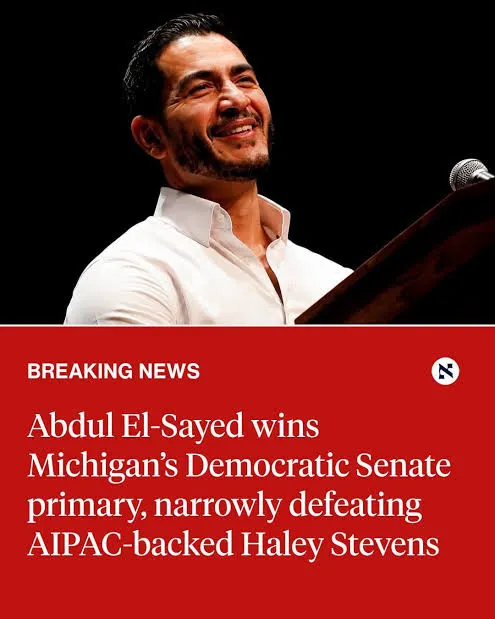
Abdul El-Sayed’s victory in Michigan has delivered a major defeat for AIPAC and a breakthrough for supporters of Palestinian rights, sending a candidate who demands an arms embargo on Israel to the United States Senate despite an expensive campaign to prevent him getting there.
The Democrat defeated Republican Mike Rogers in the 3 November election and will become the first Muslim senator in American history when he takes office in January. He held a lead of about seven percentage points with approximately 97 per cent of the vote counted on 4 November, a substantial victory in one of the country’s most closely contested states.
For Palestinian rights campaigners, the significance extended beyond that historic first. A candidate who had openly condemned Israel’s actions in Gaza as genocide, challenged American military support and refused to retreat from those positions had won a statewide election after surviving opposition in both the Democratic primary and the general election.
In his victory speech, El-Sayed addressed the American Israel Public Affairs Committee directly, putting its spending against him at $42 million.
“To AIPAC, who spent $42 million against us, thank you for giving me the opportunity to beat you twice.”
He placed that challenge within a broader promise to confront the influence of wealthy interests over American politics.
“To the super PACs and special interests who tried to beat us, we are coming for your system of politics.”
The message gave supporters of Palestine a tangible electoral success around which to organise: opposition to unconditional support for Israel had survived a sustained effort to make it a disqualification for office.
Palestinian children at the centre of the victory speech
El-Sayed used his victory address to defend the moral basis of his position, rejecting the suggestion that concern for Palestinian lives should be treated as an expression of hatred.
“They try to call you hateful if you believe that Palestinian kids should get to grow up in the land of their forefathers without being murdered by our tax dollars,” he said.
“If you believe in equal rights to peace, dignity, and self-determination, that’s not hate, it’s love.”
The passage was striking for its clarity about what Palestinian rights mean. Children should be able to grow up safely in their homeland, and the United States should not finance the destruction of that future. By placing peace, dignity and self-determination together, El-Sayed presented those rights as principles that should apply equally to everyone.
He also connected the issue to the lives of the people who had elected him, arguing that decisions about military funding abroad belong in the same political conversation as the condition of schools, hospitals and infrastructure at home.
“Michiganders, we want our taxes spent here for schools here and healthcare here and infrastructure here. We don’t want our money sent to do apartheid or genocide or war.”
That connection was central to his campaign. El-Sayed offered voters a programme built around Medicare for All, stronger public services and a challenge to corporate influence, while demanding an end to the use of American weapons against Palestinians. His victory gives supporters of that combination an answer to the claim that such positions cannot win a competitive statewide contest.
It also puts a clear obligation on the incoming senator. Having made Palestinian lives part of his winning argument, he will enter office with supporters expecting that position to shape his votes, his priorities and his willingness to confront his own party’s leadership.
Mehdi Hasan celebrates the defeat of AIPAC and its allies
Mehdi Hasan, Zeteo’s founder and editor in chief, greeted the result with an exuberant response directed at the political and media figures who had opposed El-Sayed.
During election coverage from Michigan, Hasan named Donald Trump, Mike Rogers, Elon Musk, JD Vance, Haley Stevens and AIPAC among those who had failed to stop him. His celebration focused on the political identity that opponents had tried to turn into a liability.
“He won. He won. Abdul El-Sayed, a left-wing Muslim anti-Zionist, is heading to the United States Senate.”
Hasan then addressed those opponents directly.
“And so for all of you, I have two words. Two words. Cry more. Cry more tonight.”
The reaction expressed more than satisfaction at a Democratic victory. Hasan was celebrating the election of someone whose Muslim identity, progressive programme and opposition to American military support for Israel had all been used against him. Naming AIPAC made the target of his response explicit: a powerful organisation that had sought to keep this critic of Israel out of the Senate had failed.
For supporters of Palestine, the significance lies in the example Michigan now provides. Candidates considering whether to challenge military support for Israel can point to an election in which that position survived both a primary and a general election. The result creates political space for others to take similar stands, even though it cannot guarantee that they will receive the same response elsewhere.
An expensive effort to stop him
The confrontation with AIPAC ran through both stages of El-Sayed’s campaign. In the Democratic primary, he defeated Representative Haley Stevens, an outspoken supporter of Israel who had the backing of prominent figures in the party establishment.
His campaign said more than $30 million associated with AIPAC had been spent against him during the primary. In October, it launched another fundraising drive to counter what it described as a further $9 million advertising offensive. El-Sayed brought those successive confrontations together in his victory speech with the taunt about beating the organisation twice.
The political outcome, however, was clear. Spending intended to defeat him had failed to secure either the Democratic nomination for his opponent or the Senate seat for Rogers.
Stevens’s intervention in the final days made the division particularly stark. On 1 November, she endorsed Rogers, crossing party lines to oppose the candidate who had beaten her in the primary. Her decision demonstrated how deeply the argument over Israel had fractured parts of the Democratic coalition.
AIPAC’s defeat in Michigan does not mean that money has ceased to matter in American elections. It does show the limits of treating the organisation’s opposition as an insurmountable barrier. El-Sayed’s supporters organised around a candidate who had been subjected to that pressure, and enough voters chose him to overcome it.
That matters beyond a single Senate seat. The possibility of attracting well financed opposition can influence politicians before they cast a vote or announce a position. A successful challenge to that pressure gives other candidates evidence that the political risks of defending Palestinian rights can be faced and overcome.
Organising turned a political position into a winning campaign
El-Sayed’s result rested on a sustained effort to reach voters. His campaign’s account of the primary described more than 500 events, visits to 150 churches, over 200,000 doors knocked and a million telephone calls made by volunteers.
The operation combined personal contact with an extensive digital campaign. Volunteers, donors and online supporters helped carry a message that connected the cost of living and healthcare with the influence of corporate money and the expense of foreign wars.
That breadth is important to understanding the result. El-Sayed’s campaign included demands for stronger trade unions, higher taxes on the wealthy, action against corporate monopolies, affordable medicines and investment in housing and public services. Support for Palestinians formed part of a wider argument about whose interests government should serve.
The campaign also faced attacks on El-Sayed’s religion and loyalty. Trump and other Republicans sought to associate him with extremism, including allegations of ties to terrorist organisations for which no supporting evidence was produced. His victory therefore represented a rejection of the effort to make his Muslim identity a reason to deny him public office.
El-Sayed answered Trump’s treatment of his name with a remark about the office he had just won.
“So after JD swears me in in January, you could just go on and call me senator.”
The line carried a particular force after a campaign in which his critics had repeatedly questioned whether someone with his identity and politics belonged in the Senate. Michigan voters had provided an answer through the ballot box.
A broader opening for supporters of Palestine
The Michigan result came as Democrats won control of both houses of Congress, creating a new setting for arguments over American military assistance to Israel. El-Sayed will enter the Senate with a clear commitment to an immediate arms embargo, and with allies in a wider movement seeking to turn opposition to the destruction of Gaza into government policy.
The US Campaign for Palestinian Rights Action welcomed the election as an opportunity to strengthen that effort. The organisation, which had endorsed El-Sayed, said 11 of its endorsed candidates had won races from the local to the national level.
“We’ve elected the most pro-Palestine representatives in Congress ever,” said its political director, Iman Abid.
The group called for the incoming Congress to advance legislation restricting weapons shipments to Israel. Its response showed how campaigners intend to judge the election: by whether the additional political representation produces enforceable limits on American involvement in the violence against Palestinians.
There were signs of a wider challenge to unconditional support for Israel beyond candidates sharing El-Sayed’s precise politics. In Texas, Democrat James Talarico defeated Republican Ken Paxton to win a Senate seat after campaigning on a platform that included stopping offensive weapons sales to the Netanyahu government.
Talarico had grounded his position in his experience as a teacher and his Christian faith.
“Seeing what’s happening in Gaza makes me sick to my stomach as a teacher, as a Christian, as a human being,” he said.
“And our country’s role in that slaughter makes me feel complicit in it. I think all Americans should feel that.”
Talarico’s position is narrower than El-Sayed’s. His published platform supports defensive systems such as Iron Dome, alongside restrictions on offensive weapons and a negotiated settlement recognising both Israeli and Palestinian sovereignty. El-Sayed supports a comprehensive embargo and explicitly rejects the distinction between offensive and defensive weapons.
Those differences will matter when legislation reaches Congress. They also show how opposition to the killing of Palestinians can draw support from politicians with different religious backgrounds and foreign policy programmes, potentially expanding the coalition willing to place conditions on American support.
A changing public mood
The victories followed a marked deterioration in American attitudes towards Israel. A survey of 3,507 US adults conducted from 23 to 29 March 2026 found that 60 per cent viewed Israel unfavourably, including 80 per cent of Democrats and independents who leaned towards the party.
Those findings help explain the political environment in which El-Sayed’s argument could gain a hearing. They do not establish that every voter who backed him supported his foreign policy or that Palestine was the decisive issue in the election. Economic concerns, healthcare, opposition to Trump and the war in Iran also formed part of the campaign.
The result nevertheless challenges the assumption that outspoken criticism of Israel inevitably leaves a Democratic candidate isolated from a winning electorate. El-Sayed ran with those positions in public, and Michigan elected him.
His approach also connected a foreign policy dispute to questions voters encounter in daily life. Money allocated to weapons and war was presented alongside the difficulty of securing healthcare, maintaining public services and meeting household costs. The case for Palestinian rights became part of a discussion about American priorities and political accountability.
The next test is what changes in Washington
For Palestinians, the practical importance of the election will depend on what follows. The votes cast in Michigan do not themselves halt an arms shipment, restore a destroyed home or secure a child’s safety. They put an outspoken advocate of those concerns in a position to press for changes in American policy.
El-Sayed’s published programme calls for immediate enforcement of conditions on military assistance, an arms embargo on Israel and renewed humanitarian assistance, including support for UNRWA. It also opposes the war in Iran and argues for diplomacy and international public health cooperation.
Those commitments give campaigners concrete measures against which to assess his time in office. They will be able to ask which restrictions he supports, how he challenges military funding and whether he helps assemble the votes needed to change policy.
The wider Democratic victory creates opportunities for oversight and legislation, but the new majority will contain significant disagreements over Israel. Trump will remain president, and advocates of continued military support will retain influence in both parties. Building an effective coalition for an embargo will require further political work.
For AIPAC, Michigan is already a consequential defeat: a candidate it sought to stop has won while making opposition to American support for Israel a central part of his public programme. For Palestinian rights advocates, the result supplies both an additional voice in Washington and evidence that their demands can form part of a successful electoral campaign.
El-Sayed’s victory speech set out the promise by which that success will now be measured. Palestinian children, he argued, should have the same right to a future as anyone else, and American taxpayers should not be made to finance its destruction. He has won a Senate seat while making that argument central to his campaign; the next task is to make it count in the decisions taken there.
Sources and attributions
Supplied election commentary transcript
Provided on 4 November 2026; generated through Kome.ai. The closing references identify the commentary with Owen Jones. The original video URL and publication time were not supplied. Source for the quoted victory speech, Mehdi Hasan’s reaction, the James Talarico interview excerpt and the wider campaign commentary. Obvious transcription errors in proper names have been corrected; punctuation has been regularised and non-substantive verbal fillers omitted from the Talarico excerpt. Hasan’s description of El-Sayed as an anti-Zionist is retained as Hasan’s characterisation.
Abdul El-Sayed defeats Mike Rogers in Michigan U.S. Senate race
Associated Press, published by Michigan Public, 4 November 2026; updated at 11.43am EST. Confirms the election result and historic first, the primary contest, Stevens’s 1 November endorsement of Rogers, the campaign’s policy themes and unfounded allegations linking El-Sayed to extremist organisations.
El-Sayed tells AP Michigan rejected ‘hateful, spiteful campaign’ after months of Republican attacks
Joey Cappelletti, Associated Press, 4 November 2026. Election returns showing a lead of seven percentage points with about 97 per cent counted. Returns described in this article reflect reporting available on 4 November, rather than certified final totals.
Blue Tsunami: Watch Zeteo’s Coverage with Mehdi, Prem, Mallory McMorrow, Jamaal Bowman, Rep. Greg Casar, and More!
Team Zeteo, 4 November 2026. Confirms Hasan and Prem Thakker’s election coverage from Michigan and the wider Democratic victory in both houses of Congress. The quoted Hasan passage is taken from the supplied transcript.
BEAT AIPAC AGAIN: Abdul Campaign Launches Fundraising Push To Cancel Out AIPAC’s $9 Million Ad Blitz
Abdul for U.S. Senate, 23 October 2026. The campaign’s account of AIPAC related spending in the primary and general election. The $42 million figure in the article is explicitly attributed to El-Sayed’s victory speech and is not presented as an independent audit.
Dr. Abdul El-Sayed Wins Democratic Primary, Defeats Record $70M Spending
Abdul for U.S. Senate, 5 August 2026. The campaign’s reported organising figures, including more than 500 events, 150 church visits, over 200,000 doors and one million calls. These are campaign reported figures.
Money Out of Politics — Sensible Foreign Policy
Abdul for U.S. Senate campaign platform, undated; accessed 4 November 2026. El-Sayed’s comprehensive arms embargo policy, opposition to the distinction between offensive and defensive weapons, position on the Iran war and support for humanitarian assistance including UNRWA.
BREAKING: Abdul El-Sayed Wins As Pro-Palestine Caucus in Congress Grows
US Campaign for Palestinian Rights Action, 4 November 2026. The organisation’s endorsement, its report that 11 endorsed candidates won at different levels of government, Iman Abid’s quoted assessment and its call for restrictions on weapons shipments. The claim of a historically strong congressional contingent is the organisation’s assessment.
Democrat James Talarico flips a US Senate seat in Texas and sends a shock through the GOP
Associated Press, 3 November 2026. Talarico’s Senate victory over Ken Paxton. The feature does not rely on the victory margin stated in the supplied commentary.
James Talarico on Foreign Policy, Iran & Israel
Talarico for Texas campaign platform, undated; accessed 4 November 2026. Restrictions on offensive weapons, support for defensive systems and a settlement recognising Israeli and Palestinian sovereignty, establishing the policy differences between Talarico and El-Sayed.
Negative views of Israel, Netanyahu continue to rise among Americans, especially young people
Pew Research Center, 7 April 2026; survey conducted 23–29 March among 3,507 US adults. The 60 per cent overall and 80 per cent Democratic and Democratic leaning unfavourability figures. This was an opinion survey conducted before the election, not an exit poll.