The Arms Route Through Europe: Israel’s Cargo Flights and a History of Concealment
From the Amsterdam disaster to weapons shipments through Scotland and Belgium, civilian airports have served Israel’s military supply lines. The public record exposes misleading reassurances, withheld information and gaps in scrutiny.
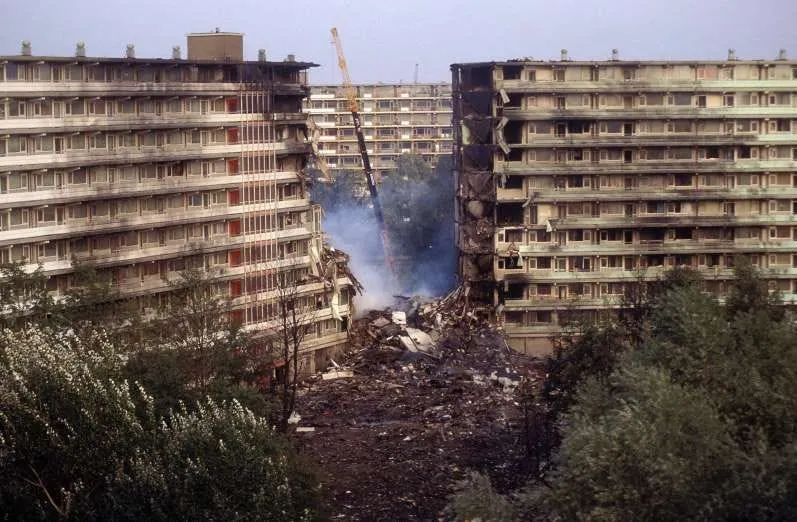
On 4 October 1992, an El Al cargo aircraft travelling from New York to Tel Aviv via Amsterdam crashed into residential blocks in the Bijlmermeer district. Forty-three people died, including 39 on the ground. For the people living beneath the flight path, an international freight route had become a catastrophe inside their homes. 1, 5
The disaster exposed a question that has resurfaced across Europe ever since: what passes through civilian airports on its way to Israel, who checks it, and how much are the people living nearby allowed to know?
The historical record documents commercial aircraft carrying military equipment and sensitive chemicals, followed in later decades by bombs, ammunition and other military supplies moving through European airports. It also reveals distinct failures by airlines and European governments. Those failures need to be attributed precisely: the carriers, officials and circumstances changed, even as the supply routes endured. 2, 3, 9, 11
After the Amsterdam crash, the public received an account centred on ordinary merchandise. NRC Handelsblad later recalled that transport minister Hanja Maij-Weggen described the cargo principally as perfume, video recorders and a consignment of gearwheels. The presence of military goods emerged subsequently. 2
Six years after the disaster, a shipping document established a particularly sensitive US-to-Israel consignment. On 30 September 1998, NRC reported that the aircraft had carried approximately 190 litres of dimethyl methylphosphonate, or DMMP, supplied by Solkatronic Chemicals in Morrisville, Pennsylvania, to the Israel Institute for Biological Research at Ness Ziona. 3
DMMP can be used in the production of nerve agents, including sarin. It also has civilian applications, including as a flame retardant, and is listed as a precursor under the Chemical Weapons Convention. Its presence therefore mattered, but did not establish that the aircraft carried finished nerve gas or that the shipment was intended for an offensive weapons programme. 3, 4
El Al acknowledged carrying the chemical while rejecting accusations of concealment. In October 1998, the Israeli business newspaper Globes reported the airline’s position that the shipment complied with international rules and that its documentation had been given to Dutch authorities immediately after the accident. El Al maintained that the chemical was intended for testing gas masks. 5, 6
That response sharpened the issue of disclosure. If the authorities already possessed the paperwork, why had public understanding remained so incomplete? A document held somewhere inside an official system is not the same as a timely explanation to the people affected.
The subsequent parliamentary inquiry established that El Al had a special security position at Schiphol, justified by the threat of attacks. It also recorded indications that staff understood that privilege more broadly than authorised. Dutch intelligence files contained reports of two other El Al weapons shipments whose papers described them as “sporting goods” and “mechanical parts”. Neither was the disaster flight. 7
Those entries show why the language on a manifest matters. Broad descriptions can make a military supply chain appear indistinguishable from routine commerce. The inquiry did not establish who was responsible for those descriptions.
The inquiry’s findings on the aftermath were equally serious. Officials withheld information they believed concerned dangerous cargo. Investigators later established that the initial warning had relied on the wrong cargo notification. That correction did not excuse the decision to suppress it: officials did not know it was wrong when they withheld it. 7
“The decision to keep information ‘under wraps’ is in itself unacceptable,” the committee concluded, translated from Dutch. El Al had said all available documentation was supplied, yet another cargo manifest emerged in February 1999. The inquiry criticised the slow cooperation. 7
The distinction between concealment and the cause of the crash remains essential. The aviation investigation traced the disaster to the failure of an engine attachment: one engine separated, struck another and damaged the wing, leaving the crew struggling to control the aircraft. It did not establish an explosion in the cargo as the cause. 1
Nor did later medical investigations establish that a secret chemical cargo had caused widespread poisoning. A Dutch health minister’s December 2004 account of the completed research reported no distinctive pattern of illness attributable to the disaster. It also acknowledged that medical examinations had failed to provide lasting reassurance for many affected people. 8
The people killed in Amsterdam were real, as were the survivors’ fears and the official failures. Their experience demands an accurate account of what was transported and concealed, with the same care applied to explaining what the evidence could not establish.
In July 2006, during Israel’s war in Lebanon, the European transit question returned in Scotland. Reports that aircraft carrying American GBU-28 laser-guided bombs had used Prestwick for refuelling and crew rest prompted foreign secretary Margaret Beckett to challenge Washington. She said she was “not happy” and that procedures for hazardous cargo appeared not to have been followed. 9
The British government subsequently confirmed the procedural failure to Parliament. In evidence dated 23 March 2007, the Foreign Office acknowledged US-to-Israel flights that had passed through Britain “without following flight procedures fully”. It said Beckett had raised compliance with the United States, that there were no subsequent breaches, and that other flights had followed the rules. 10
The same statement defended Britain’s policy of permitting transit provided international law and domestic procedures were respected. It said ministers were unaware of flights breaching international law during the Lebanon crisis. The government’s objection was therefore to how some shipments had been handled; its support for allowing compliant shipments continued. 10
Even the publication of Beckett’s criticism became a parliamentary issue. Asked why her concerns were absent from the interview transcript on the Foreign Office website, minister Kim Howells said officials had published an edited version to emphasise her comments on Lebanon. “The FCO reserves the right to edit the content of the FCO website,” he told MPs. 12
By 2024, Belgium supplied another example of military freight passing through a civilian airport despite publicly announced restrictions. Belga reported that at least 70 tonnes of ammunition and explosives had travelled through Liège since 7 October 2023. The equipment was carried by Challenge on the New York–Tel Aviv route. 11
The mechanism was a gap in the regional licensing system. An aircraft making a stop without unloading its cargo did not require the same transit permission. Wallonia’s stated refusal to grant licences for Israel therefore did not prevent these consignments passing through. In May 2024, the regional government attempted to close the gap by prohibiting transit with or without transshipment. 11
That measure was contested. Following a challenge by the airline, Belgium’s Council of State annulled the 2024 decree in 2025 because a required consultation had not taken place and the omission lacked adequate urgency justification. The procedural ruling did not erase the shipments that had prompted the ban. 13
In June 2025, Challenge chief executive Yossi Shoukroun confirmed to EUobserver and Humo that the company still transported arms, while saying those shipments went “not via Belgium”. That statement must be distinguished from evidence about any particular flight: an airline’s involvement in military logistics does not establish the contents of every aircraft it operates. 14
The scrutiny widened again in 2026. Amnesty International announced that it had joined a complaint against FedEx Belgium alleging unlawful military transit, including F-35 components. The organisation described a shipment from Hill Air Force Base in Utah to Israel’s Nevatim airbase, routed through Liège and Cologne. FedEx said it complied with applicable rules and told Amnesty: “We do not ship weapons or ammunition internationally.” The complaint concerns military components and licensing, and is an allegation requiring investigation, rather than a finding of guilt. 15
There is official confirmation that the Belgian investigations extend beyond campaigners’ claims. In a parliamentary answer dated 13 July 2026, Walloon minister-president Adrien Dolimont confirmed a judicial investigation concerning F-35 parts moving through Liège to Nevatim via FedEx. He also identified separate inquiries involving a British military-aircraft hydraulic component and Swiss drone communications antennas destined for Elbit Systems. 16
Dolimont distinguished those cases from British-owned equipment sent to Israel for maintenance, which Belgian authorities returned to the United Kingdom. He also said Challenge had voluntarily reported a military radar mistakenly brought into Belgium from Israel. Those distinctions matter: imports, repairs, military resupply and suspected licensing violations cannot all be presented as the same transaction. 16
Taken together, the cases demonstrate how deeply civilian transport infrastructure can become involved in military supply. A commercial aircraft can carry defence equipment; a refuelling stop can sustain an arms route; a distinction between unloading and remaining aboard can determine whether a licence is required. These are practical decisions through which governments enable or restrict shipments. 1, 10, 11
The political conclusion is that accountability must cover the whole journey. It requires accurate descriptions, effective inspection, clear responsibility and disclosure sufficient for independent scrutiny. The history of Amsterdam shows how badly public trust suffers when officials offer reassurance while relevant information remains withheld. The later cases show why transit airports deserve scrutiny alongside the factories and governments supplying the weapons. 2, 7, 10, 11
For the families who lost people in the Bijlmer, the consequences of a flight passing through Europe were immediate and irreversible. More than three decades later, the continuing disputes over military cargo leave European authorities with a responsibility that cannot be satisfied by saying a consignment was merely passing through.
Sources and reporting notes
The Dutch inquiry quotation is translated into English. Allegations and company responses are attributed; references to investigations do not imply convictions.
- Dutch Aviation Safety Board, El Al Flight 1862 accident report, 24 February 1994
- NRC Handelsblad, reporting on cargo disclosures and parliamentary hearings, 3 February 1999
- NRC Handelsblad, US chemical consignment revealed by shipping documents, 30 September 1998
- OPCW, Chemical Weapons Convention Schedule 2 precursor list
- Globes, El Al’s confirmation and response, October 1998
- The Washington Post, Fallout From a Crash, 15 March 1999
- Dutch parliamentary inquiry, final report, 22 April 1999; sections 4.4, 4.6, 7.3 and 7.4
- Dutch health minister, completed medical investigation, 8 December 2004
- RTÉ, UK anger at use of airport for arms, 27 July 2006
- House of Commons Foreign Affairs Committee, Global Security: The Middle East, 2007, written evidence Ev 60
- Belga, Wallonia bans all transit of arms to Israel, 27 May 2024
- Hansard, written answer to George Galloway, 9 October 2006, columns 466W–467W
- The Brussels Times / Belga, annulment of the Walloon decree, 14 May 2025
- EUobserver / Humo, Challenge Airlines statement, 23 June 2025
- Amnesty International, complaint against FedEx and company response, 3 June 2026
- Parliament of Wallonia, Adrien Dolimont’s written answer, 13 July 2026