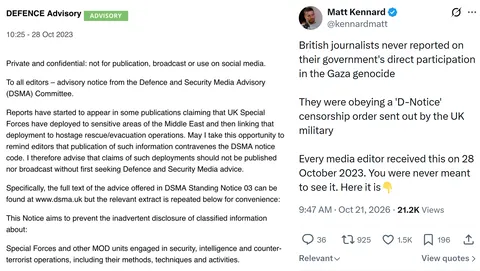
Secret UK Arms Files Reveal Wartime Exports and Unanswered Questions Over Israel Restrictions
Previously undisclosed licensing records show that military export permissions associated with the Israeli government were used during the Gaza war under both Conservative and Labour administrations. The findings raise fresh questions about aircraft components classified as training equipment, the continued supply of parts to the international F-35 programme, and the government’s refusal to identify companies whose licences were suspended.
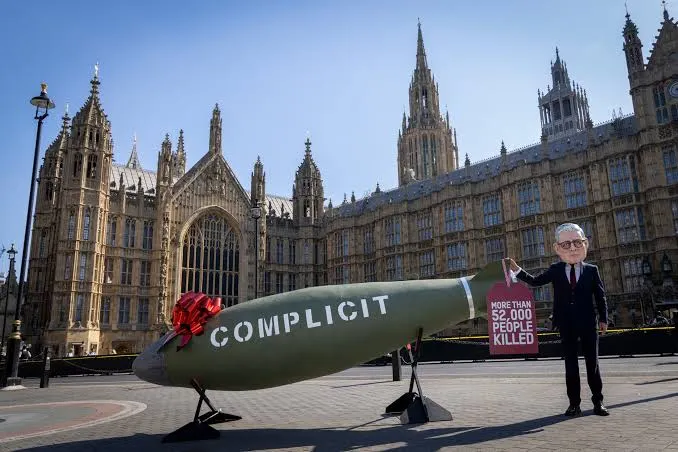
British companies used government licences to export military goods during the Gaza war under permissions associated with the Israeli government, newly disclosed records obtained by Channel 4 News in the UK reveal, providing a more detailed picture of a trade that successive administrations have defended while withholding significant information from public scrutiny.
The documents, obtained after months of efforts to secure their release, connect two elements that ordinary export statistics often leave separate: permission to supply military equipment and evidence that an export licence was actually used.
As the Conservatives left office in July 2024, the disclosed records identified 67 active military export licences associated with the Israeli government. Of those, 25 had been used to export military goods since October 2023. The permissions used included licences covering targeting equipment, military aircraft engines and components for combat aircraft.
A later snapshot, from July 2025, identified 55 active licences, ten of which had been used since Labour entered government. The combined maximum value attached to the relevant licences had risen from £164 million to approximately £498 million, although those figures represent authorised limits rather than the value of goods delivered, and include participation in the international F-35 supply chain.
The disclosures also expose an unresolved discrepancy. Ministers classified 33 licences as covering trainer aircraft, but the newly obtained records contained only 16 licences whose descriptions referred exclusively to trainer aircraft. Other active permissions mentioned combat aircraft components and military aircraft engines without explicitly identifying a training purpose.
The government strongly disputes the interpretation of the documents, arguing that the disclosed material provides only a partial view of its licensing assessments. It says it has suspended or refused more than 80 licences and rigorously examined those that remain.
The resulting dispute concerns both the military trade itself and the evidence needed to test ministers’ assurances about it.
What the files reveal
An export licence permits a company to supply specified goods under particular conditions. Its existence does not establish that a sale was completed, that goods were shipped, or that every item listed on the licence was exported.
The destination recorded in public statistics can also conceal important distinctions. Equipment sent to an Israeli company might be incorporated into a product subsequently exported elsewhere. Military grade goods might be intended for civilian protection, testing or research. Components supplied to a multinational programme might ultimately reach several different countries.
The newly disclosed material goes further by identifying licences associated with the Israeli government and recording which permissions were used during the war. That makes it possible to distinguish unused authorisations from licences under which military exports actually occurred.
Even within this narrower category, however, the distinction between an end user and a potential ultimate end user remains significant. The international F-35 programme includes Israel among its customers, but an export under a licence covering that programme does not, by itself, establish that the particular component reached Israel.
Nor do 25 used licences mean 25 shipments, 25 companies or 25 weapons. A licence may cover multiple consignments and different categories of equipment.
These qualifications define what the records establish. They provide evidence that export permissions were exercised, while leaving further questions about the quantities supplied, the precise components exported and their eventual deployment.
Military exports under the Conservatives
The first disclosed snapshot captures the position around the end of Conservative government in July 2024, after months of mounting concern about Israel’s conduct in Gaza.
The 67 active licences covered a broad range of military equipment. Their descriptions included components for military aircraft and helicopters, combat vehicles, equipment used to launch and control munitions, military communications systems and navigation equipment.
Of these permissions, 25 had been used since October 2023.
The used licences included categories with evident relevance to military operations. Targeting equipment helps forces identify and aim at targets. Military aircraft engines and associated components support aircraft that may include combat planes or drones. Other permissions covered combat aircraft parts and components for additional military aircraft types.
The records therefore add substance to a debate that has frequently focused on what Britain authorised, by showing that companies exercised permissions during the war.
They do not trace individual components to particular attacks in Gaza. Their significance lies in establishing that military supply relationships remained active while ministers were being pressed to explain whether continuing exports complied with Britain’s obligations.
The war followed the Hamas led attacks on Israel on 7 October 2023, in which approximately 1,200 people were killed and 251 were taken hostage. By January 2024, the reported Palestinian death toll had reached around 26,000, with others believed buried beneath the rubble. The investigation cites a subsequent toll of at least 75,000 Palestinians killed.
Against that background, the legal and political pressure on arms suppliers intensified.
The legal warnings before the change of government
On 26 January 2024, the International Court of Justice ordered provisional measures in South Africa’s case against Israel under the Genocide Convention.
The court found plausible the rights for which South Africa sought protection, including the right of Palestinians in Gaza to be protected from genocide and related prohibited acts. It also identified a real and imminent risk of irreparable harm to those rights.
That order did not determine whether genocide had occurred. It required protective measures while the case proceeded, including action to prevent prohibited acts and enable urgently needed humanitarian assistance.
For countries supplying military equipment, however, the question of preventive obligations arose before any final judgment.
In its earlier judgment concerning Bosnia and Herzegovina, the ICJ held that the duty to prevent genocide arises when a state knows, or should normally know, of a serious risk that genocide will be committed. The obligation requires states to use the means reasonably available to them, with their capacity to influence those responsible forming part of the assessment.
In April 2024, hundreds of British lawyers, legal academics and former judges, including former Supreme Court justices, urged the government to suspend weapons supplies to Israel. Their argument was that continuing those supplies was incompatible with Britain’s international obligations.
The legal objections extended across the Genocide Convention, the Geneva Conventions and the Arms Trade Treaty. They concerned prevention, the protection of civilians and the risk that transferred equipment could facilitate serious violations.
Britain’s own licensing criteria also involve a prospective assessment. The relevant test asks whether there is a clear risk that equipment might be used to commit or facilitate a serious violation of international humanitarian law. By its terms, that assessment concerns foreseeable misuse and does not depend on first tracing a British component to a completed unlawful attack.
The Conservatives did not introduce the suspension subsequently announced by Labour. They did not respond to repeated requests for comment made during the investigation.
Israel’s government denies committing genocide or war crimes in Gaza.
Labour’s partial suspension
Labour entered office in July 2024. On 2 September, the new government announced the suspension of approximately 30 export licences involving Israel after concluding that certain exports presented a clear risk of being used to commit or facilitate serious violations of international humanitarian law.
The announcement covered equipment assessed as potentially usable in military operations in Gaza, including components for fighter aircraft, helicopters and drones, as well as targeting equipment.
It was a partial restriction within a much broader licensing system. The approximately 350 Israel related licences cited at the time included permissions serving different destinations, commercial arrangements and end uses.
Two exclusions were particularly significant.
First, ministers continued to permit equipment assessed as having a training purpose and no combat utility in the relevant operations.
Second, the government retained exports into the international F-35 programme. Components going directly to Israel for Israeli use were subject to suspension, while exports into the multinational system could continue.
The newly disclosed records contain indications consistent with parts of the announced policy. Targeting equipment disappeared from later active licence lists, as did entries involving military helicopter components and combat vehicles.
However, the government refused to provide the complete list of suspended licences requested through freedom of information procedures. The investigation therefore compared snapshots of active permissions to reconstruct what had changed.
That method has limits. A licence can disappear because it expires, is exhausted, is surrendered or is otherwise altered. Its absence from a later list cannot establish the reason for its removal without further information.
The available records support the conclusion that some categories ceased to appear, while leaving the full sequence of decisions incompletely documented.
Fewer licences, a higher authorised ceiling
By July 2025, the investigation identified 55 active military licences associated with the Israeli government. Ten had been used to export military goods since Labour took office.
The period covered by that finding begins in July 2024, before the September suspension. Without the dates of individual exports, the ten licences cannot all be presented as evidence of shipments made after the restrictions began.
The financial comparison also requires care.
The combined maximum value attached to the relevant licences increased from £164 million in the Conservative period’s snapshot to approximately £498 million in the Labour period’s snapshot.
Those figures do not measure completed arms sales or deliveries. Licence values describe the maximum authorised amount, potentially spread over the licence’s lifetime, and the amount actually exported may be lower.
Much of the increase appears to relate to large permissions for combat aircraft components understood to concern the F-35 programme. Because that programme serves multiple countries, its authorised value cannot be treated as money exclusively earmarked for Israeli purchases.
Nevertheless, the figures demonstrate why licence numbers alone provide an incomplete account. A smaller number of permissions can carry a larger financial ceiling, while neither measure establishes the quantity of equipment supplied.
The 55 figure is also a historical snapshot. A subsequent official release recorded 68 military licences with the Israeli government as an end user or potential end user on 28 February 2026, again including participation in the global F-35 programme.
The changing totals underline the need to attach dates and definitions to claims about what remained authorised.
The F-35 exception
The continued export of F-35 components was an expressly retained part of Labour’s policy.
Ministers argued that the programme’s international structure made it impossible to prevent British components from reaching Israel without disrupting a wider system serving Britain and its allies. They presented continued participation as essential to national defence and international security.
That position preserved a route through which British components could potentially reach Israeli aircraft despite the suspension of direct exports for Israeli use.
The distinction matters because the exemption concerns the structure of the supply arrangement. It does not mean that the equipment supplied to the international programme lacks military utility.
The exception also survived a legal challenge. On 30 June 2025, the High Court refused Al-Haq permission to bring its challenge to the decision; the Court of Appeal refused permission to appeal on 12 November.
The judges framed the central issue as whether the courts could require Britain to withdraw from a multinational defence programme that ministers reasonably regarded as vital to British defence and international peace and security.
Those decisions left the exception in place. They did not establish that components ultimately reaching Israel were incapable of being used in serious violations of humanitarian law.
The new licensing disclosures therefore sit within an existing dispute about how far participation in a multinational weapons programme can be reconciled with restrictions intended to prevent equipment from supporting operations in Gaza.
The discrepancy over trainer aircraft
The most specific unresolved question concerns aircraft components that remained authorised outside the F-35 programme.
The disclosed records included around 20 licences whose descriptions referred only to training items, including trainer aircraft, training ammunition and other training equipment. Several licences covering trainer aircraft components had been used since Labour entered office.
Other active permissions, appearing in records from 2025 and 2026, referred to military aircraft engines and combat aircraft components without explicitly mentioning training. The investigation understood these licences to be separate from the F-35 programme.
A letter dated 5 November 2025, signed by ministers Chris Bryant, Luke Pollard and Hamish Falconer, classified 33 licences as covering trainer aircraft. It said the aircraft had “no combat utility” and could not be used with live weapons “without extensive upgrading”.
The disclosed records, however, contained only 16 licences whose descriptions referred exclusively to trainer aircraft.
The gap between those two figures requires an explanation of how the government mapped individual permissions into its training category.
One possible explanation is that broad component descriptions cover goods intended, under more specific contractual arrangements or licence conditions, for particular training aircraft. Another possibility is that the permissions encompass components capable of serving a wider range of aircraft.
The disclosed descriptions alone cannot resolve that question. Doing so would require the technical specifications, the approved end uses and the conditions attached to each relevant licence.
The discrepancy therefore raises a substantive question about classification and verification. It does not, by itself, establish that officials deliberately disguised combat equipment as training supplies or that the exported parts were used in Gaza.
What remains unclear is the evidence supporting the government’s confidence that the permissions fall within the limits it has publicly described.
Training equipment and the wider military relationship
Even if the aircraft covered by the retained licences were used exclusively for training, a broader argument remains about the contribution such supplies make to military capacity.
A legal expert interviewed during the investigation argued that supplying training equipment could release other resources for combat operations, particularly where other countries, including the United States and Germany, continued supplying weapons.
On that argument, the significance of British exports cannot be assessed solely by asking whether a particular item itself fires a weapon or appears over Gaza. Training and supporting equipment may contribute to the operation of the wider military system.
The expert also argued that Britain should have used its military trading relationship to exert pressure on Israel during 2024.
That criticism invokes the preventive character of the Genocide Convention: where the relevant serious risk exists, a state’s responsibility includes considering the means available to influence those responsible. The argument advanced in the investigation extended beyond weapons directly used in combat to military training supplies, equipment with civilian and military applications, and other forms of support.
These are arguments about the scope of preventive duties and military assistance. Establishing the contribution of a particular export would require evidence about the equipment, its recipient and its use.
The government’s position is that the retained items have been assessed and do not present the prohibited risk. The dispute concerns whether those assessments adequately address both the immediate function of the goods and their possible contribution to a broader military operation.
What remained authorised
Aircraft components were only part of the continuing trade.
Licences covering parts for missiles used in air defence remained active in the 2025 and 2026 records, and permissions in that category had been used since Labour entered government. These were understood to concern Israel’s defensive systems.
The official breakdown of the 55 licences in July 2025 assigned 33 to trainer aircraft, nine to the global F-35 programme, five to submarine components, five to training and testing goods, and three to air defence.
These distinctions are central to the government’s defence of its policy. Ministers maintain that remaining permissions largely cover equipment whose assessed role falls outside the prohibited activities.
The investigation challenges whether the descriptions released to the public provide enough information to substantiate that assessment, particularly where they refer to combat aircraft components or military aircraft engines.
The question is therefore partly one of evidence: how a broad description on an export record relates to the narrower purpose officials say they have approved.
The government’s response
The Labour government strongly disputed the investigation’s characterisation of the licensing system, saying the disclosed documents offered only a partial view of the data.
“Our suspension of licences that might be used by the IDF in Gaza remains fully in place, and we have suspended or refused over 80 export licences on this basis,” it said.
“All existing licences have been rigorously assessed to ensure they can neither be used by the IDF in Gaza, nor materially contribute to the Occupation. The remaining licences for Israel are largely made up of training items, submarine parts and missile defence items.”
The figure of more than 80 suspensions or refusals is also reflected in a parliamentary answer issued in September 2026. That answer said applications for exports materially contributing to the occupation would be refused and existing licences had been reviewed on the same basis.
The cumulative figure measures a different category from the number of active licences at a particular date. It combines decisions to suspend existing permissions with decisions to refuse or reject applications.
The government’s response makes its disagreement clear, but the partial nature of the disclosure remains relevant to both sides of the dispute. It limits what can be established from the investigation and what the public can independently verify about ministers’ assurances.
The separately retained F-35 exception must also remain part of that assessment, because participation in the global programme leaves Israel as a potential ultimate recipient of British components.
The companies whose names remain withheld
One of the most consequential gaps concerns the identities of companies holding licences that were suspended.
When those names were requested, the government refused to disclose them. Its explanation included the possibility that identifying the firms could lead people to conclude, correctly or incorrectly, that they had been involved in war crimes.
A company’s presence on a licence would not, on its own, establish involvement in a war crime. Equally, withholding its identity prevents further scrutiny of what it was authorised to supply and the circumstances in which that permission was suspended.
In correspondence with Parliament, ministers also cited commercial confidentiality and security risks to companies as reasons for withholding more detailed licensing information.
The resulting tension is substantial. Businesses have interests in protecting sensitive contracts and the safety of their staff, while the public has an interest in understanding military exports connected to a war involving grave allegations of international crimes.
The disclosed records provide a more detailed account than was previously available, but they remain snapshots of a changing system. They do not provide a complete shipment history, a full account of the suspension decisions or all the technical conditions governing the remaining aircraft licences.
What they establish is that military export permissions were exercised during the war and that Labour’s restrictions left significant supply arrangements in place.
What remains unresolved is the evidential basis for some of the distinctions ministers have drawn, particularly between combat aircraft components and supplies classified as training equipment. Until those decisions can be matched to the relevant specifications, conditions and export records, the government’s assurances will continue to depend partly on information it has declined to make public.
Sources and attributions
Original investigation and disclosure credit: “REVEALED: Secret files on UK weapons sales to Israel”, Channel 4 News, FactCheck team, dated 13 November 2026 in the supplied publication information. The supplied video description and transcript are the source for the newly disclosed licence usage findings, the 67 and 25 figures, the ten used licences under Labour, the £164 million and £498 million comparison, the 16 explicitly described trainer aircraft licences, the government’s quoted response and the refusal to identify companies. The underlying newly disclosed dossier was not independently inspected for this feature. The Palestinian death toll of at least 75,000 is the figure cited in the supplied investigation, rather than a separately verified count for the publication date. The transcript does not identify the interviewed legal expert, whose arguments have therefore been paraphrased without assigning a name.
September 2024 suspension and its scope: “Notice to Exporters 2024/20: suspension of licences for Israel”, Export Control Joint Unit, 2 September 2024; and “Summary of the IHL process, decision and the factors taken into account”, Foreign, Commonwealth and Development Office, 2 September 2024. These establish the suspension’s timing, the prospective humanitarian law risk test and the distinction between direct exports for Israeli use and exports into the global F-35 programme. GOV.UK
Official licence counts and value definitions: “Israel export control licensing data: 31 July 2025”, first published 28 August 2025; and “Israel export control licensing data: 28 February 2026”, published 20 April 2026. These corroborate the historical totals of 55 and 68 licences involving the Israeli government as end user or potential end user, explain the inclusion of global F-35 licences and distinguish authorised value from actual exports. GOV.UK
Trainer aircraft classification and remaining equipment: Joint ministerial letter to the Business and Trade Committee, Chris Bryant, Luke Pollard and Hamish Falconer, 5 November 2025. Annex A provides the breakdown of 55 licences, including 33 for trainer aircraft, and the qualification concerning extensive upgrading for live weapons. The letter also addresses confidentiality and company security. committees.parliament.uk
January 2024 provisional measures: South Africa v Israel, order of 26 January 2024, International Court of Justice, reproduced by South Africa’s Department of Justice. Paragraphs 54, 62, 74 and 86 support the distinction between plausible protected rights, urgent risk of irreparable harm and a final determination of genocide. justice.gov.za
Duty to prevent genocide: Bosnia and Herzegovina v Serbia and Montenegro, judgment of 26 February 2007, International Court of Justice, particularly paragraphs 430–432. These address the serious risk threshold, the means reasonably available to a state and its capacity to influence those responsible. icj-web.leman.un-icc.cloud
British lawyers’ intervention: “UK Judges’ and Lawyers’ Open Letter Concerning Gaza — April 2024”, 3 April 2024. The original letter called for suspension of weapons supplies and set out the signatories’ interpretation of Britain’s international obligations. Its legal conclusions are presented as the signatories’ arguments. Gaza Lawyers' Letter
Arms Trade Treaty: Treaty text published in the UK Treaty Series, adopted 2 April 2013, UK publication January 2015. Articles 6 and 7 address prohibited transfers and export risk assessments within the treaty’s scope. Arms Trade Treaty
F-35 litigation: R (Al-Haq) v Secretary of State for Business and Trade, High Court judgment, 30 June 2025; and Court of Appeal press summary, 12 November 2025. These establish the outcome and scope of the challenge and the subsequent refusal of permission to appeal. judiciary.uk
Subsequent government position: Parliamentary written answer on export licences and the occupation, Foreign, Commonwealth and Development Office, 15 September 2026. This records more than 80 suspended or rejected licences and the policy concerning exports materially contributing to the occupation.