Nobel Peace Prize Laureate Urges Israelis to Act Over Gaza Genocide as American Jewish Dissent Deepens
Laureate appeals directly to Israelis to confront crimes committed in their name, while new polling and a widening debate among American Jews reveal deep divisions over Gaza, military aid and unconditional support for Israel’s government.

Nobel Peace Prize laureate Navi Pillay has urged Israelis to confront her former UN commission’s finding that Israel committed genocide in Gaza, as new evidence reveals substantial opposition among American Jewish voters to providing its government with unconditional support.
“Israelis, crimes are committed in your name. I beg you: Get on the right side of history,” Pillay said in an appeal featured in an interview published on 12 November.
The intervention follows fierce attacks from Israeli leaders on the South African jurist, whose career has included judging international crimes, serving as UN human rights chief and leading the investigation that concluded Israel had committed genocide against Palestinians in Gaza.
Israel rejects the finding and accuses the commission of bias. Pillay has maintained that its conclusions rest on verified evidence and has challenged critics to identify factual errors rather than attack the investigators personally.
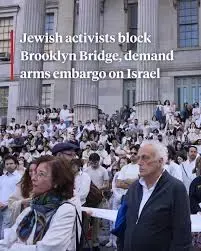
Her appeal comes amid a separate but increasingly consequential debate within American Jewish communities. Recent polling reveals a pronounced generational divide over Palestinians and Israelis, substantial support for restrictions on military assistance, and concern that defending Israeli government policy can undermine efforts to combat antisemitism.
For American Jewish writer Peter Beinart, the developments reflect a challenge to the idea that Jewish identity requires support for Israel’s political system or its government’s conduct.
Speaking in a separate interview with journalist Owen Jones, Beinart argued that many younger Jews are applying to Israel and Palestine the same principles of equality they expect to protect them as a minority in the United States.
The findings behind Pillay’s appeal
Pillay chaired the UN Independent International Commission of Inquiry on the Occupied Palestinian Territory, including East Jerusalem, and Israel from 2021 to 2025.
Its report of 16 September 2025 examined Israeli conduct and official statements between 7 October 2023 and 31 July 2025. The commission concluded that Israeli authorities and security forces had committed four categories of genocidal acts: killing Palestinians, inflicting severe physical or psychological harm, imposing conditions calculated to destroy the population in whole or in part, and taking measures intended to prevent births.
The investigators considered both the conduct of the military campaign and statements by senior officials. They concluded that the evidence established the specific intention to destroy Palestinians in Gaza, wholly or partly, required for a finding of genocide.
The commission also found that Benjamin Netanyahu, President Isaac Herzog and former defence minister Yoav Gallant had incited genocide, and that Israel bore responsibility for committing genocide and failing to prevent and punish it.
The evidence underlying the analysis included the scale of deaths and injuries, starvation and restrictions on essential supplies, destruction of healthcare, attacks on children, and the continuation of destructive policies despite repeated warnings.
The commission had also investigated crimes committed by Palestinian armed groups. In June 2024, it reported findings of war crimes by both Israeli authorities and Hamas.
Pillay’s position is that accountability must follow the evidence regardless of the identity of those responsible. Her background includes service on the International Criminal Tribunal for Rwanda and the International Criminal Court, as well as her tenure as UN High Commissioner for Human Rights.
The Norwegian Nobel Committee announced her selection on 9 October 2026, recognising her contribution to peace and international law across that wider career.
Personal attacks and a demand to examine the evidence
The Israeli response to Pillay’s Nobel award was unusually personal.
Netanyahu called her a “bigot”, while Israel’s Foreign Ministry invoked Nazi propagandist Joseph Goebbels, saying he would be “applauding from hell” at the decision to honour her.
Pillay described the response as “hurtful and insulting”. She has nevertheless continued to defend the commission’s findings and argue for investigations and prosecutions.
In another recent interview, she said that she would revise parts of the report if evidence demonstrated that its findings were wrong. Her complaint was that the criticism directed at her had concentrated on insults rather than establishing such errors.
She also called for Netanyahu, Herzog and Gallant to face investigation and trial, describing the report as a basis for action by domestic courts or the ICC.
The commission’s conclusions have a different legal status from a court judgment. South Africa’s genocide case against Israel at the International Court of Justice remains ongoing, while the ICC’s arrest warrants for Netanyahu and Gallant concern alleged war crimes and crimes against humanity, including starvation as a method of warfare. Those warrants are not convictions.
Pillay has argued that the time required for judicial proceedings cannot become an excuse for governments to disregard evidence or delay measures intended to prevent further crimes.
American Jewish support fractures over Gaza
The American Jewish debate provides a striking parallel to Pillay’s challenge to Israeli society.
A national survey of 800 Jewish voters who participated in the 2026 US election, conducted between 28 October and 3 November, found sharply different attitudes across generations.
Among voters aged 18 to 34, 60 per cent selected a statement combining the judgment that Israel had committed genocide in Gaza with a call to end US military aid. Across the full sample, 31 per cent chose that position.
The wording matters: respondents selected the closest of three statements to their own views, rather than answering a standalone question about whether genocide had occurred.
Nearly half of younger respondents, 49 per cent, expressed greater sympathy for Palestinians, compared with 20 per cent for Israelis. Among voters aged 50 to 64, the balance was reversed: 53 per cent sympathised more with Israelis and 9 per cent with Palestinians.
A separate question found that 75 per cent of those under 35 supported ending US subsidies for Israeli purchases of American weapons. Across all ages, opinion was almost evenly divided, with 49 per cent favouring an end to the subsidies and 51 per cent supporting their continuation.
There is also evidence of deterioration in Netanyahu’s standing over time. In the same polling organisation’s election surveys, his favourable rating fell from 32 per cent in November 2024 to 20 per cent in November 2026.
The findings expose a substantial constituency for changing the relationship between Washington and Israel, particularly among younger Jewish voters. They also reveal how much opinion differs within the community.
The contradiction Beinart sees at the heart of the debate
Beinart, author of Being Jewish After the Destruction of Gaza, argues that the changing debate reflects a contradiction within American Jewish political life.
As a minority in the United States, he said, American Jews have generally depended on principles of equal citizenship, religious freedom and protection from discrimination. Yet influential communal institutions have simultaneously defended a political order in Israel and the occupied Palestinian territories that, in his assessment, privileges Jews over Palestinians.
Younger Jews are increasingly questioning how those positions can be reconciled, he argued.
“We need to have one principle that governs the way we think about the United States and the way we think about Israel and Palestine,” Beinart said.
His explanation goes beyond hostility towards Netanyahu. He sees a deeper dispute over whether rights should depend on ethnicity, religion or national identity, and whether solidarity with other Jews requires defending the policies of a state.
Beinart also argued that the public language used by parts of the American Jewish establishment increasingly fails to reflect the range of views held by ordinary Jews.
“The terms of debate that they have laid out and that they’re very adamantly trying to maintain just bear less and less resemblance to the actual opinions of American Jews,” he said.
That assessment remains an interpretation of the changing political landscape. The polling nevertheless shows that positions often associated with the margins of American debate, including ending military subsidies and accepting a genocide accusation, have significant support among younger Jewish voters.
A generational divide shaped by different experiences
Beinart offered two explanations for the divide.
The first concerns how younger people encounter Palestinian experiences. Social media, he argued, has allowed Palestinians to communicate directly with audiences who previously encountered them mainly through established political and media institutions.
The second concerns the Israel that different generations have known.
Some older American Jews retain memories of diplomatic initiatives and Israeli leaders associated with the possibility of a negotiated Palestinian state. Younger adults have experienced a much longer period in which occupation, settlement expansion and the rejection of Palestinian sovereignty have dominated Israeli politics.
In Beinart’s account, the destruction of Gaza has intensified doubts that were already developing.
He described the resulting disagreements as deeply personal, reaching into families, religious gatherings and conversations between parents and children. Some younger readers, he said, had bought his book for older relatives in the hope of opening discussions that had become difficult or painful.
He cautioned, however, against assuming that demographic change guarantees a single political outcome. Orthodox communities include younger Jews whose views remain strongly supportive of Israel and more conservative, alongside Orthodox Jews who take progressive positions.
The American Jewish debate therefore contains differences of religious practice, political outlook and communal experience as well as age.
Attachment to Israel can coexist with demands for change
Other polling demonstrates the limits of describing the development as American Jews collectively turning against Israel.
A separate survey of Jewish registered voters published in September found that 86 per cent identified themselves as pro-Israel. That included 65 per cent who described themselves as pro-Israel while criticising some or many Israeli government policies.
Those findings show that attachment to Israel and opposition to its government can coexist. They also underline why criticism of Netanyahu, support for military aid restrictions, rejection of occupation and opposition to Israel’s existing political structure should be distinguished.
Beinart’s own argument goes further than many respondents’ positions. He advocates a politics founded on equal rights for Palestinians and Israelis and questions structures that confer different rights according to identity.
Other Jews who oppose the destruction of Gaza continue to support a Jewish state alongside an independent Palestinian state, or retain strong attachments to Israel while demanding a different government and different policies.
What the surveys establish is a divided constituency whose views cannot be reduced to unconditional support.
Jewish safety and the danger of collective blame
The election survey also found widespread concern about the relationship between Israeli policy, advocacy in the United States and antisemitism.
Eighty per cent of respondents said they believed Israel’s actions in Gaza and the West Bank increased antisemitism in the United States. Sixty-six per cent said the same about AIPAC funding a super PAC that runs advertisements against candidates who criticise Israel.
These responses record perceptions of repercussions; they do not establish what causes antisemitic incidents or assign responsibility for them.
Beinart was explicit that anger at a government cannot justify hostility towards Jewish people.
“It is wrong to take out your anger at Israel against Jews just like it would be wrong to take out your anger against Iran against Muslim Americans or your anger against the People’s Republic of China against Chinese Americans,” he said.
He argued that the distinction becomes harder to maintain when institutions insist that Jewish identity and support for Israeli state policy are inseparable.
For Beinart, Jews should be able to maintain religious traditions, a connection to Jerusalem, solidarity with other Jews and concern for Israeli civilians while opposing their government’s actions.
He described younger people building communal institutions in which support for Israel’s political system is no longer the defining test of Jewish belonging.
He also warned that some hostility towards Israel on the far right incorporates antisemitic ideas. A movement grounded in equal rights, he argued, must maintain a clear distinction between criticism of state conduct and prejudice against Jews or Judaism.
Electoral pressure reaches Washington
The debate is also acquiring electoral significance.
Abdul El-Sayed’s victory in Michigan’s Senate election followed a Democratic primary in which AIPAC spent nearly $30 million opposing him. His success provided a prominent example of a candidate winning despite substantial opposition connected to his criticism of Israel.
Beinart argued that El-Sayed had made the spending itself a campaign issue, challenging the assumption that accepting support from the lobby would always benefit a candidate.
The national Jewish voter survey offers some support for that concern. Thirty-nine per cent said advertisements supporting a candidate from an AIPAC-funded super PAC would make them less likely to vote for that candidate, compared with 13 per cent who said more likely. Forty-eight per cent said it would make no difference.
The election result cannot be treated as a referendum on Israel alone. El-Sayed also campaigned on healthcare and money in politics, while the national survey found democracy and living costs ranked above Israel among Jewish voters’ electoral priorities.
For Beinart, however, successful campaigns by outspoken critics can alter the calculation for politicians who previously feared that questioning unconditional support would end their careers.
“You just need to tell people that they can still hold on to their seats,” he said.
He expects the issue to become a major debate in the 2028 presidential campaign. His forecast includes pressure for restrictions on arms sales and measures against the businesses and financial institutions supporting settlement expansion.
Those are predictions about a possible policy direction. Turning public dissent into government action will depend on elections, congressional decisions and the choices of future administrations.
From public dissent to accountability
Pillay’s emphasis has been on practical action.
Her commission called for an end to the conduct it identified as genocide, unrestricted humanitarian access, investigations and prosecutions, and the cessation of arms and equipment transfers that could facilitate genocidal acts.
In a recent interview, she urged the public to read the report, examine the law and consider the statements attributed to Israeli leaders before reaching their own conclusions.
She also called for stronger collective action by governments and the protection of international judicial institutions, while insisting that public protest remain nonviolent.
Her experience of South African apartheid has remained a source of hope: she points to the capacity of sustained civic pressure and international action to change a system that once appeared immovable.
Pillay and Beinart approach the present crisis from different backgrounds and through different arguments. Her appeal concerns the evidence of international crimes and the obligations arising from it; his concerns the moral and political choices facing Jewish communities and American voters.
Both place responsibility on people and institutions capable of influencing what happens next.
For Israeli citizens, Pillay’s appeal is to confront the findings concerning their government’s actions. For American Jewish voters, the emerging dispute concerns what solidarity should require, how far Washington’s support should extend and whether concern for Israeli security can justify policies that deny Palestinian rights.
Beinart’s position is that the protection of human beings must remain the measure against which political arrangements are judged.
“It is the right of human beings to exist which always has to trump the right of states to exist under some particular political system,” he said.
Sources and attributions
Haaretz, Nobel Peace laureate Navi Pillay: interview, 12 November 2026. The opening appeal to Israelis was verified from the publicly displayed headline. The full interview was inaccessible; additional statements attributed to Pillay above come from the separately identified interviews below. www.timesofisrael.com
Norwegian Nobel Committee, Nobel Peace Prize for 2026, 9 October 2026. Official announcement supporting Pillay’s laureate status, professional background and the committee’s stated reasons for selecting her. Nobel Peace Prize
UN Independent International Commission of Inquiry, Legal analysis of Israel’s conduct in Gaza under the Genocide Convention, A/HRC/60/CRP.3, 16 September 2025. Primary source for the genocide findings, assessment of intent, named officials and recommendations. The accompanying UN announcement explains the scope and proposed responses. www.un.org
UN commission, Report examining land and housing and summarising findings on genocide, A/80/337, 2025; and UN Human Rights Council, Commission concludes Israeli authorities and Hamas are responsible for war crimes, 19 June 2024. Supports the evidence summary and the account of the commission’s earlier investigations. www.un.org
AFP and The Times of Israel, Pillay says Israel’s reaction to her Nobel win was “hurtful and insulting”, 14 October 2026. Supports the account of Israeli leaders’ criticism and Pillay’s response. The Times of Israel
Isabel Ferrer, El País, Navi Pillay: Netanyahu should be tried for genocide, 20 October 2026. Supports Pillay’s defence of the investigation, willingness to correct demonstrated errors and call for judicial proceedings. english.elpais.com
Jeremy Maggs, Moneyweb, Nobel laureate Navi Pillay talks justice, power and accountability, 26 October 2026. Interview transcript supporting her calls for examination of the evidence, collective action, protection of international justice and nonviolent protest. www.moneyweb.co.za
Owen Jones, Jews Are Turning On Israel: With Huge Consequences, with Peter Beinart, November 2026. Full credit to Jones for the interview. Beinart’s quotations and analysis were drawn from the transcript supplied for this article, with obvious transcription errors in names corrected. The video was circulating by 12 November; its precise upload date could not be independently confirmed from primary metadata. livequote.org
GBAO for J Street, 2026 National Election Survey of Jewish Voters, released 5 November 2026: analysis memo, questionnaire and topline results, presentation with demographic breakdowns, and release. The survey covered 800 self-identified Jewish voters who voted in 2026, interviewed from 28 October to 3 November. The reported overall margin of error is ±3.5 percentage points; subgroup uncertainty is larger. The genocide question combined that judgment with ending military aid. jstreet.org
Jewish Electorate Institute and The Mellman Group, What Concerns Jewish Americans Across the Political Spectrum, September 2026. Separate survey supporting the distinction between identification as pro-Israel and criticism of government policies. Its results should not be combined with the J Street sample as though they came from one poll. jewishelectorateinstitute.org
Associated Press, published by Michigan Public, Abdul El-Sayed defeats Mike Rogers in Michigan US Senate race, 4 November 2026. Supports the election result, campaign context and nearly $30 million in AIPAC spending opposing El-Sayed during the primary. michiganpublic.org
International Court of Justice, South Africa v. Israel: order on further written proceedings, 21 May 2026; International Criminal Court, Situation in the State of Palestine. Supports the distinction between the commission’s findings, ongoing interstate proceedings and individual criminal allegations.