A Hospital Bombed, a Population Trapped: Gaza’s Ceasefire of Impunity
An Israeli strike has killed six Palestinians at Nasser hospital, including a surgeon and patients, while displaced families face flooding in overcrowded areas where the danger was known months in advance. Renewed criticism from Donald Trump’s Board of Peace exposes the widening gulf between promises of peace and the conditions under which Palestinians are being forced to survive.
A hospital bombed, a population trapped: Gaza’s ceasefire of impunity
An Israeli strike has killed six Palestinians at Nasser hospital, including a surgeon and patients, while displaced families face flooding in overcrowded areas where the danger was known months in advance. Renewed criticism from Donald Trump’s Board of Peace exposes the widening gulf between promises of peace and the conditions under which Palestinians are being forced to survive.
News feature and analysis | 12 November 2026
Israel has bombed the surgical building of the largest hospital in southern Gaza, killing six people and forcing the suspension of four medical departments, as a population devastated by war confronts a winter emergency that humanitarian officials repeatedly warned was coming.
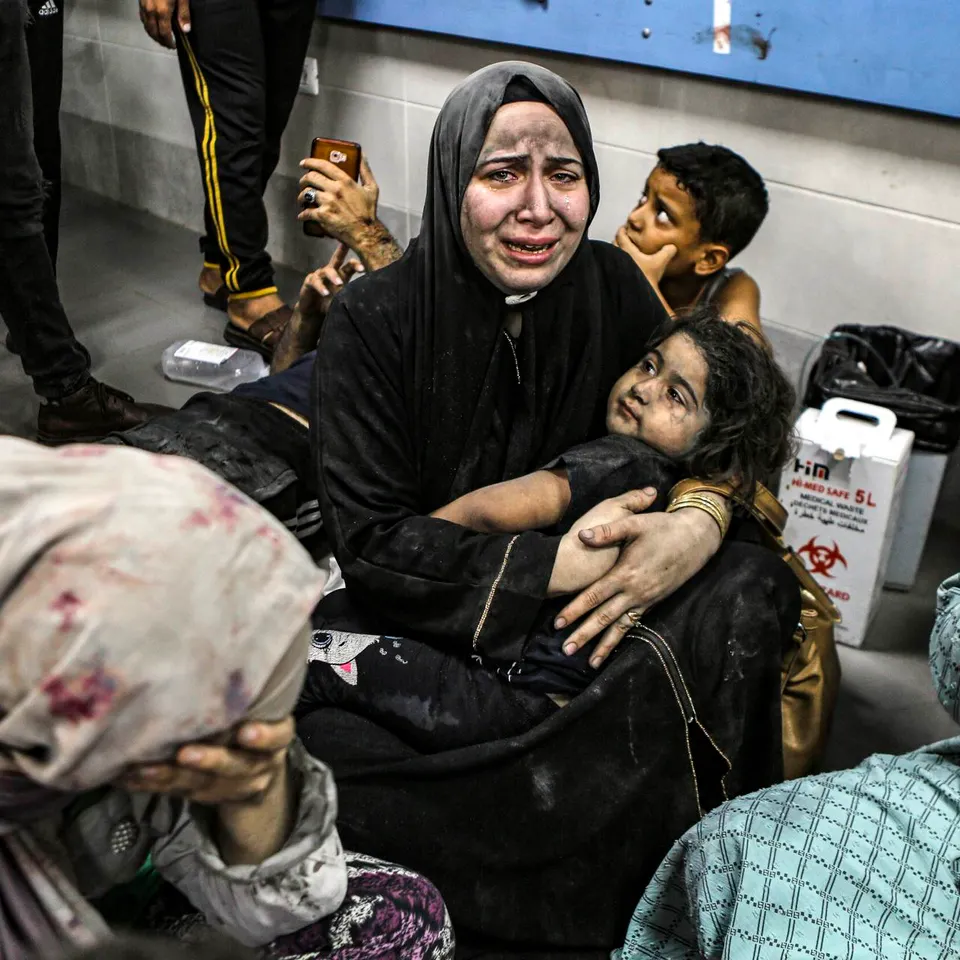
The attack on Nasser Medical Complex in Khan Younis early on Thursday killed surgeon Dr Rizq Abu Shaira and patients who had entered the hospital seeking treatment. Hospital director Dr Ahmed al-Fara said 28 people were wounded and services had been suspended in radiology, laboratories, surgical operations and inpatient surgical wards.
Among those killed was a young man awaiting an operation scheduled for later that morning. Another victim was a patient on whom Abu Shaira had already operated.
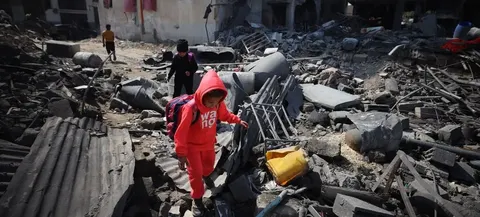
The strike came days after heavy rain flooded displacement camps across Gaza, soaking bedding, overwhelming damaged drainage systems and leaving families surrounded by water and sewage. Children and other civilians were killed when a sand embankment collapsed onto tents in the central Strip.
Even the American backed body responsible for overseeing President Donald Trump’s Gaza peace plan has publicly acknowledged the inadequacy of Israel’s response. The Board of Peace said delays in approving essential supplies had “exacerbated the consequences of a foreseeable humanitarian challenge”.
That acknowledgement goes to the heart of the disaster. The rain arrived in a territory where Israeli military operations had displaced much of the population, access restrictions had left approximately two thirds of the land unavailable, and hundreds of thousands of people were sheltering in places already identified as vulnerable to flooding.
The hospital attack and the inundated camps are connected by the destruction and restriction of the systems on which civilian survival depends: homes, medical care, safe land, drainage, sanitation and access to relief.
Gaza’s health ministry condemned the hospital bombing as a flagrant violation of international law. Hamas called it a war crime. Israel said it had targeted a Hamas commander and other fighters operating inside the hospital, an allegation that had not been independently verified.
What is already clear is the civilian consequence: people were killed where they had gone to be treated, while a hospital serving an immense and increasingly vulnerable population lost more of its capacity to keep them alive.
Killed hours before an operation
Seif Ghazi Abu Hatab, 29, had been admitted to Nasser hospital on Monday after debris fell onto his back while he was helping clear rubble from a friend’s home.
He was scheduled for surgery at 10am on Thursday and was meant to receive further treatment abroad. Instead, he was killed in the hospital overnight.
His cousin, Tareq Abu Hatab, 37, described a young man who wanted to rebuild his home and recover an ordinary life after years of destruction.
“Seif was a young man in the prime of his life. He wanted to live, rebuild his home and start a normal life, free from problems and suffering,” he said.
“Seif was killed after already losing two of his brothers and his father. His mother has now lost three of her sons.”
The account places a human life behind the familiar language of another strike and another casualty total. Seif had survived displacement and family bereavement, then suffered an injury while helping someone clear the wreckage of a home. The hospital was supposed to be the next stage in his recovery.
Dr Ayman Abu Ubaid, a surgical specialist wounded in the attack, said the bombing came at about 12.30am without warning.
“The patients in the department were all surgical patients waiting to undergo operations. The bombing happened at a time when they should have been asleep,” he said.
He described thick smoke, fires, wounded people groaning and others screaming, with staff suffering injuries to their limbs and shrapnel wounds.
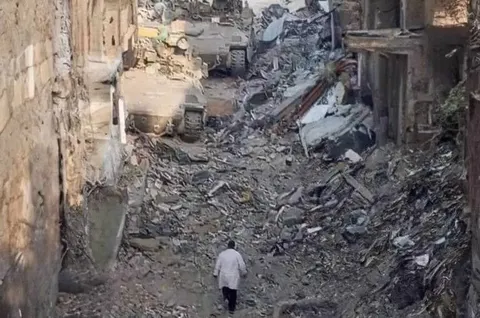
Al-Fara said two missiles struck the al-Yasin surgical building, one of which failed to explode. The attack damaged several floors, leaving collapsed ceilings, shattered concrete, wrecked medical equipment and beds covered in debris.
The unexploded missile added another danger inside a building whose patients and staff had already endured the blast.
A surgeon who stayed to serve his patients
Abu Shaira, 52, was a general surgeon whose work had featured in American Doctor, a documentary about physicians operating in Gaza.
Dr Thaer Ahmad, who also appeared in the documentary, remembered him as a doctor serving his people through surgery. Abu Shaira was killed alongside one of the patients he had treated.
Another colleague, general surgery specialist Dr Mohammed Qdeih, suffered a head wound in the attack. He said the medical staff had finished work and were preparing to sleep when the explosion struck.
“My whole body was trapped under the rubble. For a moment, I felt as if I was about to lose consciousness, or that I was about to die,” Qdeih said.
He described struggling to free his leg, calling for colleagues and crawling through darkness after the lights went out. Abu Shaira had been lying nearby. Another colleague suffered a broken leg.
Qdeih remembered the dead surgeon as kind, helpful and among the best doctors in the department.
“A patient comes to the hospital seeking treatment and leaves carried on people’s shoulders,” he said. “I do not know what kind of humanity this is.”
Nasser is a major referral centre for southern Gaza, serving close to a million residents and displaced people. The loss of its surgical capacity reaches far beyond the people directly struck.
Al-Fara said the hospital was already lacking about 80 per cent of its essential medicines and medical supplies. The bombing therefore hit an institution struggling to provide care with a fraction of what it needed.
Medical Aid for Palestinians, which supports ten departments at Nasser, said it had helped restore the surgical unit that was struck. Work undertaken to rebuild medical capacity had itself become part of the latest destruction.
The hospital had also been affected by the preceding floods, with water entering several departments. It was coping with the same environmental emergency afflicting its patients before missiles tore through its surgical building.
Israel’s explanation does not settle the legal questions
The Israeli military said it had targeted Mohammed Abu Ismail, whom it identified as the commander of Hamas’s Khan Younis Brigade, alongside other fighters.
It alleged that they were using Nasser as a headquarters to prepare attacks on Israeli forces and rebuild the brigade’s capabilities. Hamas rejected the allegation, accusing Israel of using an unsubstantiated account of military activity to justify an attack on a civilian medical institution.
Israel also said it had issued advance warnings and released an audio recording of what it described as a warning to a senior Gaza health official. Al-Fara insisted the hospital had received no warning of the attack.
These conflicting accounts require independent investigation, including scrutiny of the alleged target, the intelligence used, the warning’s timing and content, and the precautions taken to protect patients and staff.
International humanitarian law gives hospitals special protection. Treating wounded fighters does not remove that protection, nor does the presence of weapons taken from wounded patients and awaiting removal.
Protection can cease when a hospital is used, outside its humanitarian functions, for acts harmful to the enemy. The applicable rules also require a warning that goes unheeded, with a reasonable time limit where appropriate.
Even when a medical facility loses its special protection, an attacker must establish a lawful military objective, take feasible precautions and comply with proportionality. Expected civilian harm must not be excessive in relation to the concrete and direct military advantage anticipated.
Calling an attack “precise” does not answer those questions. Precision describes a weapon’s ability to reach a selected point; legality also depends on what is being attacked, why, and with what foreseeable consequences for civilians.
Intentionally directing an attack against a hospital that is not a military objective is a war crime under the Rome Statute. Determining responsibility for this particular strike requires evidence about the operation and the attackers’ knowledge and intentions.
The foreseeable consequences also extend beyond the immediate deaths. Destroying operating rooms, intensive care capacity and diagnostic services can endanger people who were nowhere near the explosion but will need treatment afterwards.
In Gaza, where alternative facilities are scarce and damaged, those consequences are especially severe.
A population confined to overcrowded land
The conditions outside the hospital explain why every further loss of medical capacity matters so much.
Approximately 2.1 million Palestinians are concentrated in the portion of Gaza remaining accessible to them, while Israeli military control and access restrictions cover about 65 per cent of the territory.
The remaining area is roughly 128 square kilometres. Spread across that land, the population density is around 16,000 people per square kilometre.
The resulting average of approximately 61 square metres per person covers every use of the land: shelter, streets, hospitals, schools, damaged buildings, rubble and whatever space remains for essential services.
These figures describe a population crowded into a severely damaged environment, with limited scope to move when the places where they are staying become dangerous.
The coastal geography matters, but the humanitarian evidence is more precise than a claim that everyone has been placed at Gaza’s single lowest point. Many displacement sites occupy low lying terrain, areas near shorelines and lagoons, or places where damaged and blocked drainage makes flooding more likely.
Those risks were documented before November’s storms.
An early October humanitarian assessment identified low terrain, proximity to shorelines and lagoons, and blocked drainage as major flood hazards. It also identified restrictions on access to 65 per cent of Gaza’s land as an obstacle to relocating families, because the remaining area was already overcrowded.
By a later October assessment, approximately 950,000 people were living in displacement sites considered at medium to high risk of flooding. More than 400,000 were in the highest risk category.
Available shelter supplies could partially assist only 18 per cent of the 294,250 families assessed as requiring help for the rainy season.
The danger was therefore foreseeable at an operational level. Humanitarian agencies had identified vulnerable locations, estimated the populations exposed and described the obstacles to making them safer.
Families could not simply choose an undamaged house on safer ground. The shortage of usable accommodation, restrictions on movement and land, and destruction of infrastructure sharply limited their choices.
Under the Fourth Geneva Convention, an occupying power carrying out evacuations must, to the greatest practicable extent, provide proper accommodation and satisfactory conditions of health, hygiene, safety and nutrition. Moving people does not end responsibility for the conditions into which they are moved.
Trump’s peace overseers had already sounded the alarm
The Board of Peace’s latest criticism is significant because it comes from the institution charged with implementing Trump’s plan. It is also part of a longer record of warnings.
On 26 August, the Board’s representative for Gaza, Nickolay Mladenov, publicly criticised Israel’s shelter policy during a briefing to the UN Security Council.
“Winter is around the corner, and Israel’s present policy on quality shelter is not acceptable,” he said.
Mladenov urged Israel to permit better shelter into Gaza for the population’s health, safety and dignity. His warning came more than two months before the November flooding.
That earlier intervention makes the latest emergency harder to portray as an unexpected seasonal setback. The need for shelter had already been raised publicly by a senior representative of the American backed peace mechanism.
In its statement on 9 November, the Board said Israel’s response remained “insufficient” and called for the immediate entry of necessary humanitarian and winter supplies.
It said it had urged the Israeli government to authorise materials for temporary shelter, water and sanitation infrastructure, drainage, waste management and sewage removal.
The Board also criticised Hamas for failing to disarm and transfer governing authority, saying those failures had compounded civilian hardship.
But its criticism of Israeli approval delays was explicit. Those delays had worsened a foreseeable emergency and obstructed progress towards the next stages of the peace plan.
The political significance lies in that acknowledgement of responsibility. The body overseeing the ceasefire was identifying decisions about the entry of essential materials as a cause of worsening civilian suffering.
Public criticism, however, has not yet secured the protection those warnings demanded. Families remained exposed when the rain arrived.
Supplies outside Gaza, exhausted stocks within it
Around 1.4 million people, approximately 65 per cent of Gaza’s population, are living in tents or makeshift shelters.
Many of those shelters offer little protection against prolonged rain and wind. Families who have repeatedly moved have few possessions left and little ability to replace bedding, clothing or materials destroyed by flooding.
More than 150,000 tents were outside Gaza ready for dispatch as the emergency unfolded. Humanitarian agencies had also positioned approximately 300,000 tarpaulins and 500,000 blankets outside the territory.
Inside Gaza, essential shelter and winter stocks were virtually exhausted.
UN humanitarian coordinator Ramiz Alakbarov called for Israeli restrictions on the entry of supplies to be lifted immediately.
“We have run out of time,” he said.
Israel disputes responsibility for the scale of the shortfall. Its military agency coordinating aid, COGAT, said more than 91,000 tents and over 8,200 trucks carrying tarpaulins, blankets, winter clothing and other supplies had entered under its winter plan.
Israeli officials said they were coordinating with the Board of Peace and humanitarian organisations, while refusing equipment they considered capable of military use. Foreign ministry spokeswoman Michal Maayan accused Hamas of hoarding aid and blamed the movement for delays and winter hardship.
Hamas rejected that account, pointing to Israeli restrictions on shelter and recovery materials and accusing the Board of failing to fulfil its own responsibilities.
Humanitarian reporting also identifies funding shortages and logistical difficulties, alongside Israeli restrictions, as constraints on the response.
Relief has entered Gaza, and aid workers are distributing supplies and repairing damaged infrastructure. The central failure is that the assistance reaching civilians and the materials permitted for recovery remain inadequate to the scale of the need.
Cumulative delivery figures cannot, by themselves, establish that families have safe shelter, that drainage systems work, or that emergency stocks will last through another storm.
The distinction is visible in the camps: tents may exist on a distribution tally while families remain inside torn, overcrowded or flooded shelters, without the materials and infrastructure needed to make them safe.
Rainwater, sewage and another round of loss
For displaced families, the storm meant the destruction of what little they had managed to preserve.
Mohammed Jneid, standing soaked in Gaza City, described rain arriving from one side while sewage overflowed from the other. The ground and the tents could no longer cope.
“We have nothing left, no bedding, no food, nothing,” he said.
Islam Al Mobayed described sharing a tent with seven children, five of them young.
“This is not life,” she said. “We are exhausted, we are tired of this entire life.”
The danger extended beyond soaked possessions. Damaged buildings and unstable sandy ground threatened people sheltering beside them. A sand embankment collapsed onto tents, killing children and other civilians. An infant was also reported to have drowned at a displacement site.
Oxfam’s Gaza response lead, Wassem Mushtaha, described severe flooding and the absence of safe places to go. His teams were working on drainage, sewage blockages and water pumping facilities, while seeking the spare parts, pipes, engine oil, machinery and shelter materials needed to prevent further deaths.
Those efforts show both the possibility of reducing harm and the consequences of obstructing the means to do so. Floodwater can be removed, drains cleared, shelters reinforced and damaged infrastructure repaired when people have the equipment, access and resources required.
The rains have also increased the need for healthcare, with families exposed to cold, overcrowding and contaminated water. The bombing of Nasser occurred as those pressures were intensifying.
The same population facing worsening conditions in the camps now has fewer functioning hospital services available to treat their consequences.
Essential relief cannot wait for a political settlement
COGAT has said reconstruction can begin only after Hamas fully disarms. Israel and Hamas remain in dispute over the sequencing of disarmament, a transfer of governing authority and further Israeli withdrawal.
Those negotiations do not suspend civilians’ entitlement to the essentials of survival.
In an advisory opinion issued in October 2025, the International Court of Justice set out Israel’s obligations as an occupying power to ensure access to food, water, clothing, bedding, shelter, fuel and medical supplies and services.
Where the population is inadequately supplied, Israel must agree to and facilitate humanitarian relief. Security inspections are permitted, but they cannot be exercised in a way that defeats those obligations.
The court’s opinion addressed legal duties that exist independently of the timetable for a political agreement.
Whatever conditions governments attach to long term reconstruction, children require protection from the weather now. Patients require medicines and functioning hospital departments now. Sewage systems and drainage cannot remain unusable while negotiators argue over the next phase.
The evidence of forewarning makes the failure especially stark. Shelter shortages and flood exposure were identified before the storms; essential materials were waiting outside Gaza; restrictions continued to constrain both preparation and movement to safer places.
The resulting disaster is shaped by those decisions as well as by the weather.
Repeated attacks on a depleted health system
Al-Fara said Thursday’s bombing was the seventh Israeli attack on Nasser during the war.
In August 2025, two Israeli strikes on the hospital killed 22 Palestinians, including journalists and medical personnel. Five journalists were among the dead.
The latest attack therefore falls within an established pattern of repeated damage to a hospital on which southern Gaza depends.
The wider medical system has suffered immense losses. In July, Médecins Sans Frontières reported that more than 1,700 healthcare staff had been killed since October 2023 and, citing Healthcare Workers Watch, that 95 Palestinian healthcare workers remained detained by Israel.
In August 2025, UN special rapporteurs Tlaleng Mofokeng and Francesca Albanese described the destruction of Gaza’s medical system as “medicide”, accusing Israel of attacking the people and institutions required to keep the population alive.
The UN Independent International Commission of Inquiry concluded in September 2025 that Israel had committed genocide in Gaza. In October 2026, it reported that genocidal acts were continuing after the ceasefire agreement. Israel rejects allegations of genocide.
Those findings concern a broader course of conduct. The evidence surrounding each new attack still requires investigation, including the strike on Nasser and its consequences for patients.
But the cumulative damage is central to understanding the severity of each further incident. A surgical department destroyed in a functioning health system creates an emergency; a surgical department destroyed in a system already devastated by repeated attacks can remove care that has no practical replacement.
The immediate death toll records only part of that loss.
A ceasefire that has not delivered civilian safety
More than 1,620 people have been killed in Gaza since the October 2025 ceasefire, according to the territory’s health ministry. Israeli strikes have continued almost daily.
The overall reported Palestinian death toll since October 2023 has passed 74,650. The war followed the Hamas led attacks on southern Israel on 7 October 2023, in which around 1,200 people were killed and 251 taken hostage.
More than a year after the ceasefire agreement, the promised transition towards safety and recovery remains out of reach for much of Gaza’s population.
The agreement envisaged Hamas giving up governance and weapons alongside a phased Israeli withdrawal. Israel has insisted on full disarmament before further withdrawal, while the dispute has left subsequent stages stalled.
For civilians, the consequences of that paralysis are measured in continued strikes, restricted access to land, damaged services and shelters that cannot withstand the weather.
The term “ceasefire” offers little reassurance to patients who are bombed in their beds or families who cannot find a dry and safe place for their children.
A peace mechanism must be judged by whether it changes those conditions. Public statements acknowledging the emergency are necessary, but they do not themselves open a crossing, restore an operating theatre or allow a displaced family to reach safer ground.
The demand for consequences
Medical organisations are calling for measures that impose consequences on those responsible for attacks and obstruction.
Medical Aid for Palestinians urged the British government to suspend arms transfers to Israel, including components for F-35 aircraft, use sanctions against those responsible for serious violations and the obstruction of relief, and support international accountability.
“Statements of concern have never protected Gaza’s patients, hospitals or healthcare workers,” its chief executive, Steve Cutts, said.
Physicians for Human Rights Israel also condemned the latest attack and linked repeated destruction of healthcare to the failure to hold perpetrators accountable.
“The international community’s inaction and continued impunity enable these attacks on Gaza’s healthcare system,” the organisation said.
The work of Palestinian medical staff, rescuers and humanitarian organisations continues despite extraordinary danger. Their efforts have kept people alive and prevented further suffering.
The failure lies with political systems that have not secured adequate relief, effective civilian protection or an end to repeated attacks on essential services.
The Board of Peace’s renewed criticism now places another acknowledgement on the public record: the danger was foreseeable, the response was insufficient, and restrictions worsened the consequences.
For the colleagues mourning Abu Shaira, the mother who has now lost three sons, and the families trying to keep their children warm inside flooded tents, the test of the ceasefire is whether it can keep them alive through the next night.
Sources and attributions
Latest hospital reporting and victims’ accounts: Seham Tantesh in Gaza and William Christou in Beirut, “Israeli airstrike on Nasser hospital in Gaza kills surgeon and five others”, The Guardian, 12 November 2026, updated 12.19 GMT. The full text supplied with the request supports the director’s figure of 28 wounded, the suspension of four departments, the accounts of Ayman Abu Ubaid and Seif Abu Hatab’s family, Abu Shaira’s documentary appearance, and the hospital’s reported shortages. Injury figures remain provisional. theguardian.com
Additional hospital testimony and military statements: Rushdi Abualouf, David Gritten and Claire Keenan, “Israeli strike on Gaza hospital kills six Palestinians, health ministry says”, BBC News, 12 November 2026, supplied in full with the request. This provides Mohammed Qdeih’s testimony, the director’s account of two missiles, the disputed warning, the Israeli military’s named target and Hamas’s response, and the reported death totals. Its original article URL was not supplied.
Flooding, residents’ testimony and the Board’s criticism: Mallory Moench, “Board of Peace says Israel’s aid response after Gaza floods ‘insufficent’”, BBC News, 10 November 2026, supplied in full. This supports the testimony of Mohammed Jneid and Islam Al Mobayed, Ramiz Alakbarov’s appeal, and the Israeli and Hamas responses.
Contemporaneous flood assessment: UN OCHA, “Humanitarian Situation Report: Heavy Rains in the Gaza Strip | 8 November 2026”, published 9 November. Supports the depleted stocks, supplies positioned outside Gaza, restrictions and funding constraints, reported infant drowning, humanitarian response and flooding within Nasser itself. Accounts differ on the number killed in the embankment collapse, so the article does not assign a definitive total. Occupied Palestinian Territory
Warnings before the storms: UN OCHA, “Humanitarian Situation Report | 2 October 2026” and “Humanitarian Situation Report | 15 October 2026”, published 5 and 19 October respectively. These document dangerous terrain, restrictions on relocation, approximately 950,000 people at medium to high flood risk, and the inadequate shelter stock. The geographical description relies on these assessments. Occupied Palestinian Territory
Territory and population calculations: The supplied AJLabs infographic, dated 12 October 2026, associated with Mohammed Haddad’s “Maps show how Israel’s ‘Yellow Line’ keeps squeezing Palestinians in Gaza”. The territorial and density figures are also supported by the UK Home Office’s September 2026 humanitarian situation note, updated 2 October, and OCHA’s land access reporting. GOV.UK
Earlier Board criticism and the November statement: Jacob Magid, “Board of Peace envoy knocks Israel’s ‘unacceptable’ Gaza policy as disarmament plan stalls”, The Times of Israel, 26 August 2026; and Lazar Berman, Emanuel Fabian and Jacob Magid, “Israel says winter supplies delivered to Gaza amid flooding; Board of Peace says it must do more”, 9 November 2026. These establish that November’s intervention followed earlier public criticism and reproduce the Board’s statement and Israeli response. The Times of Israel
Medical and humanitarian organisations: Medical Aid for Palestinians, statement on the killing of the Nasser surgeon, 12 November 2026; Oxfam, “Reaction: Severe flooding in Gaza”, 9 November; and Matthew Doran, “Six killed in Israeli air strike on Gaza’s Nasser Hospital”, ABC News, 12 November, carrying Physicians for Human Rights Israel’s response. Medical Aid for Palestinians
Protection of hospitals and displaced civilians: ICRC, “The protection of hospitals during armed conflicts: What the law says”, 6 November 2023; Fourth Geneva Convention, Article 19 and Article 49; and Article 8 of the Rome Statute. These support the legal standards explained in the article, without constituting a determination of responsibility for this latest attack. ICRC
Obligations to ensure essential supplies and facilitate relief: International Court of Justice, advisory opinion of 22 October 2025, particularly its treatment of humanitarian relief and essential supplies. Question of Palestine
Wider destruction of healthcare and UN findings: MSF, statement on arbitrarily detained Palestinian healthcare workers, 20 July 2026; UN special rapporteurs, statement on attacks on Gaza’s healthcare system, 13 August 2025; and the UN Independent International Commission of Inquiry’s September 2025 genocide findings and 26 October 2026 findings. The detention figure is dated to July rather than presented as a newly verified November count.