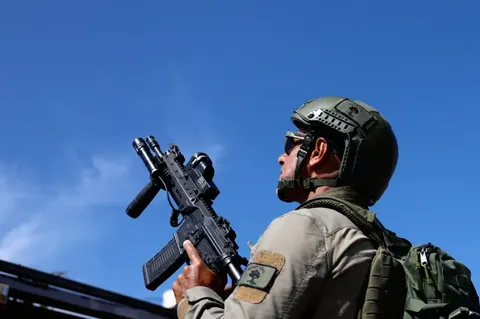
From 50 Targets a Year to 100 a Day: Inside Israel’s AI War Machine
Israel’s military described an AI-assisted expansion in Gaza target generation from 50 targets a year to 100 a day — equivalent to a 72,900% increase if the daily rate is annualised.
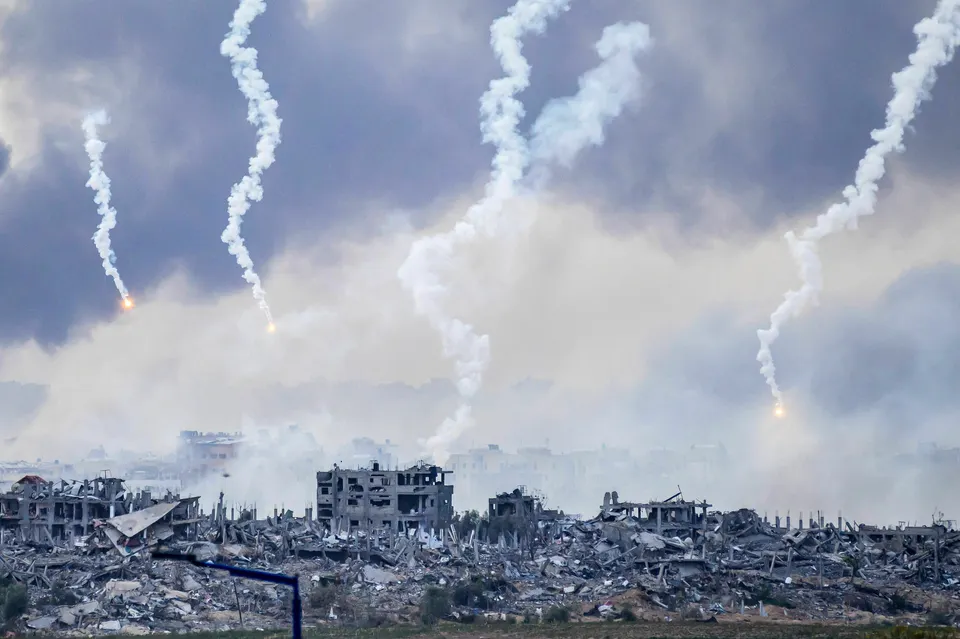
That calculation, drawn from figures given by former military chief Aviv Kochavi, captures the scale of the change. It compares production rates, however, rather than documenting an equivalent increase in airstrikes or authorisations to kill. Kochavi was describing the May 2021 Gaza operation, before the assault that began in October 2023. “And here the machine produced 100 targets in one day,” he said, according to +972 Magazine and Local Call. The publications’ November 2023 investigation examined Habsora, or The Gospel, a system accelerating target generation. One former intelligence officer described the process it helped enable as a “mass assassination factory”. The central question is what happens when the capacity to nominate targets expands faster than the time, evidence and restraint devoted to assessing them. Producing more recommendations does not establish that more people or buildings can lawfully be attacked. In a public explanation issued in June 2024, the Israeli military said Habsora combined intelligence and directed analysts towards objects potentially connected to armed groups. It said analysts had to investigate those suggestions independently and obtain an authorised officer’s approval. Its account presents technology as a means of improving intelligence and reducing mistakes. “They do not generate orders for strikes,” the military said of its data tools. It also denied that they autonomously selected targets for attack. Those distinctions matter: an algorithm suggesting a target and a weapon independently deciding to fire are different technologies, with different chains of responsibility. Yet the most disturbing testimony concerns the quality of the human judgement between the recommendation and the explosion. In April 2024, +972 and Local Call published an investigation based on six Israeli intelligence officers describing a second system, Lavender. Sources said it had identified as many as 37,000 Palestinians as suspected members of Hamas or Palestinian Islamic Jihad during the war’s early weeks. One officer described spending about 20 seconds checking a proposed target. “I had zero added value as a human, apart from being a stamp of approval,” the officer said. Sources described an internal assessment suggesting roughly one in ten identifications was erroneous. That was an account of the system’s performance, not an independently audited error rate. Two sources also alleged that early rules permitted attacks expected to kill 15 or 20 civilians alongside a junior operative. Israel disputed the investigation’s characterisation. In its subsequent public explanation, it described Lavender as a database for organising and cross-referencing intelligence, stressing that inclusion alone did not establish that someone could lawfully be targeted. The existence of a human approval stage therefore does not settle the controversy. The unresolved issue is whether officers exercise meaningful scrutiny or routinely endorse recommendations generated at a pace that discourages challenge. Human Rights Watch’s September 2024 analysis identified another danger: the assumptions underlying suspicion. Its examination of military publications described methods that could associate someone with an armed group through social connections, shared chat groups or repeated changes of phone or address. The organisation cautioned that the precise inputs to Lavender were not fully accessible. Such patterns are not proof of participation in fighting. In a devastated territory, changing a telephone, borrowing a relative’s handset or moving repeatedly may reflect displacement and attempts to survive. A system that treats those circumstances as suspicious can turn the disruption of civilian life into evidence against civilians. Human Rights Watch also confirmed that the military used a tool with the functionality attributed to “Where’s Daddy?”: tracking a marked person’s phone to notify operators when it entered a particular location. It warned that locating a phone does not reliably establish the presence of a specific person. The consequences extend beyond mistaken identity. Sources in the Lavender investigation alleged that suspected operatives were often attacked at family homes, where relatives were present, and that unguided bombs were used against junior targets. Even a correctly identified fighter does not make every surrounding death lawful. The laws of war require distinction between civilians and military targets, feasible precautions to reduce civilian harm, and an assessment of whether expected incidental harm would be excessive compared with the concrete and direct military advantage anticipated. In a 2026 article in the International Review of the Red Cross, international law scholar Jessica Dorsey examined how translating these decisions into numerical assessments can displace the contextual judgement they require. Her analysis argues that proportionality cannot be reduced to a mathematical formula. A casualty allowance cannot, by itself, answer whether a particular attack is lawful. The International Committee of the Red Cross made a related warning in guidance published on 8 October 2026. It described the danger of users over-trusting machine recommendations under pressure and cautioned that AI could reproduce harmful or unlawful targeting policies at greater speed and scale. “These systems can amplify the speed and scale of errors and risk unintended escalation,” the organisation warned. It acknowledged that carefully designed tools could improve analysis and civilian protection, but said outcomes depended on how systems were designed and used. A separate investigation offers a sobering measure of civilian harm, although it cannot establish how many deaths resulted from AI-assisted targeting. In August 2025, +972, Local Call and the Guardian reported that an internal Israeli database recorded about 8,900 named Hamas and Islamic Jihad operatives as dead or probably dead by May that year. Compared with approximately 53,000 deaths reported by Gaza’s Health Ministry at that point, that produced an estimated civilian share above 83%. The figure was an inference with limitations: the database could omit unidentified fighters and people fighting outside the named organisations. Israel rejected the published figures. It was also a calculation covering the war up to May 2025, not the first six weeks of fighting. Beyond Gaza, the use of technology to classify Palestinians and control their lives has been documented in a different setting: the checkpoints of the occupied West Bank. In Hebron, this surveillance was promoted under the language of urban modernisation. In a November 2020 article, Israel’s military described “Hebron Smart City”: cameras and radar feeding a military operations room, with automatic alerts for unusual movement or sounds. Operators could define areas or movements to trigger warnings and direct troops to investigate. The military presented the system as a way to improve security and respond more quickly to incidents. Amnesty International’s 2023 report Automated Apartheid examined Red Wolf, a facial recognition system used at checkpoints in Hebron. It described Palestinians’ faces being scanned and entered into surveillance databases without consent, with database records affecting whether they could pass. “The Israeli authorities are using sophisticated surveillance tools to supercharge segregation and automate apartheid against Palestinians,” said Amnesty’s secretary general, Agnès Callamard. The organisation also documented soldiers’ testimony about Blue Wolf, an application used to collect and retrieve information on Palestinians. According to those accounts, units competed over the number of people registered, with prizes for the highest-scoring battalion. Surveillance had acquired the incentives of a competition, while the people photographed had no comparable power over the system. For Palestinians, the consequences could be immediate and mundane: a journey interrupted, access to a neighbourhood denied, or daily movements recorded. Amnesty’s findings describe technology operating within an existing system of unequal control, making that control more pervasive. The wider controversy over surveillance in the West Bank also reached Microsoft. On 27 March 2020, the company announced that it would divest its stake in AnyVision, an Israeli facial recognition business whose technology was used at checkpoints between Israel and the West Bank. The decision followed an audit led by former US attorney general Eric Holder. A joint Microsoft–AnyVision statement said the audit had not substantiated allegations that AnyVision powered the broader West Bank mass-surveillance programme described in media reports, or established a breach of Microsoft’s facial recognition pledge. Nevertheless, Microsoft withdrew, citing “the challenges of being a minority investor in a company that sells sensitive technology”. It said such investments generally did not provide sufficient oversight or control, and announced an end to minority investments in companies selling facial recognition technology. The documented withdrawal concerned Microsoft’s shareholding in AnyVision; it did not establish that Microsoft had operated or shut down Hebron’s Smart City programme. A separate intervention followed in September 2025. Microsoft announced that it had disabled specified cloud storage and AI services used by a unit within Israel’s Ministry of Defence, after finding evidence supporting elements of reporting about surveillance of Palestinian telephone calls. Its review included records concerning Azure storage in the Netherlands and AI use. “We do not provide technology to facilitate mass surveillance of civilians,” Microsoft president Brad Smith said. The company said its cybersecurity work with Israel would continue, making clear that the restrictions applied to particular services rather than its entire relationship with the Israeli state. The commercial use of digital manipulation presents a separate, international dimension. In February 2023, the Forbidden Stories consortium exposed Team Jorge, an operation led by Israeli businessman Tal Hanan. Undercover journalists recorded demonstrations and sales pitches involving hacked accounts, fabricated online identities and influence campaigns. Hanan claimed involvement in “33 presidential campaigns, 27 of which were successful”. The investigators made clear that this boast was difficult to verify. They did verify fake accounts associated with AIMS, the operation’s platform for managing invented online personas, and reported a catalogue of more than 30,000 automated profiles. Hanan denied wrongdoing. The investigation documented a private operation; it did not establish that every campaign was directed by Israel’s government. Its significance lies in demonstrating how capabilities associated with intelligence work can be marketed to clients seeking to manufacture public opinion. The concern has continued. In June 2026, France’s Viginum agency said Israeli firm BlackCore was suspected of digital interference involving elections in France, New York and Scotland. Reuters reported that the sponsors remained unidentified, BlackCore had not responded to requests for comment, and Israel’s embassy denied any intention to interfere in French politics. These were allegations of interference, not proof that election outcomes had been changed. Israel’s own citizens have also experienced the vulnerability created by large concentrations of personal information. In 2020, security researcher Ran Bar-Zik documented flaws in Elector, an election-management system used by Likud, that exposed information on approximately 6.5 million voters. His account showed how inadequate access controls put an entire electoral register at risk. A different breach reached into intimate life. In 2021, NPR reported that Black Shadow hackers had leaked a sample of data from LGBTQ platform Atraf, including telephone numbers, sexual preferences and HIV status. For users, the danger included involuntary disclosure of information whose exposure could threaten relationships, employment or personal safety. These episodes have different perpetrators, purposes and consequences. Together, they demonstrate the stakes of collecting information about people, assigning it meaning and using it to exercise power over them. In Gaza, those stakes are lethal. The extraordinary increase described by Kochavi measures how quickly a military process could produce targets. It does not measure the reliability of each identification, the care taken over each family nearby, or the legality of each attack. The test of military AI is ultimately what happens to the people represented by its data. Faster processing can assist responsible decisions. It can also make disastrous decisions easier to repeat. The responsibility for choosing between those outcomes remains human. SOURCES 1. +972 Magazine / Local Call, ‘A mass assassination factory’, 30 November 2023 https://www.972mag.com/mass-assassination-factory-israel-calculated-bombing-gaza/ 2. IDF, The IDF’s Use of Data Technologies in Intelligence Processing, 18 June 2024 https://www.idf.il/en/mini-sites/idf-press-releases-israel-at-war/june-24-pr/the-idfs-use-of-data-technologies-in-intelligence-processing-published-june-18-2024/ 3. +972 Magazine / Local Call, ‘Lavender’, 3 April 2024 https://www.972mag.com/lavender-ai-israeli-army-gaza/ 4. Human Rights Watch, Questions and Answers: Israeli Military’s Use of Digital Tools in Gaza, 10 September 2024 https://www.hrw.org/news/2024/09/10/questions-and-answers-israeli-militarys-use-of-digital-tools-in-gaza 5. Jessica Dorsey, The erosion of human(e) judgement in targeting?, International Review of the Red Cross, 13 January 2026 https://www.cambridge.org/core/journals/international-review-of-the-red-cross/article/erosion-of-humane-judgement-in-targeting-quantification-logics-aienabled-decision-support-systems-and-proportionality-assessments-in-ihl/31024C3473211FB84FD535BC815ADC03 6. ICRC, Frequently asked questions: AI decision-support systems in armed conflict, 8 October 2026 https://www.icrc.org/en/article/faq-ai-decision-support-systems-armed-conflict 7. +972 Magazine / Local Call / Guardian, Israeli army database suggests at least 83% of Gaza dead were civilians, 21 August 2025 https://www.972mag.com/israeli-intelligence-database-83-percent-civilians-militants/ 8. Amnesty International, Israeli authorities using facial recognition to entrench apartheid, 2 May 2023 https://www.amnesty.org/en/latest/news/2023/05/israel-opt-israeli-authorities-are-using-facial-recognition-technology-to-entrench-apartheid/ 9. Forbidden Stories, ‘Team Jorge’: In the heart of a global disinformation machine, 15 February 2023 https://forbiddenstories.org/team-jorge-disinformation/ 10. Reuters, Israeli firm BlackCore suspected of meddling in New York and Scotland votes, France says, 12 June 2026 https://www.reuters.com/world/israeli-firm-blackcore-also-suspected-meddling-nyc-scotland-votes-french-2026-06-11/ 11. Ran Bar-Zik / Snyk, Security breach leaks the personal data of all 6.5 million Israeli voters, 12 February 2020 https://snyk.io/blog/security-breach-leaks-the-personal-data-of-all-6-5-million-israeli-voters/ 12. NPR / HPPR, Hackers threaten to expose the user database of an Israeli LGBTQ dating site, 1 November 2021 https://www.hppr.org/2021-11-01/hackers-threaten-to-expose-the-user-database-of-an-israeli-lbgtq-dating-site?_amp=true 13. IDF, ‘Hebron Smart City’: The technological revolution in West Bank division operations rooms (Hebrew), 26 November 2020 https://www.idf.il/אתרי-יחידות/פיקוד-המרכז/כל-הכתבות/2020/המהפכה-הטכנולוגית-בחדרי-המלחמה-באוגדת-איו-ש/ 14. Reuters, Microsoft to divest AnyVision stake, end face recognition investing, 27 March 2020 https://www.reuters.com/article/technology/microsoft-to-divest-anyvision-stake-end-face-recognition-investing-idUSKBN21E3BA/ 15. Microsoft / AnyVision, Joint statement following audit, 27 March 2020 https://m12.vc/news/joint-statement-by-microsoft-anyvision/ 16. Microsoft / Brad Smith, Update on ongoing Microsoft review, 25 September 2025 https://blogs.microsoft.com/on-the-issues/2025/09/25/update-on-ongoing-microsoft-review/ Calculation note: ((100 × 365) ÷ 50 − 1) × 100 = 72,900%. This annualises the quoted daily production rate for comparison; it is not an observed annual total or a measure of strike approvals.