‘An Attack on Free Speech’: Amnesty Exposes University Crackdown on Palestine Solidarity
Students have faced suspensions, campus bans and threats to their immigration status as universities shared legal strategies and security planning to restrict Palestine activism, a new report finds.
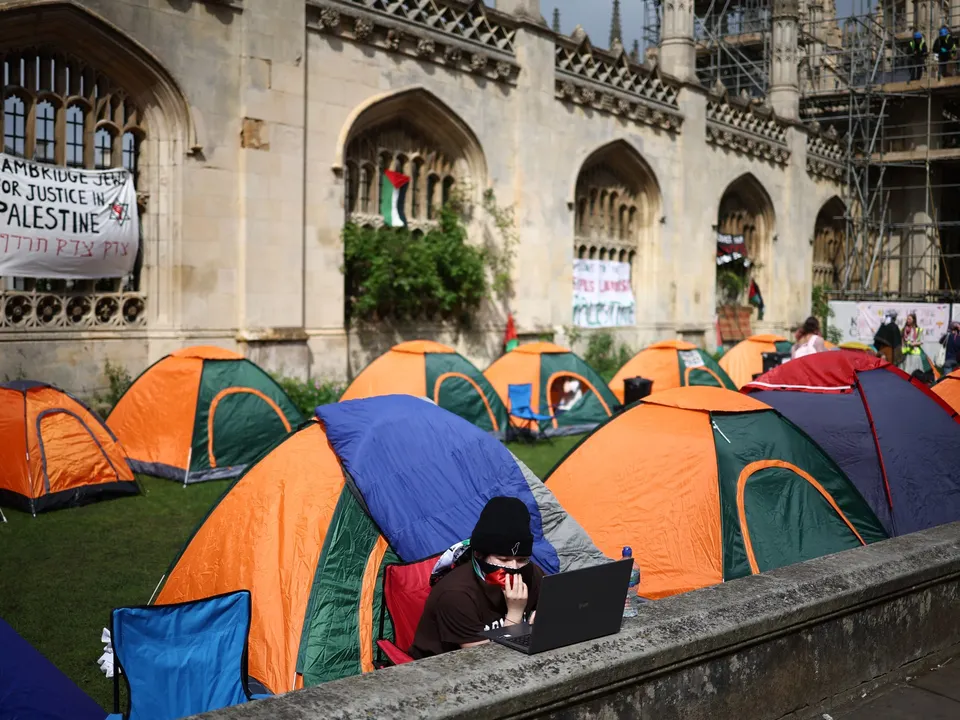
British universities have worked together to restrict Palestine solidarity, sharing legal strategies and security plans while subjecting students and academics to disciplinary proceedings that Amnesty International says have violated fundamental rights.
The organisation’s Silencing Dissent report, published on 20 October, describes institutions responding to protests against Israel’s destruction of Gaza with measures that threatened students’ education, livelihoods and ability to remain in Britain.
Actions as ordinary as chanting, clapping and wearing keffiyehs have featured in cases involving suspensions, exclusion from campus and threats to visa status. Amnesty says visibly Muslim students and those displaying Palestinian symbols have suffered disproportionately.
“This is an attack on our freedom of speech and the right to protest from the very institutions who are supposed to encourage free thought,” said Kerry Moscogiuri, Amnesty International UK’s chief executive.
The report’s central finding extends beyond individual disciplinary disputes. Amnesty describes a network of institutional responses shaped by government pressure, regulatory direction, advocacy groups, private lawyers and security contractors.
Some universities exchanged legal strategies and security planning, while others received instructions from the Department for Education. In the cases examined, Palestine-related expression frequently attracted greater scrutiny than other forms of student protest.
The result, Amnesty argues, was a climate in which expressing solidarity could carry consequences far beyond a demonstration itself.
In several cases, universities imposed restrictions before disciplinary hearings had concluded. Measures presented as temporary precautions became punishments in practice: students lost access to campus while investigations continued without clear deadlines, explanations or routes of appeal.
For an international student, such proceedings could also threaten immigration status. For others, prolonged uncertainty disrupted their studies and left them unsure whether they could complete their degrees.
The account supplied by Declassified UK highlights one particularly striking example: a university withdrew approval for a staff-student event discussing Palestine’s legal and humanitarian situation because a watermelon symbol in its publicity supposedly compromised its neutrality.
Amnesty’s research principally covers events between October 2023 and September 2025. Its 26 case studies document different institutional responses; the organisation explicitly cautions that every finding does not apply to every university, or establish how widespread each practice was across the sector.
Among the most consequential cases is that of Usama Ghanem, a 22-year-old student suspended by King’s College London in 2025 following Palestine solidarity activism.
According to Amnesty, Ghanem was told to return to Egypt during his suspension, despite having previously been detained and tortured there. His suspension was subsequently lifted, with his return to university reported in September 2026.
“I left an authoritarian regime in Egypt to find one at King’s College London,” he said.
King’s disputes his characterisation of the disciplinary action. It maintains that his suspension concerned conduct that caused harm and infringed others’ rights, rather than his political beliefs. The university upheld misconduct findings, including causing injury to a security guard. His subsequent reinstatement followed a review of whether the conditions attached to his suspension had been met; it did not overturn those findings.
The distinction matters. Ghanem’s return ended his exclusion, but the dispute over the university’s treatment of him remains.
His case also illustrates the overlap between disciplinary action and private intelligence gathering. Novara Media reported in September that King’s used Horus Security Consultancy to obtain information about demonstrations calling for his reinstatement, including publicity, locations and attendance.
King’s said it did not commission monitoring of individual students or share their personal information with Horus. It described the service as a means of identifying publicly advertised events and preparing for their safe conduct.
At the London School of Economics, Amnesty examined the treatment of seven students who held a short protest in July 2024 demanding divestment from companies supplying arms to Israel.
The students received precautionary campus bans. According to Byline Times’ account of the report, internal correspondence described them as “dressed as terrorists”, while one official proposed expulsion before an investigation had taken place.
LSE told the publication that its investigation considered witness accounts and CCTV footage. It said six students received formal warnings and one case was dismissed, with nothing placed on their student records. It also said restrictions were adjusted at students’ request.
The university defended its commitment to free expression and said intervention was reserved for unlawful, threatening or significantly disruptive conduct. It did not address the reported internal language.
Cambridge’s efforts to obtain court restrictions on Palestine protests provide another example of the methods under scrutiny. Amnesty criticised the breadth of the restrictions sought. Cambridge has defended its use of injunctions while maintaining that it supports lawful protest, pointing to demonstrations that continued near graduation ceremonies while court orders were in force.
The concern about private monitoring predates Amnesty’s latest findings.
In April, a joint investigation by Liberty Investigates and Al Jazeera reported that 12 British universities had paid Horus to monitor protest activity. The investigation, drawing on freedom of information requests to more than 150 institutions, found payments exceeding £440,000 between January 2022 and March 2025 for intelligence services covering a range of subjects.
Documents showed student social media posts being collected and circulated, alongside assessments of a Palestinian academic invited to speak at a university.
The investigation described Horus as run by former military intelligence officials. It did not establish the claim in the supplied newsletter that those officials were Israeli.
Universities defended the arrangements on security grounds. Sheffield denied seeking to discourage activism or commissioning the monitoring of individuals. Imperial said its service identified potential risks using public information. Horus did not answer the investigation’s questions; its website stated that its work was ethical and legally compliant. The investigation did not allege that the activity was illegal.
Taken together, the disciplinary cases, injunctions and monitoring arrangements explain why Amnesty regards the issue as an institutional problem requiring a wider response.
Its findings challenge the assumption that a university protects freedom of expression simply by declaring support for it. Restrictions can deter participation long before a final disciplinary decision, particularly where students believe their degree, access to campus or immigration status may be at risk.
Amnesty is urging universities to adopt its Defend Dissent Charter, protecting students’ ability to organise, express political views and engage in peaceful protest. Its demand is that those protections operate in practice when students challenge their own institutions over Palestine.