‘We Can’t Hide’: Israel-Backed Militias Bring Night Raids and Fear to Gaza’s Displaced Families
Palestinians sheltering near Israel’s expanding military boundary describe beatings, threats against children and relatives taken away by armed groups. Their accounts expose the civilian cost of a policy Israel has publicly defended as a way to fight Hamas while protecting its own soldiers.
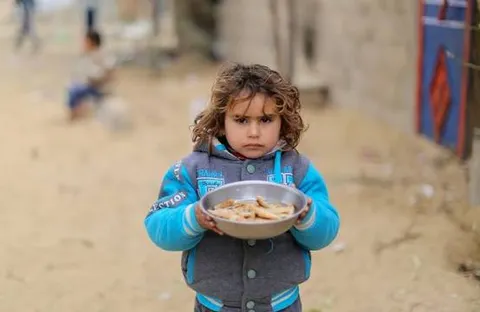
The gunman’s warning, Youssef Al-Sheikh recalled, was directed at his wife as their terrified children cried: silence them, or he would shoot them all.
Masked men had entered the damaged building in Jabaliya where Al-Sheikh was sleeping with his wife and eight young children. It was around 2am on the night of 24 September. Armed with assault rifles and powerful lights, they demanded to know where he kept weapons and explosives.
“I told him, ‘I’m a peaceful citizen. I don’t have anything.’”
Then, Al-Sheikh said, they began beating him.
His account, published on 19 October, describes a raid in which relatives were assaulted, phones confiscated and one man taken away. It also opens a window onto a growing source of fear for displaced Palestinians: armed Palestinian groups operating from Israeli-controlled territory, close enough to enter their shelters at night.
Israel has acknowledged supporting anti-Hamas groups in Gaza. Their stated purpose is to weaken Hamas and help establish an alternative order. For families living beside the expanding boundary of Israeli military control, however, the encounters described in the latest reporting involve intimidation, violence and uncertainty over who can be held accountable.
Al-Sheikh said approximately seven gunmen entered his room. Their lights were so bright that he could barely see them.
“Three of them came at me, punching and slapping me and beating me. They beat me in the most brutal ways.”
When two of his brothers-in-law intervened, they too were beaten. The men were taken into another room and made to kneel. One relative, Hossam Tafesh, was accused of belonging to the resistance after the gunmen found a black T-shirt among his possessions. Al-Sheikh said they wrapped it tightly around Tafesh’s face until he began to suffocate.
One of Al-Sheikh’s children repeatedly struck his own face while crying for his father.
Eventually, the gunmen photographed the three men and, according to Al-Sheikh, sent their pictures through WhatsApp. A telephone call followed, after which they were told they could be released. The identity of whoever received those photographs has not been established.
A third brother-in-law, Said Okasha, was less fortunate. He had gone upstairs in fear.
“They started beating him. We could hear the blows and the screaming,” Al-Sheikh said. “They restrained him and took him away in his underwear.”
Two residents interviewed separately corroborated that a Palestinian militia had raided the area that night. The published account does not establish which group was responsible or where Okasha was subsequently held. Those uncertainties remain central to the case.
The broader Israeli policy behind support for armed Palestinian rivals of Hamas is openly acknowledged.
On 5 June 2025, Prime Minister Bibi Netanyahu defended the use of anti-Hamas clans following revelations about weapons transfers.
“What’s wrong with that?” he asked. “It’s only good. It saves the lives of IDF soldiers.”
The statement supplied a clear rationale: Palestinian armed groups could take on tasks that would otherwise expose Israeli troops to danger. It did not explain how civilians would be protected from those groups or how allegations against them would be investigated.
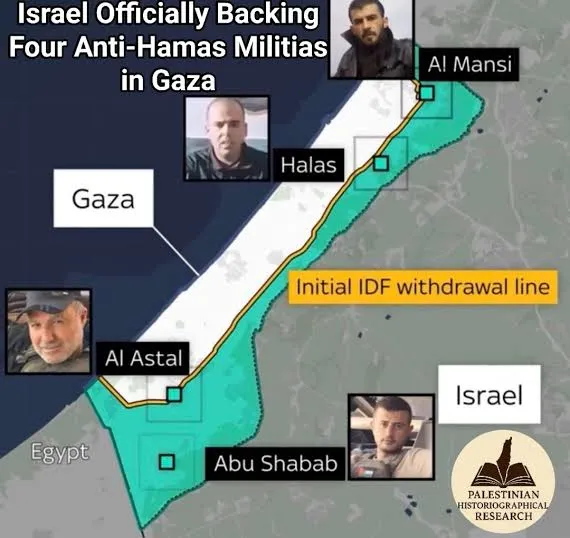
The best-known early example was the Popular Forces, led by Yasser Abu Shabab in southern Gaza. Its emergence was intertwined with the struggle over humanitarian supplies. Aid workers accused the group of looting deliveries; it presented itself as a force protecting aid distribution. The Associated Press documented those competing accounts in June 2025, alongside allegations that looters operated with Israeli tolerance or protection.
Abu Shabab was killed in December 2025, in circumstances his organisation described as an attempt to mediate a family dispute. His deputy, Ghassan Duhine, took over.
His death did not end the project. Reporting later that month documented armed groups seeking a lasting role from bases inside Israeli-held areas. Their ambitions extended beyond fighting Hamas to participation in whatever political and security arrangements followed the war.
By June 2026, reporting identified five militias based in Israeli-controlled territory, some conducting raids across the yellow line. Footage also showed an operative from Ashraf al-Mansi’s northern group using a large drone. Whether Israel supplied that aircraft was not established.
The northern militia associated with al-Mansi operates geographically closest to the Jabaliya building where Al-Sheikh’s family was attacked. Proximity, however, does not identify the perpetrators. The original investigation expressly said it could not confirm which militia carried out the raid.
Other reporting offers a more direct illustration of how militia activity can intersect with Israeli instructions to displace civilians.
In a video examined by The Times of Israel, commander Shawqi Abu Nuseira told armed men:
“This is a message we are conveying from the Israeli side, that people should evacuate the area.”
The newspaper reported allegations of militia involvement in evacuations near Deir al-Balah. Israel’s military declined to address those allegations in response to its questions. Militia representatives have meanwhile portrayed their groups as prospective providers of security for Palestinians exhausted by Hamas rule.
An earlier incident in central Gaza shows the potentially lethal consequences when militia incursions and Israeli fire converge.
On 6 April, residents and medics described an alleged attempt by an Israeli-backed militia to abduct people from a school shelter near Maghazi. Clashes followed, and Israeli drones fired missiles into the area. Health officials reported at least ten deaths. Reuters could not establish how many of those killed were civilians. A militia leader subsequently claimed that five Hamas members had been killed, in a video the agency could not immediately authenticate.
The latest testimony from Jabaliya therefore sits within a wider pattern of reported incursions, attempted detentions and violence around places sheltering displaced families. It does not, by itself, establish a common chain of command for every incident.
For residents, those distinctions coexist with an immediate practical problem: the military boundary is moving towards them.
The yellow line marked the initial Israeli withdrawal position under the October 2025 ceasefire, leaving Israeli forces deployed across approximately 53 per cent of Gaza. Subsequent advances have pushed that boundary further into areas where displaced people sought refuge.
On 11 October, families in Shujaiya were again forced to gather their belongings after Israeli forces moved the concrete markers westward. Anadolu footage documented people carrying possessions past the yellow blocks.
“The yellow line used to be approximately 200 metres away from us,” resident Osama Mushtaha said in the supplied reporting. “This morning, it was only 10 metres away.”
For someone living in a tent or a damaged building, that movement can abruptly place a sleeping space beside a military position. Families face another departure without any assurance that the next location will remain accessible or safe.
The UN’s latest humanitarian report records the reported westward movement of the markers near Shujaiya on 11 October. It also cites UN human rights investigators’ verification of 331 deaths near the yellow line between the ceasefire announcement and the end of July.
Separately, Gaza’s health ministry reported 1,493 deaths and 5,299 injuries across the territory between the ceasefire and 12 October. Those figures cover different periods and scopes; the deaths near the line are not an additional toll.
Beyond the boundary, Israel is consolidating its military infrastructure. A recent Wall Street Journal report described more than 30 bases, roughly a third built since the ceasefire. Israeli officials said the outposts guarded the dividing line while troops cleared tunnels. The newspaper also reported extensive removal of buildings in Israeli-controlled areas.
Taken together, the advancing markers, fortified positions and militia raids suggest why a ceasefire can remain an abstraction for families living along its edges. Reduced large-scale fighting has not necessarily brought stable boundaries, secure shelter or protection from armed men.
Near the destroyed Jabaliya Services Club, residents described a landscape of rubble, gunfire and scarce water.
Safaa Al-Basyouni had moved there because concrete seemed to offer better protection than a tent.
“We thought sheltering under concrete would be better than sheltering under a tent. That’s what brought us here,” she said.
Instead, she found insects, shelling and another source of danger.
“Water trucks can’t reach us, so we have to walk a long distance to get water. No food from charity kitchens reaches us at all.”
Her description of life beside the boundary was stark: “We can’t hide from the Israelis, and we can’t hide from the militias.”
Another displaced resident, Arafat Ali, described armed men arriving during the night, opening fire and taking people away.
“They don’t come during the day,” he said. “They come at three in the morning, like bandits.”
The alternatives are narrowing as winter approaches. The UN reports that 1.98 million people need shelter and essential household assistance. Approximately 950,000 displaced people are living at sites assessed as facing medium or high flood risk. Supplies available for winter could partially assist only 18 per cent of the families requiring shelter support.
For Al-Sheikh, the consequences of the raid continue after the gunmen’s departure. He described uncontrollable tears and profound distress, alongside the impact on his wife and children.
“No matter how much I describe the scene, I can’t truly convey what it was like.”
In Shujaiya, Sara Al-Ramlawi, repeatedly displaced with her family over three years, faced another journey after the yellow line moved closer.
“We’re heading into the unknown,” she said. “This is our situation, and the situation of every family from Shujaiya living here.”
Her request was modest.
“We’re not asking for a house. Just a piece of land where we can put up tents.”
Reporting credit: The Jabaliya and Shujaiya eyewitness testimony comes from Abdel Qader Sabbah and Sharif Abdel Kouddous’s Drop Site News report of 19 October 2026, supplied for this feature, with contributions from Mohamed Ahmed and Jawa Ahmad. Additional research draws on the UN humanitarian office, Reuters, Associated Press, Anadolu, The Times of Israel and The Wall Street Journal.