Former CIA Analyst Says US Soldiers’ Parents Told Him Nuclear Defence Units Are Deploying to Kuwait
Larry Johnson’s unverified account follows Donald Trump’s threats to destroy Iran, raising questions about preparations for a wider conflict and the possibility of nuclear escalation.
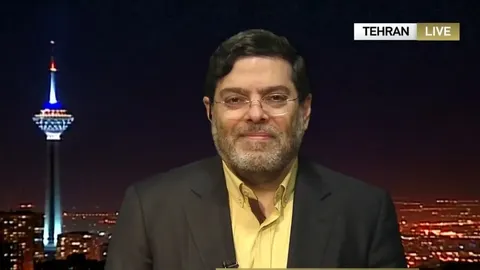
Former CIA analyst Larry C. Johnson says parents of serving American military personnel have told him that US units specialising in chemical, biological, radiological and nuclear threats are being deployed to Kuwait, an unverified account emerging after President Donald Trump threatened Iran with annihilation at the United Nations.
Speaking in an interview with commentator Cyrus Janssen published on 7 October, Johnson said his information came from family members whose children, primarily sons, were serving in the military. He attributed the alleged deployment order to Trump or his defence secretary, Pete Hegseth.
“They reportedly are being deployed to Kuwait,” Johnson said.
The account has not been independently verified for this report. Johnson did not identify the units, specify their strength, provide a departure or arrival date, or produce deployment orders. His account establishes what he says he has been told; it does not establish that the personnel have arrived or reveal their intended mission.
Nevertheless, the claim places a potentially significant military movement alongside a public threat whose language extended beyond the destruction of individual military targets. Trump has threatened Iran’s survival while leaving the weapons he might employ unspecified.
Johnson himself qualified his account. “I find that odd if true,” he said, explaining that American bases in Kuwait were vulnerable to Iranian attack.
That concern has a documented backdrop. An Associated Press investigation published on 5 October examined the Iranian drone strike on Port Shuaiba, Kuwait, on 1 March, which killed six US soldiers and wounded dozens. Survivors and officers told AP that warnings about the location’s vulnerability had been ignored. The reporting concerned the protection of American personnel and did not corroborate Johnson’s CBRN claim.
The allegation was already circulating before the Janssen interview. A Dialogue Works episode featuring Johnson, dated 4 October, referred in its description to reports of CBRN units deploying to Kuwait. Oneindia also published coverage dated 4 October. Its video described Johnson’s source as someone associated with the unit, rather than the family members he cited to Janssen.
The available material does not establish whether those descriptions concern different contacts. Both reports refer back to Johnson and therefore cannot be treated as independent confirmation of the deployment.
Johnson worked for the CIA from 1985 to September 1989 and served as a deputy director in the State Department’s Office of Counterterrorism from 1989 to October 1993, according to the biography accompanying his 2003 congressional testimony. He subsequently co-founded BERG Associates, a consultancy whose work included money-laundering investigations, risk management and counterterrorism. He now publishes commentary through Sonar21. His Kuwait account is presented as information from military families, not a current CIA assessment.
His record of public claims also warrants scrutiny. In 2008, he promoted an unsubstantiated allegation that a recording existed of Michelle Obama using a racial slur. In 2017, he acknowledged being a source for Andrew Napolitano’s disputed British-surveillance story, which GCHQ rejected. Johnson told CNN that Napolitano had misrepresented his account: he was not alleging that Obama ordered a British wiretap of Trump Tower.
Those episodes do not establish whether the Kuwait claim is true, but they reinforce the importance of independent corroboration.
The distinction between capability and intent is particularly important here. CBRN stands for chemical, biological, radiological and nuclear. These personnel can detect hazards, assess contamination, protect troops and equipment, conduct reconnaissance and carry out decontamination. The US Army describes their core functions as assessing threats, protecting against them and mitigating their effects.
Such capabilities can support forces operating in dangerous environments during a wider military campaign. They are not, by their designation alone, evidence of a mission to employ chemical, biological or nuclear weapons.
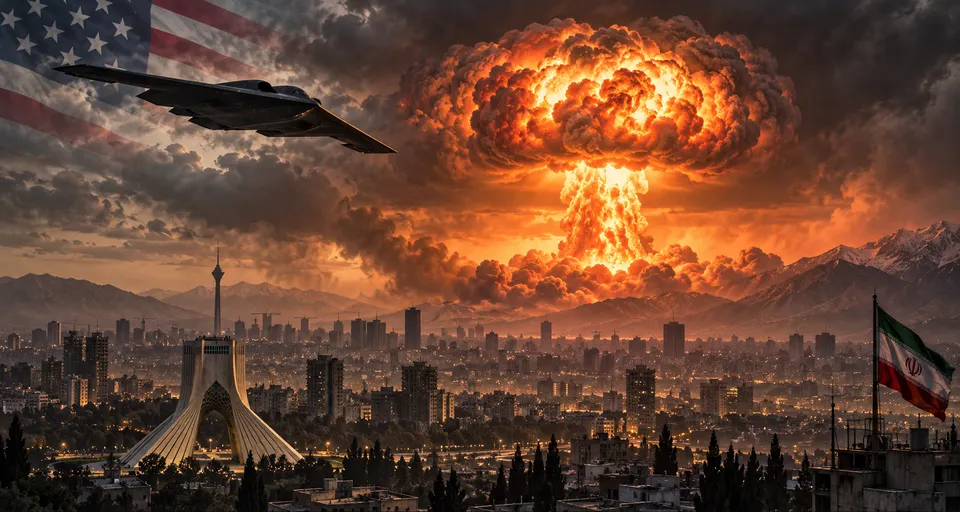
The presidential rhetoric surrounding Johnson’s account is, however, explicit about the possibility of enormous destruction. At the UN General Assembly on 22 September, Trump threatened to “annihilate the Islamic Republic” and asked: “Do I drive them into hell with no chance of survival and no hope of future greatness or generations?”
The surrounding passage presented Iran with a choice between a negotiated agreement allowing reconstruction and a rapid, devastating American response. Trump immediately predicted a deal after the US midterm elections, arguing that Tehran was waiting for the results. He subsequently denied that electoral considerations would influence his decisions about Iran.
Earlier in the address, he had justified US military action as necessary to prevent Iran acquiring nuclear weapons. The speech placed the threat within an argument for coercing Tehran into an agreement, but did not specify whether further attacks would use conventional or nuclear weapons.
Trump reinforced the threat in a TIME interview published on 1 October. Asked whether he might annihilate Iran, he replied: “Yeah, I would do that. It’s possible.”
Challenged about threatening an entire population while presenting himself as a president of peace, he said: “Because by annihilating Iran, we’ve created peace in the world.”
When asked to distinguish the government from innocent people, he discussed alleged killings by Iran’s authorities without clearly resolving that distinction.
Those statements make nuclear escalation a legitimate question for analysis. The reference to survival and future generations can be read as suggesting destruction on a scale consistent with nuclear warfare. That is an interpretation of the language, however, rather than a disclosed military plan.
Other interpretations remain possible, including an intensified conventional bombing campaign or an attempt to destroy Iran’s governing regime. The words do not identify a weapon, target, timetable or operational decision. Nor does Johnson’s account supply the missing connection between a possible CBRN deployment and an American nuclear strike.
Oneindia’s video itself makes that limitation clear. Despite a headline invoking biological warfare, its narration says Johnson has not claimed that the unit was ordered to use such weapons. It also acknowledges the absence of independent public confirmation of a CBRN deployment for an offensive mission against Iran.
There is a longer history of US CBRN deployments to Kuwait. In September 2014, the Army reported that the 71st Chemical Company was preparing for an October deployment involving site surveys and sampling. In February 2019, official military photographs documented the Ohio National Guard’s 637th Chemical Company at Camp Arifjan, identifying it as the CBRN defence response force for US Central Command’s area of responsibility.
Those records establish a precedent. They do not confirm the movement Johnson describes, demonstrate that it is routine, or explain what a new deployment would be intended to accomplish.
The wider movement of American forces also requires careful interpretation. AP reported on 1 October that approximately 9,000 personnel aboard ships were heading to the Middle East, including the USS Theodore Roosevelt carrier strike group and the USS Makin Island amphibious readiness group. That report concerned naval and Marine forces, not a deployment of thousands of CBRN specialists.
In the Janssen interview, Johnson challenged the impression created by a headline figure of 10,000 troops. He argued that much of the number consisted of aircraft-carrier personnel and accompanying ships’ crews, alongside Marines, and interpreted the carrier movement as a replacement rather than proof of a major escalation.
“It’s not like it’s an actual massive deployment of forces,” he said.
His CBRN allegation was introduced separately. He did not say that 10,000 chemical or nuclear specialists were being sent to Kuwait, or claim to know that a nuclear attack had been authorised.
The evidence therefore leaves two related but distinct issues requiring scrutiny: the president’s publicly stated willingness to inflict catastrophic destruction, and a former intelligence analyst’s account of specialist personnel being sent into the region. Their proximity is a reason to investigate, not proof that one explains the other.
For the military families Johnson describes, the immediate stakes are their children’s orders and safety. For the wider region, the unanswered question is what conditions American commanders expect those specialists to face—and whether any new deployment reflects precaution, a rotation, or preparations for a further escalation.
Sources and attribution
Cyrus Janssen, “CIA Analyst Larry Johnson: 10,000 US Troops Moving Toward Iran — What Happens Next?”, published 7 October 2026. Johnson quotations and the account of his interview are drawn from the transcript supplied for this article. The supplied text is an automatically generated transcript; quotations omit verbal fillers where appropriate.
Dialogue Works, episode featuring Larry Johnson, 4 October 2026. Listen to the episode.
Oneindia, deployment report dated 4 October 2026, and accompanying Dailymotion video transcript. Oneindia report. Dailymotion video.
Donald Trump’s UN General Assembly address, 22 September 2026. Relevant threat at approximately 11:19–11:50. Roll Call transcript. American Presidency Project transcript.
TIME, interview transcript published 1 October 2026. Read the transcript.
Associated Press, naval deployments, 1 October 2026. Read the report.
Associated Press, investigation into the Port Shuaiba strike, 5 October 2026. Read the investigation.
US Army, “Operationalizing CBRN Core Functions”. Source.
US Army, 71st Chemical Company deployment preparation, 30 September 2014. Read the report.
DVIDS, 637th Chemical Company at Camp Arifjan, photographed 14 February 2019. View the photograph and caption.
Larry C. Johnson and John F. Moynihan, testimony before the House Financial Services Committee, 11 March 2003; Johnson biography on pages 9–10 of the PDF. Read the testimony.
David Weigel, “Larry Johnson’s Strange Trip”, The American Prospect, 24 June 2008. Read the article.
CNN, Reliable Sources interview with Larry Johnson, 19 March 2017. Read the transcript.
TIME, reporting on GCHQ’s rejection of the wiretapping allegation, 17 March 2017. Read the report.