Israel Is Tearing Itself Apart Warn Former US Officials as Gaza War Deepens Crisis
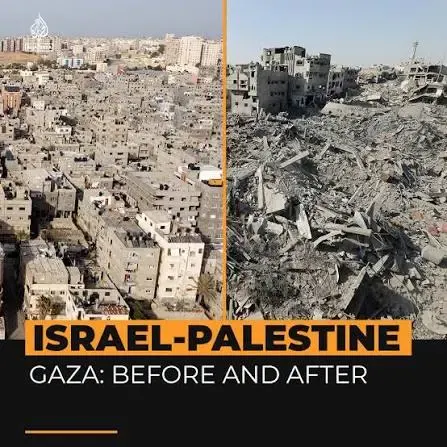
Israel is tearing itself apart under the strain of prolonged war, bitter political divisions and the consequences of its devastation of Gaza, former CIA analyst Larry Johnson and retired US Army Colonel Lawrence Wilkerson have warned, as a reported American intelligence assessment raises the prospect of civil conflict and state collapse.
Israel is tearing itself apart under the strain of prolonged war, bitter political divisions and the consequences of its devastation of Gaza, former CIA analyst Larry Johnson and retired US Army Colonel Lawrence Wilkerson have warned, as a reported American intelligence assessment raises the prospect of civil conflict and state collapse.
Johnson also argued that Benjamin Netanyahu had handed his critics a devastating comparison at the United Nations. Having asked Americans to imagine Israel’s losses on 7 October scaled up to the population of the United States, the Israeli prime minister had invited the same calculation for Palestinians killed in Gaza. Applied to their deaths, Johnson said, the result was the equivalent of “11 to 12 million Americans”.
“So I don’t think Bibi wants to trot out that comparison anymore because it highlights the genocide that has been carried out,” Johnson said.
Speaking on 7 October, the third anniversary of the Hamas-led attacks, Johnson and Wilkerson described a country whose military campaigns were intensifying the pressures within its own society. Johnson’s verdict was blunt: “Those three factions are tearing Israel apart from the inside.”
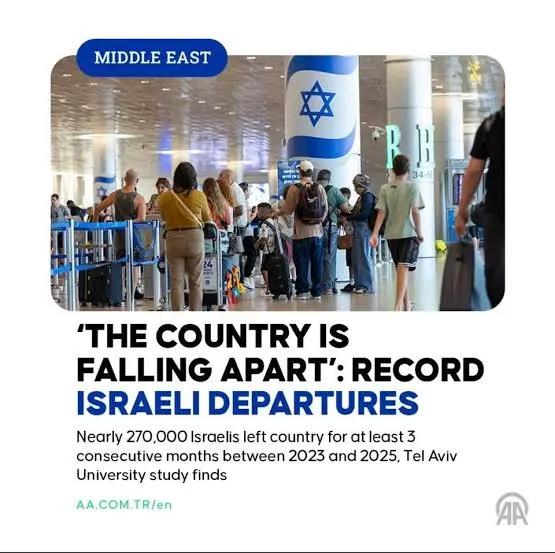
The warnings also echo concerns inside Israel about the growing number of citizens building lives abroad. “The country is falling apart. It lacks stability,” Israeli political commentator and former university professor Ori Goldberg said in an interview published on 21 August.
Their comments come amid reports of an August assessment by the CIA’s Red Cell, entitled Fracture From Within, examining how economic pressure, prolonged military mobilisation, disputes over conscription and political confrontation could develop into internal conflict. Two US sources described the assessment’s contents to journalists. The CIA did not respond to a request for comment.
The unit’s role is to challenge prevailing assumptions. Its reported scenarios therefore describe risks, rather than an official prediction that collapse is inevitable. Wilkerson explained that such teams are assembled “to challenge the standard view, the establishment view”. He nevertheless believed the tensions deserved serious attention.
Netanyahu’s UN address supplied Johnson with a different way of measuring the crisis: the prime minister’s own appeal to proportionality.
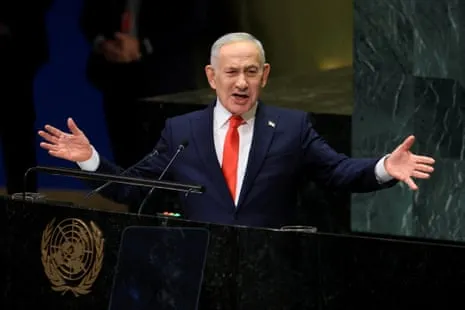
In his 24 September speech, Netanyahu said that the deaths of 1,200 people on 7 October, in a country of roughly 10 million, should be understood in American terms. “Proportionately, this is equal to 40,000 innocent Americans slaughtered in less than 24 hours,” he said.
Johnson took that method and turned it towards Gaza.
“And I thought, well, hell, if it’s good for the goose, it’s good for the gander,” he said. “And so I said, let’s apply that to the Palestinians.”
He used a figure of 73,000 Palestinian deaths for his comparison, while arguing that the actual toll was higher. “But let’s just go with the 73,000 figure,” he said.
Using that figure, Gaza’s pre-war population of approximately 2.2 million and a US population estimate of 341.8 million, the calculation produces an American equivalent of about 11.3 million deaths. That is roughly one person in every 30, and around 280 times the 40,000 American deaths Netanyahu had invoked.
The comparison scales the cumulative Gaza toll used by Johnson against the losses Netanyahu described from a single day. Its force lies in the proportion of a population killed: the same method Netanyahu used to make Israeli suffering comprehensible to an American audience exposes the vastly greater cumulative scale of Palestinian loss.
Johnson’s argument was that Netanyahu would have been better advised to leave the comparison unsaid. Once Palestinian lives were entered into the same calculation, his chosen measure became a devastating indictment of Israel’s conduct.
“They would have killed 11 to 12 million Americans,” Johnson said. “And here we are three years since that event.”
Netanyahu rejected accusations of genocide in the same UN address, maintaining that Israel had taken extensive steps to protect civilians. Johnson and Wilkerson presented the destruction of Gaza as central to understanding the damage they believed Israel was inflicting on itself.
That sense of instability has a measurable demographic dimension. Research based on official Israeli statistics found that 268,509 Israeli citizens left for at least three consecutive months between 2023 and 2025, compared with 183,219 during 2013–2015. That represents an increase of approximately 47 per cent.
The measure includes temporary departures. Using it as an early indicator while official longer-term data remained unavailable, the researchers estimated that 45,000 to 50,000 Israelis who left in 2025 would remain abroad for at least a year.
The profile of those leaving raises particular concerns for public services and the economy. Data presented to Israeli lawmakers showed that the proportion of emigrants aged 25–64 holding doctorates in 2022 was 4.6 times the proportion in the general population; the share with master’s degrees was twice as high.
In 2024 alone, 530 physicians left Israel, two-thirds of whom had studied in the country, while the number returning declined. The loss therefore includes professionals whose training had taken place within the system they were leaving.
Tax research also showed that emigrants’ average annual income in the year before departure rose, in real terms, from about 125,000 shekels during 2015–2019 to roughly 200,000 shekels in 2024. The increase of around 60 per cent points to the growing earning power of those departing.
Goldberg said doctors and technology workers had both the means and professional opportunities to relocate as conditions deteriorated.
“Practicing these professions in Israel will become more and more difficult. So people will simply leave, which is what I think is happening,” he said.
“I think most of it is because of October 2023,” Goldberg added, linking the acceleration to the trauma, political polarisation and social changes that followed.
The researchers cautioned that present departure levels did not, by themselves, threaten economic resilience. Their concern was the longer-term vulnerability of sectors dependent on small pools of skilled workers, and the possibility that continued departures could encourage others to leave.
Goldberg doubted that the movement would simply reverse with an improvement in immediate conditions.
“I don’t think it’s such a temporary wave, and I don’t think political and security conditions can be stabilized so easily,” he said. “I’m not so sure Israel can simply go back to the way it was.”
Wilkerson’s accounts from inside Israel offered another view of that instability. He referred to reports from Tel Aviv, Haifa and Nazareth, describing “some really discordant notes being sounded”.
He also recounted a disagreement with an unnamed ambassador whose judgment he respected. According to Wilkerson, the ambassador believed fears of returning soldiers turning their weapons on fellow Israelis were misplaced, and that the political tensions resembled those of previous elections.
“Their big problem is post-traumatic stress, wounds and tired of serving,” Wilkerson recalled the ambassador saying. “They’re not about to turn their own weapons on their own people.”
Wilkerson’s response was that the circumstances had changed fundamentally.
“This is not a typical election,” he said. “They’ve never had an election like this.”
He connected that difference directly to Gaza. Wilkerson endorsed a much higher estimate of 600,000 deaths, which he attributed to Ralph Nader, arguing that the destruction of hospitals had severely compromised the recording of casualties. That figure was an estimate he supported, not an established death toll.
His wider point was that the killing could have consequences for Israelis capable of confronting it. He asked what it meant for people who retained “a heart, a soul, a sense of decency”.
Johnson placed particular emphasis on the divisions between competing visions of Israeli national identity. He described tensions among hardline Zionists, ultra-Orthodox communities and more secular Israelis, arguing that their differences over religion, the state and military service were becoming increasingly difficult to contain.
His description was a broad political interpretation of those communities. The practical pressure he identified was the repeated mobilisation of reservists whose civilian lives were being consumed by war.
“They’ve got regular jobs during the week,” he said. Since October 2023, however, many had been “on active duty for months at a time”.
The effects, he argued, extended beyond exhaustion. “Let’s call it battle fatigue, post-traumatic stress syndrome, put it whatever name you want on it.”
Johnson described what he called “a suicide crisis among its reservists”, linking it to the psychological burden of the fighting and, in some cases, to soldiers’ reactions to their own actions.
“Many come back appalled at what they’ve done,” he said. “Those who still have a conscience are horrified at the genocide they’ve committed.”
For Wilkerson, the danger was compounded by the possibility that Netanyahu would pursue further military escalation while those internal pressures continued to build. He described the Israeli prime minister and Donald Trump as “a tandem team” who appeared nowhere near separating politically.
Yet he questioned Israel’s ability to achieve a decisive result in another attack on Iran.
“I don’t know how they have reconstituted particularly enough force to be decisive or even remotely have a chance of being decisive with regard to Iran,” he said.
Wilkerson raised the possibility of nuclear escalation as speculation about what Israel might consider if conventional force proved insufficient. He did not identify evidence of a decision to use nuclear weapons. His concern was that expanding the conflict could expose Israel to further destructive retaliation while leaving its underlying strategic problems unresolved.
“I don’t see how they can extend this battlefield or make this conflict with Iran go their way with what they’ve got right now,” he said.
Johnson likened the strategy to a Wile E. Coyote scheme that ends with its inventor falling off a cliff or being struck by his own contraption.
“The device blows up in his face,” he said, “or he gets run over by a locomotive and the roadrunner gets away.”
The two men’s warning was that the consequences of Gaza were accumulating inside Israel: in its politics, in the lives of repeatedly mobilised soldiers and in the widening distance between Netanyahu’s claims of strength and their assessment of the country’s condition.
Johnson expressed that judgment in the same terms that underpinned his reversal of the UN speech: “Israel has lost its moral foundation.”
Sources and attribution
- Larry Johnson and Colonel Lawrence Wilkerson, interviewed by Danny Haiphong, 7 October 2026. Quotations follow the supplied transcript, with punctuation standardised. Original programme.
- Aída Chávez, “CIA Report Warns Israel Could Head Toward Civil War, Total Collapse”, Drop Site News and Capital & Empire, 5 October 2026. Report.
- Seyit Şamil Kurt, “‘The country is falling apart’: Record Israeli departures signal deeper shift”, Anadolu, 21 August 2026. Source of the Ori Goldberg quotations and reporting on physicians, educational qualifications and emigrants’ incomes. Report.
- Tel Aviv University, “Emigration from Israel Remains at Record Levels, New TAU Study Finds”, 4 August 2026. Research by Itai Ater, Nittai Bergman and Doron Zamir, using Central Bureau of Statistics data. The headline figure measures departures lasting at least three consecutive months, not confirmed permanent emigration. Study summary.
- Benjamin Netanyahu’s UN address, 24 September 2026. Automated speech transcript, checked against contemporaneous coverage.
- Population comparison: UN OCHA’s Gaza population baseline and the US Census Bureau’s 2025 estimate. Calculation: 73,000 ÷ 2,200,000 × 341,800,000 = approximately 11.3 million. The 73,000 figure is the death toll used by Johnson in the interview.