Gaza in Ruins as US Protection Shields Israel from Accountability
With Gaza’s economy devastated and Netanyahu addressing the UN under an ICC arrest warrant, former UN official Craig Mokhiber challenges the gap between Israel’s growing isolation and meaningful action. His warning extends to Trump’s threats against Iran and the contest to choose the next UN chief.
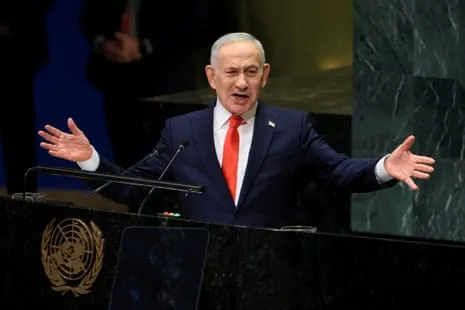
Israel’s devastation of Gaza and its treatment of Palestinians have brought mass walkouts, international criminal proceedings and sanctions against senior ministers: the diplomatic signs of a state becoming a pariah. Yet at the United Nations, its prime minister could still take the world’s most prominent diplomatic stage while wanted by the International Criminal Court.
Two days earlier, from the same podium, the president of Israel’s principal ally had threatened to annihilate Iran. For Palestinians waiting for protection, the juxtaposition revealed how far international condemnation remained from constraining either Israeli power or the American support behind it.
The Israeli prime minister addressed the General Assembly on 24 September despite an outstanding International Criminal Court arrest warrant. Dozens of delegations left the chamber. Outside the UN, organisers reported that more than 100 protesters were arrested. Netanyahu remained free to deliver his speech.
For Craig Mokhiber, the human rights lawyer who spent more than three decades at the UN, those scenes exposed the limits of diplomatic protest when governments continue to shield Israel from practical consequences.
“All that just tells me is that Israel’s impunity is still fully intact,” he said.
Speaking to The Electronic Intifada’s Ali Abunimah and Nora Barrows-Friedman on 1 October, Mokhiber contrasted Netanyahu “being received as a VIP inside the UN” with the arrests of people protesting against the destruction of Gaza outside.
“He’s being guaranteed not just impunity but VIP status and he’s allowed to enter the UN to address the General Assembly and treated as if he is some sort of global statesman,” he said.
The welcome, in his assessment, undermined the meaning of the walkout. Governments could refuse to listen to Netanyahu while leaving intact the relationships and protections that enabled him to keep acting.
“Now, those same delegations have not taken the action necessary to hold the regime accountable, but it is important.”
He recognised the political significance of delegations refusing to normalise Israel’s conduct. But he argued that the refusal had to extend to military assistance, economic relationships and diplomatic protection.
“Symbolism is important, but action is still lacking, I think.”
Mokhiber headed the New York office of the UN High Commissioner for Human Rights before leaving in October 2023, denouncing the international response to what he described as genocide in Gaza. His criticism now reaches beyond Israel’s closest allies to governments that condemn its conduct without applying the pressure available to them.
Israel’s growing pariah status has acquired concrete diplomatic expression. In June 2025, Britain joined Australia, Canada, New Zealand and Norway in announcing sanctions and other measures against Itamar Ben-Gvir and Bezalel Smotrich over incitement of violence against Palestinians in the West Bank. In September that year, Britain formally recognised Palestine alongside Canada and Australia.
Those steps showed that even governments with longstanding relationships with Israel were prepared to challenge its leadership and policies. They also exposed the limits of the response: sanctions against particular ministers did not amount to a comprehensive embargo, and recognising Palestine did not itself protect Palestinians from attack or dispossession.
In that sense, Israel’s pariah status describes a widening rejection of its conduct that has yet to become comprehensive isolation. The scenes at the UN showed the loss of diplomatic acceptance. Netanyahu’s freedom to address the Assembly showed the protection that remained.
“So the regime is isolated but that action is still missing,” Mokhiber said.
The ICC warrant makes the spectacle especially grave. Issued on 21 November 2024, it concerns alleged war crimes and crimes against humanity, including starvation as a method of warfare. Netanyahu rejects the allegations. The warrant is a judicial demand for his arrest, not a conviction, but it places his position far beyond that of a leader merely facing political criticism.
This year’s appearance was a repetition of an extraordinary precedent: Netanyahu had already addressed the Assembly in September 2025 with the warrant outstanding. The disturbing development was that a wanted leader’s protected access to the UN podium could become an annual occurrence.
An earlier confrontation over another ICC suspect illustrates the contrast. In 2013, Sudan’s Omar al-Bashir sought to attend the General Assembly while wanted over Darfur. The ICC invited the United States to arrest and surrender him if he entered its territory. His proposed appearance never took place. Netanyahu, by contrast, has been able to travel to New York and address the Assembly despite the warrant against him.
The United States is not an ICC member, and the warrant does not operate like a domestic American arrest order. That legal limitation helps explain Netanyahu’s ability to visit. It does not settle Mokhiber’s wider challenge to member states: why continue to accord the full privileges of diplomatic normality to a leader facing allegations of such gravity?
“These people are granted UN credentials every year, year after year. And you have to ask yourself why,” he said.
Mokhiber’s objection also extended to the ceremony surrounding the speech. He criticised the presence of the deputy secretary-general behind Netanyahu, arguing that the chair could have been left empty as a visible refusal to endorse his presence. His point was that even the gestures available to the UN Secretariat had not been fully used.
“So this normalisation of this kind of criminality is the problem that we are confronting,” he said.
Trump’s intervention at the same General Assembly gathering gave Mokhiber a further reason for alarm. Addressing the UN on 22 September, the US president presented Iran with a choice between an agreement and destruction.
“But I have a big decision to make,” Trump said. “Will a deal be made with Iran that lets them rebuild and create a far greater country than it ever was before? Maybe one of the greatest in the Middle East or even the world?”
He continued: “Or do I annihilate the Islamic Republic and do it quickly, never giving them a chance to kill and destroy people and countries again?”
Then came the most ominous formulation: “Do I drive them into hell with no chance of survival and no hope of future greatness or generations?”
The threat followed US and Israeli attacks on Iran earlier in the year. Trump framed his military campaign around Iran’s nuclear programme and threats to American and regional security, while invoking the 7 October attacks in Israel. He also said he expected an agreement after the US midterm elections. Diplomacy and the threat of annihilation appeared in the same passage.
Trump did not specify nuclear weapons. Mokhiber warned that the promise of rapid annihilation, following the use of conventional force, raised the possibility of precisely that escalation.
“You cannot dismiss the fear that he’s talking about the use of tactical nuclear weapons, for example,” he said. “And you cannot dismiss the charge that he’s talking about genocide of the Iranian people in the process as well.”
That was Mokhiber’s interpretation of the danger, rather than an announced American nuclear strike plan. The words Trump actually used were themselves explicit about the threatened scale of destruction, extending beyond military installations to the prospect of survival and future generations.
For Mokhiber, the two speeches belonged to the same political picture. Washington was protecting Israel’s leadership from accountability while threatening overwhelming force against its principal regional adversary. The UN was providing the platform for both.
He condemned Trump’s address as “open criminality, deranged murderous threats” and accused him of “using genocidal language” from the UN podium.
“These are very serious times, I think.”
Trump also used his speech to attack the ICC and urge its member countries to withdraw. His intervention therefore challenged the institution seeking Netanyahu’s arrest as well as threatening Iran. For governments committed to international justice, it posed a question about their willingness to defend the court against pressure from their most powerful ally.
Mokhiber argued that American protection of Israel also reaches into the contest to choose the next UN secretary-general. In his account, Washington is trying to prevent the appointment of a leader willing to confront Israel over Gaza.
“The US is working very hard to block any secretary-general candidate who would say anything that might sound like holding the Israeli regime accountable for its genocide,” he said.
The selection process gives Washington the power to stop a candidate. The General Assembly appoints the secretary-general on the Security Council’s recommendation, which requires at least nine votes and no veto from any of its five permanent members. The United States, like Britain, France, China and Russia, can therefore prevent a nominee from reaching the Assembly for appointment.
Mokhiber singled out Michelle Bachelet, the former Chilean president and UN human rights chief, and Carolyn Rodrigues-Birkett, Guyana’s permanent representative to the UN. He attributed Bachelet’s withdrawal to American opposition and fear that she would speak out. Of Rodrigues-Birkett, he said: “She has been blocked by the US simply for acknowledging the genocide in Palestine.”
Those claims concern the politics behind the selection, rather than an announced formal US veto. Bachelet withdrew on 19 September after a sharp loss of support in an informal Security Council poll. Reuters’ account of her departure did not establish that concern about her position on Israel caused it.
The Rodrigues-Birkett claim is disputed. PassBlue reported that The New York Times had linked Washington’s opposition to her description of Israel’s actions in Gaza as genocide. But Rodrigues-Birkett told PassBlue that US authorities had assured her the report did not originate with the American government. Guyana’s president, Irfaan Ali, also said Washington had communicated no such veto position. She remained in the contest.
Mokhiber also said Washington and Israel were backing Rafael Grossi, the director-general of the International Atomic Energy Agency. His broader warning was that the appointment process could reward candidates acceptable to powerful governments while excluding those willing to challenge them over Palestine.
“The US in particular will do everything it can to prevent the appointment of a secretary-general who will take any kind of a principled position,” he said.
He invoked the longstanding preference of powerful states for a UN chief who is “more secretary and less general”.
“They don’t want somebody who’s going to be a principled leader and they want that secretary to be a secretary to the US empire,” he said. “And I’m afraid that that may well be what they get.”
The urgency of that debate is visible in the statistics Abunimah set against the celebrations surrounding Trump’s Board of Peace. Citing the UN trade and development agency, UNCTAD, whose findings were presented at a press conference on 24 September, he described the destruction of Gaza’s economy as a reality check on claims that the conflict had been solved.
“Gaza is experiencing the world’s most severe economic crisis on record,” he said, quoting the agency’s assessment.
Annual economic output per person stood at just $212 in 2025, equivalent to 58 US cents a day and 83 per cent below its already depressed 2022 level. This measures economic production per resident, rather than the cash each person receives. It shows how completely the means of supporting ordinary life have been stripped away.
Since October 2023, 92 per cent of Gaza’s economic establishments had been damaged or destroyed. Farms, workshops and businesses that once provided food, goods and employment had been reduced to a fraction of their former capacity.
“Agriculture and industry in Gaza produced 94 per cent less in 2025 than in 2022. Construction was down 99 per cent,” Abunimah said.
Unemployment reached 78 per cent in 2025, while more than 90 per cent of the working-age population had no work. The figures measure different things: the unemployment rate concerns people in the labour force, while the broader measure also captures those outside it, including people who have given up looking for jobs that no longer exist.
The damage extended far beyond lost wages. Abunimah cited an estimated $35.2 billion in physical infrastructure damage by early 2026, alongside $22.7 billion in economic and social losses. Recovery and reconstruction needs were estimated at $71.5 billion. That reconstruction estimate is a separate measure of what recovery would require, rather than a sum to add to the damage and loss figures.
“A bill that is growing every day,” he said.
At the September briefing, UNCTAD also reported that only 1.5 per cent of Gaza’s cropland remained both usable and accessible, 93 per cent of school facilities required full reconstruction and half its hospitals were non-functional. The destruction of productive capacity was accompanied by the loss of the institutions needed to keep people healthy, educate children and sustain a future beyond emergency aid.
For Abunimah, these figures exposed the distance between conditions in Gaza and the presentation of the Board of Peace as an achievement. The interview played a clip of Jared Kushner describing the arrangement as “almost like the building of a really, really big startup”.
“They’re listening to Kushner talking about the conflict being solved,” Abunimah said, “while on the same day he was speaking, Israel is bombing and killing Palestinians in Gaza as it does almost every day.”
The statistics describe a collapse that continued to shape daily survival when the interview aired on 1 October; the annual production and employment figures relate to 2025, and the infrastructure damage estimate to early 2026. They document the destruction confronting Palestinians as governments debate future reconstruction.
For Mokhiber, that destruction continues to claim lives after buildings have been bombed. The loss of shelter, healthcare, food production and sanitation leaves people exposed to hunger, disease and untreated wounds. In his assessment, protecting the survivors requires urgent measures to reverse those conditions.
That assessment also shaped his criticism of the Trump-backed Board of Peace and proposals for administering Gaza. The Security Council endorsed the US peace framework in November 2025 and welcomed the board’s establishment. Mokhiber argues that the arrangement entrenches outside control at the expense of Palestinian self-determination; its supporters present it as a route to stabilisation and reconstruction.
“Its purpose is to consolidate the gains of the genocide for the perpetrators,” he said.
His objection is that a reconstruction programme controlled by external powers can preserve the political conditions that produced the destruction. For Palestinians, the test of any peace arrangement is whether it restores safety, homes, livelihoods and control over their future.
The demand for accountability is already reaching beyond Israel itself. Nicaragua’s case against Germany at the International Court of Justice seeks to establish responsibility for the assistance another state has supplied.
Filed in March 2024, the case alleges that German support for Israel, including military assistance and the suspension of funding to the UN Palestinian refugee agency UNRWA, breached obligations under the Genocide Convention and international humanitarian law. Germany rejects the allegations.
Hearings held from 7 to 10 September concerned Germany’s preliminary objections to the court hearing the case. They did not determine whether Germany had violated international law.
Among Germany’s arguments is that adjudicating Nicaragua’s claims would require the court first to determine Israel’s responsibility, although Israel is not a party to these proceedings. This invokes the Monetary Gold principle, which protects the legal interests of an absent state when those interests would form the very subject matter of a decision.
Nicaragua’s response is that Germany must answer for its own obligations and conduct. The dispute therefore tests how far a government can be held responsible for assistance it gives another state, and whether that responsibility can be examined without the recipient’s participation.
Mokhiber sees the case as a challenge to the wider system of support sustaining Israel’s actions. He argues that governments cannot indefinitely defer their preventive responsibilities while waiting for a final judgment against Israel.
There is an established legal basis for that distinction. In its 2007 judgment concerning Bosnia and Serbia, the ICJ held that the duty to prevent genocide arises when a state knows, or should know, of a serious risk that genocide will be committed. States must then use the means reasonably available to them, within international law, to try to prevent it. Whether a particular state breached that duty remains a separate question for adjudication.
The Germany case also illustrates why precise reporting of court proceedings matters. In April 2024, the ICJ declined to order the emergency measures Nicaragua requested. It also refused Germany’s request to remove the case from its list and reminded states of their obligations concerning arms transfers and the risk of violations. That was neither a judgment establishing German complicity nor a final ruling clearing Germany of responsibility.
For Mokhiber, humanitarian donations cannot answer allegations about the consequences of military support. He described attempts to invoke relief assistance as a shield against scrutiny of other policies as “humanitarian smoke screening”. A government’s contribution to feeding civilians, in his argument, does not settle the question of whether its weapons policy helps endanger them.
South Africa’s separate genocide case against Israel exposes another gulf: the distance between the time required by international litigation and the urgency of protecting a population facing destruction.
Under the court’s May 2026 timetable, South Africa has until 22 November 2027 to submit its reply, and Israel until 22 May 2029 to submit its rejoinder. Those are deadlines for written pleadings, not dates for a final judgment.
The existing provisional measures remain binding on Israel while the case proceeds. They include obligations to prevent acts prohibited by the Genocide Convention and to enable urgently needed humanitarian assistance. These interim orders do not constitute a final finding that Israel has committed genocide.
Separately, the UN’s independent commission of inquiry concluded in September 2025 that Israel had committed genocide in Gaza. Israel rejects that conclusion and maintains that its military campaign targets Hamas. Netanyahu used his General Assembly address to call the genocide accusation “the greatest lie of the century”.
The two courts address different forms of responsibility. The ICC seeks to prosecute individuals; South Africa’s case at the ICJ concerns Israel’s responsibility as a state. Neither the arrest warrant nor the provisional measures should be confused with a completed trial or final judgment.
Those distinctions do not require governments to wait until 2029 before acting to protect Palestinians. Mokhiber argues that the repeated focus on eventual court judgments risks obscuring political decisions that states can make now.
“It’s that the world is refusing to meet their international obligations,” he said.
His proposals include ending military support, applying economic pressure, pursuing cases in courts with jurisdiction and challenging Israel’s diplomatic representation. He pointed to the exclusion of apartheid South Africa’s delegation from General Assembly participation in 1974 as a precedent for action over credentials. Such a challenge would be distinct from expelling a state from UN membership and would require a decision by member states.
“This is the General Assembly. There’s no Russian nor Chinese or other veto there,” he said. His argument was that governments condemning Israel should organise the majority needed to challenge its participation instead of treating obstruction in the Security Council as the end of the discussion.
Mokhiber’s criticism of the UN is therefore also a demand that governments use the institution more effectively. He sees international law as a means of applying pressure, even when powerful states obstruct its enforcement.
“Those are tools that we can use,” he said. “We have to take them back.”
For campaigners, he advocates boycotts, divestment, demonstrations and legal proceedings capable of raising the cost of continued support for Israel’s actions. He draws on the struggle against apartheid in South Africa, arguing that international solidarity helped force governments to withdraw support they had maintained for years.
“Our job is to bring every pressure that we can against the institutions that are complicit in genocide or inactive in the face of genocide,” he said.
The practical measure of that pressure, in his account, will be changes in government and corporate behaviour. Israel can lose standing, its prime minister can face an arrest warrant, and delegates can leave the room, while the protection that matters most remains in place. Breaking that protection requires governments to make decisions affecting arms supplies, economic support and the enforcement of international law.
For Gaza’s survivors, another walkout will offer little protection unless it changes the conditions under which they are trying to stay alive.
“They have to feel the pressure from our side.”
Sources and attribution
Interview. Craig Mokhiber in conversation with Ali Abunimah and Nora Barrows-Friedman, The Electronic Intifada, livestream of 1 October 2026. Source
UN address. UN record of Netanyahu’s General Assembly address, 24 September 2026. Source
Protests and arrests. The Guardian reporting on the walkout and protests outside the UN, 24 September 2026. The reported arrest total was the organisers’ estimate. Source
Gaza economy. UNCTAD press conference, 24 September 2026, including reconstruction costs, damage to economic establishments, employment and output figures. Source
Board of Peace. UN Security Council coverage of resolution 2803, 17 November 2025. Source
Nicaragua and Germany. ICJ case record, including the 2024 order and September 2026 preliminary-objection hearings. The parties’ submissions are arguments, not judicial findings. Source
Duty to prevent genocide. ICJ, Bosnia and Herzegovina v Serbia and Montenegro, judgment of 26 February 2007, especially paragraph 431. Source
South Africa and Israel. South African Presidency statement of 2 June 2026 on the ICJ order of 21 May 2026 and the continuing provisional measures. Source
Commission finding. UN Independent International Commission of Inquiry, genocide findings published 16 September 2025. Source
Arrest warrant. ICC announcement of arrest warrants for Benjamin Netanyahu and Yoav Gallant, 21 November 2024. Source
South African credentials precedent. United Nations University account of General Assembly action against apartheid South Africa, including the 1974 exclusion. Source
Trump’s UN address. Address of 22 September 2026, American Presidency Project reproduction of the UN automatic transcript, corroborated by Reuters. The nuclear interpretation is explicitly attributed to Mokhiber; Trump did not specify nuclear weapons in the quoted threat. Source
Reporting on Trump’s threat. Reuters, 22 September 2026, on the threat to annihilate Iran and the accompanying diplomatic discussions. Source
US and Israeli attacks on Iran. Reuters, 4 October 2026, reporting the conflict’s origin in US and Israeli strikes in February and the continuing negotiations. Source
Netanyahu’s earlier appearance under the warrant. CNN reporting and transcript, 26 September 2025; also documented in coverage of the completed address. Source
Bashir comparison. Sudan Tribune, 25 September 2013, on the proposed UN appearance and the ICC invitation to US authorities to arrest and surrender Bashir. Source
US legal position. Reuters explainer, 22 July 2026, on the limitations on enforcing the ICC warrant in New York. Source
Measures against Israeli ministers. UK government statement, 10 June 2025, on coordinated measures against Ben-Gvir and Smotrich. Source
Recognition of Palestine. UK government announcement of recognition alongside Canada and Australia, September 2025. Source
Secretary-general selection rules. UN Regional Information Centre explanation of the Security Council recommendation, nine-vote threshold and permanent-member veto. Source
Bachelet’s withdrawal. Reuters, 20 September 2026, on Bachelet’s withdrawal following declining support in Security Council polling. The report does not establish Mokhiber’s proposed Israel-related motive. Source
Rodrigues-Birkett and reported US opposition. PassBlue, 27 September 2026, reporting both the New York Times account and Rodrigues-Birkett’s response disputing the reported US position. Source
Guyana’s response. News Room Guyana interview with President Irfaan Ali, 25 September 2026, stating that Washington had communicated no veto position. Source