Archive Genocide Releases Gaza Evidence Map on Eve of 7 October Anniversary
A new map connects more than 35,000 videos and photographs to Gaza locations as the wider archive passes 200,000 media records and preserves the names of 72,835 people killed.
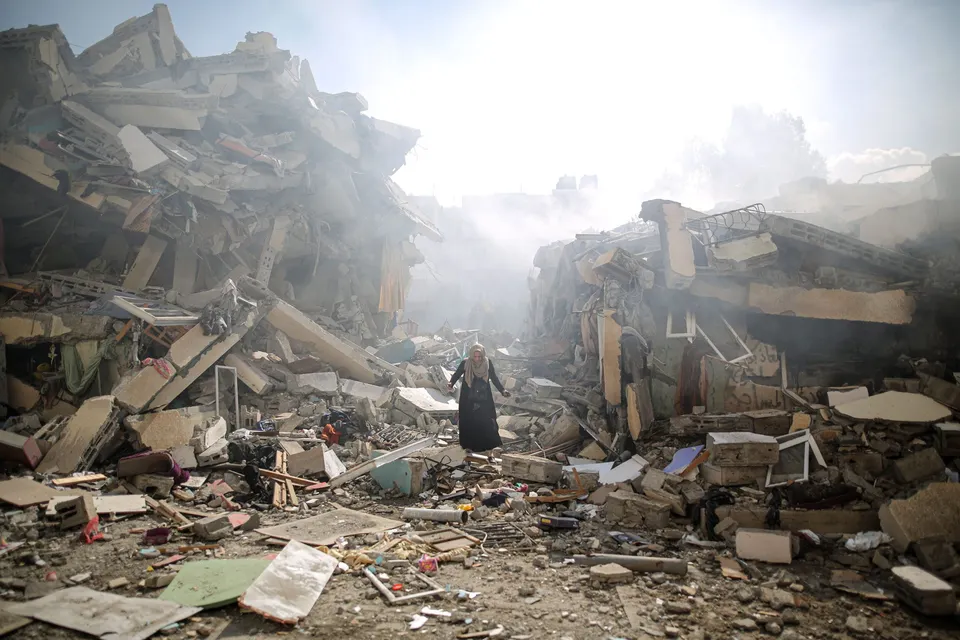
Archive Genocide has released an interactive map linking more than 35,000 videos and photographs to locations across Gaza, on the eve of the third anniversary of the 7 October 2023 attacks on Israel, as its wider collection passes 200,000 media records.
Announced on 6 October by the Israel Exposed group, the release adds geographic search to a project that combines footage of Israel’s actions in Gaza and the West Bank with witness captions, source links, daily reports and public lists of the dead. It gives researchers another way to locate material scattered across social media and preserved channel archives.
The group announced that “we have finished the Gaza Geolocation Map”, while explaining that researchers would continue placing more footage as they worked through the collection. The launch credits geolocation work by genocide.live, GeoConfirmed, Abu Location and NemoAnno.
The map follows an expansion announced on 2 October, when the organisers said their holdings had crossed 200,000 videos and images and that they had added an AI search assistant called Iris. A matching public update reported 33,145 new videos and photographs. Together, the releases broaden both the collection and the ways in which people can search it.
The latest announcement advertises filters for area, date, type of attack and location precision, alongside original-post links, suggested research leads and reverse-image searches. Researchers can download data in spreadsheet and geographic formats, including files suitable for Google Earth. A United Nations satellite damage layer allows footage to be examined alongside a wider assessment of destruction.
Those connections have practical value. A researcher starting with a neighbourhood or a date can look for relevant recordings, examine their captions and trace their publishers. Preserving those links matters when copies circulate without their original context, or when an account or post can no longer be reached.
The map’s precision needs to be read carefully, however. An automatically generated X trend described approximately 35,000 Gaza videos as pinned to exact locations. The archive’s own public statistics give a more qualified picture: 35,258 placed items, comprising 4,012 in its exact category and 31,246 at approximate locations. The exact category therefore accounts for about 11.4 per cent of the total.
Even that label covers several situations, including locations supported by cited reporting or outside researchers. The place a recording discusses may differ from the camera position or the location of an attack. A hospital receiving casualties is another distinct location. The map’s more detailed labels recognise these differences, which must survive when its findings are quoted or shared.
The public memorial supplies a different way into the record. Across 122 plain-text pages, the site lists 72,835 people identified by name as having been killed in Gaza. A separate interface allows visitors to search the names, while downloadable files make the register available for further research.
On the first page are Rafat Amir Hamdan Abed, recorded as 50, and Fatima Ahmed Mohammed Jouda, recorded as 92. Each appears as a name with an age and sex. The page makes clear that the register does not supply a date or place of death. It preserves identity without asking the reader to view the graphic footage elsewhere in the archive.
Analysis of the full public file finds 21,637 records for people aged under 18: 8,834 girls and 12,803 boys. These figures match the documentation supplied by Tech for Palestine, which compiles the underlying Gaza Ministry of Health list. Its stated cut-off is 7 May 2026.
That date is essential to understanding the figures. The register is a dated list of identified people, rather than a live total of everyone killed. It cannot capture deaths that have not been recorded or people whose identities remain unknown. Nor does a name’s inclusion, by itself, establish the circumstances of that person’s death or connect them to a particular video.
A comparison with the site’s graph also reveals an identity-counting question. The graph displays 72,785 identified dead, 50 fewer than the memorial file. That lower figure exactly matches the number of distinct Arabic name strings in the file: 50 names each occur twice, with different identifiers and birth dates. The arithmetic suggests that the graph may be counting unique names, although it does not establish the internal cause. People who share a name must not be merged on that basis alone.
The graph, called the Node Map, links footage clusters to people, places, facilities and named actors. Its displayed totals include 115,155 events and 132,385 clips. The supporting documentation explains that an event means a cluster of footage and should not automatically be understood as a distinct, verified incident.
That distinction is consequential in a collection assembled from overlapping sources. Several accounts may repost the same recording. Different edits may depict the same event. A shared place name may connect records without showing that they concern the same attack. The graph’s uncertainty labels and downloadable provenance information help researchers investigate those relationships, provided its headline counts are read alongside its methodology.
Iris offers another route through the material. In a test during the content review, a query for Zeitoun in September 2025 returned 29 clips grouped into 22 graph events. The system showed its filters and qualified what had been checked. That is useful for discovery, but it leaves authentication of a recording and its caption as separate tasks.
The organisers’ social posts describe Iris as their own AI and refer to using Claude to examine large quantities of footage. Those descriptions do not establish how the system processes recordings, whether a model has been trained specifically for the archive, or how accurate its interpretations are. Clear documentation of the processing and human review would help readers assess its output.
One sampled record illustrates why generated descriptions need close attention. Record 32762 carries a caption describing children injured in an attack on a home in Zeitoun, with another displayed copy referring to their arrival at the Baptist Hospital. Its generated node title nevertheless reads “Al-Ahli Arab Hospital — strike”. A lower note acknowledges that the possible facility-struck connection is inferred from a category rather than a passage stating that the hospital was hit.
The discrepancy concerns the description attached to the material; it does not establish that the recording itself is false. It shows how an automated connection can turn a hospital receiving casualties into an apparent attack location. The review also found inconsistent source fields and clip counts in the sampled records. These are specific problems to correct, rather than a basis for estimating an error rate across the archive.
The collection’s scale presents a related reporting challenge. On 7 October, the homepage header displayed 129,166 videos and 75,551 photographs, a combined 204,717, with text posts counted separately. The download page listed 205,366 media items across three releases. Other interfaces used different totals, reflecting subsets, display rules and snapshots that are not consistently explained.
The broad claim that the collection exceeds 200,000 media records is supported by those displays. A claim that it contains 200,000 independently verified incidents would be a different assertion. The site’s own gallery logic counts associated posted copies in some totals while collapsing them for display, making a clear distinction between files, posts and incidents particularly important.
The accountability purpose is explicit. The organisers say material is forwarded to the International Criminal Court, the Hind Rajab Foundation and South Africa’s legal team at the International Court of Justice. These are statements about the organisers’ submission work. They do not, on their own, establish institutional endorsement, admission into evidence or use in a particular proceeding.
The site’s Intent section approaches the question of responsibility through recorded statements. It presents 52 statements, including responses, alongside a further 606-item index, source references and verification labels. It also publishes a provisional scoring method. Making that method inspectable is useful, but its numerical results are editorial assessments rather than a legal determination or a probability of genocide.
The section distinguishes the ICJ’s January 2024 provisional order from a final finding of genocide. Its sourcing also needs chronological care: a heading associated with South Africa’s December 2023 application appears above entries concerning later statements from August 2024 and May 2025. Later material can be relevant, but it requires its own accurate attribution.
Other parts of the project provide historical context. The Daily Reports page displays 516 entries spanning February 2024 to August 2026, with substantial gaps and some multi-day digests appearing more than once. It functions as an incomplete historical collection, rather than a continuously updated daily account. Footage from the same calendar day cannot automatically corroborate every claim in a report.
The Films section broadens the subject beyond the immediate record of violence. It mirrors the Palestine Film Index and displays 727 films spanning 1968 to 2026, with 522 labelled available free in full, alongside 76 books and talks. The catalogue credits the independent index and links to external viewing services, giving visitors access to Palestinian history, culture and creative work.
The wider project includes a source directory, submission instructions, a cybersecurity guide and a linked political-finance investigation. Its social account also mixes archive announcements with campaigning commentary, protest clips and recommendations for other research tools. These serve different purposes and should be distinguished from individually sourced evidential records.
An October 1 post, for example, claimed that 31,213 videos and images in the archive showed the killing of children. That figure describes the organisers’ classification of media. It cannot be read as a count of children killed, unique deaths or separate attacks, and should be accompanied by an explanation of how the category is compiled.
Preservation remains one of the project’s strongest practical contributions. The archive distributes its holdings through downloadable releases and makes its website code available for others to host. It also links to raw source collections preserved through Distributed Denial of Secrets. The approach gives the material a means of surviving beyond one website or social account.
The latest curated volume lists 58,730 media files and acknowledges that it includes footage wrongly removed by earlier filters, subsequently restored and reviewed. That disclosure records a correction as well as an expansion. Cryptographic signatures allow users to check that downloaded files match an official release, although they do not establish the truth of every caption or allegation.
The anniversary release therefore makes a large body of material easier to find and preserve while also exposing the editorial work that remains: resolving conflicting counts, retaining original captions, distinguishing inferred links from checked findings and keeping each person’s identity intact. For journalists and investigators, the archive offers a substantial starting point whose records can be followed back to their sources.
In their launch announcement, the organisers returned to the people who made the recordings possible: “God bless all those who sacrificed their lives to get this footage out.”
Sources
Website observations and data review conducted on 7 October 2026. The map announcement is dated 6 October 2026. Figures describe the observed releases and datasets; they are not continuously updated totals.
Map release announcement dated 6 October 2026 — https://x.com/xIsraelExposedx/status/2107549866968695242
Matching map announcement and feature list — https://www.reddit.com/r/Palestine/comments/1wzdu9t/israel_exposed_group_have_developed_a_gaza/
October collection expansion — https://www.reddit.com/r/Palestine/comments/1ww3rqg/we_have_now_crossed_200000_videos_images_on/
Archive homepage and Iris — https://archivegenocide.com/
Geolocation statistics built 6 October 2026 — https://archivegenocide.com/geolocation/data/stats.json
Memorial public list — https://archivegenocide.com/memorial/p1.html
Full public memorial dataset — https://archivegenocide.com/victims.json
Tech for Palestine names dataset and cut off — https://data.techforpalestine.org/docs/killed-in-gaza/
Node Map — https://archivegenocide.com/nodes/
Graph methodology — https://archivegenocide.com/nodes/data/README.txt
Sample record 32762 — https://archivegenocide.com/#v=32762
About and submission claims — https://archivegenocide.com/about.html
Statements collection — https://archivegenocide.com/intent.html
Daily reports — https://archivegenocide.com/reports.html
Palestine film catalogue — https://archivegenocide.com/media/
Child related collection claim — https://x.com/xIsraelExposedx/status/2105760389480743329
Download releases and preservation — https://archivegenocide.com/download.html
Release verification — https://archivegenocide.com/verify.html
Sources and wider project navigation — https://archivegenocide.com/sources.html