Britain Threatens Mass Expulsion of Israeli Diplomats
Up to 27 Israeli diplomats could be expelled from London if Israel forces Britain’s East Jerusalem consulate to close, threatening a historic rupture in relations.
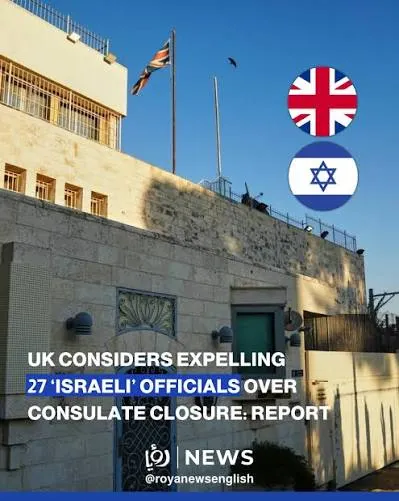
Britain has reportedly threatened to expel as many as 27 Israeli diplomats in retaliation for Israel’s planned closure of the British consulate in occupied East Jerusalem, raising the prospect of a mass diplomatic expulsion that would severely diminish Israel’s embassy in London.
British ambassador Simon Walters has reportedly informed Israeli officials that London would expel one Israeli diplomat for every British diplomat forced out of the East Jerusalem consulate. The proposed total of 27 would remove a large proportion of the Israeli embassy’s diplomatic staff in London, severely restricting its ability to operate.
The warning remains a reported ultimatum. The Foreign Office has declined to comment on speculation, and no mass British expulsion has been publicly announced. Israel has, however, maintained that the consulate will close on Thursday 8 October.
An attempt to avert that outcome has already reached the level of Britain’s national security adviser. Jonathan Powell travelled to Israel last week for talks that failed to produce an agreement. Discussions were still continuing on Monday, leaving a narrow opportunity to prevent the confrontation from escalating.
The consulate’s role gives the confrontation particular significance. It serves Britain’s relations with Palestinians in Jerusalem, the West Bank and Gaza, separately from the British embassy to Israel in Tel Aviv. Closing it would disrupt a direct channel to Palestinian institutions and communities as well as British consular work.
Britain regards East Jerusalem as occupied territory. Former attorney general Dominic Grieve has reportedly advised informally that Israel would be acting unlawfully in closing the mission. That is a legal assessment, rather than a court judgment on the proposed closure, but it highlights the underlying dispute over Israel’s authority in territory whose annexation Britain does not recognise.
Israel’s announced countermeasures extend beyond the consulate. They include removing British representatives from the international Gaza coordination centre, ending the British team’s training of Palestinian security forces and barring 12 British public figures and citizens.
The immediate dispute centres on measures announced on 8 September to restrict economic activity sustaining illegal Israeli settlements. Britain plans to ban settlement imports, prohibit the advertising of settlement property and create powers to sanction individuals and companies supporting or profiting from settlement activity.
Those wider measures have not yet fully taken effect. Foreign Secretary Ed Miliband told Parliament that the new regime would take six to nine months to introduce, although he wanted implementation sooner if possible. Five individuals were sanctioned immediately under existing powers. Israel’s planned closure therefore precedes the implementation of the broader restrictions it is intended to punish.
Britain also formally accepted that Israel’s continued occupation of Palestinian territory is unlawful, moving beyond its longstanding position on the illegality of settlements. Miliband’s parliamentary statement was unusually direct about what Palestinians in the West Bank are experiencing.
“The British Government agree that there is ethnic cleansing of Palestinians in areas of the west bank, perpetrated by settler terrorists,” he said.
He accused members of the Israeli government of supporting forced displacement through their statements and actions. The proposed E1 settlement development near Jerusalem has sharpened the dispute, with Britain warning that it would undermine the territorial viability of a Palestinian state.
Israeli foreign minister Gideon Sa’ar rejected Miliband’s accusations and described the sanctions as “morally distorted”. He accused Labour of hostility towards Israel and interference in its election campaign ahead of the national vote scheduled for 27 October.
Other European governments have faced similar retaliation. Norway’s representative office in Palestine closed in August 2024 after Israel withdrew arrangements enabling its diplomats to operate. On 27 September this year, Israel announced that Dutch diplomats in Ramallah would lose their diplomatic status following the Netherlands’ settlement import ban.
The restrictions are also attracting wider international support. Twelve countries signed a joint statement in September committing themselves to introducing, supporting or actively considering measures against settlement trade. France and Canada joined Britain in announcing plans for national bans.
For Israel, the widening willingness of European partners to impose economic consequences is a further sign of diplomatic alienation over its treatment of Palestinians. Yet Britain continues to support wider trade with Israel, and the current confrontation has not become a formal severance of diplomatic relations.
An expulsion of 27 diplomats would greatly exceed prominent recent British precedents. In 1988, Britain expelled an Israeli diplomat and barred another from returning over intelligence activities. In 2010, it required an Israeli embassy official to leave after an investigation into the misuse of British passports associated with the Dubai assassination operation.
Claims that relations have never been worse since 1948 nevertheless require historical care: five RAF aircraft were shot down during clashes involving Israeli forces in January 1949, with two British pilots killed. The present crisis is potentially historic in the scale of diplomatic representation at risk.
The confrontation has developed alongside a public reassessment of Labour’s response to Gaza. Foreign Secretary Ed Miliband has acknowledged the concerns of those who demanded stronger action over Palestinian suffering, following an earlier apology from Prime Minister Andy Burnham.
Speaking at Labour’s conference in Liverpool on 28 September, Miliband addressed the millions in Britain and elsewhere who had been moved and outraged by the plight of the Palestinian people.
“We hear you. You were right. And under Andy’s leadership, we have reset our approach,” he said.
The message was delivered from the conference platform to a wider public whose demands had helped make Gaza a defining political issue. Miliband linked the acknowledgement to opposition to settler violence, evidence of war crimes in Gaza and Israel’s unlawful occupation, and promised restrictions on settlement imports and the British finance, construction and services supporting them. He also condemned antisemitism and the 7 October attacks, and reaffirmed his support for both Israeli security and Palestinian self-determination.
Burnham had already gone further in accepting responsibility for Labour’s earlier stance. On 9 July, before becoming prime minister, he accompanied a video statement with an explicit apology.
“Labour’s initial response to the treatment of Gaza caused huge hurt. We got it wrong and I am sorry for that.”
In the video, Burnham acknowledged that Britain had been too slow to demand a ceasefire and said its response had repeatedly been inadequate. He called for greater pressure on the Israeli government, including further sanctions and restrictions on trade with illegal settlements.
Thursday’s deadline now threatens to turn the dispute into a major reduction in diplomatic representation on both sides. If Israel forces British diplomats out of East Jerusalem and London carries out its reported warning, a confrontation over settlement policy will leave both countries with fewer channels through which to resolve it.
Sources and attribution
Miliband’s conference remarks and their context: Labour Party transcript, 28 September 2026.
Burnham’s 9 July apology, including the distinction between his written caption and spoken remarks: LabourList, 10 July 2026 and The Journal, 9 July 2026.
The reported reciprocal expulsion warning and embassy staffing: Ynet, 5 October 2026, independently corroborated through two sources by The Jerusalem Post. The Foreign Office response and Grieve’s reported advice: The Guardian, 5 October 2026.
Powell’s visit, continuing talks and the 8 October deadline: Reuters, 5 October 2026.
Settlement measures, the implementation timetable and Miliband’s parliamentary statement: Hansard, 8 September 2026, FCDO announcement and House of Commons Library briefing.
Sa’ar’s response and announced countermeasures: The Times of Israel, 8 September 2026. Consulate responsibilities and Britain’s position on Jerusalem: FCDO.
Other countries and settlement restrictions: Norwegian government, 16 August 2024, Reuters on Dutch diplomats, 27 September 2026 and joint foreign ministers’ statement, 8 September 2026.
Historical comparisons: parliamentary records for January 1949, July 1988 and March 2010.