“Black Wednesday”: Mass Civilian Slaughter in Beirut While Lebanese Prime Minister Covers for Israeli War Crimes
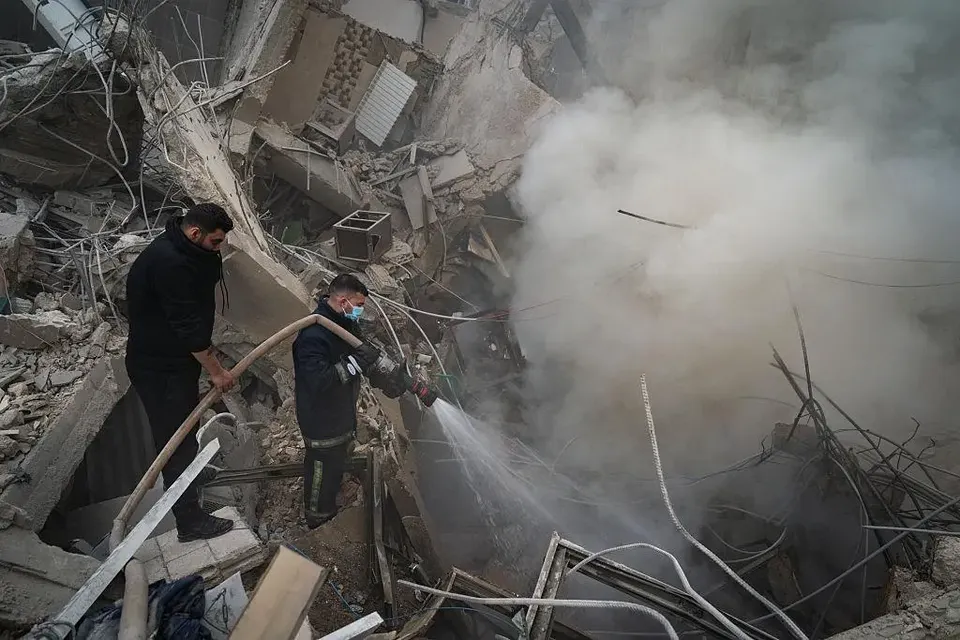
In one of the most intense and concentrated bombardments of a civilian population in recent Middle East history, Israeli forces launched between 100 and 150 missiles into Beirut in the space of just ten minutes—an attack that has left hundreds dead, thousands wounded, and an entire nation reeling.
The strikes, now widely referred to in Lebanon as “Black Wednesday,” targeted the southern suburbs of the capital, including the densely populated district of Dahieh. Within minutes, entire residential blocks were reduced to rubble.
Lebanon’s Health Emergency Operations Center has confirmed more than 300 people killed and at least 1,150 wounded. But the true scale of the atrocity is still emerging. Hospitals remain overwhelmed, with bodies so severely mutilated that many cannot be identified. Others remain trapped beneath collapsed buildings in overcrowded neighborhoods where rescue access is limited.
For many legal observers and regional analysts, the sheer intensity, speed, and civilian toll of the strikes raise urgent questions under international humanitarian law.
A Strike Measured in Minutes, a Death Toll Measured in Hundreds
The attack’s defining feature is not only its brutality, but its concentration.
Up to 150 airstrikes in ten minutes equates to a near-continuous barrage—leaving civilians with no meaningful opportunity to flee. The areas hit were among the poorest in Beirut, heavily residential, and already damaged by previous rounds of bombing.
Such conditions have led critics to argue that the attack may meet the threshold of an indiscriminate or disproportionate strike—both prohibited under the laws of war.
And yet, despite the magnitude of the event, the response from Lebanon’s own political leadership has stunned observers even more than the attack itself.
“No Strike Without a Reason”
In a cabinet meeting held in the immediate aftermath of the massacre, Lebanese Prime Minister Nawaf Salam reportedly defended—or at minimum rationalized—the Israeli bombardment.
“No strike has ever happened without a reason,” Salam told ministers during a heated debate over whether to declare Beirut a weapons-free zone.
The remark came despite direct objections from Lebanon’s health minister, who had personally witnessed the aftermath and insisted the victims were civilians.
To many Lebanese, Salam’s statement amounted to something unthinkable: the justification of a mass-casualty attack on his own population.
The backlash was immediate and severe. Across social media and political circles, accusations of complicity—and even treason—began to circulate.
Covering for War Crimes?
The controversy has since deepened into a broader question: did Lebanon’s prime minister effectively provide political cover for what may constitute a war crime?
Under international law, the deliberate or reckless targeting of civilians, or attacks that fail to distinguish between military and civilian objects, are prohibited. The scale of casualties in “Black Wednesday,” combined with the nature of the targeted areas, has prompted calls for independent investigation.
Yet instead of condemnation, Salam’s remarks appeared to shift the narrative—suggesting that the strikes were somehow justified.
Critics argue this framing serves a critical function: normalizing or deflecting accountability for Israeli actions at a moment when global scrutiny could otherwise intensify.
A Pattern of Destruction
The Beirut massacre did not occur in isolation.
Between March 2 and April 9, Israeli operations in Lebanon killed 1,888 people and wounded more than 6,000. Entire towns in the south have been systematically destroyed, including Christian communities far from Hezbollah’s traditional base.
Essential infrastructure has also been targeted. Water systems have been obliterated in multiple areas, leaving civilians without access to basic necessities. In one case, a Vatican aid convoy attempting to reach affected villages was reportedly turned back.
Even more striking are reports that Lebanese authorities delayed repairing damaged infrastructure pending Israeli approval—raising profound questions about sovereignty and the extent of external influence over domestic decision-making.
Internal Complicity and External Pressure
The role of Lebanon’s leadership is now under intense scrutiny.
Nawaf Salam, once a judge at the International Court of Justice who acknowledged the plausibility of genocide claims against Israel, rose to power in 2025 under circumstances widely believed to involve pressure from Washington and Riyadh.
President Joseph Aoun, meanwhile, has faced criticism over his handling of the conflict and his government’s apparent deference to Israeli military decisions.
More troubling still are allegations that factions within Lebanon’s political establishment may actively prefer the continuation of war—viewing it as a means to weaken or eliminate Hezbollah, regardless of the civilian cost.
According to reports cited by Lebanese journalists, foreign diplomats were told by officials close to the presidency that ending the conflict was not a priority if it meant preserving Hezbollah’s position.
If accurate, such statements suggest a convergence of interests between segments of Lebanon’s leadership and Israel’s military objectives.
A Strategy of Collective Punishment?
Beyond the immediate devastation, analysts warn that Israel’s broader strategy in Lebanon may amount to collective punishment—targeting civilian areas, infrastructure, and entire communities to exert pressure on resistance forces.
In the south, towns have been razed and depopulated. In Beirut, entire districts have been repeatedly targeted. And increasingly, Israeli messaging has suggested an expansion of targets into new areas, including Christian areas—claims critics say are designed to provoke sectarian conflict.
The danger is not only physical destruction, but national fragmentation.
A Nation Betrayed?
For many Lebanese citizens, the sense of outrage is no longer directed solely at Israel.
It is increasingly focused inward.
The perception that their own government may be excusing—or even enabling—such attacks has triggered a crisis of trust that could prove as destabilizing as the bombardment itself.
Yet even amid this anger, restraint has prevailed—for now. Hezbollah and its allies have reportedly discouraged protests, fearing that public unrest could spiral into civil conflict at a moment of extreme vulnerability.
The Silence of the International Community
Perhaps most striking is the relative absence of sustained international outrage.
Despite casualty figures that rival some of the most notorious attacks in recent conflicts, “Black Wednesday” has yet to generate the level of global attention or accountability demands that many believe it warrants.
For critics, this silence is part of a broader pattern—one in which Israeli military actions escape meaningful scrutiny, particularly when political cover is provided by regional actors.
The Road Ahead
As rescue teams continue to pull bodies from the rubble, Lebanon faces a stark reality.
It is a nation under attack—but also a nation divided.
The events of “Black Wednesday” have not only exposed the devastating power of modern warfare, but also the fragility of political legitimacy in times of crisis.
Whether this moment becomes a turning point—toward accountability and unity—or a step further into fragmentation and impunity remains to be seen.
But for the families of those killed in ten minutes of relentless bombardment, one question will linger long after the dust settles:
Who will be held responsible?