Ed Sheeran’s Own Band Quits His Tour After Macklemore’s Firing Over Gaza Protest
Beoga’s departure, alongside withdrawals by Finneas, Aaron Rowe and Lukas Graham, has turned the removal of one pro-Palestinian performer into a wider challenge to the businesses controlling the stage.
Ed Sheeran’s own backing band, Beoga, has quit the remaining US dates of his Loop tour in protest at Macklemore’s removal after he spoke out for Palestine.
“We have made the decision to depart as Ed Sheeran’s band on the remaining US Loop tour following the silencing of Macklemore by Zionist lobbies,” the Irish musicians announced.
Their statement made clear that friendship with Sheeran, and the opportunity to perform before stadium audiences, could not outweigh their objection to the exclusion.
“As musicians, playing to those crowds every night is the stuff of dreams, but to play in venues that silence anyone advocating for a free Palestine is simply not an option for us.”
By 15 September, Aaron Rowe and Danish band Lukas Graham had also withdrawn from their remaining North American appearances. Finneas pulled out of his forthcoming South American dates, extending the consequences beyond the US shows where the confrontation began.
Robert Kraft, the billionaire owner of the New England Patriots and Gillette Stadium, has confirmed that he barred Macklemore from the Massachusetts venue. The promoter says other venues also refused to allow concerts to proceed with the rapper on the bill.
Sheeran says he tried to resolve the dispute and that the decision belonged to the promoter. His fellow performers’ departures have nevertheless sharpened the question at its centre: what does neutrality mean when venue owners determine which political voices an audience can hear?
What Macklemore actually said
The confrontation followed Macklemore’s opening performances at MetLife Stadium in New Jersey on 4 and 5 September. He spoke about Palestinians in Gaza and the occupied West Bank, called for a free Palestine and performed “Hind’s Hall”, accompanied by images from Gaza.
He told the audience that speaking about Palestine was one of his reasons for joining the tour.
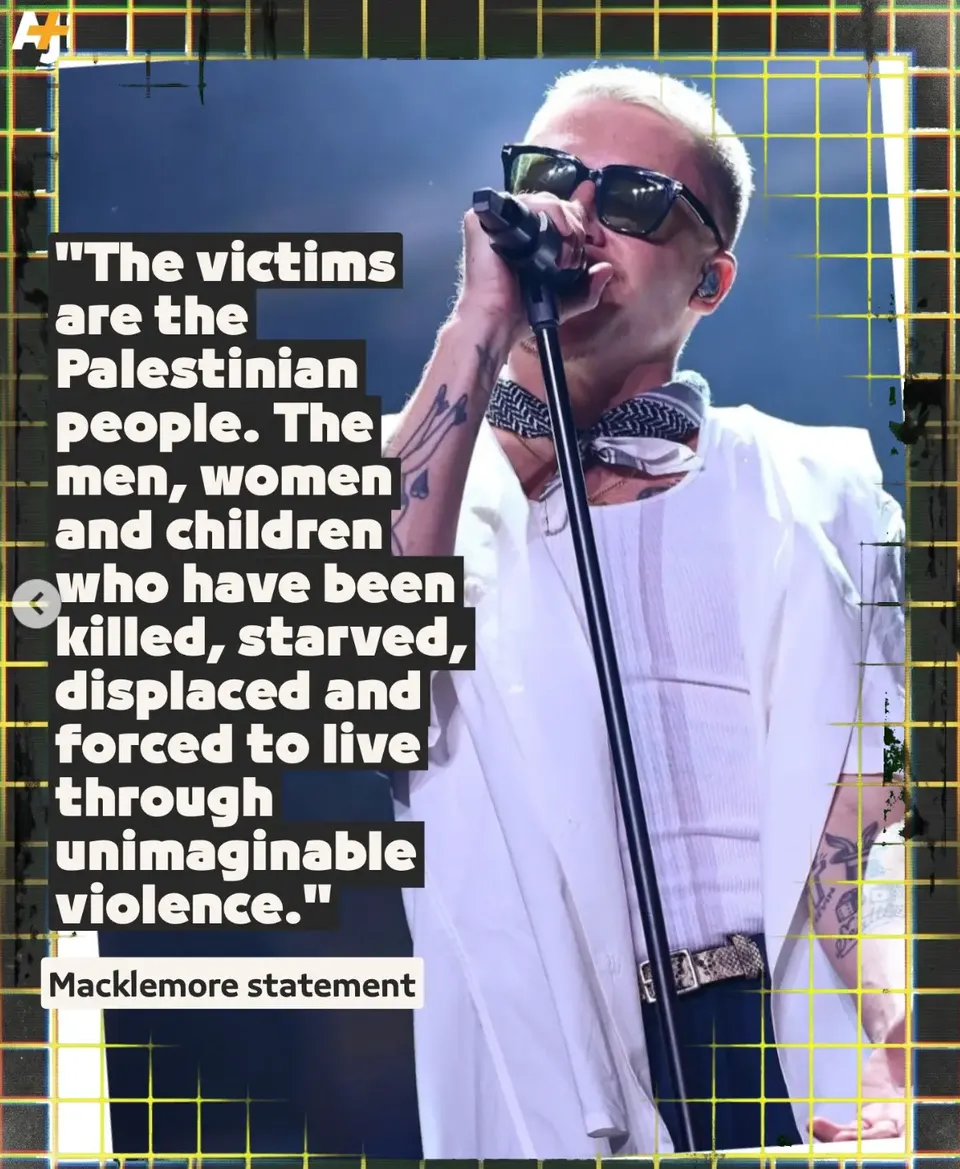
“One of the reasons why I wanted to come on this tour was because I wanted to stand up here on stages and stadiums across America and say two words that are very near and dear to my heart: Free Palestine.”
He thanked the Columbia University protesters whose action had inspired the song, recognising students who had risked their education and scholarships. He also addressed Jewish audience members directly.
“To all of my Jewish brothers and sisters: criticism of Israel, criticism of apartheid, being against genocide in no way is a criticism of you. My message is for peace; love for all human beings to be treated with dignity, respect, and equality.”
His appeal extended to Lebanon, Cuba, Congo and Sudan. He condemned US immigration enforcement and declared: “None of us will be free until we are all free.”
The Israeli American Council subsequently promoted a petition calling for his removal, describing the performance as “a one-sided political agenda” and seeking clarification about whether the speech and imagery had been approved.
The dispute then acquired an immediate commercial consequence: venues threatened to withhold their stages.
The ultimatum behind the removal
Macklemore alleged that Sheeran told him Kraft would not permit him to perform at Gillette and had rallied other stadium owners behind an ultimatum: remove the rapper or lose access to their venues.
That account of Kraft organising the wider pressure remains Macklemore’s allegation. The involvement of multiple venues is supported by the promoter’s own statement.
Messina Touring Group said venues had refused to host concerts featuring Macklemore, threatening cancellations affecting hundreds of thousands of fans. It announced that he would no longer appear on the remaining support dates.
Macklemore also said Sheeran told him that the words “Free Palestine” and the Palestinian flag had upset people he had spoken with.
Kraft confirmed that Macklemore would not appear at Gillette on 25 and 26 September. He cited the recent performances and what he described as “a broader history of antisemitic rhetoric and imagery”.
He denied that the decision was intended to diminish Palestinian suffering or prevent advocacy on Palestinians’ behalf. He argued that such advocacy should recognise Hamas’s responsibility and avoid harming the Jewish community, and offered to meet Macklemore.
The rapper’s history includes a 2014 performance in a costume criticised for resembling an antisemitic caricature. He apologised at the time and denied intending to portray an ethnic stereotype.
Macklemore rejects the characterisation of his Palestinian advocacy as antisemitic. His response acknowledged antisemitism while arguing that conflating it with opposition to Zionism shields Israel from accountability.
“But there is no neutral position between the oppressor and the oppressed,” he wrote.
Kraft, Israel and the campaign against BDS
Beoga’s statement pointed beyond the immediate booking dispute.
“Research how much Robert Kraft has done to fight the BDS movement,” the band wrote, referring to the Palestinian-led boycott, divestment and sanctions campaign.
There is a documented history behind that reference. In June 2019, while receiving the Genesis Prize in Jerusalem, Kraft pledged $20 million to establish a foundation whose announced work included combating antisemitism and opposing BDS.
The prize organisation’s own account identifies opposition to BDS and efforts to delegitimise Israel among that year’s philanthropic priorities. Kraft separately directed his $1 million prize towards initiatives opposing antisemitism and the delegitimisation of Israel.
His relationship with Sheeran predates the present dispute: the singer performed at Kraft’s wedding to Dana Blumberg in October 2022.
Gillette Stadium also houses the headquarters and command centre of Kraft’s Blue Square Alliance Against Hate, previously called the Foundation to Combat Antisemitism. The organisation says its technology monitors more than 500 million social-media posts daily, analysing conversations about antisemitism, Judaism and Israel.
Its stated mission is to combat antisemitism and other forms of hatred.
Kraft therefore occupies two influential positions: he funds advocacy concerning Israel and controls a venue through which artists reach mass audiences. His intervention over Macklemore has brought the relationship between those roles into public scrutiny.
Friends who refused to stay
The departing musicians repeatedly acknowledged what Sheeran had done for their careers. Their statements also made clear that personal loyalty did not resolve the question of whether to continue.
“We have been friends with Ed for over 10 years now and will continue to be,” Beoga said.
The band explicitly endorsed the performance that had triggered the dispute: “We were there for Macklemore’s performance and speech. We fully supported his message.”
Describing themselves as founding members of Irish Artists for Palestine, they connected their decision to Ireland’s experience of colonialism.
Rowe similarly said Sheeran had changed his life, before explaining why he could not remain.
“But as Irish people we know all too well about genocide, forced famine and violent occupation,” he wrote.
“I cannot stand by and allow billionaires to use their position of power to silence the rightful voices of those who speak up against Israeli genocide and who highlight the savage murder of children.”
He added: “I would lose all respect for myself to carry on as normal.”
Lukas Graham’s lead singer, Lukas Forchhammer, addressed the relationship between wealth and expression directly.
“Money doesn’t give you the right to own the conversation. Nobody’s bank balance should decide who gets to speak or which suffering we’re allowed to acknowledge.”
“I love Ed and I’m grateful for everything we’ve shared. That hasn’t changed,” he added. “But I can’t put these words out into the world and carry on with this tour as things stand. We’re withdrawing from the remaining dates.”
Finneas’s statement was equally explicit: “Artists must not be silenced when they speak up for the oppressed. I have decided to withdraw from my upcoming tour dates with Ed Sheeran. I stand with Palestine and its people.”
These decisions surrender valuable performances and access to large audiences. They also turn an exclusion imposed on one artist into a dispute involving the wider production.
Sheeran’s defence and the limits of neutrality
Sheeran’s explanation centred on his responsibilities to audiences and the people employed by the tour.
“Macklemore coming off tour was the promoter’s decision; it was not mine,” he wrote.
He said he had spent the preceding week speaking to venues and trying to reach a resolution. Macklemore’s contract, he explained, was with the promoter.
“I would never let down the fans who had made plans, nor would I abandon the touring crew and the other support acts and musicians who rely on me for work and to make a living,” he said.
Sheeran described his concerts as places where people from different backgrounds could come together and defended keeping his professional platform outside political debate.
“I am not complicit,” he wrote.
Those responsibilities to fans and workers are substantial. Cancelling stadium dates affects people who have no control over a disagreement between performers, promoters and owners.
But the explanation also reveals how commercial pressure operates. If the threatened loss of venues is sufficient to remove a performer, the owners possess an effective veto over the line-up.
An artist can keep personal opinions private. A tour’s response to an exclusion remains a public action, with consequences for the person excluded and for other musicians deciding whether to speak.
Ukraine and the question of consistency
Sheeran’s earlier support for Ukraine complicates his claim to avoid public politics.
In March 2022, he performed at the Concert for Ukraine in Birmingham. The event raised more than £13.4 million for the Disasters Emergency Committee’s Ukraine Humanitarian Appeal.
Before the concert, he told Ukrainians: “I love you, I stand with you.”
A benefit concert and a commercial stadium tour are different settings. Even so, that appearance demonstrates that Sheeran has used his professional platform to express solidarity with people suffering through war.
Supporting Ukrainian civilians and supporting Palestinian civilians are compatible positions. The question raised by his critics is why advocacy for Palestinians has become unacceptable to venues hosting his tour.
The comparison concerns the freedom to express solidarity and the commercial penalties attached to doing so.
A backlash beyond the tour
The criticism has spread beyond the artists directly affected.
Ms Rachel, the children’s educator and YouTube presenter, accused Sheeran of missing an opportunity to resist pressure over support for Palestine.
“Ed Sheeran had an opportunity [to] show that we won’t be bullied into punishing people for supporting Palestine,” she wrote. “Instead he caved to people who refuse to accept what the world knows. A genocide is happening in Gaza. We all need to speak on it.”
Kehlani also backed Macklemore, alleging that the pressure extended across venues: “A LOT of the venues / owners are rallied together this way. honored to know you brother.”
On 16 September, Myles Smith, who had supported Sheeran on an earlier tour leg, expressed solidarity with Palestinians while defending his friend’s character. He urged people to direct more attention towards governments and others with the power to stop the violence.
“My solidarity will never be selective,” he said.
The language used by Macklemore and the other artists also has a history beyond the music industry. On 16 September 2025, an independent United Nations commission of inquiry concluded that Israel had committed genocide against Palestinians in Gaza. Israel rejects that conclusion.
From cancellation to collective refusal
Macklemore has lost a booking amid controversy over Palestine before.
In September 2024, Las Vegas’s Neon City Festival dropped him days after footage circulated of him saying “Fuck America” at a benefit event for Palestine. Organisers cited “unforeseen circumstances”, without publicly giving a fuller explanation for the removal.
This time, other musicians have responded by withdrawing their own performances. Their decisions have exposed the role of stadium owners and extended the consequences into another continent’s tour dates.
The immediate result is a depleted bill and a controversy that removing Macklemore has failed to contain.
For the departing artists, the issue is whether they can speak about Palestinian lives without accepting that venue owners should decide which suffering an audience may be asked to acknowledge.
Macklemore has resisted presenting the episode principally as a story about his own losses. He pointed to the safety, money and opportunities celebrities retain, urging attention back towards Palestinians.
“I didn’t need 10 shows from Ed. I needed 2,” he wrote.
He had lost the remaining appearances. The message had already reached the stadiums.
Sources and attribution
Updated on 16 September 2026 using additional published reporting and the original Double Down News transcript, with further checks against the sources below. Extended quotations supplied in the additional material are retained with speakers identified. Publication references are collected here.
- ITV News: the backing band’s departure, regional tour dates, artists’ statements and Myles Smith’s response; updated 16 September 2026.
- The Guardian: the withdrawals, performers’ statements, and reactions from Ms Rachel and Kehlani; 15 September, updated 16 September 2026.
- Newsweek: Macklemore’s MetLife remarks and the Israeli American Council petition; 7 September 2026. Speech excerpts and the report’s attribution were supplied in the additional material.
- The FADER: Macklemore’s account and Messina Touring Group’s statement; 14 September, updated 15 September 2026.
- GBH: Kraft’s explanation of the exclusion; 14 September, updated 15 September 2026.
- ABC News / Good Morning America: Sheeran’s response and statements from Macklemore, Kraft and the promoter; 15 September 2026.
- TIME: Macklemore’s costume apology; 20 May 2014.
- Genesis Prize Foundation: Kraft’s 2019 ceremony and the stated opposition to BDS, and the allocation of his $1 million award.
- Associated Press, published by The Times of Israel: Kraft’s $20 million pledge; 21 June 2019.
- Blue Square Alliance: organisational history and its description of the command centre.
- People: Kraft’s 2022 wedding and Sheeran’s performance.
- ITV News: the Concert for Ukraine’s humanitarian purpose and Sheeran’s statement; 29 March 2022, and the fundraising total; 30 March 2022.
- UN human rights office: the independent commission of inquiry’s genocide finding; 16 September 2025.
- KTNV: Macklemore’s removal from Neon City Festival and the organisers’ stated explanation; 24 September 2024.