Andy Burnham Said Sorry for Labour’s Gaza Stance: "A Scar on Our Collective Conscience" - A Global Political Reckoning Made That Inevitable
The UK’s likely next prime minister has broken with Keir Starmer’s legacy, triggering fury from pro-Israel groups and scepticism from activists. But his apology is only one tremor in a worldwide earthquake reshaping politics around Palestine.
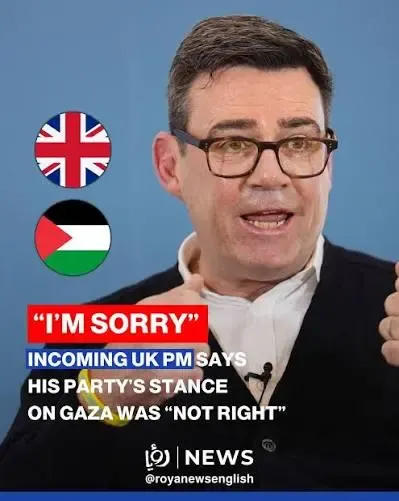
Andy Burnham, the man on the brink of becoming Britain’s prime minister, has done something no senior Labour figure has dared: he apologised for his party’s record on Israel’s war on Gaza and promised a tougher line on the Israeli government. The immediate response was as predictable as it was fierce. Jewish communal organisations accused him of a “misguided” intervention. Conservative opponents charged him with pandering to the “pro-Palestine lobby”. And from the left came a different verdict: “You can’t even call it a genocide, you coward.”
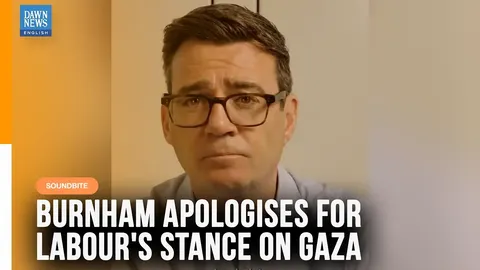
Burnham’s video statement — in which he said Labour “didn’t get it right” and the UK was “too slow to call for a ceasefire” as more than 73,000 Palestinians were killed — has torn open Britain’s toxic debate over Israel. But to see this as merely a Westminster story is to miss the larger earthquake. Burnham’s apology is a tremor from a global political reckoning that is being felt from Manchester to Michigan, where the issue of Palestine has become the litmus test of political authenticity, pro-Israel lobbying groups are being dragged out of the shadows, and the establishment’s answer, as Palestinian writer Susan Abulhawa puts it, has been a “full-blown red scare”.
The Burnham break — and the backlash
In a question-and-answer video posted on Thursday, Burnham described the “unbearable suffering” in Gaza as a “scar on our collective conscience”. He criticised Israel’s repeated violations of the ceasefire, the expansion of its military control, and a Netanyahu government “clearly attempting to make a two-state solution impossible”. He also signalled he would go further than outgoing Prime Minister Keir Starmer on sanctions, pledging to look at banning trade in goods from illegal settlements and potentially ending all arms sales to Israel.
The backlash was swift. The Board of Deputies of British Jews and the Jewish Leadership Council conveyed “significant concerns” to Burnham’s team, warning that critics were using “distorted or one-sided portrayals” to “single out the world’s only Jewish state”. Shadow Foreign Secretary Priti Patel accused him of trying to “please everyone” and attacking Israel “just to pander to Labour backbenchers and the pro-Palestine lobby”. Conservative sources labelled the remarks “misguided”.
Yet the activist left was equally unimpressed. The Palestine Solidarity Campaign called the statement “totally inadequate”, and former Labour MP Zarah Sultana posted on X: “You can’t even call it a genocide, you coward.” Burnham had stopped short of the term, saying it was for international courts “to determine” whether genocide had occurred — a careful legalism that satisfied almost no one.
The global picture: AIPAC’s shadow and a moral awakening
Burnham’s calculation, however, did not materialise in a vacuum. It is of a piece with a global political realignment in which support for Israel has become an electoral liability and candidates who refuse pro-Israel lobby money are toppling incumbents.
In the United States, the past few weeks have seen a wave of insurgent Democratic primary victories built substantially on rejecting AIPAC funding and opposing the genocide in Gaza. Claire Valdez and Daria Lisa won in New York, Maurus in Colorado, and Abdullah Sayed in Michigan — all running explicitly against the pro-Israel donor class. Palestine, Abulhawa told Rania Khalek on Breakthrough News, “has become this litmus test” in American elections. “Nobody can keep watching people getting slaughtered to this extent and just be okay with it. It goes against human nature. And I think there is this moral revulsion at Israel.”
That revulsion is being met with a fierce institutional counter-attack. The US establishment has responded with what Abulhawa calls a “full-blown red scare” — an effort to smear critics of Israel as foreign assets or extremists. The political terrain, she argues, is shifting precisely because the pro-Israel lobby, particularly AIPAC, was forced out of the shadows. “When I was younger, nobody knew the word AIPAC. You would say AIPAC and nobody — because they operated from the shadows. But then they got pretty comfortable and they started boasting about all the politicians that they bought and so now it’s in people’s faces.”
This new visibility has turned refusal of AIPAC money into a badge of honour for progressive candidates, and in turn helped reveal a deeper rot. As Abulhawa notes, the issue hits a nerve because it exposes everything Americans have been told about their democracy — that it is free, not controlled by outsiders, that the press is independent. The moral shock of a livestreamed genocide, combined with the revelation of how a foreign government effectively purchases US policy, has become an “infuriating” awakening.
The UK in the same riptide
Burnham is reading exactly the same currents. A recent YouGov poll found that 50 percent of the British public believes Israel is committing genocide. A survey for the Palestinian Solidarity Campaign showed that two-thirds of Labour voters who defected to the Greens were driven by the party’s position on Gaza. The electoral damage was real, and Burnham’s apology is an open attempt to repair it.
But the UK is also navigating the same minefield as the US. Labour has only just moved past the anti-Semitism crisis of the Corbyn era, and Burnham must simultaneously reassure Jewish voters, maintain the party’s historic commitment to Israel’s existence, and manage relations with a profoundly pro-Israel Trump administration. His choice of James Purnell, a former cabinet minister with ties to Labour Friends of Israel, as prospective chief of staff is a signal that he intends to keep one foot in the traditional camp even as he pivots.
The question, as analyst Tim Bale told Al Jazeera, is whether his remarks are “more symbolic than substantive”, given that the UK “is already at the edge of what it’s likely to do and say on Israel”. Tahani Mustafa of the European Council on Foreign Relations argued that the apology was a “step in the right direction” but must be translated into “tangible policy outcomes” — something Burnham has yet to demonstrate.
Beyond platitudes
Abulhawa’s broader challenge to the solidarity movement — expressed in a recent piece for Mondoweiss — resonates far beyond the US. She warns against a movement that centres “reassuring the colonizer rather than liberating the colonized”, pointing to the cultural boycott as a tool that must isolate Israeli society, not seek its validation. That same tension courses through Burnham’s apology: is he trying to comfort a morally repulsed electorate, or is he prepared to lead a genuine policy rupture? The next few weeks will supply an answer, but the terrain has already shifted under his feet.
What is clear is that Burnham is no outlier. He is surfing a wave that has already transformed primaries in New York and Colorado, made AIPAC a dirty word for a new generation of candidates, and forced a conversation about power and money that the foreign policy establishment has long suppressed. “I think future generations will think very differently than folks do now,” Abulhawa said. Burnham’s apology suggests that future may be arriving sooner than many expected — but whether it brings a change in policy or merely a change in rhetoric is a question that will be answered not in words, but in weapons licences, trade bans, and the daily body count from Gaza.