Incoming UK Prime Minister Andy Burnham Apologises for Labour's Gaza Response, but Critics Say It Doesn't Go Far Enough
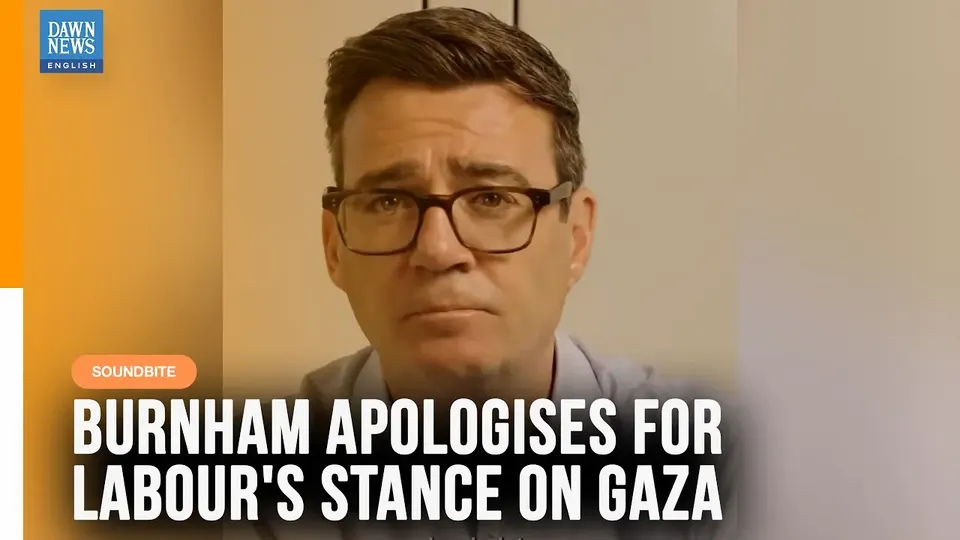
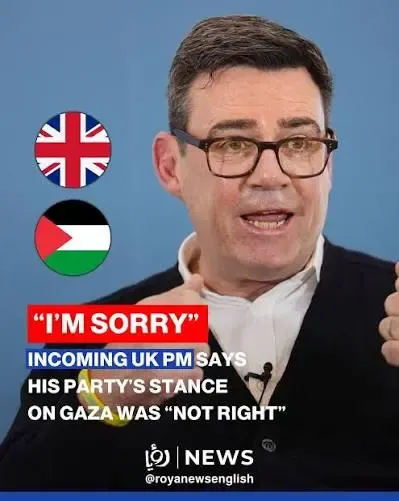
Andy Burnham has apologised for Labour's initial response to Israel's military action in Gaza, saying the party "didn't get it right" and needs to do better under his leadership.
Burnham, who is expected to become prime minister later this month, was one of several high-profile Labour figures who were calling for a ceasefire in Gaza by late October 2023 – which at the time put him at odds with Sir Keir Starmer.
"Labour's initial response to the treatment of Gaza caused huge hurt. We got it wrong and I am sorry for that," he wrote on social media.
In a video message, the Makerfield MP also reiterated his condemnation of the 7 October Hamas attack, as well as antisemitic attacks in the UK.
During the early weeks of the conflict, Sir Keir had backed humanitarian pauses to help aid reach Gazans but stopped short of calling for a ceasefire. Compared to a formal ceasefire, humanitarian pauses tend to last for short periods of time, sometimes just a few hours, and are implemented purely with the aim of providing support as opposed to achieving long-term political solutions.
"I know that many people feel that at the start of Israel's military action in Gaza, my party didn't get it right, and I am sorry about that," Burnham said in his video message on Thursday. "The response has too often not been good enough. We need to do better. The UK was too slow to call for a ceasefire."
In the early weeks of the conflict, Sir Keir was also criticised for an interview he gave to LBC on 11 October in which he was asked whether it was "appropriate" for Israel to cut off the supply of power and water to Gaza. "I think that Israel does have that right," he said. "Obviously everything should be done within international law, but I don't want to step away from the core principles that Israel has a right to defend herself."
A spokesman for the Labour leader later said he had only meant to say Israel had a general right to self-defence. Sir Keir's stance on a ceasefire at this time was also in line with that of the previous Conservative government, led by Rishi Sunak.
In February 2024, Labour called for an immediate humanitarian ceasefire in Gaza for the first time since the outbreak of the conflict the previous October.
The Full Text of Andy Burnham's Statement
In his video message, Burnham said:
"Let me start by saying the unbearable suffering in Gaza is a scar on our collective conscience. It's completely unacceptable that innocent Palestinians, including children, continue to be killed. That there's still a humanitarian crisis with too little aid getting in, and that the Israeli military continues to expand the area it controls in Gaza. We've got to do more to put pressure on the Israeli government.
I want to repeat what I've said before about the actions of Hamas and the monstrous October the 7th terror attack, which I condemn as strongly today as I did in the immediate aftermath. I also condemn the increase in appalling anti-semitic attacks here in the UK and those who seek to divide our communities by targeting Jewish people.
Following the Heaton Park synagogue attack in Manchester, I felt firsthand the anxiety in our Jewish community and the very real threat they face. This is unacceptable and we must continue to stamp out anti-semitism across the UK.
We must also be clear in our criticism of what has happened in Gaza. I know many people feel that at the start of Israel's military action in Gaza, my party didn't get it right, and I am sorry about that. The response has too often not been good enough. We need to do better.
Yes, we have taken some important steps. These include recognizing the Palestinian state, placing sanctions on Israeli ministers, and imposing waves of sanctions on violent settlers and the organizations that support them. I also fully support the restrictions on arms licenses to make sure that no British bombs or bullets can be used by the IDF in Gaza or in the West Bank.
But let's be honest, the UK was too slow to call for a ceasefire, and we must now do more to strengthen our approach. Israel continues to violate the ceasefire agreement, killing innocent Palestinians. We're seeing a surge in settler violence in the West Bank and East Jerusalem and the continued expansion of illegal settlements, displacing Palestinian communities, and Netanyahu's government is clearly attempting to make a two-state solution impossible.
That's why we need to do more, which includes looking at further sanctions both on those involved in the violence in Gaza, but also looking at measures to ban trade and goods with illegal settlements.
I, like many people, feel passionately about Gaza and I will do everything I can to work with international partners to stop the suffering, to ensure the Israeli government adheres to international law and to keep the prospect of a two-state solution alive, because this is the only way to lasting peace for both Israelis and Palestinians.
I have been absolutely appalled by what I've seen and read about the destruction of Gaza. There's increasing evidence that war crimes appear to have been committed. There must be accountability for the depth of the suffering the people of Gaza have experienced.
Ultimately, however, it must be for the international courts to determine rather than politicians. There is no contradiction between a zero tolerance approach to anti-semitism and holding the Netanyahu government to account. I will always take a fair and balanced approach and stand up for what is right."
Praise from Labour MPs – and Criticism from Activists
Burnham's apology has received praise from several Labour MPs. Wes Streeting, Sir Keir's former health secretary who was seen as a possible challenger to Burnham until he endorsed him last month, said on X: "This is extremely welcome." Meanwhile, Rupa Huq, MP for Ealing Central and Acton, said on X: "High time this is acknowledged and glad something will be done about it."
Burnham in his video praised several policies Labour had enacted in government – the recognition of a Palestinian state, placing sanctions on Israeli ministers and settlers, and restrictions on arms licences to Israel. But he said more needed to be done to "strengthen our approach", to "ensure the Israeli government adheres to international law and to keep the prospect of a two-state solution alive".
He accused Israel of violating the US-brokered ceasefire agreement and said there had been a surge of settler violence in the West Bank and East Jerusalem. "[Prime Minister Benjamin] Netanyahu's government is clearly attempting to make a two-state solution impossible," he said, calling for further sanctions and measures to ban trade in goods with illegal settlements in the West Bank.
However, the apology has been met with deep scepticism from pro-Palestinian activists and commentators, who argue that it falls far short of what justice demands – and that it fails to address the central charge of genocide. Several UN reports have accused the Israeli government of committing war crimes which amount to genocide in Gaza. Israel has repeatedly denied all such allegations. The Israeli military launched a campaign in Gaza in response to the unprecedented Hamas-led attack on southern Israel on 7 October 2023, in which about 1,200 people were killed and 251 were taken hostage.
'We're talking about the crime of crimes'
Political commentator Owen Jones, responding to Burnham's statement, argued that the apology does not adequately address the scale of what has occurred. He emphasised that genocide is not a matter of ordinary political disagreement but of criminal liability under the Genocide Convention of 1948, which Britain signed and legislated to implement.
"We're talking about genocide," Jones said. "We're talking about the crime of crimes. There is no worse crime, none, zero, than genocide. And complicity in genocide is criminalised by the genocide convention of 1948 which Britain signed up to and then legislated to implement. So what we're talking about here isn't simply about Labour getting it wrong... We're talking about criminal liability."
Critics have pointed to the language Burnham used in his video – particularly his characterisation of Labour's failure as being "too slow" to call for a ceasefire. They argue this misrepresents what actually happened in the early months of the conflict. "Labour supported Israel's genocidal onslaught for months and framed it as Israel's right to self-defense," Jones argued. "That's what it did. And specifically, Keir Starmer, the leader of the Labour party – now prime minister until he's replaced by Burnham – supported Israel's right to commit war crimes. He was asked specifically about a siege against Gaza against civilian population and he said Israel does have that right. Straightforwardly legitimizing war crimes."
Jones also took issue with the clinical language used in Burnham's accompanying social media post, which referred to "the treatment of Gaza". He argued that such phrasing "takes away the action... it erases the perpetrator", and noted a stark asymmetry in the language used for different parties. While Burnham described the October 7th attacks as "monstrous", critics say no equivalent emotive language was used for the destruction visited upon Gaza. "The violence committed against Palestinians by Israel is not given even the tiniest fraction of the importance, the outrage over the much smaller factually violence committed by Hamas," Jones said.
One of the most pointed criticisms concerned Burnham's statement that it must be "for the international courts to determine rather than politicians" whether war crimes have been committed. Critics argue this is a convenient shield that allows politicians to avoid the legal obligations that would follow from naming what has occurred. "He knows Israel has committed war crimes in industrial scale," Jones said. "He's refusing to say so because it would impose legal obligations on him to actually act. That's why – any lawyer will simply tell you – if you say Israel has committed war crimes, then we will have to do these things."
Jones drew a provocative comparison: "Could any political journalist actually do their job for a change and actually ask him if he says the same about Russia? Is that his view? He can't say whether Vladimir Putin's committed war crimes in Ukraine because he's not a lawyer? No. Doesn't work like that. Would he say this about the Holocaust? The Nazi Holocaust of the Jewish people in which 6 million Jews were exterminated. No court ever, international court adjudicated and said that's the genocide."
A Damning Historical Record
Beyond the immediate critique of Burnham's words, investigative journalist Matt Kennard has offered a broader assessment that places the incoming prime minister's entire political trajectory under scrutiny. In a blistering critique aired on the July 13 episode of The Deep Dive with host Ahmed Alnaouq, Kennard warned that Burnham represents a continuation of the establishment status quo, particularly regarding UK policy on Gaza and Israel. "I don't think that Andy Burnham calling for a ceasefire early on in the genocide really has any significance for us trying to understand what his position will be when he's in power," Kennard said. "He is a snake. He will do what is useful for him."
Kennard pointed to Burnham's 2003 vote for the Iraq War and his subsequent repeated votes against holding an inquiry into the conflict as foundational evidence of his character. "In 2010, we already knew that the whole pretext for the war was a lie," Kennard told Alnaouq. Despite a million Iraqi civilians killed and no weapons of mass destruction found, Burnham still refused to apologise for his vote at that time. "It goes to the heart of his character, which is that he says whatever he thinks he needs to to get power."
This record, Kennard argued, is not ancient history but a consistent pattern of placing political expediency above moral clarity – a pattern that should inform how we interpret his current statements on Gaza.
Ties to the Israel Lobby and Personnel Choices
Kennard also highlighted Burnham's long‑standing relationship with Labour Friends of Israel (LFI), noting that Burnham joined the organisation in 2015 and publicly declared during his 2010 leadership campaign that he wanted his first foreign visit to be to Israel and that he opposed boycotts of the country. These affiliations, Kennard suggested, are not incidental but indicative of a deep alignment with the pro‑Israel establishment within the Labour Party.
The interview also drew attention to Burnham's recent appointment of James Purnell – a former chair of LFI – as his chief of staff. "That doesn't really signify that he's going to have a good position on Palestine," Kennard stated, calling the move a clear signal that Burnham will not break from establishment orthodoxy. For Kennard, personnel choices are more revealing than public apologies, and this appointment speaks louder than any carefully crafted video message.
Kennard criticised Burnham's refusal to legally classify Israel's military campaign in Gaza as a genocide – echoing the concerns raised by Jones about deferring to courts. "He said 'I wouldn't be qualified to judge something of that enormity,'" Kennard recounted. "It's like, well, you're about to be prime minister, so you maybe should." This framing of the issue as a deliberate evasion of responsibility that has concrete consequences for British policy and international law cuts to the heart of the criticism: that Burnham's careful language is designed to avoid triggering legal obligations rather than to genuinely address the atrocities.
A Broader Critique of the Labour Party
During the nearly hour‑long discussion, Kennard framed Burnham not as an anomaly, but as the perfect expression of the modern Labour Party – an institution he described as having been co‑opted by the British establishment and the Israel lobby for decades. "The Labour Party has been torturing the Palestinians for 80 years," Kennard said, referencing the Nakba occurring under a previous Labour government. This historical perspective placed Burnham's current stance within a continuum of Labour complicity, rather than as a departure from it – a point that directly challenges the narrative that Burnham represents a fresh start.
When Alnaouq pressed Kennard on whether there was any room for optimism under Burnham, the journalist was unequivocal. "He is Starmer 2.0," Kennard replied. "Don't trust the vibes. Don't trust what he's saying in rhetoric. Trust what he's done." This blunt assessment cuts through the performative apology and redirects attention to Burnham's actions over his entire political career, suggesting that his words on Gaza are merely the latest iteration of a familiar pattern.
British Complicity and the Call for Real Action
Critics have also highlighted ongoing British support for Israel's military campaign, which they argue undermines any apology. This includes the supply of components for F-35 jets used by Israel, intelligence sharing, RAF surveillance flights over Gaza, and billions of pounds worth of annual trade with Israel.
Jones noted that while Burnham spoke of "looking at further sanctions", these measures have so far targeted only a small number of individuals rather than the Israeli state as a whole. "If you want to start with someone who's involved in the violence in Gaza, then you should start with the Israeli prime minister Benjamin Netanyahu," he said. "The whole government is up to their neck in it."
The fundamental question, Jones argued, is whether Palestinian life is seen as having equal worth. "There is a basic dividing line on the question of Palestine and it fundamentally is this: do you think Palestinian life has equal worth? You either believe it or you don't. And you either act accordingly or you don't."
'Nothing will scrub away what Labour has done'
While acknowledging that Burnham has been pushed into making this statement by grassroots pressure – including mass protests, organising, and the electoral rise of the Green Party – critics maintain that it does not go far enough. "Nothing will scrub away what Labour has done," Jones concluded. "Genocide is, as I've said, the crime of crimes. And what Labour has done, its complicity in genocide is a crime that can't be washed away. But Andy Burnham can offer some actual action. And this statement will appeal to wishy-washy liberals who thought all this Gaza stuff is just so awful, isn't it? But for those who actually care about Palestinians, you should demand this government ceases its complicity in a genocide."
The response from Jewish community organisations, including the Jewish Board of Deputies and the Jewish Leadership Council, has expressed "significant concerns" about Burnham's remarks. While welcoming his zero-tolerance approach to anti-Semitism, they argued that anti-Semitism cannot be confronted without addressing what they see as all its drivers.
Critics of that response, however, argue that such organisations are themselves conflating criticism of Israel with anti-Semitism – and that this conflation is both irresponsible and dangerous. Jones argued that this approach risks pushing people toward anti-Semitism rather than preventing it, by encouraging the false belief that opposing Israel's actions is inherently hostile to Jewish people. "You should not smear people or suggest people are anti-semitic because they object to the crime of crimes," he said. "People do not like horrible atrocities being committed with the complicity of their own government. That's where most people are at on this issue."
The Way Forward: Beyond the Two‑Party System
While painting a bleak picture of the two‑party system, Kennard urged progressive voters to look toward alternative institutions like the Green Party rather than placing false hope in Burnham's Labour government. "The Labour Party is the problem. It's not the answer," he said. "There has to be a cost because if we keep saying we should triangulate with these people for a bigger purpose, then we'll keep losing eventually."
This call for electoral realignment adds a strategic dimension to the critique, suggesting that pressure must extend beyond individual politicians to challenge the entire institutional framework. The Deep Dive episode concludes with Alnaouq and Kennard agreeing that while the establishment is deeply entrenched, the widespread public awakening regarding Gaza and British democracy provides a foundation for genuine political change outside the traditional Labour‑Conservative duopoly.
What comes next?
Burnham is expected to become prime minister later this month, and his statement on Gaza is being seen as an early indication of how his government might approach the conflict. While Labour MPs have welcomed the apology, pro‑Palestinian activists have made clear they will continue to press for more – including a total arms embargo, sweeping sanctions against Israel, and a clear acknowledgment that genocide has taken place.
Whether Burnham's apology represents the beginning of a genuine policy shift or merely an attempt to manage domestic political pressure remains to be seen. But with polling showing that 50% of British voters believe Israel has committed genocide, according to a recent survey, and with critics like Jones and Kennard insisting that the bar for accountability is far higher than any statement yet offered, the issue is unlikely to fade from the political agenda.
As Kennard put it, the real test will not be in words but in actions – and for those who see the Labour Party as fundamentally compromised, the only viable path may lie in building political alternatives that are not beholden to the same establishment forces. For now, Burnham's apology has satisfied some within his own party, but it has done little to convince those who believe that complicity in genocide cannot be apologised away. The coming weeks will reveal whether Burnham's government will translate its words into meaningful policy change, or whether his critics' warnings about his political character prove prescient.