“I Never Expected to Witness a War of Annihilation”: Nakba Survivor in Gaza Mourns 70 Lost Family Members
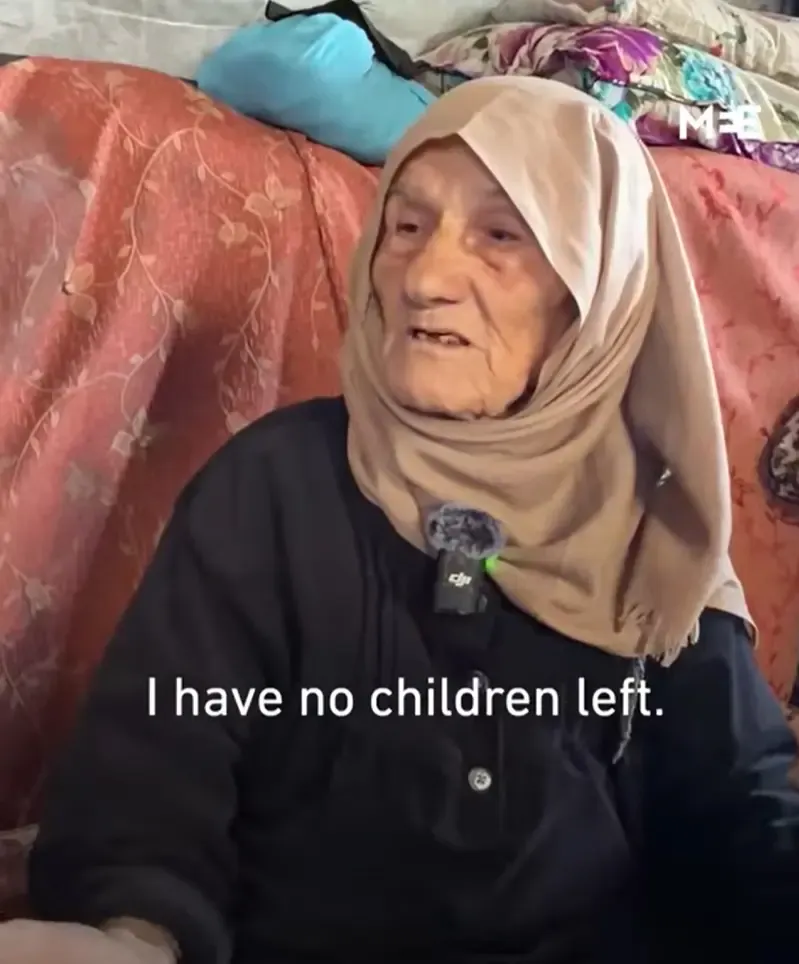
In an emotional interview from Gaza, veteran journalist Maha Hussaini spoke with 95-year-old Palestinian survivor Hajja Fatima Obeid, who lived through the 1948 Nakba and now finds herself displaced once again amid Israel’s ongoing assault on the besieged enclave.
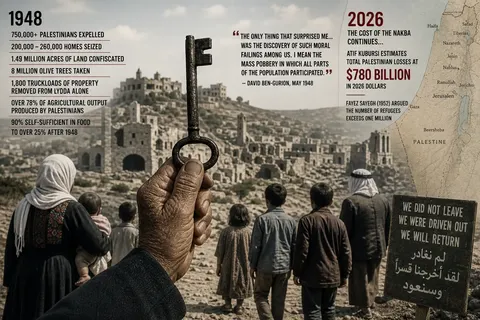
Speaking to Middle East Eye in May 2026, Hajja Fatima described what she called a “war of annihilation”, saying the destruction unfolding in Gaza today is even more devastating than the catastrophe she witnessed as a child during the founding of Israel.
The elderly woman lost her home in Gaza City’s Shuja’iyya neighbourhood, east of Gaza City, along with more than 70 members of her extended family, including children, grandchildren and great-grandchildren, during months of relentless Israeli bombardment.
“I raised them all,” she said. “I lost every one of them.”
Hajja Fatima, who has endured decades of occupation, siege and repeated wars on Gaza, said she never believed she would survive long enough to witness another mass displacement on such a scale.
Reflecting on the differences between the Nakba of 1948 and the destruction now engulfing Gaza, she explained that while Palestinians were expelled from their homes in 1948, many families eventually returned to find at least some remnants of their lives still standing.
“Back then we left for months, and when we returned we found our belongings, our homes, our things,” she said. “Now everything is gone.”
The loss, she explained, extends far beyond buildings.
“I lost children, grandchildren, entire generations,” she said. “Around seventy people.”
At one point in the interview, she spoke painfully about the few relatives she still has left alive.
“They laugh when I say I only have one and a half left,” she said bitterly. “One is exhausted, and the other has spent a year lying injured with metal plates in his legs.”
Describing the chaos of displacement, Hajja Fatima recalled scenes of civilians fleeing on foot under bombardment, carrying children, spouses or whatever they could manage to save.
“We escaped wearing only the clothes we had on,” she said. “One person carrying his son, another carrying his wife, another simply trying to save himself.”
Despite her advanced age, she said she managed to walk during the mass flight eastward from Gaza City.
“It was not fear that drove me,” she said quietly. “Nor greed.”
The memories she left behind inside her destroyed home remain deeply painful. Speaking about her late husband, who died around twenty years ago, she recalled that many of his belongings were still hanging untouched when she fled.
“His jackets are still hanging in the wardrobe,” she said. “Things from our wedding are still there too. I didn’t take a single thing.”
Now living under severe humanitarian conditions during her continued displacement, Hajja Fatima has become a living witness to two defining chapters of Palestinian history: the Nakba of 1948 and the devastation of Gaza today.
Her testimony reflects the growing sentiment among Palestinians that the current destruction represents not simply another war, but the erasure of entire families, communities and histories.
“I wish we could return to how life was before,” she said. “To walk by the sea, breathe the air, sit in our homes in good health, with our children around us.”