The Other Nakba: Gaza, the $780 Billion Ledger, and the Unfinished Theft of 1948
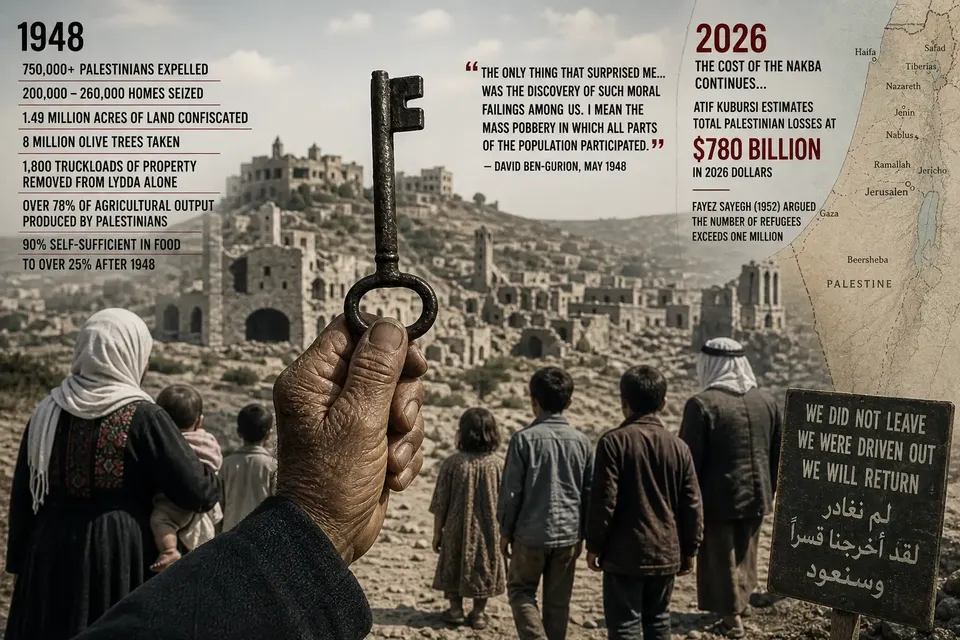
The keys are still there. They hang on walls from Gaza to Chicago, from refugee camps in Lebanon to flats in London, from family homes in Amman to storage boxes in Berlin. Rusted iron. Brass darkened by time. Heavy old keys to stone houses, orange groves, workshops, shops, courtyards, terraces, storerooms and front doors that no longer exist, or that now open for somebody else.
They are often described as symbols. That is too soft a word. They are evidence.
Everyone knows the number most commonly attached to the Nakba: around 750,000 Palestinians driven from their homes in 1948. Yet even that number has long been contested. In 1952, the Palestinian scholar Fayez Sayegh argued that the official counting systems were too narrow, because they excluded people who had lost livelihoods but not homes, those who were displaced but not destitute, and those who had emigrated beyond the reach of United Nations relief agencies. UNRWA’s own rolls then counted 875,998 registered refugees, but Sayegh wrote that when the omitted categories were added, the true number would “exceed one million.” He later referred to Israel’s refusal to repatriate “the one million refugees.”
The dispute over numbers matters because numbers decide whose suffering is administratively visible. They decide who is counted, who is erased, who is compensated and who is told that no record exists.
But the Nakba was never only a demographic catastrophe. It was also an economic seizure. It was the transfer of a country’s accumulated wealth from one people to another, through war, expulsion, massacre, legal fiction and bureaucratic laundering.
What followed the expulsions was not merely abandonment. It was looting on a national scale.
The prime minister’s complaint
In May 1948, days after declaring the State of Israel, David Ben Gurion sat with his ministers and complained about what was happening across the country.
“The only thing that surprised me,” he said, “and surprised me bitterly, was the discovery of such moral failings among us, which I had never suspected. I mean the mass robbery in which all parts of the population participated.”
It is one of the most revealing admissions in the early record of the Israeli state. Ben Gurion was not lamenting the destruction of Palestinian society. He was not proposing restitution to the families expelled from Lydda, Ramle, Haifa, Jaffa, Safad, Acre, Tiberias, Jerusalem and hundreds of villages. His fury was directed at the disorder of the plunder.
The state wanted control. Soldiers, civilians, government departments and new arrivals were stripping homes, shops, farms and public buildings before the authorities could consolidate the spoils through official channels.
A ministerial committee for “abandoned property” had already been established. The formula was simple. Palestinians were expelled or prevented from returning. Their homes, lands, tools, crops, livestock, bank accounts, businesses and furniture were then redefined as “abandoned.” The word was a legal mask. Many owners had not abandoned anything. They had fled under fire, been forced out at gunpoint, or were trapped only a few miles away, sometimes still inside the borders of the new state.
“The army did what it wanted”
From Lydda alone, a city of roughly 17,000 people, Israeli forces removed 1,800 truckloads of property. Bechor Shalom Shitrit, a minister on the abandoned property committee, went into the field and reported back on the scale of the looting. Finance Minister Eliezer Kaplan admitted that neither his ministry nor the official custodian had control. “The army,” he said, “did what it wanted.”
The custodian’s own reports described a countrywide operation to dismantle water pump engines from Palestinian farms. This was not random theft in the margins of war. It was the stripping of agricultural infrastructure. Pumps, pipes, engines, tools, animals, crops and irrigation systems were taken from the people who had built and used them.
The private homes were stripped too. Estimates put the number of Arab dwellings emptied at between 200,000 and 260,000. Inside them was the material life of generations: jewellery, cash, carpets, photographs, family records, ledgers, deeds, furniture, radios, sewing machines, bedding, books, kitchenware, clothing, musical instruments, religious objects and children’s belongings.
Yoram Kaniuk, a Palmach soldier who later became a celebrated Israeli novelist, recalled entering wealthy homes after their owners had been expelled. “We had never seen such splendour,” he wrote. “Gold, giant mirrors, gleaming kitchens, crystal chandeliers, and tons of food. Silver cutlery, bottles of liquor stood like soldiers in formation.”
From his veranda in Jerusalem’s Al Baq’a neighbourhood, the Armenian resident John Rose watched carts and pickup trucks carrying away pianos, refrigerators, radios, paintings, ornaments and furniture, some wrapped in Persian carpets. Safes were forced open and emptied of money and jewellery. Moshe Smilansky, a Jewish writer and contemporary observer, described a society overcome by appetite: “The urge to grab has seized everyone. Individuals, groups and communities, men, women and children, all fell on the spoils.”
The land was not empty
The mythology of 1948 depends on an empty landscape. A desert redeemed. A wilderness made productive. A country waiting for history to begin.
The record says otherwise.
The British Survey of Palestine found that Palestinian Arabs, although less than 69 percent of the population, produced more than 78 percent of total agricultural output. Palestine in 1945 had a population of about 1.9 million and was around 90 percent self sufficient in staple foods, with export surpluses despite the disruption of the Second World War.
What passed into Israeli control in 1948 included approximately 1.49 million acres of cultivated Arab land, almost a quarter of a million tonnes of winter crops standing ready for harvest, eight million olive trees that were 99 percent Arab owned, more than 200,000 cattle, more than half a million sheep and goats, and around half the country’s citrus orchards. Citrus had been the crown jewel of the Palestinian economy, with exports reaching more than 15 million cases a year.
This was not wilderness. It was a developed agrarian economy.
The new state inherited groves, terraces, wells, pumps, barns, mills, orchards, markets and transport links. It inherited a landscape cultivated by fellahin who knew the soil, water, seasons and trees with an intimacy that no army could confiscate.
Then production collapsed.
By 1949, Israeli citrus exports had fallen below one million cases. By 1952, they had recovered only to 3.5 million. A country that had been around 90 percent self sufficient in staple food before 1948 was, in the early years of Israel, only about 25 percent self sufficient. Food rationing lasted for years. The new state relied heavily on foreign support and imports to feed its population.
The reason is simple. Land can be seized in a day. Agricultural knowledge cannot.
Fayez Sayegh and the disputed count of the expelled
Sayegh’s 1952 work, The Palestine Refugees, is important because it challenged the statistical narrowing of the Nakba almost immediately after the event. The pamphlet, published in Washington by AMARA Press, explicitly asked how many Arabs had been displaced and criticised the use of 700,000 as a safe working estimate.
Sayegh noted that UNRWA’s figures were based on relief eligibility, not on the total number of Palestinians displaced. In other words, the system counted those who met a working definition: people normally resident in Palestine who had lost their homes and livelihoods and were in need. It did not fully count those who had lost livelihoods but stayed in place, those who had found work elsewhere, or those who had moved beyond the region.
That is why Sayegh concluded that the true number exceeded one million. The claim sometimes repeated as 1.1 million should be treated carefully. I found strong support for “over one million” in Sayegh’s text, not a clean, directly quoted 1.1 million figure. The broader point is still significant: from the beginning, Palestinian scholars argued that the familiar 700,000 to 750,000 figure understated the scale of displacement.
Sayegh also linked the refugee question to property. He cited estimates that Arab property in Israel and Israel held territory amounted to 7,487,445 dunums, compared with 1,480,651 dunums of Jewish property, meaning Arab property was estimated at more than five times Jewish property in the relevant territory.
That ratio helps explain why the Nakba was not only a war of territory. It was a war over accumulated wealth.
Kubursi and the $780 billion ledger
Decades later, economist Atif Kubursi tried to measure the loss in monetary terms.
Kubursi, a professor of economics at McMaster University, argued that compensation and return should not be treated as substitutes. “Restitution of property and compensation for lost opportunities,” he wrote, “are primary components of the rights of refugees, regardless of whether they choose to return to their homeland.”
His methodology included lost movable and immovable property, damage to property, income derived from refugee property, lost income streams, collective goods such as infrastructure and natural resources, and non material damages. He stressed that compensation could only ever be partial, because no monetary value can capture the loss of a homeland.
Kubursi estimated that the Palestinian economy before Israel replaced it was viable, with output and income capable of sustaining a growing population of about two million people in 1948. He calculated Palestine’s national income at market prices in 1944 at £P123 million, or about $496 million, and estimated total wealth at about £P3.075 billion, or $12.4 billion. The Palestinian share, he wrote, was roughly 51.2 percent, translating into about £P1.575 billion, or $6.4 billion.
Using another method, Kubursi estimated full compensation for Palestinian material losses at $743 million, or $2.994 billion in 1948 prices. Adjusted to 2000 prices, that became $22.5 billion. Including human capital losses raised the figure to $35.7 billion. With a modest real growth rate of 4 percent, the figures rose to $173 billion and $275 billion respectively. Adding psychological damage and pain, following German compensation schemes, raised the 2000 total to $327 billion.
That is the basis for the modern $780 billion figure. Updating Kubursi’s $275 billion estimate from 2000 to 2026 at roughly 4 percent annual real growth produces a figure in the region of $760 billion to $780 billion, depending on rounding and the precise assumptions used. This is not a casual number. It is an attempt to price the economic consequences of expulsion, confiscation and blocked development across generations.
It also excludes major later claims, including offshore oil and gas resources identified off the coast of Gaza, which UNCTAD has discussed separately in relation to the unrealised natural resource potential of the occupied Palestinian territory. The UNCTAD report cites Kubursi’s earlier work on Palestinian losses in 1948.
Gaza as the heir of 1948
The relevance to Gaza is direct.
Gaza is not simply a place where Palestinians live. It is one of the great repositories of the Nakba. A large share of its population descends from families expelled from towns and villages in what became Israel. Many of the keys kept in Gaza belong to homes not in Gaza, but in Majdal, Isdud, Beersheba, Jaffa, Lydda, Ramle and the villages of southern Palestine.
The Gaza Strip became a compressed archive of dispossession. People who had once owned orchards, workshops, fishing boats, farms, houses and shops became refugees in camps. Their land was elsewhere. Their titles were elsewhere. Their villages were often destroyed, renamed, repopulated or planted over.
Over decades, Gaza’s economy was then separated from its natural hinterland. It was cut off from the lands, markets and ports that had sustained Palestinian life before 1948. After 1967, it came under Israeli military occupation. Later, under blockade, its economy was confined, restricted and made dependent on aid, permits and border controls.
This is why Gaza cannot be understood only through the lens of the latest war. Its destruction is the latest chapter in a longer economic history.
The homes destroyed in Gaza are often homes of refugees whose original family homes were taken in 1948. The businesses destroyed in Gaza are often businesses created by people whose earlier property claims were never resolved. The land under bombardment is inhabited by the descendants of those who were first dispossessed elsewhere.
In that sense, Gaza is not separate from the $780 billion ledger. Gaza is one of its living entries.
The legal fiction of abandonment
The phrase “abandoned property” deserves special scrutiny. It is one of the central frauds of the period.
A property cannot honestly be called abandoned when its owner has been expelled, terrorised, prevented from returning, or barred by law from reclaiming it. The legal transformation of Palestinian property into state managed property was not an innocent administrative act. It was the conversion of wartime dispossession into permanent ownership.
The owners were not missing in a metaphysical sense. They were in refugee camps. They were in Gaza. They were in Jordan, Lebanon, Syria and the West Bank. Some were internally displaced inside Israel itself, close enough to see their own land but not allowed to recover it.
This is why the keys matter. So do the deeds, maps, tax records, land registers and family documents. The paper trail did not vanish simply because a new state declared the owners absent.
The crime was not merely that people were driven out. It was that their absence was then used against them as proof that they had relinquished what they owned.
The violence behind the transfer
It is impossible to separate the looting from the violence that made it possible.
Palestinian towns and villages did not empty themselves in a vacuum. The expulsions took place in the context of military operations, massacres, threats, bombardment and panic. The massacre at Deir Yassin became one of the most notorious examples, but it was not the only episode that spread fear. Lydda and Ramle were emptied in July 1948. Villages across the Galilee, the coastal plain and the south were depopulated. Families fled expecting to return when fighting ended. Many were never allowed back.
Sayegh argued in 1952 that the refugees were not the product of voluntary evacuation, but of systematic terrorisation and expulsion. He rejected the claim that Arab leaders had ordered a mass flight, citing refugee testimony and United Nations material.
That matters because the property question depends on causation. If people left voluntarily and permanently, the moral and legal issue would be one thing. If they were expelled, terrified or barred from returning, the property transfer becomes something else entirely.
It becomes dispossession.
A civilisation stripped in stages
The plunder had layers.
First came the immediate looting by soldiers and civilians: furniture, carpets, jewellery, food, clothing, appliances, safes and household goods.
Then came the organised seizure of land, houses, businesses, shops, farms, orchards and infrastructure.
Then came the legal structure that made the seizure permanent.
Then came the economic exclusion of the refugees, who were denied return and cut off from the productive assets that had sustained them.
Finally came the historical laundering, in which the emptied land was retold as empty land, and the seizure of another people’s country was rebranded as redemption.
The result was an extraordinary inversion. The Palestinians, whose land and property had been taken, were recast as a humanitarian problem. The new state, enriched by their assets but struggling to operate the economy it had inherited, was recast as a miracle of development.
The Palestinian farmer became a refugee. The refugee became a statistic. The statistic became a burden. The original property claim disappeared behind relief budgets, camp administration and diplomatic process.
Why the ledger remains open
UN General Assembly Resolution 194, adopted in December 1948, affirmed that refugees wishing to return to their homes and live at peace with their neighbours should be permitted to do so at the earliest practicable date, and that compensation should be paid for the property of those choosing not to return and for loss or damage to property. Your source material rightly places this resolution at the centre of the compensation framework.
The resolution is important because it recognised two principles that have never disappeared: return and compensation. Kubursi’s work begins from the same premise. Compensation is not a replacement for return. It is part of the accounting of what was taken.
That is why the $780 billion figure has political force. It turns memory into a balance sheet. It challenges the idea that the Nakba is only a tragic origin story. It says that the material consequences are measurable, cumulative and still unpaid.
For Gaza, this is especially important. The destruction of homes, hospitals, schools, universities, mosques, churches, water networks, roads, farms, bakeries, archives and municipal systems is not occurring in an economic vacuum. It is falling on a population already deprived of its original property base.
A family expelled in 1948 from land now inside Israel, confined for generations in Gaza, then displaced again by bombardment, is not suffering two separate events. It is living one continuous dispossession.
The theft that became a state system
The most damning evidence is not from Palestinian memory alone. It is in Israeli records and Israeli testimony.
Ben Gurion acknowledged “mass robbery.” Ministers admitted loss of control. Soldiers remembered splendour. Witnesses described convoys of stolen goods. Officials recorded the dismantling of pumps. The state created the legal machinery to absorb what had been taken.
This is why euphemism fails. “Abandoned property” is too polite. “Absentee property” is too bureaucratic. “Transfer” is too bloodless.
Palestinians were expelled, and their property was taken.
Not every individual who arrived in Israel in 1948 personally looted a home. Not every Jewish immigrant was a soldier, a policymaker or a beneficiary by choice. Many Jewish refugees and survivors arrived with their own histories of persecution and loss. A serious account should not collapse individuals into a collective accusation against Jews as a people.
But the state project did benefit from a vast transfer of Palestinian wealth. Zionist military forces, state institutions, civilian looters and incoming settlers occupied, used, distributed and legalised the assets of those who had been driven out.
That is the historical charge, and it is strong enough without exaggeration.
The final account
The keys still exist because the claim still exists.
So do the land records. So do the memories. So do the village books, tax documents, British Mandate records, family deeds and oral histories. The descendants of the expelled have not forgotten which orchard belonged to whom, which house stood beside which road, which well served which fields, which shop was on which street.
Kubursi’s $780 billion figure is not merely an economic estimate. It is a reminder that history has an accountancy of its own. Sayegh’s challenge to the refugee numbers is part of the same argument. Count the people properly. Count the land properly. Count the homes, groves, pumps, animals, crops, businesses, wages, skills, ports, roads, schools, books and futures properly.
Then count Gaza.
Count the refugee camps built from the first dispossession. Count the generations born into exile. Count the blockade. Count the destroyed universities and hospitals. Count the children killed before they could inherit anything except a key. Count the families displaced from tents to schools to ruins, many of them descendants of people whose first homes were taken in 1948.
The Nakba was not only the loss of Palestine as territory. It was the seizure of Palestine as wealth.
That wealth did not evaporate. It was occupied, looted, nationalised, redistributed and renamed.
The ledger remains open because the owners, and their heirs, remain.