Blood Guilt in Washington: How Gaza’s Destruction Is Being Justified in the Name of the West

For more than two years, the destruction of Gaza has been treated in Washington not as a crime but as a political inconvenience — something to be explained away, managed, or ignored. But in December, a moment of unfiltered witness exposed this moral collapse on the world stage.
That moment came during a visit to Doha by American commentator Tucker Carlson, who documented what he saw of the human cost of the war and questioned the U.S.–Israel relationship in stark terms.
Firsthand Witness in Qatar
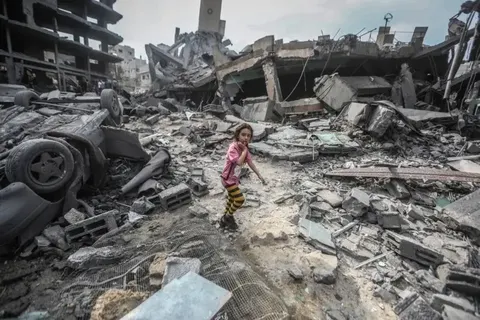
In mid-December, Carlson traveled to Qatar and visited a medical and rehabilitation facility where many of the roughly 2,000 Palestinians evacuated from Gaza and taken in by the Qatari government are being treated. Many are children who survived Israeli bombardment with life-altering injuries, including amputations and severe facial trauma.
The New Arab
In the footage he later released on The Tucker Carlson Show, Carlson described the trip as deeply emotional, saying he and his team “had to hold back tears” as they encountered wounded and orphaned children.
“It’s almost unbelievable. Tens of thousands of children killed, by a country with the most precise military technology in the world,” Carlson said, rejecting explanations of “collateral damage” and attributing the deaths to intentional policy.
He also explained that he had not planned to air the footage but ultimately felt it was important for audiences to see the suffering he witnessed, shot on an iPhone to avoid exploiting the victims with intrusive camera equipment.
Carlson’s commentary from Doha represents one of the most visible mainstream American media reckonings with the human toll of the Gaza war, amplified through his substantial audience footprint. Carlson’s independent platform, the Tucker Carlson Network, has around 1.6 million subscribers on YouTube alone, with hundreds of millions of cumulative views — giving his reporting a broad reach outside traditional cable news.
Precision Killing and Mass Death
For years, Israel has marketed itself as the world’s most precise military power. Its intelligence and targeting capabilities have produced highly specific operations in conflicts across Lebanon, Syria, and Iran without leveling entire cities.
Yet in Gaza, the same technological sophistication has accompanied tens of thousands of civilian deaths, including a disproportionate number of children — by far one of the highest proportions of non-combatant casualties in any major conflict of the modern era. Critics, including Carlson, have dismissed claims that such loss of civilian life could be accidental, given the weapon systems involved.
What makes Gaza particularly notable is not only the scale of death but the absence of anything resembling contrition. In past conflicts involving U.S. forces, civilian deaths have at times prompted investigations, official apologies, and legal scrutiny. In Gaza, those responses have been absent, and critics argue that the violence has been normalized or justified by segments of American political life.
Ideology of Collective Guilt
That normalization became explicit in Washington earlier this month in the reaction — and lack of reaction — to a photograph shared with Republican Congressman Randy Fine of a dead child in Gaza. Fine’s response — “Quite well, actually. Thanks for the pic!” — and his later defense of collective punishment have crystallized for many observers the moral challenge facing American politics today.
Carlson, who has long criticized the U.S. alliance with Israel and what he calls uncritical support for its military strategies, used his Doha visit to amplify that critique. His commentary argued that reducing civilians to members of a single collective — all assumed to be hostile or guilty because they are from Gaza — underpins a doctrine of punishment without distinction. That doctrine, he suggested on his show, is not merely immoral but contrary to the foundational values of Western civilization.
In his Doha footage, Carlson described witnessing children “with mangled faces” and severe injuries — scenes he said professionals who had covered wars around the world found profoundly unsettling.
Why This Matters in Washington
Israel is not the only state in history to commit atrocities. That is not the point.
The point is that no other modern ally of the United States has done so while demanding that its sponsors applaud. The United States did not merely fund Gaza’s destruction. It defended it diplomatically, vetoing ceasefire resolutions and providing political cover. It shipped the weapons. It blocked independent investigations. And now, its own media ecosystem contains powerful voices willing to present images of suffering and ask unvarnished questions about policy and morality.
Carlson’s journey to Doha — and his willingness to show parts of it to U.S. audiences — represents a crack in the silence of mainstream U.S. media over Gaza. Whether it widens into broader public reckoning remains to be seen, but what is clear is that personal witness — of faces, of injuries, of children who will live with trauma forever — has entered the heart of a debate that until recently many in Washington preferred to keep at arm’s length.
This is not merely foreign policy. It is a debate about morality, about power, about whether violence on this scale can ever be justified in the name of security — and it is now, unexpectedly, being shaped not only by diplomats and soldiers, but by journalists and commentators willing to take their cameras where others have not.