INO-HUB Energy Unveils Its Own Vanadium Flow Battery to Customers and Partners
At INO-HUB Energy Tech Day in Bratislava, Slovakia, the company presented its own commercial prototype of a battery energy storage system for industrial and energy infrastructure applications, with representatives of the European Commission in attendance. The technology broadens energy storage options, with a focus on long service life, safety and flexibility.
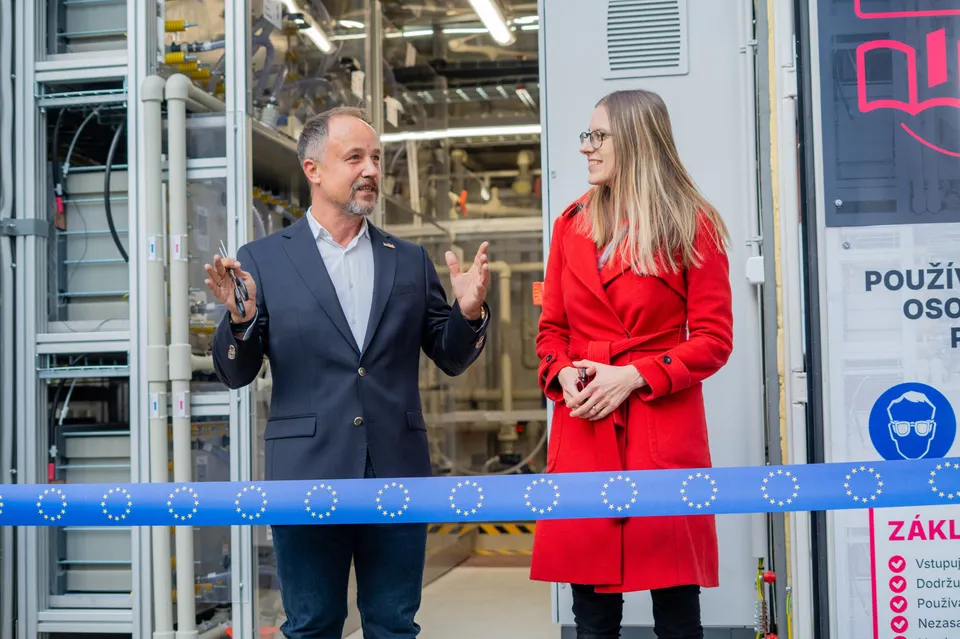
Slovak technology innovator INO-HUB Energy unveiled its proprietary commercial prototype of a vanadium redox flow battery (VRFB) to customers, technology partners and potential investors at its first Tech Day event in Bratislava. Designed for long-duration electricity storage, the technology makes a significant contribution to grid stability and the more efficient use of renewable energy sources.
The prototype unveiling was the highlight of the event, at which the company presented the results of its research and development activities and outlined their practical applications in industry and the energy sector. The programme also included a technical tour of the battery storage system.
“Presenting our proprietary commercial prototype of a vanadium flow battery is an important step for us. Our goal is not to keep technologies at the laboratory research stage, but to turn them into practical solutions for industry and the energy sector. Europe will need ever greater energy storage capacity, alongside technologies that are safe, cost-effective and reliable over the long term. This is precisely where we see significant potential in the technologies we are developing,” said Rudolf Sihlovec, Chief Executive Officer of INO-HUB Energy.
European technologies for safer energy systems
The development of energy storage technologies plays an important role in Europe's energy transition. It helps make better use of renewable energy sources, supports the stability of electricity systems and strengthens energy security. The company's research project has been notified by the European Commission as an Important Project of Common European Interest (IPCEI).
“The transition to clean and sustainable energy is one of the European Union's main priorities. However, to fully harness the potential of renewable energy sources, we need innovative solutions that ensure the stability and safety of our energy networks. The INO-HUB Energy project is an excellent example of how European Union investment can support the development of breakthrough technologies right here in Slovakia. Thanks to more than €17 million in European funding, solutions are being developed that could serve as an inspiration for the whole of Europe. Slovakia is demonstrating its potential to become a leader in green technologies and innovation that strengthen our energy security and competitiveness,” said Peter Stano, Head of the European Commission Representation in Slovakia.
Vanadium technology as an alternative to lithium-ion batteries
Vanadium redox flow batteries expand the range of available energy storage solutions, with particular emphasis on safety and long service life. Energy is stored in a water-based electrolyte containing vanadium salts. The technology allows the energy capacity and power output of a storage system to be sized independently, enabling the system to be tailored to the specific needs of each customer.
Key advantages include a long service life, which can exceed 25 years under suitable operating conditions, and the ability to undergo repeated charging and discharging cycles without significant capacity loss. Another major benefit of vanadium flow batteries is their high level of safety, as the risks of thermal runaway and explosion are eliminated.
“Vanadium batteries offer an attractive combination of long service life, safety and flexibility. From an economic perspective, it is important to assess not only the initial investment but also the total cost of energy storage over the system's lifetime. When the secondary use of the electrolyte is considered, this cost is comparable to that of other electrochemical energy storage technologies,” explained Rudolf Sihlovec. The importance of energy storage in Europe is growing alongside the expansion of renewable energy sources. According to a June 2026 report by SolarPower Europe, Europe's total operational battery storage capacity had exceeded 100 GWh by the end of 2025. Under the medium forecast scenario, this capacity could reach 582 GWh by 2030. As the share of renewable energy sources in the energy mix continues to grow, so does the need for technologies capable of storing electricity and supplying it when required.
From battery development to intelligent energy management
The company's portfolio also includes its proprietary AORTA+ software, which uses artificial intelligence to simulate, optimise and manage energy systems. The software analyses each customer's electricity generation and consumption profiles and uses the resulting data, together with the DigiTwin digital twin tool, to optimise the design of a solution tailored to that customer's specific needs. This helps optimise energy use and operating costs while improving the economic efficiency of the investment.
At the event, the company also presented the potential practical applications of its solutions in industrial settings.
INO-HUB Energy's strategy for developing comprehensive energy solutions for industrial customers and energy infrastructure operators is built on combining the development of its own battery storage technologies with intelligent software.
INO-HUB Energy is an innovative Slovak technology company that develops its own battery technologies and integrates commercial battery energy storage systems (BESS) designed to optimise the operation of renewable energy sources and support the stability of electricity distribution networks.
Founded in 2019, the company combines research and development of advanced battery technologies with the development of intelligent energy management software.
In research and development, the company collaborates with Pavol Jozef Šafárik University in Košice, the Technical University of Košice and the University of Žilina on developing a new generation of flow batteries. Its research activities also include the development and testing of battery cells to improve their reliability and efficiency.
The company's research project has been notified by the European Commission as an Important Project of Common European Interest (IPCEI).
A key part of the company's future development is the planned construction of a manufacturing facility in Kysucké Nové Mesto. The building permit has been issued and is now final, and the detailed construction design documentation has been completed. The facility will be dedicated to the research, development and production of battery assemblies and power units.