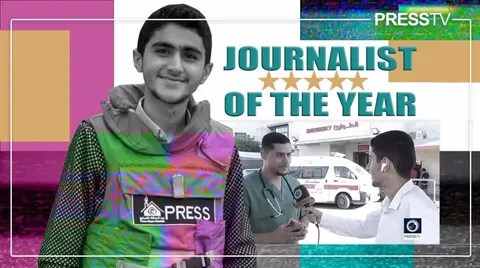
Journalist Maha Hussaini and the Burden of Bearing Witness in Gaza
Reporting on starvation while hungry and displacement while displaced, the Palestinian journalist describes why she keeps documenting lives the world has failed to protect. Her testimony is accompanied by a record of famine, destruction and abuse assembled by international investigators and humanitarian agencies.
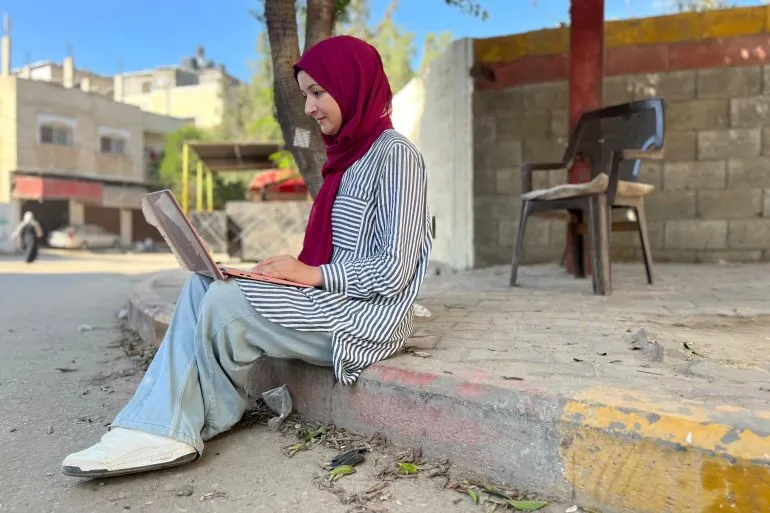
When Maha Hussaini interviewed Palestinians about starvation in July 2025, the conversation kept becoming personal. They described aching stomachs and exhaustion. She recognised the symptoms because she was hungry too, and found herself asking about something else she had experienced.
“Did you reach that point when you actually smell food that is not physically there?”
For the Palestinian journalist and human rights defender, the question captured the impossibility of standing outside the events she was documenting. The people she interviewed were describing a life she shared.
“It simply means that you’re a main character of the stories you report on,” she told Hussam Tannera in an episode of Middle East Eye’s The Gaza Podcast published on 22 October. “You are reporting on the same things that you are experiencing and living along with the people you report on.”
Reporting on starvation, she explained, meant doing so “while you’re hungry”.
“When you report on displacement, you do that while you are displaced yourself.”
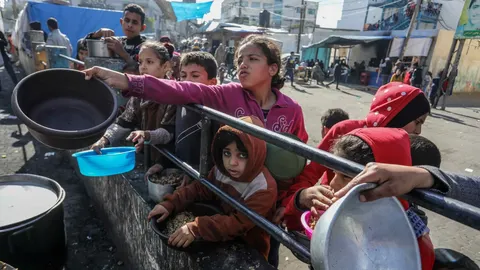
Her recollection belongs to a documented period of extreme deprivation. On 22 August 2025, the Integrated Food Security Phase Classification, or IPC, confirmed famine in Gaza Governorate as of 15 August, with reasonable evidence. Its assessment placed more than half a million people across the Gaza Strip in catastrophic food insecurity. [1]
The IPC subsequently recorded improvements following the October 2025 ceasefire and expanded assistance. But its July 2026 assessment projected that more than 1.4 million people would face crisis-level food insecurity or worse between July and December. On 19 October, the World Food Programme announced that funding shortages were forcing it to reduce monthly assistance from 1.6 million people to 1.1 million and halve food rations. [2][3]
For Hussaini, the crisis continues beyond the moment a report reaches an editor.
“As local correspondents here in Gaza, this story actually does not end when you, for example, file your report or close your laptops,” she said.
“When you close the laptop, you have to deal with that story on the ground. Now you have to deal with it in real life. And this is how we are living the story day and night, even at work and in our daily life.”
She began reporting during Israel’s 2014 offensive, after studying English and French literature. A news agency needed a French-speaking reporter. She was inexperienced and hesitant, but felt a responsibility to describe what was happening around her. Human rights documentation followed.
“I didn’t choose this profession. It chose me,” she said.
Over time, that responsibility has become difficult to escape, even briefly.
“Whenever you feel that you need to rest or take a break, you feel guilty.”
She described the accusation she directed at herself: “You are taking a break while people outside are being killed. What are you doing? What the hell are you doing?”
Working without respite eventually made further work impossible.
“I reached a point where I was going numb for days. I couldn’t do anything or write or interview or even get any more stories into my brain,” she said. “So I would take a short break and during that break I would feel guilty about taking that break while people are being killed outside.”
The danger facing those who document Gaza is independently established. In September 2026, the Committee to Protect Journalists concluded, after reviewing its casualty database and commissioning an external audit, that Israeli forces remained responsible for the overwhelming majority of journalist and media-worker killings worldwide since 2023. The organisation also reported that Israel continued to bar journalists and researchers from entering Gaza independently. [4]
Hussaini’s own reporting had reached an international courtroom long before she had time to consider its significance.
In January 2024, displaced in Rafah, she was trying to work through blackouts. Her editors suggested using pen and paper and dictating reports by telephone when a connection was possible. Days later, after she regained internet access, colleagues told her that South Africa’s legal team had cited her reporting before the International Court of Justice.
“I did not process or understand the significance of that,” she recalled. She had been “more occupied and concerned about the urgency of getting my words out”.
The citation can be traced. Hussaini’s 4 January 2024 report, “War on Gaza: Survivors recount harrowing Israeli field executions”, appears in footnote 201 of South Africa’s presentation at the 11 January hearing. It supported counsel’s reference to reports of field executions. Its inclusion put the reporting before the court; it did not itself establish the allegations as judicial findings. [5]
“Looking back at that, I think that it brings home the importance of our work as journalists,” she said.
Later that month, the ICJ ordered Israel to enable urgently needed humanitarian assistance and preserve evidence relating to alleged violations of the Genocide Convention. These were provisional measures, rather than a final determination of the case. [6]
For Hussaini, the work still mattered even when it failed to produce immediate protection.
“As long as the perpetrators are going after the one who speaks out, you know that you are doing something right,” she said.
The cost of continuing is carried into interviews with other survivors. Their experiences are close enough to feel like warnings about what might happen next.
“The violations are not distant from you. You know that at some point these violations and these experiences might be your own experiences,” she said.
Even the language available to describe them feels insufficient.
“I always find myself lost between words, between terms,” she said, searching for language that reflected what she had seen. “But I never say that I could actually convey the exact image, not even in my own language.”
“No language could translate what we all lived here in Gaza.”
Her account of displacement centres on a set of house keys. When she left home on 13 October 2023, she expected to return within hours or days. The keys initially offered reassurance that she still had somewhere to go back to. Then their meaning changed.
“Looking at these keys started to frighten me,” she said. They recalled the keys preserved by older Palestinians to homes from which they had been expelled in 1948.
“I started seeing these keys as resembling the keys of my grandparents and I was frightened by the idea that I would never be able to return.”
When she eventually returned, her home was badly damaged.
“We insisted on repairing it and repairing the door and the keys were functional again.”
Further displacement followed. She counted seven displacements since October 2023, excluding her returns home, and described herself as lucky compared with people she had interviewed who had moved more than 20 times.
“I still feel that this is not the end of the story, that I could lose my home at any given moment now,” she said.
The scale of destruction helps explain why returning offers so little certainty. OCHA’s August 2026 report, citing UN satellite analysis of imagery from 16 June, said approximately 82 per cent of structures across Gaza had sustained damage. Of 201,290 affected structures, 134,422 were assessed as destroyed. [7]
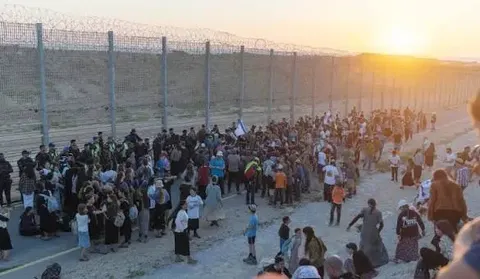
The insecurity has continued under the ceasefire. OCHA’s situation report dated 15 October 2026 described continuing Israeli airstrikes, shelling and gunfire, alongside incursions, demolitions and reported shifts in the “Yellow Line” separating areas of Israeli military control. It also reported that about 950,000 displaced people were living in sites assessed as facing medium to high flood risk. [8]
Hussaini argued that diplomatic language can obscure those daily conditions.
“People here in Gaza are still thinking of ways to survive,” she said. “What occupies their minds is the mere idea of how I would survive the next day.”
“They still wake up in the morning to think of how to collect water, how to secure food, how to move from one place to another without being bombed.”
“The genocide did not end with the ceasefire,” she said.
In September 2025, before that ceasefire, the UN Independent International Commission of Inquiry concluded that Israel had committed genocide in Gaza. Israel rejected the commission’s finding, alleging bias and unreliable evidence, and said its military objective was to dismantle Hamas. The commission’s conclusion is separate from an international court judgment. [9][10]
Some of Hussaini’s most detailed testimony concerns women’s experiences, which she believes are frequently lost within broader accounts of bombardment and displacement.
“We all lived the same war, but we didn’t all live the same experience of war,” she said. “Women had a war of their own.”
She described a woman whose sister helped her give birth at home, using basic domestic implements while Israeli tanks were nearby and reaching hospital was impossible. Mother and baby survived, she said, but the delivery took place during a blackout in a house crowded with displaced people.
The collapse of maternity care is documented beyond her reporting. In July 2025, UNFPA, citing Gaza’s Ministry of Health, reported that 5,560 babies born during the first half of that year — about one-third of recorded births — were premature, underweight or required neonatal intensive care. [11]
For women managing menstruation, ordinary supplies became difficult to obtain. Hussaini recalled women cutting material from babies’ nappies to improvise sanitary protection. Water shortages also forced changes that were intensely personal.
“Some women had to cut their own hair very short because there was no water to bathe every day. And I had to cut my own mother’s hair,” she said.
UNFPA independently described the wider shortage in June 2025: Gaza needed more than 10 million sanitary pads a month, but fewer than a quarter of that number were available. The agency reported women and girls using old clothes, torn fabric and sponges, sometimes repeatedly and without adequate washing. [12]
Alongside these privations came an expectation that women would sustain everyone around them.
“Women are always expected to hold the family together, to comfort their children, to support their husbands, to reassure their parents,” Hussaini said.
She warned against romanticising their ability to endure.
“Women in Gaza are also not superhumans. They are not superheroes.”
“They are also vulnerable and they have their needs. They were not born to endure that kind of suffering.”
Her interviews with released detainees brought accounts of sexual violence, humiliation and threats that persisted beyond captivity. She recalled meeting women in Rafah in February 2024 and hearing allegations of forced stripping, sexualised comments and other abuse. Every woman she interviewed in that group reported at least one form of sexual violence, she said.
“Even when I conducted separate interviews with separate people who did not know each other, they repeated the same phrases,” she said of her wider documentation of detainees’ accounts.
Some survivors reported being threatened with retaliation if they spoke after release. Hussaini understood the repetition as evidence of a pattern rather than isolated misconduct.
International investigators have reached findings about such patterns. In March 2025, the UN commission concluded that forced stripping, sexual harassment including rape threats, and sexual assault had become part of Israeli security forces’ “standard operating procedures” towards Palestinians. It also documented rape and other sexualised torture. Israel rejected the report’s allegations as unfounded and accused the commission of pursuing a biased political agenda. Those findings concern the wider pattern; they do not independently verify every individual account Hussaini described. [13][14]
The responsibility to preserve testimony did not, she stressed, override a survivor’s wishes.
“First and foremost they want you to listen to them. They want you to believe them without judging them,” she said. “They want you to listen to them at their own pace, in their own words.”
Some women wanted to speak without having their experiences published.
“I respected that. I listened to them without documenting the story,” she said. “This is why I say that there are many stories that are still untold.”
The pressures of survival also entered her relationship with Tom, the cat who accompanied her through successive displacements. During starvation, she said, he went two days without eating. She eventually found a jar of baby food, brought it home and watched him eat.
“I remember feeling overjoyed. I was celebrating and jumping and happy,” she said.
Then relief gave way to guilt.
“I suddenly stopped and I started crying instead. I thought in my mind that what if that jar could have gone to a starving child.”
Yet he was hungry too, dependent on her and unable to understand what was happening.
“He could not understand the starvation, the occupation, the blockade, the genocide.”
Hussaini said she had turned down several opportunities to leave Gaza. Remaining among her own people made the feeling of helplessness easier for her to bear than watching events from abroad. She insisted this was no judgment on those who had left.
“That does not mean that they abandoned Gaza, because we all reached our limits at different points,” she said. “Some of them had only one chance to live, to survive, and that was to leave Gaza.”
She would consider leaving temporarily if she could be certain of returning. What she wanted was a short break in which survival did not consume every thought.
“All of us in Gaza need that short respite, that short break to breathe, to feel that you are living without having to think of the next day.”
Asked whether human rights had failed Palestinians, she distinguished the principles from the governments and institutions claiming to defend them.
“For decades they have failed the Palestinians. They have been selectively applying these rights,” she said. “But this does not mean that Palestinians do not deserve or do not have human rights.”
“I want to be the Palestinian who speaks about her own rights, her own story.”
Her commitment does not depend on confidence that accountability will arrive soon. She expressed little expectation of that under the present international political system. But she could still preserve an account that those responsible would prefer to suppress.
“I’m doing something that the perpetrator does not want me to do, and this is enough for me at the moment,” she said.
“The least we can do now is to tell our own stories, to advocate for our own rights now, to stand up for our own rights.”
At the end of the interview, Tannera asked what additional human right she would propose for Gaza.
“The right to live without having to prove that our lives are worth saving,” she replied.
“For decades Palestinians had to prove that they deserve to live, that their lives matter, that they deserve to eat, to be educated,” she said. “They had to prove everything for the world to believe them.”
Sources and quotation note
Principal source: Middle East Eye, The Gaza Podcast, “Why we document history even if accountability feels distant”, interview with Maha Hussaini by Hussam Tannera, published 22 October 2026. Quotations are drawn from the supplied transcript. Verbal fillers, repetitions and interruptions have been removed where needed, and punctuation standardised. Individual experiences are attributed to Hussaini; external sources establish the accompanying conditions and institutional findings.
[1] IPC famine assessment. 22 August 2025. Famine confirmed in Gaza Governorate as of 15 August; over half a million people across Gaza in catastrophic food insecurity. Read source
[2] IPC food insecurity assessment. 23 July 2026. Observations for April–June and projections for July–December 2026. The 1.4 million figure is a projection, not a count observed on the interview date. Read source
[3] World Food Programme. Funding cuts force WFP to drastically reduce lifesaving assistance in Gaza, 19 October 2026. Monthly assistance reduced from 1.6 million to 1.1 million people; rations halved. Read source
[4] Committee to Protect Journalists. CPJ completes review of journalists killed in Israel and the Occupied Palestinian Territory, 24 September 2026. Review findings and restrictions on independent entry. Read source
[5] International Court of Justice hearing record. South Africa v Israel, CR 2024/1, 11 January 2024, footnote 201. Hussaini’s 4 January report is cited among the sources for counsel’s reference to reports of field executions. Read source
[6] International Court of Justice provisional measures. Summary of the Order of 26 January 2024, measures 4 and 5, concerning humanitarian assistance and preservation of evidence. Read source
[7] OCHA structural damage figures. Humanitarian Situation Report, 7 August 2026, citing UNOSAT’s satellite assessment as of 16 June 2026. The 82 per cent includes destroyed, severely damaged, moderately damaged and possibly damaged structures. Read source
[8] OCHA continuing hostilities and shelter risks. Humanitarian Situation Report dated 15 October 2026, published 19 October. Reporting period generally 29 September–12 October; includes flood-risk estimates and reported changes near the Yellow Line. Read source
[9] UN commission genocide finding. Independent International Commission of Inquiry statement, 16 September 2025. Its analysis covered events from 7 October 2023 to 31 July 2025. Read source
[10] Israeli response to genocide finding. Israeli statement, 16 September 2025, reproduced by UNISPAL as a non-UN document. It rejects the commission’s conclusion and states Israel’s military objective. Read source
[11] UNFPA birth outcomes. UNFPA warns of catastrophic birth outcomes in Gaza amid starvation, psychological trauma and collapsing healthcare, 23 July 2025. Data attributed to Gaza’s Ministry of Health for January–June 2025. Read source
[12] UNFPA menstrual health. From natural process to nightmare: How Gaza’s women and girls cope with their periods in a war zone, 2 June 2025. Supply shortages, improvised materials and insufficient water. Read source
[13] UN commission sexual violence findings. More than a human can bear, 13 March 2025, especially paragraph 224. Findings concern patterns of sexual and gender-based violence by Israeli security forces. Read source
[14] Israeli response to sexual violence report. UN Geneva briefing, 13 March 2025, reporting the Israeli mission’s rejection of the commission’s allegations and accusation of political bias. Read source