A Home in a Truck, a Childhood at Work: Five Lives in Gaza’s Ruins
A mother preparing for another child after losing three, a boy working through his childhood, a displaced grandmother, a lecturer and a skateboarder reveal how war has transformed the most ordinary acts of living.
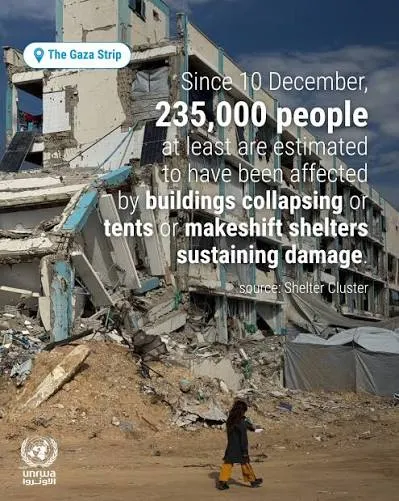
Alaa Hessi was preparing to bring a baby into the world on the ruins of the home where her three children were killed.
An Israeli airstrike had destroyed the house. Her shelter was a tent pitched over what remained. Pregnancy meant anticipating another child while living at the site of the loss that made that anticipation so frightening. The place where she was preparing for a new life was inseparable from the lives that had ended there.
“I lost my children, and I’m afraid of losing my baby again,” she said.
“Everything reminds me of them.” [1]
For an expectant parent, thoughts of the future ordinarily gather around the child to come. Alaa’s words describe the difficulty of imagining that future after three children have been killed. The expectation of a birth brings joy and fear into the same space. The tent stands over the physical remains of the family home; the family she lost remains present in her anticipation of another child.
Her story sits alongside four others in the Guardian’s Gaza: a week in the life, published between 21 and 26 September. Together, they offer a portrait of people trying to maintain a family, earn a living, teach a class, remember a home and give children somewhere to play as the war approaches its fourth year.
The range of ages and responsibilities gives these accounts their force. A child and a grandmother describe lives reorganised around survival. Adults whose work involves preparing young people for the future struggle to keep that future imaginable. For Alaa, the hope of raising another child exists alongside the fear of losing one again.
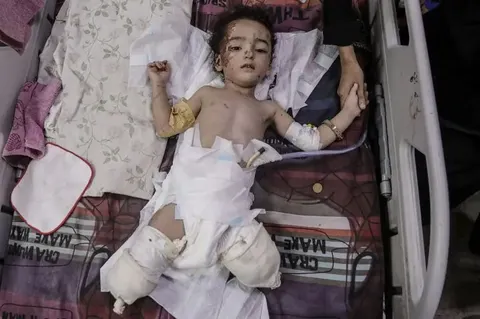
At 12, Ramadan works in a café on the beach. He remembers school, games and family barbecues: a childhood in which the adults carried responsibilities that have now fallen to him.
He says his father was killed helping relatives evacuate. His working day typically lasts 12 hours, for 10 shekels. [2]
“I’m afraid they’ll bomb the cafe where I work, or bomb me,” he said.
The sentence places work and the possibility of death in the same breath. There is no age at which such a calculation should become routine, but hearing it from a 12-year-old makes the burden unmistakable. A café, ordinarily a place of leisure, has become the setting for a boy’s effort to survive. His recollection of family barbecues makes the change particularly stark: he remembers being a child enjoying a meal, while his present revolves around working.
“I really loved reading,” he said. [2]
The past tense is painful. School belongs to the life he remembers, while work belongs to the life he must manage now. Reading, games and family meals are ordinary childhood experiences; in his account they have become measures of what the war has taken.
Yet Ramadan also imagines a future occupation. He wants to become a lifeguard. [7]
That ambition carries its own poignancy beside his fear of being killed. His account holds both possibilities: the threat to his own life and the wish to protect someone else’s.
For Mansoura, 76, the vehicle in which her family fled has become her home.
“This is where I live now, the back of a truck,” she said.
The pickup is a place to sleep in an old age defined by displacement. Her most treasured possession is the key to her former house, a connection to the life she remembers as beautiful.
She keeps the bullet removed from her son, shot seeking flour, she says.
“Everything beautiful is gone.” [3]
The key belongs to the everyday confidence of having a home: somewhere to return to, a door to open, a place that is yours. Keeping it preserves a connection that the truck in which she now lives cannot replace.
“We will return there,” she said. [3]
Her attachment to that key also challenges any account of displacement that ends once a person has somewhere to sleep. A vehicle can offer a sleeping place while leaving the loss of home untouched. At 76, she is having to accommodate herself to conditions that her own recollection of a beautiful life makes harder to accept.
Across the five accounts, familiar objects acquire this burden. A truck becomes a home. A key becomes a connection to a lost life. A laptop becomes the means of keeping an education going when the conditions needed for teaching cannot be relied upon.
For Mahmoud, a university lecturer, the difficulties begin before a lesson can start.
“First there’s the gruelling task of trying to charge my laptop,” he said.
Electricity and internet access determine whether he can reach his students. His response to an interrupted class is practical:
“I will record the lecture, upload it to YouTube and send you the link.” [4]
His account shows how the work of teaching has expanded to include securing the basic means to teach. Preparing a lesson is only part of the task. Delivering it requires overcoming interruptions that consume time and effort before any learning can happen.
Read alongside Ramadan’s memories of school, Mahmoud’s persistence gives the series a further dimension. Education connects a child’s present to an adult life still to come. Its disruption reaches beyond the lessons missed today.
He describes their approach as “patience and perseverance”. [4]
There is a restraint in that description. Patience is required to keep trying; perseverance keeps the relationship between teacher and student alive. Neither can supply reliable power or an internet connection. His efforts reveal how much the continuation of education depends on people repeatedly doing work that functioning infrastructure would make unnecessary.
Rajab al-Reefi’s work with young skateboarders concerns another part of childhood: the chance to enjoy an activity for its own sake.
He teaches children to skate, trying to give them pleasure in circumstances where even finding boards and somewhere safe to use them is a daily problem.
“We skate on the rooftops of damaged buildings,” he said.
He salvages buried boards. The boards, Rajab says, are “something that harms no one” and “could bring happiness to hundreds of children”. [5]
Israel bars new skateboards, the Guardian reports. [6]
His efforts invite a question that runs through the whole series: how much of a life can people preserve when meeting immediate needs becomes so difficult? Play, study and family routines all belong to the answer. The fact that people continue them demonstrates their importance; it does not make the conditions surrounding them adequate.
A skating lesson asks a child to concentrate on balance and movement, to attempt something and try again. Rajab’s stated purpose is modest: to bring some joy. Against the conditions he describes, that modest aim becomes a demanding undertaking, dependent on equipment and usable space that cannot be taken for granted.
His story belongs beside Ramadan’s because both concern the time and freedom available to a child. One boy remembers when his days included school and games. An adult tries to preserve an activity through which children can still play. Between them is the question of what a childhood becomes when survival dominates its hours.
“Death still surrounds us in every direction,” Alaa said. [1]
There is no easy separation between grief and daily life in these portraits. Ramadan’s memories accompany him into work. Mansoura keeps the key to her home while living in a vehicle. Alaa prepared for a birth on the ruins of the house where her children died.
The different generations bring different memories to the same struggle. Mansoura can look back across a long life. Ramadan remembers the childhood that preceded his working day. Alaa must carry the loss of her children into the experience of becoming a mother again.
The accounts also resist a neat ending in which determination resolves everything. A lecturer’s ingenuity cannot guarantee electricity. A skating lesson cannot guarantee a child’s safety. A tent cannot provide the home that Alaa lost.
Since the reporting, Alaa has delivered a healthy boy, named Waseem after his brother who was killed. [1, 6]
The birth changes the tense of her story. Her fear during pregnancy is now part of the history of a child who has arrived. It cannot resolve the grief expressed in her account, or answer the question her words raised: whether this baby will be able to grow up safely.
Through these five lives, that question becomes immediate. It concerns a mother and her child, a boy’s working day, a grandmother’s shelter, a teacher’s next lesson and a place where children might play without fear.
Sources and attribution
This feature draws on the Guardian’s Gaza: a week in the life. Original reporting is credited to Seham Tantesh in Gaza, Tess McClure, Aseel Mousa and Hoda Osman across the individual pieces. Video is credited to Tantesh Media Services. Quotations and personal accounts come from that reporting; this article does not present them as independently conducted interviews. Some opening quotations reproduce the source articles’ headlines. The connections drawn between the five accounts are this feature’s analysis.
- Alaa Hessi: pregnancy after the loss of three children, 21 September 2026, subsequently updated.
- Ramadan: a 12-year-old working in a beach café, 22 September 2026.
- Mansoura: a grandmother living in a truck, 23 September 2026.
- Mahmoud: the daily struggle to continue teaching, 24 September 2026.
- Rajab al-Reefi: keeping children skating, 25 September 2026.
- Tess McClure’s reflection on the five portraits, 26 September 2026.
- The series overview, 26 September 2026.