Luxury Returns to Growth but Hits a Volume Ceiling
Insights from RLC Global Forum’s Leadership Series reveal a luxury market increasingly driven by concentrated wealth, changing travel patterns and new global growth corridors — framing the discussion ahead of “Uneven Futures”, the theme of the 2027 RLC Annual Forum in Riyadh.
Global luxury is returning to growth, with the market expected to expand by approximately 4% in 2026 and strengthen towards 5–6% in 2027. Yet the recovery is unfolding very differently from previous cycles. Growth is becoming increasingly concentrated among affluent consumers, geographical performance is diverging more sharply, and value creation is shifting towards a smaller number of high-spending clients.
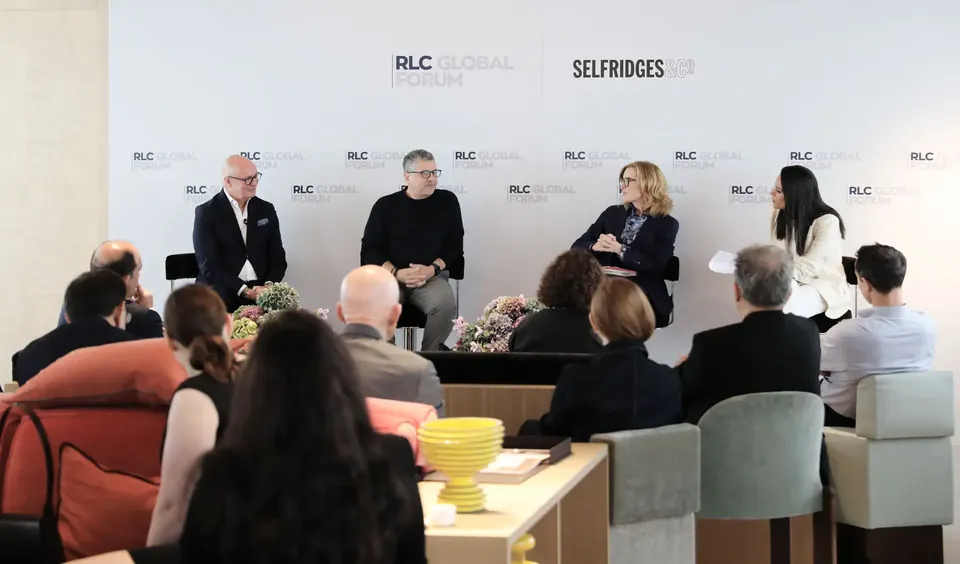
These were among the principal conclusions emerging from “The New Geography of Growth”, an executive leadership session convened by RLC Global Forum in partnership with Selfridges. Bringing together chief executives, investors and senior industry analysts, the discussions explored the structural forces reshaping global luxury demand as markets, consumers and investment patterns continue to diverge.
The United States has firmly established itself as the luxury industry’s primary growth engine, while China has entered a more measured phase of recovery following two years of contraction. Performance is also becoming more polarised across categories, with jewellery and hard luxury continuing to outperform as leather goods face mounting resistance from aspirational consumers following successive price increases.
“Most brands are now seeing high single-digit to double-digit growth in the market, supported by wealth creation, particularly from technology,” said Deborah Aitken, Senior Industry Analyst at Bloomberg Intelligence. “The next phase of luxury growth will depend less on broad consumer participation and more on attracting high-value clients.”
Global Blue data showed that across Europe’s leading luxury destinations, the number of ultra-affluent international shoppers has remained broadly flat — declining slightly in some markets—while spending per client has continued to increase. Among Europe’s highest-spending international visitors, U.S. shopper penetration has risen from below 10% historically to approximately 17%, with purchasing behaviour correlating more closely with S&P 500 performance than exchange-rate movements. At the same time, travellers from Brazil, Mexico and Argentina are contributing an increasingly significant share of European tax-free luxury spending.
“The number of high-spending travellers has become more concentrated, but average spend continues to rise,” said Derrick Hardman, Regional Chief Operating Officer of Global Blue. “One percent of shoppers now account for 27% of tax-free luxury spending.”
As spending becomes concentrated among a relatively small group of global consumers, destination retailers are rethinking how physical space is used, placing greater emphasis on private clienteling, hospitality, personalised services and curated experiences.
“Luxury is no longer only about buying a product. It is about creating moments people remember. Retail today is about creating happiness,” said André Maeder, Chief Executive Officer of Selfridges Group. “We want people to come for the experience, even before they decide what they want to buy.”
International retail destinations are also adapting to changing travel behaviour, with experience becoming an increasingly important driver of destination choice for high-value travellers.
“Luxury today is no longer only about value. It is about hospitality, culture and the quality of the experience,” stated Sylvie Freund-Pickavance, Global Strategy & Business Development Director at Value Retail. “Travellers increasingly choose destinations that combine shopping with culture, hospitality and experiences.”
As consumers become increasingly selective, competitive advantage is becoming progressively less dependent on scale or physical expansion and increasingly linked to craftsmanship, creativity, authenticity and sustained cultural relevance.
“Desirability cannot simply be manufactured through marketing. It is earned through authenticity, creativity and consistency,” Helen Brocklebank, CEO of Walpole said.
The executive session also introduced “Uneven Futures”, the theme of the 2027 RLC Annual Forum, taking place in Riyadh on 1–2 February 2027.
“Growth is becoming more uneven and investment more selective,” Panos Linardos, Chairman of RLC Global Forum. “Understanding why some markets, sectors and businesses accelerate while others stall is becoming a defining leadership challenge. That’s the thinking behind ‘Uneven Futures’, and the conversation we will continue in Riyadh next February.”
RLC Global Forum is a CEO-level platform convening brand and retail leaders, innovators, and policymakers to advance strategic dialogue across the retail and consumer-facing industries. Through its portfolio of high-level gatherings, including the RLC Annual Forum in Riyadh, the RLC Fashion Summit in Milan, and the RLC CEO Summit in New York, it connects decision-makers across markets and disciplines to shape the future direction of global retail. The RLC Fashion Summit is the RLC’s flagship event for the global fashion and luxury industries.
To find out more about the RLC Global Forum, please visit:
www.rlcglobalforum.com| LinkedIn: www.linkedin.com/company/rlcglobalforum
X: www.x.com/rlcglobalforum | Instagram: www.instagram.com/rlcglobalforum/