'They Buried Them Alive': Gaza's Graves, the Surgeons Who Bore Witness, and the Sign Carved into Its Earth
A retrospective account, drawn from the testimony of American surgeons who volunteered in Gaza, the forensic record of the Khan Younis mass graves and satellite imagery of a Star of David gouged into northern farmland. The events span November 2023 to the present. More than 1,000 days after the war began, and despite a ceasefire that has held, uneasily, since October 2025, the reckoning is unfinished – and the court that might one day deliver it is now the target of an American campaign to take it apart.
'They buried them alive'
The account that has travelled furthest is one Mark Perlmutter did not witness himself. Standing in Gaza, the Jewish-American orthopaedic and hand surgeon says he walked the length of a mass grave in the backyard of the Al-Aqsa Martyrs Hospital, in the Nasser complex at Khan Younis, and interviewed the people who had watched it fill.
Several of them, he says, described the same night. 'Many witnesses told me that on one night they saw two children, one wearing a light red shirt and the other a dark green shirt, who were buried alive by occupying soldiers,' Perlmutter recounted. 'A bulldozer covered them with large amounts of soil into the mass grave.' The children were not alone. 'They buried them in the grave, and everyone could hear the screams of the two children and an older man who was with them. Soil piled up on top of them – they buried them alive.'
He returned to the moment in a filmed testimony that has since been shared hundreds of thousands of times. The witnesses, he said, saw 'two children being pushed into the mass grave by Israeli soldiers with a bulldozer, and then there are cries being muffled by the dirt that was poured upon them.' What made the account impossible to dismiss came later, when the pit was reopened. 'And then when the bodies were excavated,' Perlmutter said, 'the red and green shirts of these kids, whose hands were tied behind their backs, were found.'
For the surgeon, the detail of the bound wrists settled the question of intent. 'That type of monstrousness, that level heinous behavior can only happen if your hatred is formulated by design from your birth,' he said.
It is second-hand testimony, and it should be read as such – an account Perlmutter gathered from eyewitnesses at the graveside rather than something he saw with his own eyes. His filmed retelling, first published in a segment by the Arab Organisation for Human Rights in Britain, resurfaced again in May 2026 when Ramy Abdu, chairman of the Geneva-based Euro-Med Human Rights Monitor, posted it to his own large following, and it has been treated online, wrongly, as first-hand. But the man relaying it is not an anonymous source. He is a board-certified surgeon, a vice-president of the International College of Surgeons, and a veteran of more than 40 humanitarian missions across three decades and four continents. And what he says he saw with his own eyes is, if anything, no gentler.
What the surgeons saw
Perlmutter went to Gaza twice: to the European Hospital in Khan Younis at the end of April and the first weeks of May 2024, and back to the Nasser complex in 2025. On the first trip he worked alongside Feroze Sidhwa, a Californian trauma surgeon who had volunteered with MedGlobal and, before Gaza, in Haiti and Ukraine. The two came home and did not stay quiet.
Perlmutter's interview with Tracy Smith of CBS's Sunday Morning, aired in July 2024, became one of the defining testimonies of the war. Asked to set Gaza against everything else in his career, he did not hedge. 'All of the disasters I've seen, combined – 40 mission trips, 30 years, Ground Zero, earthquakes, all of that combined – doesn't equal the level of carnage that I saw against civilians in just my first week in Gaza.'
Asked whether the civilians were mostly children, his answer was flat: 'Almost exclusively children. I've never seen that before.' He went further than the arithmetic of a bad blast radius. 'I've seen more incinerated children than I've ever seen in my entire life, combined,' he said. 'I've seen more shredded children in just the first week – missing body parts, being crushed by buildings, the greatest majority, or bomb explosions, the next greatest majority. We've taken shrapnel as big as my thumb out of eight-year-olds.'
Then came the wounds a surgeon cannot explain away. Told by his interviewer to confirm what he was saying – that children in Gaza were being shot by snipers – Perlmutter replied, 'Definitively.' He had the photographs. 'I have two children that I have photographs of that were shot so perfectly in the chest, I couldn't put my stethoscope over their heart more accurately, and directly on the side of the head, in the same child.' And then the line that outlived the interview: 'No toddler gets shot twice by mistake by the "world's best sniper." And they're dead-center shots.'
Sidhwa, working two months and a different hospital apart, reached the same disbelieving conclusion independently – almost every day, a new child shot in the head or chest – and initially wondered whether it might be the work of one sadistic soldier, before an emergency physician who had worked elsewhere in Gaza told him he had seen the same thing. Sidhwa carried the account into the chamber of the United Nations Security Council in 2025, describing what the two men had treated as a rain of fire and death, and pressing for an immediate and permanent ceasefire, an arms embargo, guaranteed medical evacuations and unimpeded aid. A child could conceivably be hurt by accident in an explosion, he told the Council; a gunshot wound to the head is a different category of event.
The two surgeons were among 45 American doctors and nurses who signed an open letter in October 2024 describing widespread war crimes committed with US-supplied weapons. It is in that letter that Perlmutter's most quoted sentence appears – nine words that have been carried around the world. 'Gaza was the first time I held a baby's brains in my hand. The first of many.'
Their conclusions are contested, and it would be dishonest to pretend otherwise. Pro-Israel media monitors such as CAMERA have accused both surgeons of running a propaganda campaign and dressing advocacy as clinical observation. Israel and its supporters point to Hamas's documented practice of operating from within civilian infrastructure, and a separate filing at the International Criminal Court, lodged on behalf of a Gazan civilian who lost his family, accuses 14 Hamas leaders of using Palestinians as human shields and of crimes against their own people. A serious account has to hold both things at once: that Hamas's conduct is itself the subject of criminal complaint, and that the testimony of the surgeons – graphic, specific and consistent between two independent witnesses – is not disposed of by pointing at Hamas.
The graves at Nasser
The surgeons' accounts do not stand alone. In April 2024, after Israeli forces withdrew from the Nasser Medical Complex following a months-long operation, Palestinian Civil Defence teams began recovering bodies from three grave sites on the compound. By the end of the search they had exhumed several hundred – gravediggers and Gaza's health authorities put the figure above 390, among them dozens of children. Civil Defence officials said some of the dead had their hands bound with plastic ties, some were stripped, some were still in hospital gowns with cannulas in their arms, and that a number bore marks they described as consistent with field executions. Those are the claims of Palestinian responders, not of an independent forensic body, and they have not been tested in a courtroom.
Israel rejected the allegations outright. The military said any suggestion that it had buried Palestinian bodies in mass graves was false, and that the grave at the Nasser site had been dug by Gazans themselves some months earlier. That denial is on the record and belongs in any honest telling.
What is not in dispute is that the discoveries alarmed the United Nations. The high commissioner for human rights, Volker Türk, said he was horrified by the reports of mass graves at Nasser and al-Shifa and called for international investigators to be given unfettered access. Nor is it in dispute that the graves have entered the machinery of international justice: prosecutors from the ICC have interviewed staff from both Nasser and al-Shifa, the two largest hospitals in Gaza, about possible crimes.
The sign in the earth
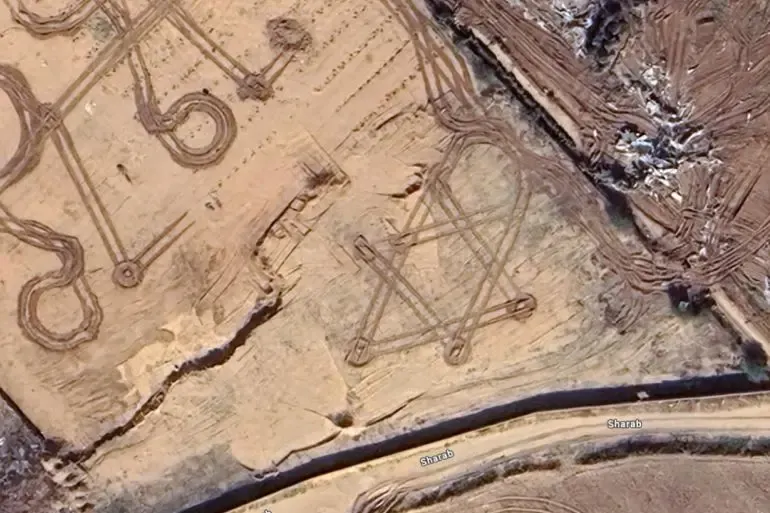
Some eight kilometres from the Israeli town of Sderot, in the farmland of Beit Hanoun in Gaza's north, there is a mark on the ground large enough to be read from orbit. On 27 January 2025, in a piece headlined 'Branded', Al Jazeera's Simon Speakman Cordall and Justin Salhani reported that a Star of David – the symbol of both the Jewish faith and the Israeli state – had been carved into what had been green fields, at coordinates 31.542988, 34.545391. Beside it were scored the numbers 7979, which the network read as a possible reference to the 97th battalion, Netzah Yehuda.
The carving was made, in the assessment of the reporting, by armour. Al Jazeera and CBC both attributed it to Israeli tanks, and satellite imagery of the shape can be traced back as far as November 2023, only a month after the war began. That is a different kind of act from the burial of bodies, and a different machine; it would be wrong to fuse the two into a single event, and I have not. But they belong to the same campaign, the same unit's theatre of operations, and the same grammar of impunity, and read together they say something neither says alone – that the marking of Palestinian bodies and the marking of Palestinian land are gestures of one hand.
Netzah Yehuda is an all-male, ultra-Orthodox battalion raised in 1999 to draw the religious into the ranks. Before it deployed from the occupied West Bank into Gaza in January 2024, it already carried a reputation: American officials had assessed that some of its conduct could amount to gross violations of human rights, including the killing of unarmed Palestinians and the abuse of prisoners. Among its alleged victims was Omar Assad, a Palestinian-American in his eighties who died in the unit's custody in January 2022; Israel later paid compensation to his family while insisting that no member of the battalion be held to account for his death.
The defence analyst Hamze Attar told Al Jazeera that the star had been made 'for Google Maps, to be seen that they were here' – a signature, in other words, meant for the sky, cut at a scale that only makes sense if you intend it to be seen from above. Attar linked it to the Biden administration's aborted move to sanction the unit under the Leahy Laws, which bar arms transfers to foreign military units credibly implicated in gross abuses; that review was quietly wound down. Elia Ayoub, who writes the Hauntologies newsletter, framed it as the behaviour of an army that has been given everything it needs and knows it will not be stopped. 'As in any genocide,' he said, 'those committing them often take pleasure in displaying their superiority by forcing their symbols on their victims.' He noted that soldiers had carried the menorah and the shofar onto the battlefield, and reached back to the Israeli philosopher Yeshayahu Leibowitz, who warned in the 1990s that a strain of what he called Judeo-Nazism could become the norm if it went unchecked. 'Sadly,' Ayoub said, 'he was right.'
Chris Arning, a semiotician who studies the meaning of brand marks, read the carving as an act of ownership. 'Branding is about ownership. It's about marking your territory,' he said, pointing out that branding began with tradespeople marking goods and farmers marking cattle, and later extended to the marking of convicts and slaves. To cut the star into the soil of Beit Hanoun, he said, was in many ways to brand the land. Al Jazeera put the symbol to the Israeli defence ministry and received no reply.
The pattern did not stop with a single field. By the ceasefire, researchers Jamon Van Den Hoek of Oregon State University and Corey Scher of the City University of New York had found that 60 per cent of all buildings in Gaza had been destroyed; in Beit Hanoun the figure was 70 per cent. Al Jazeera's own satellite unit later documented the town being flattened further even after the guns fell largely silent.
An unnamed voice, and the limits of it
Into this record, in May 2026, came a viral fragment: a video of an unnamed French woman, seated at a microphone, saying that a mass grave in Gaza had held 300 bodies, and that small children had been killed with their hands tied behind their backs. The clip was amplified by the same Ramy Abdu of Euro-Med. It should be treated with more caution than the rest of this account, and it is treated so here: the speaker has not been publicly identified, no organisation has been attached to her, and the claim is unsourced beyond her word. What can be said is that her description does not sit at odds with what Palestinian responders and the surgeons have already documented – it echoes it. That is corroboration of a weak and circumstantial kind, and no more.
Where the reckoning stands
It is tempting, at a distance of two years, to assume the evidence has all been gathered, filed and adjudicated. It has not, and the window in which it might be is now being deliberately closed. The ICC's investigation into the situation in Palestine is live but embattled. The court issued arrest warrants for Prime Minister Benjamin Netanyahu and his former defence minister Yoav Gallant on 21 November 2024, alongside a warrant for the Hamas commander Mohammed Deif. In response, the Trump administration sanctioned ICC officials in early 2025 – the prosecutor, Karim Khan, his two deputies and six judges – Israel banned a cluster of civil-society groups that had fed evidence to The Hague, among them the Khashoggi-founded organisation DAWN, and Khan has since stepped back amid misconduct allegations that have left the court's leadership in question. The sanctions net was later widened to take in Francesca Albanese, the UN special rapporteur for the occupied Palestinian territories, and three Palestinian human-rights groups whose work was collecting exactly the kind of evidence set out above.
Then, on 13 July 2026, the campaign changed shape. Marco Rubio, the US secretary of state, announced what his department called a 'whole-of-government' effort not merely to shield individual Americans or Israelis from the court but to disable the institution itself. 'Using all the tools at our government's disposal,' Rubio wrote in the Wall Street Journal, 'we will dismantle the ICC – brick by brick, if necessary.' In a companion video he accused the court of 'waging a war against our country', called it a tribunal of 'unelected globalist bureaucrats', and framed the effort as 'sovereign states over globalism'. The tools, State Department officials confirmed, would include travel bans, visa revocations and expanded sanctions against the court and any organisation affiliated with it – and, most consequentially, pressure on other governments to abandon it. Nations that relied on US assistance and yet refused to reject the ICC's authority, one official warned, were 'likely to come under increased scrutiny'. It amounted to a demand that the 125 states party to the Rome Statute choose between American money and international law.
The significance for the graves of Khan Younis, the testimony of the surgeons and the star cut into Beit Hanoun is not abstract. The court now being taken apart is the same court that holds this file. Legal observers were blunt about what the campaign is for. Kenneth Roth, the former head of Human Rights Watch, said Rubio was 'dressing up his quest for impunity for American war crimes under the label of national sovereignty', and that what Washington wanted was the freedom 'to commit war crimes on the territory of countries that have accepted the court's jurisdiction'. Raed Jarrar of DAWN went further, warning that the campaign 'could amount to obstruction of justice, a crime under the Rome statute in and of itself'. 'It is not the ICC that Rubio is dismantling brick by brick,' Jarrar said, 'but the rules-based international order that grew out of the ashes of world war two.' Both the United Nations and the European Union moved to defend the court; whether that holds against the threat of American sanctions is the open question of the moment.
None of it is resolved, and that is the point. The children in the red and green shirts, if the witnesses are right, have never been the subject of a verdict, and the effort now under way in Washington is designed to ensure they never are. The star is still in the earth. The warrants sit unexecuted. And the machinery of accountability – courts, sanctions, arrest warrants no state will enforce – is no longer merely slower than the machinery that made the graves. It is being taken apart, brick by brick, by the government that supplied the weapons.
Reporting drawn from CBS News, the October 2024 open letter of American medical workers (gazahealthcareletters.org), Common Dreams and Democracy Now! (Perlmutter and Sidhwa); the Arab Organisation for Human Rights in Britain (the mass-grave testimony); Al Jazeera, CBC and L'Orient Today ('Branded', 27 January 2025); Reuters and NBC News (the Nasser graves); the Office of the UN High Commissioner for Human Rights; Euro-Med Human Rights Monitor; the US State Department, the Wall Street Journal, CNN, TIME, Euronews and The Guardian (the July 2026 campaign to dismantle the ICC); DAWN and the International Criminal Court; and the Gaza Health Ministry. Contested claims are attributed to their sources, and Israeli denials are noted where they exist.