‘A Criminal Group of Jewish Terrorists’: The Assassination of Count Folke Bernadotte and Israel’s Pattern of Attacking Those Who Tried to Help
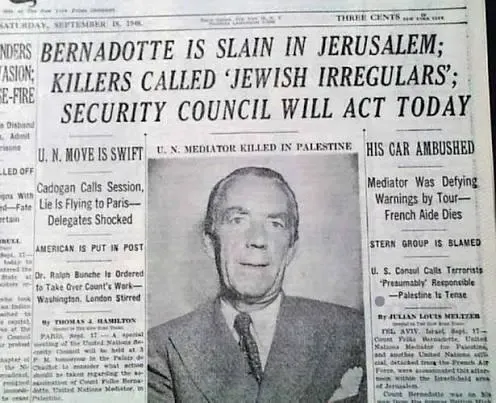
On a quiet Friday afternoon, September 17, 1948, in the Rehavia neighborhood of Jerusalem, a Swedish diplomat who had once negotiated with Heinrich Himmler and saved thousands of Jews from Nazi concentration camps was gunned down in the street by Jewish terrorists. Count Folke Bernadotte, the United Nations mediator for Palestine, had submitted his final peace plan to the UN General Assembly just the day before. He never lived to see its reception.
From Red Cross to Rescue Mission
Born into Swedish royalty in 1895, Bernadotte was a nephew of King Gustav V. He served in the Swedish army before becoming an official of the Boy Scout movement, but it was his work during World War II that would cement his place in history.
As vice‑president of the Swedish Red Cross, Bernadotte negotiated directly with SS commander Heinrich Himmler in the spring of 1945. The result was the legendary “White Buses” expedition—a fleet of vehicles painted white with Red Cross emblems that ventured into the heart of Nazi Germany. The operation successfully liberated an estimated 27,000 prisoners from concentration camps, including thousands of Jewish women from Ravensbrück and approximately 450 Danish Jews. Some historians estimate that roughly half of the 7,000 women saved from Ravensbrück were Jewish.
Bernadotte also attempted to negotiate an armistice between Germany and the Western Allies in the war’s final days, carrying Himmler’s surrender offer—though the proposal, which excluded the Soviet Union, went nowhere.
A Diplomat in a Powder Keg
When the UN Security Council appointed Bernadotte as mediator in Palestine on May 20, 1948, he inherited one of the most volatile conflicts on Earth. Israel had declared independence just days earlier, and five Arab armies had invaded. Bernadotte, fluent in six languages, was tasked with the near‑impossible: negotiating a truce and a lasting peace.
He succeeded in arranging a four‑week cease‑fire that began on June 11, 1948. But his subsequent peace proposals infuriated hardliners on all sides.
His first plan called for a union between Transjordan (now Jordan) and British Mandatory Palestine, with certain territories allocated to each community: Palestinians would control the Naqab (Negev) desert, while the Galilee would go to the Jews. Haifa’s port and the airport at Lod (today Ben‑Gurion Airport) would remain freely accessible to both. Jerusalem, however, would become an international city under UN control. That proposal was rejected by all sides, and the truce quickly collapsed.
His second proposal, submitted on September 16, 1948, was even more conciliatory—and therefore even more dangerous in the eyes of militant Zionists. While it affirmed the existence of the state of Israel, it firmly endorsed the Palestinian right of return, arguing that Palestinians displaced during the Nakba should be allowed to reclaim their homes and properties. Those who did not return, he wrote, should be resettled and compensated.
“It would be an offence against the principles of elemental justice,” Bernadotte stated, “if these innocent victims of the conflict were denied the right to return to their homes while Jewish immigrants flow into Palestine, and, indeed, at least offer the threat of permanent replacement of the Arab refugees who have been rooted in the land for centuries.”
The Assassination
The Stern Gang—known in Hebrew as Lehi (Lohame Herut Yisrael, or “Fighters for the Freedom of Israel”)—had already been labeled a terrorist organization by the British. Its leaders, including future Israeli prime minister Yitzhak Shamir and future MK Natan Yellin‑Mor, approved the assassination a week before it was carried out.
The assassins were unaware that Israel had already decided to reject Bernadotte’s plan. They feared he might actually succeed, and they believed his proposal posed an existential threat to the emerging Jewish state.
On September 17, Bernadotte was traveling in a UN convoy through the Katamon neighborhood of Jerusalem. Four Lehi terrorists ambushed his motorcade, firing six rounds into the UN mediator and another 18 at French Air Force Colonel André Serot, a UN observer sitting next to him. Serot was killed instantly; Bernadotte was rushed to hospital but died shortly after.
“A Criminal Group of Terrorists”
The assassination sent shockwaves through the international community. The very next day, the UN Security Council adopted Resolution 57, which condemned the killing as “a cowardly act which appears to have been committed by a criminal group of terrorists in Jerusalem while the United Nations representative was fulfilling his peace‑seeking mission in the Holy Land”.
The phrase was unmistakable—and unmistakably pointed. The “criminal group” was Lehi, the militant Zionist organization that had carried out the murder.
Israel’s provisional government, desperate for international legitimacy, moved swiftly—at least on paper. Around 200 Lehi members were arrested, and some of the leadership were convicted. But the condemnation was short‑lived. Prior to Israel’s first elections in January 1949, authorities granted a general amnesty to Lehi members. No one—not the planners, not the triggermen—was ever held accountable for Bernadotte’s murder.
The cover‑up continued for decades. In May 1949, the Israeli government filed a formal report to the UN falsely claiming that no Lehi members had been linked to the assassination. That denial stood for years. Only after the statute of limitations for the murder expired in 1968 did Lehi members begin to speak openly. The first public admission that the organization had carried out the killing did not come until 1977—nearly three decades after the crime.
Even more astonishing were the political fates of the perpetrators. Yitzhak Shamir, who approved the assassination, went on to become Prime Minister of Israel. Natan Yellin‑Mor served as a member of the Knesset. And Yehoshua Cohen—the man who actually pulled the trigger and fired the fatal shots—became the personal bodyguard of none other than Prime Minister David Ben‑Gurion. The assassin was entrusted with protecting the very leader of the state he had helped to violently shape.
In 1980, Israel further cemented its reverence for the group by instituting the Lehi ribbon—a military decoration signifying “award for activity in the struggle for the establishment of Israel”. The same organization that the UN had branded a criminal group of terrorists was now being officially honored by the state.
Diplomatically, the fallout with Sweden was severe. Stockholm condemned Israel’s investigation as a sham, and relations between the two countries suffered a deep and lasting rift.
A Pattern of Attacking Those Who Helped
Bernadotte’s assassination was not an isolated incident. It fit a troubling pattern: militant Jewish forces in Palestine and, later, the state of Israel itself, repeatedly targeted those who sought to help—or who were perceived as standing in the way.
The most notorious example came nearly two decades later. On June 8, 1967, during the Six‑Day War, Israeli forces attacked the USS Liberty, a United States Navy intelligence‑gathering vessel operating in international waters off the Sinai Peninsula. In a coordinated assault involving Israeli fighter jets and torpedo boats, 34 American servicemen were killed and 171 were wounded. The ship was clearly marked as American. Survivors have long insisted the attack was deliberate.
One survivor, retired Marine Gunnery Sergeant Bryce Lockwood, stated flatly: “There is no doubt Israel meant to kill every American on board”. Israeli forces fired on life rafts after they were deployed and jammed communication frequencies during the attack. Israel later claimed the attack was a “tragic mistake”—a position the U.S. government officially accepted. But many survivors and military historians have never accepted that explanation.
The Liberty was not a combatant. It was a research ship. Its crew was not threatening Israel. They were Americans—allies—who had done nothing to provoke the attack. Yet 34 of them were killed and 171 wounded in what many believe was a deliberate act of aggression against those who were, at minimum, neutral observers.
A Legacy of Impunity
Bernadotte’s efforts did not die with him. His work laid the foundation for the United Nations Truce Supervision Organization, which still monitors cease‑fires in the region, and for UNRWA, the agency created to provide relief for Palestinian refugees. In many ways, he built the very infrastructure of UN operations on the ground in the Middle East.
But the impunity that followed his murder—the amnesty, the decades of denial, the killers rewarded with political power and even a military ribbon—set a dangerous precedent. When the UN Security Council condemned “a criminal group of terrorists,” it named the perpetrators precisely. Yet the world moved on. The killers went free. And the pattern continued.
Today, Bernadotte remains a controversial figure—criticized by some for not saving more Jews during the war, and by others for his mediation proposals after it. But few dispute the scale of his wartime heroism. A Swedish count who had once stared down the architects of the Holocaust was brought down by the very extremists he had sought to reconcile. The UN called them what they were: a criminal group of terrorists. History has yet to fully reckon with that judgment.