'Israel's Toast': Scott Ritter and the Verdict the West Won't Admit
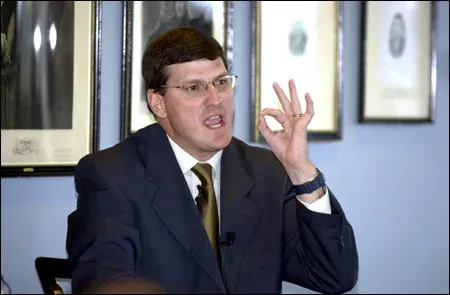
A week after Donald Trump signed an interim deal with Iran at Versailles, the former weapons inspector delivered a sweeping verdict on the war's loser. In Ritter's telling, it is not Tehran. It is Tel Aviv – and the bill, he insists, will be paid first in southern Lebanon and then in Washington.
On 24 June 2026, with the ink barely dry on the memorandum of understanding that Trump and the Iranian president, Masoud Pezeshkian, signed at the Palace of Versailles a week earlier, Scott Ritter sat down with Nima R. Alkhorshid on the YouTube interview programme Dialogue Works and offered a single organising claim from which everything else in his analysis follows. The episode's title – 'Israel DEFEATED on Every Front: The Fallout Begins' – announced its verdict before he had said a word. The 2026 war, in his account, ended in neither an American nor an Israeli victory. 'Israel has lost this war,' he said. 'Israel has no negotiating position. Iran will not buckle.' Pressed on whether Washington could still rescue its ally, he was blunter still: 'Israel's toast. We can just leave it at that.' From that premise he built a forecast of almost total Israeli collapse – military, political and territorial – and a rupture between Washington and Jerusalem that he believes is already under way.
The Lebanon trap
The load-bearing element of Ritter's case is Lebanon, and on the facts he is standing on firmer ground than his critics might assume. The 2026 Lebanon war between Israel and Hezbollah, which broke out on 2 March, remains unresolved; Iran made any lasting ceasefire conditional on it; and a fifth round of Israeli–Lebanese talks has been grinding on in Washington. Lebanon's president, Joseph Aoun – no friend of Hezbollah, and a figure Ritter dismisses as having humiliated himself in earlier negotiations – has publicly insisted that Beirut will accept nothing less than the end of the Israeli occupation in the south. That is the reality Ritter builds on.
His argument runs from a single inversion: that the occupation is the cause of the very threat it claims to answer. 'Hezbollah wouldn't exist today if Israel withdrew from Lebanon,' he said. 'Hezbollah exists only because of Israel's illegal occupation of Lebanon.' Withdraw from every inch of Lebanese soil, he argues, and the militia loses its rationale and is left to disband or be absorbed into the Lebanese army – 'the best way to disarm Hezbollah,' as he puts it, 'is to liberate all of Lebanon's territory.' He returns, repeatedly, to 2000, when Israel ended its long occupation under Hezbollah pressure. 'Israel has been kicked out of Lebanon once before by Hezbollah,' he said, 'and Hezbollah will kick Israel out again. That's what's going to happen.' The asymmetry he sees in the present arrangement he puts starkly: 'Israel gets to bomb Beirut anytime it wants to in the name of Israeli security, but Hezbollah is not allowed to retaliate in the interest of Lebanese sovereignty.' The deconfliction mechanism floated by JD Vance will fail, he argues, for that exact reason – it subordinates Lebanese sovereignty to Israeli security – and into the gap he drops his recurring image of an absent rescuer: 'There is no Seventh Cavalry charging up over the hill to rescue Lebanon. Custer's dead. No trumpets are going to sound.'
From there he draws the trigger. The memorandum, in his reading, is indivisible – every element holds or none does. 'If Israel attacks Lebanon, the MOU is not in effect,' he said, 'and if the MOU is not in effect, then Iran will retaliate' – as, he notes, it already did once during the war. And Washington, on this account, will do nothing: 'What would the United States do? Nothing. The United States is desperate for an agreement. The Strait of Hormuz must remain open.' This is where his refrain – 'it's the economy, stupid' – does its heaviest lifting. With the strait only fitfully reopened and energy prices a live political wound, he argues that Trump's overriding need is an economic uptick before the November midterms, and that he cannot risk a war that would choke the waterway again. 'This is about Donald Trump's political survival,' Ritter said, 'which hinges on the American economy, which is being choked to death because of the Strait of Hormuz situation.' The premise is sound even where the conclusion is contestable: the Senate has indeed passed a war-powers resolution rebuking Trump over the Iran conflict, and falling pump prices have plainly become an administration priority.
The rupture with Washington
If Lebanon is the mechanism, the US–Israel relationship is the prize Ritter believes is now in play. The dynamic between Trump and Benjamin Netanyahu has fundamentally shifted, he argues, because Trump now blames the prime minister for the war that imperilled his own political survival. 'He sees Benjamin Netanyahu as being the man responsible for the demise of the Trump brand,' Ritter said, 'and Trump is a very vengeful person.' He reads Vance's increasingly careful language on Israel as the leading edge of a recalibration: the vice-president, he predicts, 'will not go down with the ship... he's not going to fall on the sword for the state of Israel.' What may follow, in his forecast, is 'a complete reworking of the US–Israeli relationship' – one Netanyahu cannot survive, because 'he needs American support in order to retain his legitimacy at home. If Trump pulls the cord,' he said, the prime minister is finished. The United States, he adds, is 'agreement incapable,' a phrase he applies to Washington's conduct toward Russia and Iran alike and one that carries an obvious irony given his own affiliations. He is careful, too, not to cast the prime minister as a victim of the turn: 'Netanyahu is humiliating himself. He's not an innocent actor here.'
His most provocative thesis is about leverage, and here the New York results he cites are real. Israel's hold on American policy, he argues, has always depended on the American public never being asked to pay for it. 'The American people have never been called upon to suffer on behalf of Israel,' he said. 'It's always been a free ride.' In his telling the arrangement was nakedly transactional – 'we accepted the two-way street of allowing Israel to buy our Congress' – and it held only so long as voters could be 'lulled to sleep' and kept from the bill. The energy crisis, he argues, ends it: 'The American people will not tolerate empty wallets... and the American people will turn on Israel.' As evidence of a shifting mood he points to New York, where the mayor, Zohran Mamdani – a self-described democratic socialist who has called AIPAC 'monsters' and accused Israel of genocide – won City Hall and is now campaigning openly against the lobby's preferred congressional candidates. Whether that amounts to the wholesale collapse of pro-Israel influence Ritter forecasts is another matter entirely, but the data point is not invented.
He extends the same logic to two pieces of proposed legislation aimed at deepening US–Israeli military and intelligence integration, which he predicts will fail on constitutional grounds and public resistance. They are also the springboard for his harshest claims. 'Israel is the greatest intelligence threat to the United States in the world today,' he said, invoking the convicted spy Jonathan Pollard; 'Israel does more spying on America than any other nation out there.' Of the proposal to fold Israeli forces into American structures he is witheringly dismissive: their 'ground forces suck,' he said, and half of them 'couldn't pass Marine Corps physical fitness standards.' Israeli personnel, he went on, are not merely foreign but adversarial – 'they're hostile foreigners; they don't care about America.' These are assertions, delivered with conviction and no small contempt, and they are his alone. The register is worth marking, too: the charge that Israel buys Congress and that its soldiers would serve as hostile aliens in American uniform is precisely the framing that Jewish communal leaders – among them critics of AIPAC's own conduct – warn shades from criticism of a state into older and uglier tropes.
The maximalist endgame
Asked where all this leads, Ritter does not hedge. 'Greater Israel's over,' he said. 'The greater Israeli experiment's over.' He forecasts an Israeli retreat to redrawn borders 'altered to reflect a new reality called the state of Palestine,' an evacuation of the Golan Heights, an end to the Israeli presence in Syria, and a blunt terminus: 'Gaza will become Palestine.' What remains, in his account, is a state fighting for its life – 'Israel will retreat to whatever borders it has and then it will just struggle for survival.' Underpinning the forecast is an economic argument: that Israel is 'economically unsustainable,' that recovery requires stability, and that stability requires normalisation with a world that, in his words, 'condemns Israel as a genocidal state.' That last characterisation he treats as settled fact; it is one a United Nations commission of inquiry has also reached, and one that Israel and its allies reject in the strongest terms – a dispute the reader should hold in view rather than resolve on Ritter's say-so.
The fate he reserves for Netanyahu is the sharpest passage of all. He refuses the prime minister any sympathy as Trump turns on him, calling him 'a murderous, genocidal thug' and a criminal whose deeds are 'matched only by some of the greatest criminals in history' – naming Adolf Hitler. He predicts not merely electoral defeat but prosecution: there is, he says, 'a better chance of him being ousted, arrested, tried and imprisoned' than of his dying in office. And he forecasts that Israel's divisions will end in open conflict – 'this is going to end with an Israeli civil war, because Benjamin Netanyahu has polarised the nation to such extremes' – reaching back to a warning issued by Israel's own president before the October 2023 attacks about a country sliding toward armed internal strife. These are predictions stated in the indicative mood, and they should be read as the things he expects rather than the things that have happened.
That distinction is the whole of it. Strip away the certainty and what remains is a coherent, aggressively argued case that the 2026 war ended in a strategic defeat the West has not openly conceded, and that Israel's position in Lebanon and in Washington is weaker than it has been in a generation. On the architecture of that case – the contested 'surrender' at Versailles, Aoun's demand for full withdrawal, the congressional rebuke, the shifting mood in New York – Ritter is describing real ground. On the demolition he forecasts above it, he is describing a future, and a man whose forecasts have a long history of arriving ahead of the facts and not always being met by them. The diplomacy he dismisses as theatre is, for now, still in the room: talks continue in Washington, inspectors are negotiating their return to Iran, and the strait is open one day and contested the next. Whether Israel has lost, as Ritter insists, or merely been bloodied, is the question his interview poses with great force and does not, on its own evidence, answer.